January 2, 2026 at 11:29
Buy Now Pay Later and the Broken Signal: Why Record Holiday Spending Doesn't Mean a Healthy Consumer
Authored by MyEyze Finance Desk
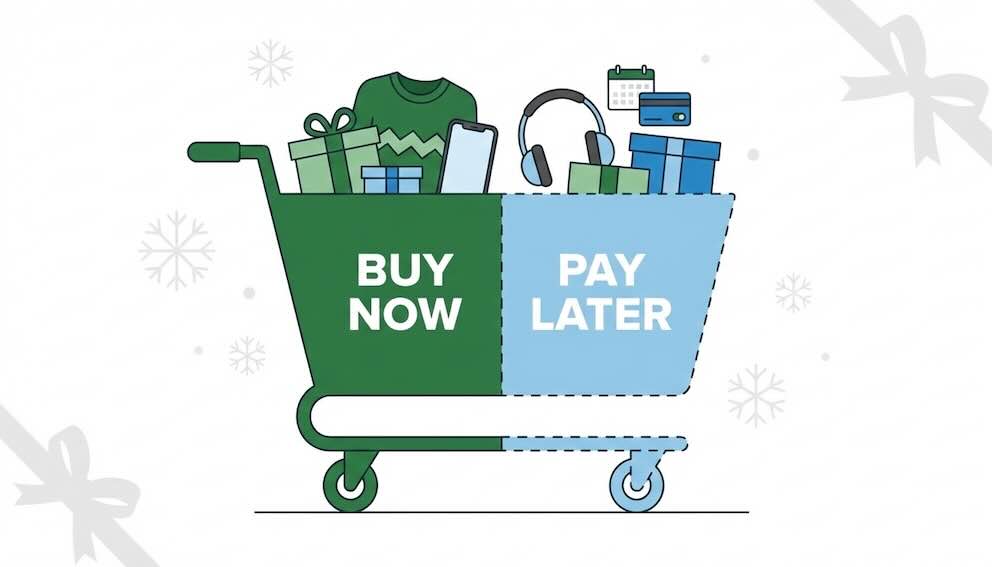
Buy Now Pay Later drove record holiday online spending, enabling consumers to buy higher-value items while managing cash flow, but heavy reliance on deferred payments suggests this surge reflects short-term financial manoeuvring rather than stronger underlying demand.
Executive Signal
Holiday spending looks strong, but it’s being driven by delayed payments rather than stronger consumer finances or rising demand. BNPL is allowing consumers to spend more by spreading costs over time, which signals financial caution and cash-flow management, not a fundamental improvement in consumers’ willingness or ability to spend. Holiday retail data shows headline strength, but the composition of demand matters. U.S. online holiday sales are projected at $253.4 billion (+5.3% YoY) for November–December, with Buy Now, Pay Later (BNPL) accounting for a record share of spending. final actual numbers have not been published yet. BNPL usage materially boosted conversion rates and average order values, supporting peak-season sales despite elevated interest rates and strained household budgets. However, the data suggests BNPL pulled demand forward rather than signaling improved consumer health. This raises downside risk to discretionary retail, consumer credit, and BNPL providers in early-to-mid 2026, once deferred payments constrain future spending.
Key Takeaways
- BNPL accounted for ~8% of total online holiday spending, representing approximately $20.2 billion in volume (+11% YoY).
- Cyber Monday 2025 spending reached $14.25 billion (+7.1% YoY), with BNPL driving $1.03 billion of that total.
- From November 1 to early December, 7.3% of all e-commerce transactions used BNPL, confirming its shift from optional payment method to structural demand driver.
- Consumers purchased fewer items but generated higher average order values (AOVs), indicating selective spending enabled by installment financing.
- While some of this reflects income-based bifurcation, the concurrent rise in BNPL penetration and higher AOVs within BNPL transactions suggests installment financing played a meaningful role in enabling selective, higher-ticket purchases among liquidity-constrained households.
- BNPL users spend 20–30% more per transaction, but exhibit higher credit card utilization (60–66%) than non-users (~34%), indicating that BNPL is being added on top of existing debt rather than replacing it.
- Record holiday sales were boosted by deferred payments, but this front-loading of spending may reduce consumers’ ability to buy discretionary goods in the months ahead.
Why This Matters for Markets
Retail & Consumer Discretionary
BNPL improved holiday sell-through and reduced cart abandonment, but also likely borrowed from future consumption. Retailers face risk of a post-holiday demand air pocket in Q1–Q2 2026 as deferred payments reduce consumer flexibility. Margin pressure remains elevated due to BNPL merchant fees combined with heavy discounting.
Consumer Credit & Lenders
BNPL is capturing share from credit cards, particularly among Gen Z and Millennials, due to 0% interest offers and easier approval relative to credit cards with 20–25% APRs. However, BNPL adoption correlates with higher existing credit utilization, raising the risk that installment products are shifting—rather than reducing—household leverage.
Fintech / BNPL Providers
BNPL transactions are growing quickly, which makes these fintech providers look strong, but it also raises the risk that more borrowers will fall behind on payments, especially if lenders loosen credit checks to keep expanding while their own funding costs stay high. As BNPL becomes a normal form of consumer borrowing, it will react more strongly to job losses or slower growth and is likely to draw more scrutiny from regulators focused on consumer protection.
Macro & Consumption Outlook
BNPL is helping to lift holiday sales by letting people “buy now, pay later,” so spending looks strong even when shoppers do not have the cash on hand, which can make consumers appear healthier than they really are. If much of this strength reflects people stretching with BNPL, households may need to pull back in early 2026 to pay down what they already owe, which could slow consumption growth and weigh on GDP.
Structural Shift in Consumer Behavior
The 2025 holiday season confirms a key behavioral transition: BNPL is no longer primarily a convenience tool—it is increasingly a budget management mechanism. Consumers are using installment payments to manage cash flow amid inflation pressure, slower real income growth, and depleted savings buffers.
Notably:
- BNPL adoption has broadened beyond younger cohorts into middle-income households.
- Spending is increasingly planned and consolidated, favoring higher-value purchases over higher unit volumes.
- BNPL usage allows consumers to maintain traditions and perceived lifestyle stability without immediate liquidity.
This dynamic supports spending in the short term, but reduces future discretionary capacity.
What to Watch (Leading Indicators)
Investors should focus on post-holiday stress signals, not peak-season volume:
- BNPL delinquency and late-payment trends (January–April window)
- Credit card utilization and missed payments among BNPL users
- Retail promotional intensity and return rates in Q1
- Regulatory developments, including CFPB efforts to treat BNPL more like traditional credit
- Funding cost trends for BNPL providers as rates remain restrictive
These indicators will determine whether BNPL acts as a stabilizer—or an amplifier—in a slowing economy.
Bottom Line
BNPL played a central role in delivering record online holiday sales, but it did so by reallocating timing, not by restoring consumer balance sheets. Roughly $20 billion in holiday spending was enabled through deferred payments, allowing consumers to spend through financial pressure rather than beyond it. For investors, strong holiday data should be interpreted as a timing distortion, not a demand inflection. The risk is not immediate default, but slower consumption growth once deferred obligations come due.
Holiday spending was strong. The consumer signal beneath it is more fragile.
Sources
Disclaimer
This article is for educational purposes only and should not be interpreted as financial advice. Readers should consult a qualified financial professional before making investment decisions. Part of this content was created with formatting and assistance from AI-powered generative tools. The final editorial review and oversight were conducted by humans. While we strive for accuracy, this content may contain errors or omissions and should be independently verified.