
December 10, 2025 at 18:20
US Economy Weekly Round-Up — 09-Dec-2025
Authored by MyEyze Finance Desk
This week capped a tumultuous year with a mix of resilient data and lingering uncertainties from the federal shutdown’s aftermath. Consumer sentiment edged higher in preliminary readings, buoyed by holiday optimism and easing inflation expectations, yet remains subdued amid tariff worries and labor market softening. Key releases included stable JOLTS figures signaling a “no-hire, no-fire” dynamic, alongside a contracting manufacturing PMI that underscores sector-specific headwinds. As the Fed convenes for its final 2025 meeting, markets price in a likely quarter-point cut, reflecting a labor market cooling without distress.
Executive Summary
The week’s data painted a picture of steady but fragile growth, with consumer confidence showing tentative gains post-shutdown while labor metrics highlight regional and sectoral strains.
The University of Michigan’s preliminary December Consumer Sentiment Index rose to 53.3, up from November’s 51.0 low, driven by softer inflation outlooks (year-ahead at 4.1%, long-term at 3.2%). The RealClearMarkets/TIPP Economic Optimism Index held at 47.9 for December, below neutral but stable. It rose from November’s 43.9, a 4.0 points or 9.1% gain showing confidence is strengthening but still below historical average.
On the labor front, October JOLTS data (released alongside September revisions) showed job openings little changed at 7.7 million, hires and quits steady, and a persistent openings-hires gap pointing to skill mismatches.
Revised forecasts now cluster around 2.0% real GDP growth for 2026, with inflation at 2.75%, tempered by tariffs and productivity offsets from AI. The Conference Board’s Leading Economic Index declined 0.3% in September (latest available), its seventh straight drop, flagging potential Q4 slowdowns, though nowcasts suggest solid Q3 momentum at ~3.0-3.5%.
Key Macroeconomic Data Released This Week
The spotlight fell on delayed labor and sentiment indicators. The BLS’s JOLTS report for October showed job openings little changed at 7.7 million (4.6% rate), edging above forecasts of 7.2 million and signalling resilient demand despite shutdown disruptions. Hires remained at 5.1 million (3.2% rate), quits at 2.9 million (1.8% rate)—the lowest since 2014—and total separations steady at 5.1 million, reinforcing a stable but cooling market.
The University of Michigan’s preliminary December survey pegged Consumer Sentiment at 53.3 (vs. 52 expected), with Current Conditions dipping to 50.7 but Expectations rising sharply to support the uptick; inflation expectations eased notably, aiding the mood.
The ISM Manufacturing PMI slipped to 48.2 in November from 48.7, marking its ninth consecutive month below 50. The New Orders Index also weakened, falling to 47.4 after two prior months of decline and coming in 2 points below October’s 49.4 reading. Meanwhile, the Prices Index stayed in expansion, rising slightly to 58.5 from October’s 58.0, indicating continued upward pressure on input costs. These prints suggest households are cautiously optimistic, but businesses face uneven pressures.
Federal Reserve and Interest Rates
The upcoming Dec. 9-10 meeting of the Federal Reserve is front and center, and a strong majority of economists — roughly 82% — expect a 25-basis-point cut to take the federal funds rate to 3.50–3.75%, matching market-implied odds of about 87%. The decision would mark a third straight reduction as inflation (September PCE at ~2.8% YoY) continues to moderate. While the move is widely anticipated, most analysts expect no major overhaul of language or guidance — the real focus will be on the updated “dot-plot.” There is growing speculation that the Fed may only signal a limited number of further cuts in 2026, reflecting the tension between labour-market softness and the risk of sticky or resurgent inflation.
The Mercatus Center eyes 10-year Treasury yields stabilizing at 4.0-4.2% as the Fed navigates growth risks and tariff-induced pressures. Borrowing costs could ease further into 2026, bolstering spending if inflation trends toward 2%, though gasoline/food spikes and policy uncertainty temper hawkish pushback.
Employment Trends
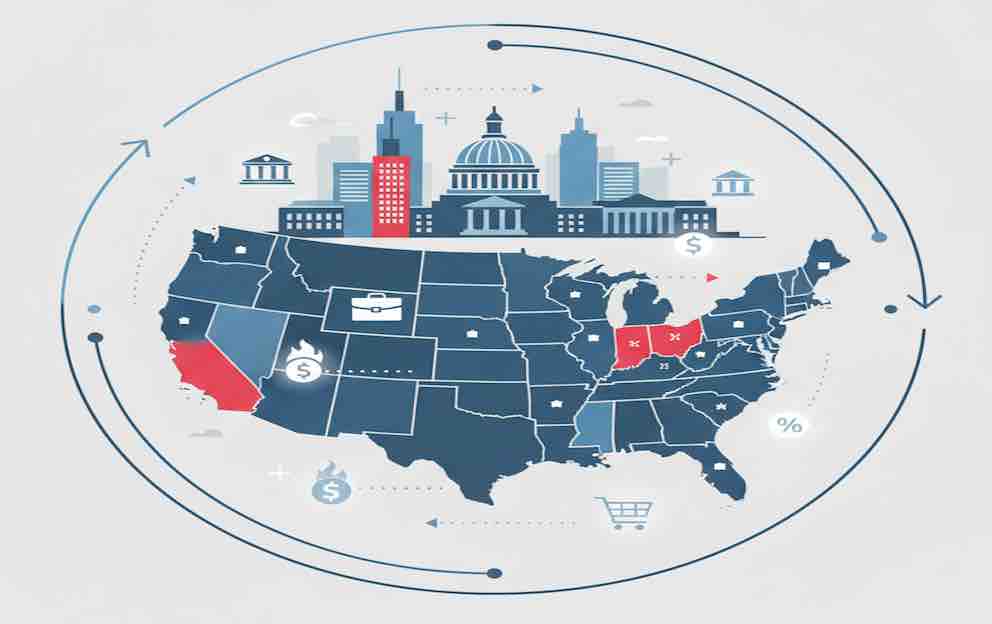
Labor data revealed pockets of weakness amid overall stability. State-level September figures showed 11 states with YoY job losses in Q3 2025, up from three in Q2, with Moody’s state-level assessment now flagging 22 states in recession by employment metrics—concentrated in services and retail.
On the labor front, the BLS JOLTS release showed job openings at roughly 7.7 million in October, underscoring continued demand even as hiring and quits appeared subdued in recent months — a pattern often described as a “no-hire, no-fire” equilibrium. (BLS). ADP’s November snapshot signalled further softness in private payrolls, with ADP reporting a ~32,000 decline in private-sector jobs in November, concentrated among smaller firms. (ADP).
Manufacturing, however, remains a clear weak spot: the ISM Manufacturing PMI contracted to 48.2 in November, with weak new orders and elevated prices paid — consistent with tariff-related cost pressures noted by respondents (ISM).Job growth tilts toward tech-adjacent roles, with traditional sectors shrinking; unemployment holds at 4.4%, but regional divergences signal caution. These patterns suggest households are cautiously optimistic while business conditions — especially in factories and some regions — are uneven.
Growth Indicators & Outlook
The delayed Q3 GDP report (rescheduled for December 23) looms large, with nowcasts from the Philadelphia Fed, Atlanta Fed (3.5%), and Wall Street Journal clustering at 3.0-3.5% growth, fueled by manufacturing and pre-tariff inventory builds. Shutdown effects shaved ~0.5pp from Q4 estimates, per Conference Board, but AI productivity (Q2 at 3.3%) cushions the blow. The Leading Economic Index fell 0.3% in September to 98.3 (seventh consecutive drop), attributed to tariffs trimming H1 momentum. Mercatus maintains a 2.0% real GDP forecast for the next 12 months, noting “productivity from AI will offset employment slowdowns.” Despite LEI headwinds, nowcasts affirm Q3 solidity, with resilient consumer activity underpinning a soft landing—though tariff escalations risk Q4 drag.
Outlook for Next Week
Investors and analysts will be focused on a backlog of delayed and regular data releases as markets try to regain footing amid holiday volatility:
- The BEA will publish the delayed Q3 2025 GDP initial estimate on December 23, providing fresh insight into growth momentum after an extended reporting hiatus.
- On December 16, the U.S. government will release the November employment report (nonfarm payrolls, etc.), which — given weak private-sector data from ADP — may influence market expectations for the path of rates.
- Later in December, the final reading of the University of Michigan consumer sentiment index will test whether the early-month uptick holds, or if headline and inflation worries reassert.
- Meanwhile, the services sector — which already registered a November PMI of 52.6 — merits watching for signs of sustained strength or weakening in coming releases.
Key downside risks remain: renewed volatility from oil markets (e.g., OPEC+ actions), potential trade-policy developments, and uncertainty over how delayed data may be revised. On balance, the economy could follow a “soft-landing / lower-for-longer” path — particularly if productivity gains (e.g. from AI, investment) help offset labor-market softness and support growth.
Sources
• Institute for Supply Management – Manufacturing PMI, November 2025
• University of Michigan – Surveys of Consumers, Preliminary December 2025
• Bureau of Labor Statistics – JOLTS, October 2025
• RealClearMarkets/TIPP – Economic Optimism Index, December 2025
• ADP – National Employment Report, November 2025
• Reuters – Economist Poll & market pricing, December 2025
Disclaimer
This content was created with formatting and assistance from AI-powered generative tools. While we strive for accuracy, this article may contain errors or omissions and should be independently verified. The final editorial review and oversight were conducted by humans. This article is for educational purposes only and should not be interpreted as financial advice. Readers should consult a qualified financial professional before making investment decisions.