
January 4, 2026 at 11:10
Contrarian Investing: A Beginner’s Guide to Thinking Differently in Markets
Authored by MyEyze Finance Desk
Most investors follow the crowd, but contrarian investors look for signals that others miss. By studying market sentiment, positioning, and investor psychology, contrarians act when fear or greed reaches extremes. This tutorial explains how contrarian investing works, its challenges, and how legendary investors have built wealth by thinking differently.
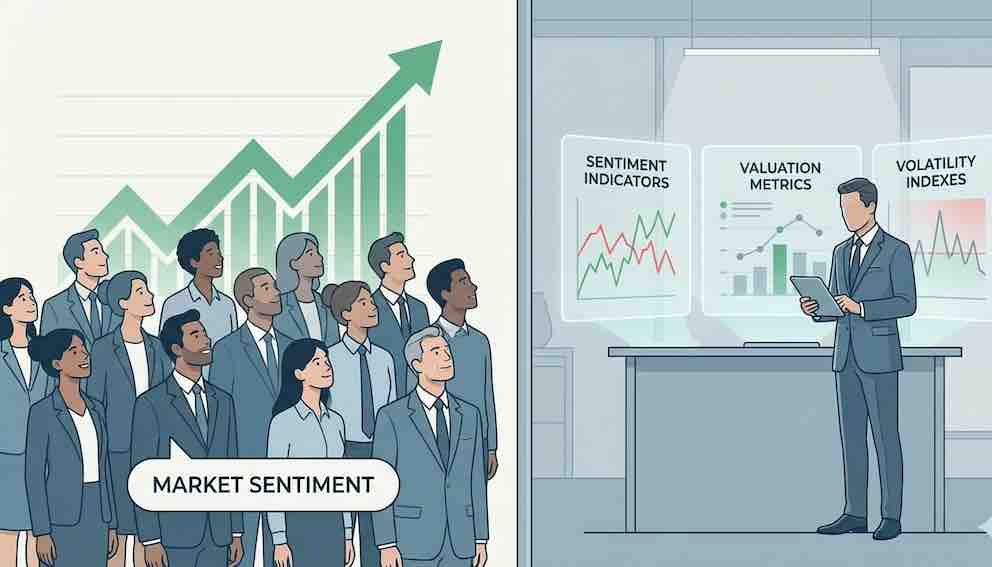
Most investors learn one simple rule early in their journey: follow the trend, stay invested, and let time do the heavy lifting. That advice works well for many. But markets are not driven by fundamentals alone. They are driven by human behavior—fear, greed, overconfidence, and panic.
Contrarian investing is an attempt to understand those emotions and act differently when they reach extremes.
This is not a shortcut to profits, nor a formula for perfect market timing. It is a mindset—one that takes years to develop, emotional discipline to sustain, and humility to practice.
What Is Contrarian Investing?
Contrarian investing is the discipline of going against prevailing market sentiment—not reflexively, but thoughtfully.
When most investors are optimistic and confident, contrarians become cautious.
When fear dominates headlines and prices fall sharply, contrarians begin to look for opportunity.
The key insight is simple but powerful:
Markets tend to be most wrong when consensus is strongest.
Contrarians do not assume the crowd is always wrong. They assume the crowd is most vulnerable to error at emotional extremes.
Contrarian investing means acting differently from the majority when the majority is emotionally committed to a view.
That last part is crucial.
Markets are efficient most of the time. Contrarian investing is not about opposing the crowd every day. It matters only at emotional extremes, when:
- Fear overwhelms logic, or
- Confidence turns into complacency
At those moments, prices stop reflecting fundamentals and start reflecting emotion.
A contrarian investor asks:
- Is fear exaggerating risk?
- Is optimism underpricing uncertainty?
When sentiment becomes extreme, future returns often become asymmetric — meaning downside risk is large when optimism is high, and upside potential is large when fear dominates.
Why Crowds Get It Wrong at Market Turns
Market tops and bottoms are psychological events before they are economic events.
At market tops:
- Good news feels endless
- Risks feel theoretical
- Everyone feels smart
At market bottoms:
- Bad news feels permanent
- Fear feels rational
- Selling feels necessary
This is not coincidence — it is human nature.
Contrarian investing works because markets turn when the marginal buyer or seller disappears. When everyone who wanted to buy has already bought, prices become fragile. When everyone who wanted to sell has already sold, prices become resilient.
Contrarian Legends — And Exactly How They Won
Warren Buffett: Contrarian Through Valuation and Patience
Buffett’s most famous contrarian success came after the dot-com bubble (2000–2002).
- In 1999–2000, tech stocks dominated markets.
- The Nasdaq traded at extreme valuations.
- Buffett refused to buy tech and was widely mocked.
During the bubble:
- The Nasdaq peaked in March 2000.
- Buffett’s Berkshire Hathaway underperformed badly in the late 1990s.
Then reality arrived:
- Nasdaq fell ~78% from peak to trough.
- Many high-profile tech companies disappeared.
- Buffett preserved capital and later deployed it into undervalued businesses.
Contrarian lesson:
Buffett wasn’t early because he wanted to be right — he was patient because risk was mispriced.
Howard Marks: Contrarian Through Cycles and Risk Awareness
Howard Marks focuses on where we are in the cycle rather than predicting the economy.
During the Global Financial Crisis (2008–2009):
- Credit markets froze
- Investors refused to buy distressed debt
- Fear dominated every asset class
Marks wrote memos explaining that:
- Risk premiums were extremely high
- Prices reflected panic, not probability
- Future returns were likely exceptional
Oaktree deployed capital aggressively when:
- Defaults were feared
- Liquidity was scarce
- Sentiment was universally bearish
The result:
- One of the strongest performance periods in Oaktree’s history
Contrarian lesson:
Marks didn’t predict the bottom — he recognized that fear had created extraordinary value.
John Templeton: Buying When Pessimism Was Absolute
Templeton’s most famous contrarian move occurred during World War II.
- Europe was devastated
- Global confidence was shattered
- Most investors avoided international markets entirely
Templeton borrowed money to buy every public stock trading below $1 on the New York Stock Exchange — many tied to war-ravaged economies.
Over time:
- Global recovery followed
- Those investments multiplied in value
- Templeton became one of the wealthiest investors in history
Contrarian lesson:
Maximum pessimism often creates maximum opportunity — but only for those willing to endure discomfort.
Contrarian Investing in Modern History — With Data
October 2008–March 2009: Fear at Its Peak
- S&P 500 fell ~57%
- Volatility (VIX) spiked above 80
- Investor surveys showed extreme bearishness
Contrarians observed:
- Forced selling
- Bank recapitalization underway
- Prices implying depression-level outcomes
From March 2009:
- One of the strongest bull markets in history began
- Long-term investors who bought during panic were rewarded for years
October 2022: Universal Bearishness
- Inflation fears dominated
- Central banks aggressively tightening
- Recession widely expected
Sentiment indicators showed:
- Very high bearish readings
- Equity allocations near multi-year lows
Contrarian view:
- Much bad news already priced in
- Marginal sellers exhausted
Markets bottomed in October 2022 and rallied strongly afterward.
Early 2024: Extreme Optimism
- Equity exposure near record highs
- Narrow leadership in a few mega-cap stocks
- Analyst forecasts overwhelmingly positive
Contrarians did not necessarily sell everything — but recognized:
- Risk/reward had worsened
- Expectations were stretched
- Volatility suppression suggested complacency
Key point:
Contrarians are not always bearish — they are risk sensitive.
How Contrarians Actually Use Sentiment Data
Contrarians track extremes, not daily noise.
They look at:
- Bullish vs bearish surveys
- Cash levels
- Leverage
- Media narratives
- Valuation dispersion
When multiple indicators align, contrarians pay attention.
Important:
Sentiment is a warning system, not a timing tool.
Why Contrarians Are Early — And Why That’s Dangerous
Contrarians are often right too soon.
That creates three problems:
- They miss the strongest part of a rally
- They endure ridicule and doubt
- They face opportunity cost
Being early feels the same as being wrong — until it doesn’t.
Many contrarians fail not because their analysis is flawed, but because:
- They size positions incorrectly
- They lack patience
- They underestimate how long sentiment can stay extreme
What Success and Failure Mean in Contrarian Investing
Success is not calling tops and bottoms.
Success means:
- Avoiding catastrophic drawdowns
- Preserving capital
- Participating when risk is favorable
Failure means:
- Fighting trends emotionally
- Staying contrarian for ego
- Ignoring evidence
Contrarians must constantly update their views — stubbornness is not conviction.
Does Contrarian Investing Violate “Don’t Time the Market”?
Not entirely.
Contrarian investing does not mean constant market timing. It means:
- Adjusting risk exposure over time
- Recognizing when probabilities change
- Accepting uncertainty
Time in the market matters — but risk is not constant through time.
Contrarian investing acknowledges that reality.
Why Contrarian Investing Takes Years to Master
Contrarian skill is earned through:
- Multiple bull markets
- Multiple bear markets
- False signals
- Emotional mistakes
You must experience:
- Fear that feels rational
- Greed that feels justified
- Being right too early
- Being wrong temporarily
Books teach theory.
Markets teach humility.
The Emotional Battle: Fear, Greed, and Nerves
Contrarians must:
- Buy when fear feels logical
- Wait when greed feels irresistible
- Sit still when noise is overwhelming
This is mentally exhausting.
Most investors fail at contrarian investing not because they lack intelligence — but because they cannot control their emotions.
Notes for a Budding Contrarian Investor
If you want to learn contrarian investing:
- Observe sentiment over several cycles
- Study past market extremes
- Keep a decision journal
- Never go “all in” on a view
- Accept being early
Contrarian investing is a craft, not a shortcut.
Why Contrarian Thinking Remains Valuable
Crowds are efficient during trends — but fragile at turning points.
Contrarian investing exists because:
- Fear and greed repeat
- Extremes distort prices
- Independent thinking creates opportunity
It will never feel comfortable.
It will never be popular.
But history shows it has built extraordinary wealth for those who mastered it.
Contrarian investing doesn’t promise easy returns —
It promises clearer thinking when it matters most.
Disclaimer
This article is for educational purposes only and should not be interpreted as financial advice. Readers should consult a qualified financial professional before making investment decisions. Part of this content was created with formatting and assistance from AI-powered generative tools. The final editorial review and oversight were conducted by humans. While we strive for accuracy, this content may contain errors or omissions and should be independently verified.