
Tutorial Categories
Last Updated: January 25, 2026 at 10:30
How Monetary Systems Begin to Fracture - World Financial History Series
Money almost never fails outright. What changes first is the relationship people have with it. They begin to expect more from money—stability, reliability, reassurance—and slowly realize it can no longer deliver all of that. Everyday decisions start to shift: how long cash is held, what prices are mentally anchored to, which commitments feel safe to make. These adjustments happen quietly and without coordination, but together they tell a clear story. Monetary transition begins not with disappearance or decree, but with a subtle redefinition of what money is trusted to do.
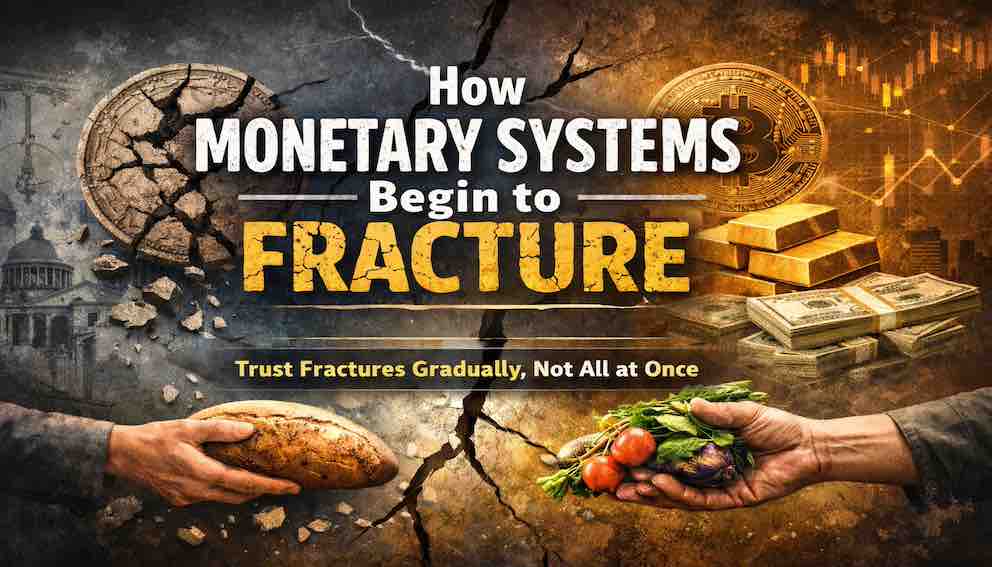
Monetary systems rarely collapse in dramatic moments. They wear down through behavior. People adjust how they price goods, how they write contracts, and where they store value. History shows that when official money begins to lose its coordinating role, societies do not wait for reform. They improvise. Parallel systems emerge to keep exchange possible—new units of account, alternative payment methods, substitute stores of value. These are not ideological rebellions or speculative experiments. They are practical responses to uncertainty. Long before crisis headlines appear, behavior has already moved on.
The Diagnostic Framework: Why Parallel Systems Appear
Every monetary system, no matter how complex, is ultimately judged by a few very simple tests. People may not articulate them formally, but they ask these questions through their behavior every day.
First, can it move? Can money be transferred easily when a payment is due, without delay, restriction, or friction?
Second, will it last? Can money hold its value long enough for people to save, plan, and make promises that extend into the future?
Third, will it be accepted without hesitation? When money is offered, does the other side take it immediately, or pause, discount it, or refuse it altogether?
When official money begins to struggle with any one of these questions, people do not stop coordinating economic life. They adapt. Rather than abandoning money entirely, they build parallel systems that repair the specific function that has weakened.
When payments become slow, restricted, or unreliable, parallel media of exchange emerge. Foreign currencies, commodities, local scrip, or digital alternatives allow transactions to keep moving when the official currency cannot. These substitutes answer the most basic question of commerce: can this payment happen at all?
When money no longer feels stable over time, parallel units of account appear. People begin pricing goods, writing contracts, or thinking about wealth in a different measuring stick—often a foreign currency, a commodity, or an index. Even if transactions still settle in the official currency, value is no longer measured in it. This is a quiet but profound shift.
When holding money feels unsafe, parallel stores of value absorb savings. Land, durable goods, foreign assets, or hard commodities take on the role the currency can no longer play. These assets do not need to circulate to matter. They reshape spending, saving, and investment behavior simply by existing as alternatives.
Finally, when acceptance itself becomes uncertain, parallel settlement systems form. Closed networks, clearing arrangements, barter systems, and private payment rails ensure that obligations can still be settled among trusted participants. These systems reduce dependence on the official currency by narrowing the circle of trust.
In all of this, the old money has not stopped functioning entirely. It still circulates. It is still legal. What has changed is its usefulness. Each parallel system represents an attempt to restore full coordination where the official system now falls short. Monetary transition is not a rejection of money. It is a practical effort to make coordination work again.
Case Study I: Late Imperial Rome — When the Unit of Account Leaves the Coin
By the mid–third century AD, Rome’s monetary system was in visible distress. The silver denarius—once nearly pure, trusted across the Mediterranean—had been steadily debased to fund military expansion and political instability. By the reign of Emperor Gallienus, its silver content had collapsed from roughly 95 percent to less than 5 percent. What remained was effectively a bronze coin with a thin silver wash.
The consequences were severe. By around 265 AD, prices across the empire had risen by an estimated 1,000 percent. A Roman soldier’s wages bought a fraction of what they had a generation earlier. The coin still circulated by law, but it no longer functioned as a stable measure of value.
Emperor Caracalla’s introduction of the antoninianus accelerated the breakdown. Officially declared to be worth two denarii, it contained far less than double the silver. Markets complied formally. In practice, trust evaporated.
The response was not abandonment—but adaptation.
Merchants and tax collectors began keeping accounts in an abstract unit known as the nummus or denarius communis. No such coin existed. Prices were quoted in this unit, while payments were settled using whatever debased coins were available, adjusted constantly for metal content.
Money split in two.
One system measured value.
Another performed exchange.
This was not clever bookkeeping. It was a vote of no confidence. When a society invents a stable unit of account with no physical representation, it has already concluded that its currency can no longer be trusted to measure economic reality.
Roman monetary authority survived in law. It failed in ledgers.
Lesson: The unit of account leaves the currency before the currency disappears. It always does.
Case Study II: Weimar Germany — Parallel Media at Full Speed
Germany’s hyperinflation was not an accident of arithmetic. It was the result of political choice. During the French occupation of the Ruhr in 1923, the German government chose to pay striking workers with newly printed money. The printing presses ran continuously.
At its peak, prices rose by 50 percent per month—then faster. By late 1923, they were rising daily.
Behavior adapted instantly.
Factories paid workers daily, then multiple times per day. Wages were spent immediately, before they lost value. Professionals accepted payment in goods. Economic life collapsed inward, toward essentials.
Parallel currencies appeared everywhere. Towns and firms issued Notgeld—emergency money backed by coal, grain, or local output. These notes circulated locally and were trusted precisely because they were tied to something tangible.
For larger transactions and long-term thinking, Germans abandoned the mark entirely as a mental reference. Contracts were priced in U.S. dollars. Rent, machinery, and foreign trade were valued in a currency that held meaning—even if settlement still occurred in marks.
Eventually, stabilization came not through rhetoric but constraint: the introduction of the Rentenmark, often called the “rye mark,” backed by land and industrial assets. It worked because it restored credibility, not because it replaced paper.
The Reichsmark did not die in a single moment. It was hollowed out as people routed around it.
Distributional reality:
Exporters, asset holders, and those with access to foreign currency adapted early. Salaried workers and pensioners adapted last—and lost the most. Monetary fracture redistributed wealth along lines of access to parallel systems.
Case Study III: Post-Soviet Russia — Settlement Without Money
Russia in the 1990s did not experience mere inflation. It suffered a collapse of settlement.
The 1998 Russian financial crisis triggered a sovereign default, a banking freeze, and a ruble devaluation that erased two-thirds of its value in a single month. Money existed, but it could not reliably move.
Enterprises adapted by bypassing cash altogether.
Factories settled obligations through barter and netting. Utilities paid suppliers with power credits. Workers were paid in goods—tires, furniture, metal—which they then traded onward.
To manage this complexity, firms issued veksels—private promissory notes that circulated within trusted networks as quasi-money. These instruments moved more reliably than state currency.
At its peak, over half of industrial transactions occurred through barter or clearing arrangements.
This was not economic regression. It was a sophisticated settlement system built on trust, output, and necessity.
The state's ruble failed the test of 'Can it move?' Society's answer was to build a new settlement system that could.
Lesson: When money fails to coordinate, coordination migrates. It does not disappear.
The Historical Pattern of Monetary Fracture
Across time and geography, the sequence repeats:
The unit of account weakens first
- Rome priced in the nummus.
- Weimar priced in dollars.
- Russia stopped planning in rubles.
Parallel media of exchange multiply
- Goods, foreign currencies, local scrip, private instruments.
Settlement moves outside official channels
- Trade becomes local, networked, or closed-loop.
Authority lingers after legitimacy fades
- Law remains. Behavior moves on.
Transitions often feel slow—until network effects push them past a tipping point.
Connecting History to the Present
These patterns are visible again today:
- Parallel media of exchange: cryptocurrencies for cross-border payments, stablecoins in emerging markets
- Parallel units of account: real estate, equity indices, Bitcoin as mental benchmarks
- Parallel settlement systems: private blockchain rails, corporate netting in supply chains
- Parallel stores of value: global movement into U.S. assets—not optimism, but refuge, alongside renewed dedollarization efforts and not to forget Gold
These are not predictions of collapse. They are signals. For certain functions and groups, official coordination is no longer sufficient.
What History Teaches—and What It Does Not
History teaches that:
- Failure appears in behavior first
- People route around money; they do not abandon coordination
- Units of account change early
- Stabilization works only when credibility returns
History does not offer timelines or guarantees. Adaptation does not ensure collapse. Patterns are not prophecies.
What history offers instead is clarity.
It turns the confusing present into a recognizable pattern.
That is its power—and now, yours.
About Swati Sharma
Lead Editor at MyEyze, Economist & Finance Research WriterSwati Sharma is an economist with a Bachelor’s degree in Economics (Honours), CIPD Level 5 certification, and an MBA, and over 18 years of experience across management consulting, investment, and technology organizations. She specializes in research-driven financial education, focusing on economics, markets, and investor behavior, with a passion for making complex financial concepts clear, accurate, and accessible to a broad audience.
Disclaimer
This article is for educational purposes only and should not be interpreted as financial advice. Readers should consult a qualified financial professional before making investment decisions. Assistance from AI-powered generative tools was taken to format and improve language flow. While we strive for accuracy, this content may contain errors or omissions and should be independently verified.