
Tutorial Categories
Last Updated: January 26, 2026 at 10:30
Who Gets to Create Money? - World Financial History Series
Money does not appear on its own. Someone is allowed to create it, and that permission shapes who gains first and who pays later. Across history, monetary systems have not failed because money stopped working overnight, but because the power to create it lost legitimacy. New money always enters the economy somewhere first, and that path matters more than most people realize. Inflation, financial booms, and crises are rarely accidents—they are outcomes of how, where, and why money is created. To understand money, we must first understand who controls its creation, and under what limits.
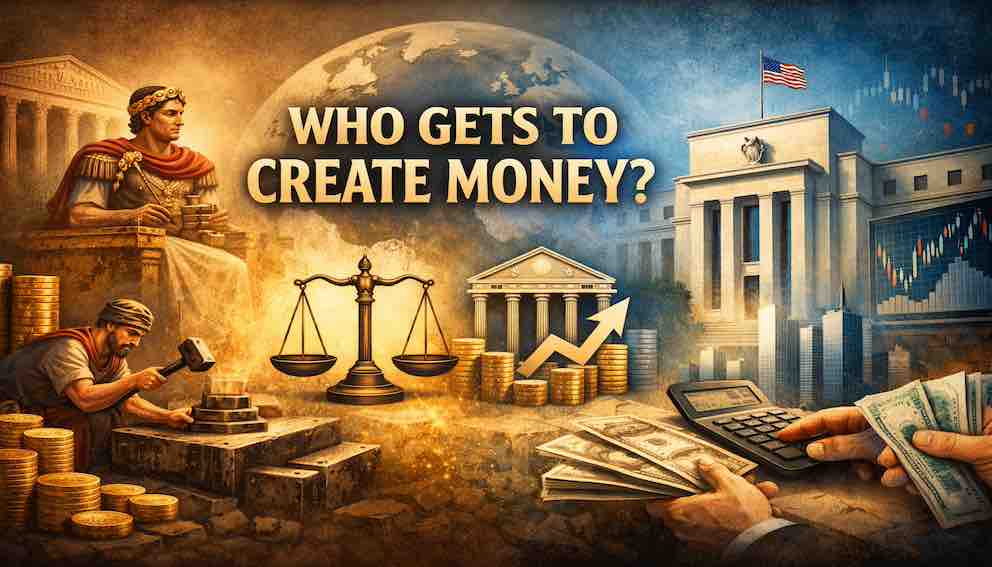
In 2020, governments around the world created trillions of dollars in new money.
Some of it reached households directly, through stimulus checks and wage support. Much more flowed through central banks into financial markets, stabilizing banks and raising asset prices. Both actions used the same tool—money creation. But they produced very different outcomes.
This difference—where newly created money goes—is the hidden core of monetary power.
Money helps an economy coordinate. It allows people to trade, save, plan, and settle obligations without constant negotiation. But money does not appear naturally. Someone is allowed to create it. And that permission carries consequences.
Across history, monetary systems have not failed because money stopped moving or stopped being accepted overnight. They failed when the authority to create money lost legitimacy—when people no longer believed that creation followed understandable rules.
If the previous chapter asked whether money could move, last, and be accepted, this chapter asks who controls the levers that make those answers change. It explains who gets to create money, how that power has been used and abused, and what history consistently shows about its limits.
Money Creation Begins as Power, Not Policy
In early history, money creation was openly political.
When the first standardized metal coins appeared in Lydia in the 7th century BCE, they were valuable because they solved a practical problem. Traders no longer had to weigh metal or test purity at every exchange. Coins reduced friction.
States quickly took control of minting. Not because others lacked skill, but because standardized money made taxation easier, armies easier to supply, and trade easier to monitor.
As long as coin weight and metal content remained stable, trust held. Coins moved easily. They were accepted without argument.
Problems emerged when rulers began reducing metal content to fund spending without raising taxes. This happened repeatedly in the Roman Empire. Silver coins slowly lost silver. The process took decades.
The effects were not immediate collapse. Instead:
- Prices rose unevenly
- Merchants demanded more coins
- Soldiers demanded higher pay
- Older coins disappeared from circulation
Money still worked—but less smoothly. Acceptance became conditional.
The lesson is not that money creation is bad. It is that money creation redistributes real purchasing power, whether intended or not.
Seigniorage: Power Over Timing and Direction
Seigniorage is often described as the profit made by issuing money cheaply. Historically, that definition misses what matters.
The true power of money creation lies in timing and direction.
New money does not enter an economy evenly. It enters somewhere first.
In 16th-century Spain, silver from the Americas first reached the crown and its creditors. Prices across Europe rose over decades. Wages rose much more slowly. Those close to the source of new money benefited. Those further away lost purchasing power over time.
This pattern appears in every era.
In modern systems, when central banks create new money, it often enters through banks, government spending, or financial markets. Asset prices respond first. Consumer prices respond later.
Inflation, in this sense, is not mysterious. It follows a path.
Creation vs Allocation: Why Where Money Goes Matters More Than How Much
Two systems can create the same amount of money and produce very different results.
The difference is allocation.
Creation answers: how much new money exists?
Allocation answers: who receives it first?
In medieval Europe, debasement funded military payrolls. In early modern Britain, expanding credit funded trade and infrastructure. Both involved money creation. Only one supported long-term growth.
Modern investors often miss this distinction. But history shows most monetary harm comes not from creation itself, but from where the money flows.
The Second Tier: Banks and the Alchemy of Credit
In modern economies, money creation is a two-tier system.
The state—through the treasury and central bank—creates base money: cash and bank reserves.
But most money people use is not base money. It is bank-created credit.
When a bank issues a mortgage, it does not lend existing deposits. It creates new deposit money. This is private money creation.
This system allows economies to grow faster than metal-based systems ever could. But it also introduces risk. Banks are motivated by profit. If credit expands too quickly or flows into speculation instead of production, instability follows.
The 2008 financial crisis becomes clear through this lens. It was not a failure of coins or printing. It was a failure of private money creation and allocation.
Sovereigns create the foundation. Banks build the structure on top.
Authority Can Declare Money. Legitimacy Sustains It.
A government can declare what counts as money. It can pass laws, print notes, and require taxes to be paid in that unit. This is authority.
But authority alone is not enough to make money work smoothly. For money to function without friction, people must believe that its value will behave in a reasonably predictable way. This belief is legitimacy.
History repeatedly shows that authority can force acceptance, but only legitimacy produces confidence.
A clear example comes from Song Dynasty China. Paper money was introduced to solve a real problem. The economy had grown faster than the supply of metal coins. Carrying large amounts of copper or silver was costly and inefficient. Paper notes made trade easier.
At first, these notes could be exchanged for metal coins. This convertibility helped people trust the new system. Over time, convertibility weakened. Even then, paper money continued to circulate because the state accepted it for taxes and because commerce had already reorganized around it.
For many years, the system worked.
Problems began when the government increased issuance to fund state spending. More notes entered circulation faster than the economy grew. Prices began to rise unevenly. In rural areas, merchants started accepting paper at a discount. Long-term contracts became rarer because people were unsure what the money would be worth in the future.
The government still had authority. Paper money was still legal. Taxes were still enforced. But legitimacy had weakened.
The same pattern appeared in revolutionary France. The assignats were introduced as paper notes backed by confiscated land. Initially, they were issued cautiously and served a clear purpose. Political pressure soon pushed issuance higher. Each increase seemed manageable on its own.
Over time, people noticed that the rules were changing. Trust did not disappear overnight. It drained quietly. Prices adjusted faster. Contracts shortened. People demanded more notes for the same goods.
Money rarely fails because people stop obeying authority. It fails because people stop believing that money creation follows stable and understandable rules. When that belief disappears, money continues to circulate—but it no longer coordinates economic activity smoothly.
Inflation Is Redistribution With a Delay
Inflation is often described as “too much money chasing too few goods.” This is mechanically true but incomplete.
New money always reaches some people before others.
In Weimar Germany, early inflation reduced debt burdens and supported employment. Only later—when savers and wage earners realized they were always last in line—did behavior change. Contracts shortened. Goods were hoarded. Money lost its coordinating role.
These were rational responses.
Inflation is not confusion. It is redistribution over time.
The Time Lag Problem: Why Authorities React Too Late
Monetary failure rarely looks dangerous at first.
Roman debasement worked for decades. Spanish silver took generations to reshape prices. Early inflation often feels helpful.
The danger lies in delayed feedback. Behavior changes before statistics do.
By the time authorities react, legitimacy has already weakened.
When Money Creation Falls Into the Wrong Hands
“Wrong hands” does not mean immoral people. It means decision-makers insulated from consequences.
Late Roman emperors did not feel local shortages. Late Ming officials enforced rigid tax demands despite silver scarcity. Policy became disconnected from lived reality.
Money creation fails when creators no longer bear its costs.
When Authorities Forget Why Money Exists
Money is created to coordinate exchange, production, and settlement.
History shows failure when creation shifts toward preserving authority itself—funding obligations, postponing reform, or masking fiscal weakness.
Roman debasement stopped being about liquidity. Assignats stopped being about commerce.
Money still circulated—but coordination became dishonest.
When Money Creation Destroys Power
Misuse of monetary authority often destroys the authority it seeks to protect.
Roman debasement weakened tax capacity. French inflation delegitimized government. Weimar inflation reshaped politics for decades.
Formal control remains longer than real control.
When Money Creation Works
Money creation is not the enemy.
It works when:
- It solves real coordination problems
- It flows toward production and trade
- It is constrained
Historically, constraint came from metal convertibility. In the modern era, it often comes from independent central banks with price stability mandates.
These institutions exist to prevent money creation from becoming a political escape valve.
Their legitimacy depends on restraint.
The Global Hierarchy of Money Creation
Not all money creators are equal.
Countries issuing global reserve currencies can export inflation. New money is absorbed internationally. Others cannot.
This is why similar actions produce different outcomes in the U.S. versus Venezuela or Zimbabwe.
Money creation exists within a global hierarchy.
Why People Tolerate Bad Money Longer Than Expected
People adapt before they revolt.
They shorten contracts. Move savings. Hedge quietly.
Exit is costly. Coordination inertia is powerful.
This is why breakdowns seem sudden—and never are.
Behavioral Signals That Appear Before Crisis
Across history, the same signals appear:
- Rising use of alternative stores of value (gold, real assets, foreign currency)
- Shorter time horizons in contracts
- Dollarization(people losing confidence in domestic money) or foreign currency saving
- Growing financial complexity to hedge instability
These signals matter more than headlines.
What History Teaches Us
- Money creation redistributes purchasing power
- Allocation matters as much as quantity
- Legitimacy depends on constraint
- Behavior changes before crisis
- Temporary fixes accumulate costs
What We Still Fail to Learn
- Inflation is governance, not accident
- Behavioral warnings are ignored
- Complexity is mistaken for immunity
- Legitimacy repair comes too late
A Simple Diagnostic for Any Monetary System
Ask:
- Who creates money?
- Under what limits?
- Where does it enter?
- Who benefits first?
- What behaviors are changing?
Looking Ahead
This tutorial explains who controls the lever of money creation.
The next will examine what happens when that lever is pulled too often, too unevenly, or without restraint.
Money does not fail suddenly.
Legitimacy drains quietly.
History shows us how.
About Swati Sharma
Lead Editor at MyEyze, Economist & Finance Research WriterSwati Sharma is an economist with a Bachelor’s degree in Economics (Honours), CIPD Level 5 certification, and an MBA, and over 18 years of experience across management consulting, investment, and technology organizations. She specializes in research-driven financial education, focusing on economics, markets, and investor behavior, with a passion for making complex financial concepts clear, accurate, and accessible to a broad audience.
Disclaimer
This article is for educational purposes only and should not be interpreted as financial advice. Readers should consult a qualified financial professional before making investment decisions. Assistance from AI-powered generative tools was taken to format and improve language flow. While we strive for accuracy, this content may contain errors or omissions and should be independently verified.