
Tutorial Categories
Last Updated: January 18, 2026 at 10:30
Uncertainty, Probability, and the Illusion of Control: Why Investors Overestimate What They Know - Behavioral Finance Series
Why do investors often overestimate what they know? Markets are uncertain, and the illusion of control can be costly. This tutorial explains the difference between quantifiable risk and true uncertainty, introduces probabilistic thinking, and shows how experts navigate ambiguity through scenario planning, robust decision-making, and optionality. Learn to separate decision quality from outcomes, avoid behavioral traps, and build resilient strategies in unpredictable markets.
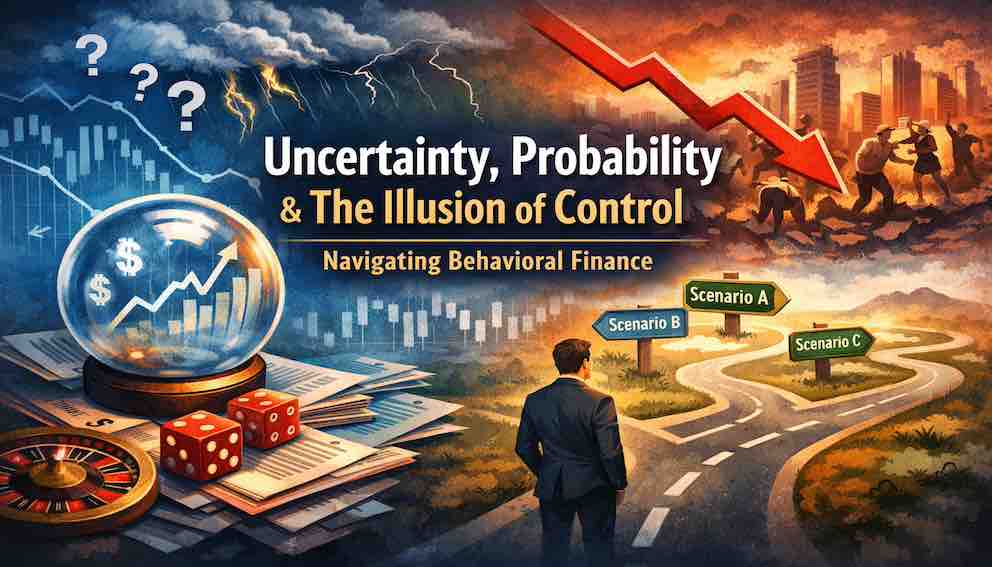
“The most dangerous thing in investing is not risk itself, but the illusion that we can control it.”
Financial markets are uncertain, yet investors often act as if they can foresee every move. This tutorial explores why we overestimate control, how to think probabilistically, and practical tools to make better decisions under uncertainty.
The Control Paradox
Consider two investors:
- Ethan constantly tweaks his portfolio. He follows every earnings report, reads analyst forecasts, and adjusts his holdings based on short-term market predictions.
- Sophie invests with a long-term plan, diversifies broadly across asset classes, and only occasionally reviews her portfolio.
Over a decade, Sophie often outperforms Ethan, even though Ethan feels “in control” of every move. Ethan suffers from the illusion of control—believing he can predict and influence outcomes in an unpredictable market. Sophie accepts uncertainty and focuses on resilience.
The paradox: believing we control outcomes in a fundamentally uncertain world can be more dangerous than the uncertainty itself.
Risk vs. Uncertainty: The Knightian Distinction
Economist Frank Knight (1921) distinguished two types of unknowns:
- Knightian Risk: Situations where probabilities are known. Example: rolling a fair die; each outcome has a 1/6 chance. Traditional finance often assumes markets behave this way.
- Knightian Uncertainty (Ambiguity): Situations where probabilities are unknown or unknowable. Example: Will the next financial crisis resemble 2008, 2000, or be something completely new? Most major market events fall here.
Investor trap: Mistaking Knightian Uncertainty for Knightian Risk leads to overconfidence. We act as if we can assign precise probabilities to events that are fundamentally ambiguous.
Fat-Tailed Distributions
Markets aren’t “normal.” Extreme events (like crashes or spikes) occur more often than a bell curve predicts. These fat-tailed events—popularized by Nassim Taleb as Black Swans—make calculating Expected Value (EV) extremely difficult because both probability and impact are uncertain.
Probability, Randomness, and Expected Value (EV)
Even when markets seem predictable, randomness dominates:
- Flip a coin 10 times. You expect 5 heads, but 8 or 2 is possible. Small samples exaggerate randomness.
- Similarly, a stock rising 20% doesn’t mean your prediction was correct—it could be random noise.
Expected Value (EV): Thinking Beyond One Outcome
Markets are unpredictable in the short run. A single investment can succeed or fail for reasons outside your control. Expected Value (EV) helps investors think beyond one outcome and focus on whether a decision makes sense over time.
At its core, EV asks a simple question:
If I could make this same decision many times, would it help or hurt me on average?
The Illusion of Control
Humans tend to overestimate their influence over random events, especially when outcomes matter to them:
- Dot-Com Bubble 2000: Investors believed early-stage tech companies were “different this time.” Many ignored timing and structural risk.
- Housing Crisis 2008: Lenders and investors trusted complex models, assuming low default risk, underestimating systemic uncertainty.
- COVID Crash 2020: Even experts misjudged the speed and scale of market swings. Narratives like “quick recovery” were appealing but misleading.
The illusion of control reinforces overconfidence, often leading to overtrading, leverage, or ignoring risk management.
Behavioral Biases That Amplify Misperceived Control
Overconfidence Bias: Overestimating knowledge, forecast accuracy, and influence.
Outcome Bias: Judging decisions by outcomes, not the decision process.
Example: Alice predicts a stock rise, it happens, and she assumes her skill, ignoring chance.
Narrative Fallacy: Humans love stories that explain randomness in hindsight.
Hindsight Bias: After events, we reconstruct the past as more predictable than it was, reinforcing false confidence.
Expert vs. Novice Thinking Under Uncertainty
Novice Investors:
- Try to predict exact prices, often using gut instincts.
- Let narratives override probabilistic thinking.
- React emotionally to short-term outcomes.
Expert Investors:
- Accept markets are fundamentally uncertain.
- Use formal frameworks for decision-making under uncertainty:
Robust Decision-Making (RDM)
- Don’t aim for a “perfect prediction.”
- Seek strategies that perform “well enough” across a range of plausible futures.
- Examples: diversification, liquidity buffers, hedging.
Scenario Planning (Shell Oil Method) — Made Simple
Scenario planning is not about predicting the future.
It is about preparing for different futures.
Key ideas:
- Go beyond simple forecasts
- Instead of one “best guess” (or basic best/worst cases), imagine very different but plausible worlds.
- Build complete stories, not numbers
- Each scenario is a short, logical story of how the world could evolve
- (e.g., rapid decarbonization, trade breakdowns, technological shocks).
- Each scenario must make internal sense
- Economic, political, and market forces in the story must fit together logically.
- Test your strategy against each scenario
- Ask: Would my portfolio survive? Where would it break?
- Look for early warning signals
- Identify signs that suggest one scenario may be unfolding
- (policy changes, credit stress, supply-chain shifts).
- The goal is resilience, not accuracy
- You are not trying to guess which future will happen—
- you are making sure your decisions are not fragile if you are wrong.
Optionality & Process Confidence
- Experts separate Decision Quality from Outcome Quality: a sound process can still produce bad results. Confidence lies in the process, not in predictions.
- Preserve optionality: make smaller or staged investments, keep some cash, or use tools like options. Accept a small cost today so you retain the ability to adjust your decisions as the future becomes clearer.
Rule for all investors: “Focus less on being right and more on being resilient if you are wrong.”
Historical & Modern Examples
| Event | Common Misperception | Reality |
| Dot-Com 2000 | Predictable tech winners | Outcome was highly random; many failures despite research |
| Housing 2008 | Risk models reliable | Tail risks and correlations were underestimated |
| COVID-19 2020 | Quick V-shaped recovery | Volatility and policy interventions made outcomes unpredictable |
| Meme Stocks 2021 | Social media research predicts prices | Crowd behavior dominated; fundamentals mattered less |
Practical Strategies for Probabilistic Thinking
Scenario Planning: Build multiple futures, identify vulnerabilities, plan responses.
Robust Decision-Making: Focus on strategies that survive a wide range of outcomes.
Pre-Mortem Analysis: Imagine catastrophic failure and write an “autopsy report” before investing.
Bayesian Updating: Treat beliefs as probabilities; update systematically as new data arrives.
Example: Start with “60% chance this company succeeds,” adjust with each new report.
Optionality & Flexibility: Keep choices open through liquidity, staged investments, or hedges.
Diversification & Hedging: Protect against unpredictable outcomes rather than betting on precision.
Reflective Journaling: Separate decision quality from outcome luck.
Nuance & Trade-Offs
- Probabilistic thinking doesn’t prevent losses; it manages them over time.
- Experts rarely predict market moves; they control exposure, preserve optionality, and stay resilient.
- Accepting uncertainty is uncomfortable but prevents overtrading, panic selling, or falling for hindsight-biased narratives.
Takeaway
Markets are uncertain, yet humans crave control. Overestimating it leads to poor decisions. The key is to:
- Think probabilistically
- Plan for multiple scenarios
- Focus on process, not predictions
- Preserve optionality and resilience
Reflective Prompt:
Next time you feel sure about a market outcome, ask yourself:
- What do I actually know?
- How much is probability vs narrative?
- Am I overestimating my control?
Small habits of probabilistic thinking and reflective analysis can prevent overconfidence from turning into costly mistakes.
About Swati Sharma
Lead Editor at MyEyze, Economist & Finance Research WriterSwati Sharma is an economist with a Bachelor’s degree in Economics (Honours), CIPD Level 5 certification, and an MBA, and over 18 years of experience across management consulting, investment, and technology organizations. She specializes in research-driven financial education, focusing on economics, markets, and investor behavior, with a passion for making complex financial concepts clear, accurate, and accessible to a broad audience.
Disclaimer
This article is for educational purposes only and should not be interpreted as financial advice. Readers should consult a qualified financial professional before making investment decisions. Assistance from AI-powered generative tools was taken to format and improve language flow. While we strive for accuracy, this content may contain errors or omissions and should be independently verified.