
Tutorial Categories
Last Updated: January 20, 2026 at 08:30
Why Doing Nothing Is Often the Hardest and Best Decision - Behavioral Finance Series
Investing often tempts us to act at every market move, but some of the best decisions require restraint. Doing nothing—when guided by a clear, rules-based process—is not passivity; it is active discipline. Historical events, from the 1929 crash to the COVID-19 market drop, show that panic-selling often locks in losses, while patient, structured investors preserve capital and capture recoveries. Research confirms this: Morningstar’s “Do Nothing Portfolio” delivered strong long-term returns with lower volatility, and DALBAR studies show that emotional, reactive trading consistently underperforms. By standing apart from the herd, exercising patience, and following a disciplined process, investors build an antifragile advantage, keeping their options open and letting time and compounding work in their favor. When approached thoughtfully, inaction can be the most difficult—but also the most rewarding—investment decision.
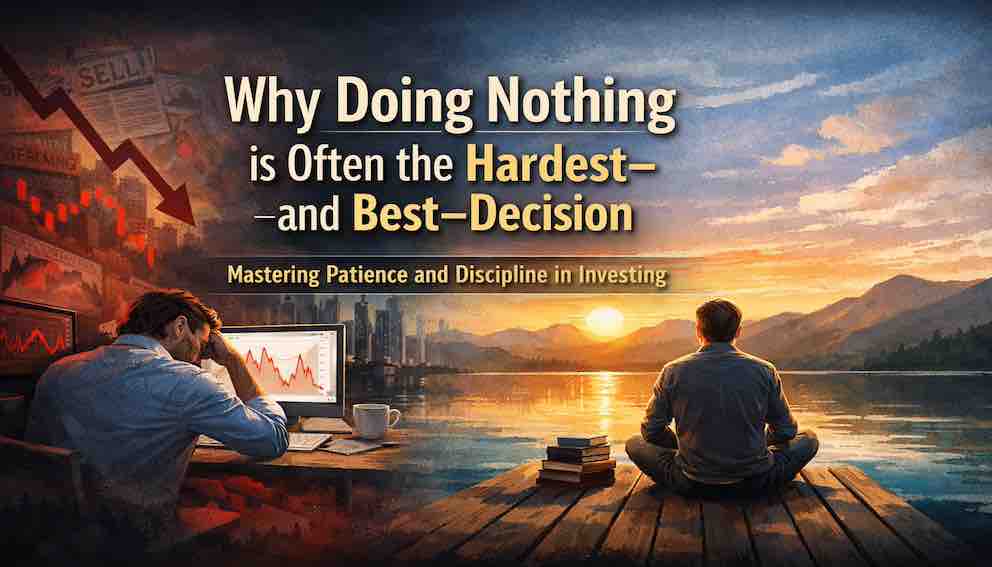
The Paradox of Inaction
Imagine watching the market plunge 30% in a matter of weeks. Headlines scream disaster, analysts urge action, and every investor around you seems to be selling in a panic. Your gut screams: “I need to do something—buy, sell, adjust!”
Yet, counterintuitively, some of the best investment decisions are not the ones you take—they are the ones you don’t. Doing nothing, when deliberate, is often harder than acting. It requires resisting powerful emotional impulses, trusting a clear process, and letting time, patience, and disciplined strategy work on your side.
Example: During the 2008 financial crisis, many investors panicked and sold stocks at rock-bottom prices, locking in heavy losses. Those who stayed invested—or followed a structured process of rebalancing and selective buying—captured the market recovery and avoided long-term damage. In this case, doing nothing was not passive; it was an active, profitable choice that rewarded patience and discipline.
Emotional Self-Control: The Quiet Advantage
Markets are not just numbers—they are emotional machines. Fear, greed, and herd behavior can overwhelm even the smartest investors. Daniel Kahneman’s research on System 1 and System 2 thinking shows why: our fast, instinctive brain (System 1) reacts immediately, while the slower, analytical brain (System 2) allows reflection and deliberate decision-making.
Resisting the urge to act is surprisingly difficult because humans are social creatures. We feel pressure to follow the crowd and seek validation from others. In investing, this manifests as panic-selling or impulsive buying—the “everyone else is doing it, so I must too” problem.
Example: In March 2020, the stock market dropped sharply. Many investors sold in fear, only to lock in losses that could have been avoided. Meanwhile, disciplined investors who resisted emotional impulses preserved capital and even selectively bought opportunities at lower prices.
Research insight: A 2023 NIH study found that an investor’s first experience in a market crisis strongly shapes risk perception and future behavior. Panic-selling early in one’s investing journey can create a lifetime habit of excessive risk aversion. Practicing deliberate inaction, on the other hand, helps build a resilient mindset and lays the foundation for better long-term decision-making.
Patience as an Investment Tool: Time Arbitrage
Time is one of the most powerful advantages in investing. Short-term market movements are mostly noise; long-term returns depend on patience, compounding, and emotional discipline.
Missing the best market days can be extremely costly. DALBAR studies show that over a 20-year period, investors who react emotionally underperform the S&P 500 by a wide margin. Simply missing the 10 best market days can cut your total returns by more than half.
Patience allows you to exploit time arbitrage: letting compounding and long-term trends work while others react emotionally.
Example: Warren Buffett often buys stocks and holds them for decades. He rarely sells based on short-term market fluctuations. Each temporary crisis might tempt others to act, but his patience has consistently amplified returns over time.
Process Over Prediction: Structured Inaction
Predicting markets is nearly impossible. Even experts often fail. This is why focusing on process rather than predictions is crucial.
Doing nothing doesn’t mean ignoring your investments—it means following a structured, rules-based approach. This is what I call structured inaction:
- Rebalancing portfolios only when allocations deviate significantly from your plan.
- Avoiding impulsive trades based on headlines.
- Keeping reserves (“dry powder”) to take advantage of opportunities when others panic.
Evidence: Morningstar’s “Do Nothing Portfolio” experiment simulated a 10-year buy-and-hold approach for the S&P 500. It generated an annualized return of 12.2% with lower volatility than actively managed portfolios. DALBAR studies also show that average investors underperform due to emotional, reactive trading.
Structured inaction is active discipline—it is deliberately letting the system, compounding, and probabilities work for you.
Contrarian Thinking: Standing Firm When Others Flee
Doing nothing often requires courage. Social pressure makes acting the default; resisting the crowd feels uncomfortable.
Contrarian thinking is about recognizing when everyone else is panicking and deciding to remain calm. This is not stubbornness—it is understanding that extreme collective behavior often signals opportunity.
Example: During the 1929 crash, those who panicked sold at the bottom. Investors who maintained discipline preserved capital and benefited in the long run. Standing firm was a conscious, strategic choice.
Research insight: Behavioral finance shows that herding is a well-documented bias. Breaking away from it—choosing inaction at the right times—can protect you from avoidable losses.
Historical Illustrations of Strategic Inaction
The Great Depression (1929–1932)
- Panic-selling destroyed wealth.
- Investors who held diversified portfolios survived and participated in the eventual recovery.
Japanese Asset Bubble (1989–1990s)
- Speculators bought at euphoric highs and suffered losses when the bubble burst.
- Long-term holders of quality bonds or companies fared better.
COVID-19 Crash (2020)
- Novice investors who sold out of fear locked in losses.
- Those who followed rules-based strategies, or even just stayed calm, recovered quickly and even bought opportunities at discounted prices.
Insight: A novice’s first experience with a market crisis heavily influences their long-term risk perception. Early disciplined inaction can set a foundation for better investment behavior in the future.
Practical Reflection for the Thoughtful Investor
Before acting, ask yourself:
- “Am I acting because of news, fear, or pressure from others?”
- “Does this move follow my rules or process?”
- “Am I giving time and patience a chance to work?”
- “Could inaction achieve the same or better outcome than acting now?”
Answering these questions turns inaction into a deliberate, intelligent choice. It trains emotional discipline and strengthens your long-term strategy.
Doing Nothing is Active, Not Passive
Doing nothing does not mean neglect. Strategic inaction is often a disciplined buy-and-hold approach. It can include:
- Periodic portfolio rebalancing.
- Monitoring risk without reacting to every market move.
- Maintaining cash reserves to take advantage of volatility.
This approach reduces mistakes caused by emotional reactions and positions you to benefit from volatility without needing to predict it.
Antifragile insight: When you avoid unnecessary or impulsive actions in investing, you keep your choices open for the future. In finance, “optionality” refers to having the flexibility to take advantage of opportunities as they arise, rather than being locked into a particular position or strategy. Just as Nassim Taleb explains, antifragile systems gain from disorder. Your “do nothing” strategy allows you to harvest opportunities when others are forced to sell.
Closing Thought
Investing rewards patience, discipline, and emotional resilience. Acting impulsively often harms more than it helps. Doing nothing—when guided by a clear process, rules, and reflection—is an active, strategic decision. It reduces fragility, protects capital, and allows time and compounding to work in your favor.
Sometimes, the hardest and most profitable choice in investing is simply: do nothing.
Key Takeaways
- Emotional impulses drive most mistakes; deliberate restraint is a skill.
- Patience and long-term perspective create antifragile advantages.
- Rules-based inaction—structured buy-and-hold with rebalancing—outperforms emotional trading.
- Contrarian thinking and resisting the herd often protect capital and optionality.
- Doing nothing is active, strategic, and requires courage, but it is often the most rewarding decision.
- Early disciplined experiences shape long-term risk perception; inaction can build resilience.
- Empirical evidence (Morningstar, DALBAR) confirms that buy-and-hold often beats active, reactive investing.
About Swati Sharma
Lead Editor at MyEyze, Economist & Finance Research WriterSwati Sharma is an economist with a Bachelor’s degree in Economics (Honours), CIPD Level 5 certification, and an MBA, and over 18 years of experience across management consulting, investment, and technology organizations. She specializes in research-driven financial education, focusing on economics, markets, and investor behavior, with a passion for making complex financial concepts clear, accurate, and accessible to a broad audience.
Disclaimer
This article is for educational purposes only and should not be interpreted as financial advice. Readers should consult a qualified financial professional before making investment decisions. Assistance from AI-powered generative tools was taken to format and improve language flow. While we strive for accuracy, this content may contain errors or omissions and should be independently verified.