
Tutorial Categories
Last Updated: January 22, 2026 at 08:30
Behavioral Finance Concluding Tutorial: Master Biases and Resilient Investing
Having explored the full range of behavioral finance topics—from human cognition and biases to social dynamics, market narratives, and practical investing frameworks—we see how these lessons connect in practice. Behavioral finance teaches us that markets are not just numbers—they are reflections of human emotion, cognition, and social dynamics. Biases like loss aversion, overconfidence, and herding can quietly sabotage decisions, while volatility and narratives amplify collective behavior. Practical frameworks—structured inaction, probabilistic thinking, contrarian positioning, and social immunity—help transform awareness into disciplined action. Pioneers like Kahneman and Shefrin & Statman show that these insights are grounded in decades of research and historical observation. The true power of behavioral finance lies not in predicting markets, but in building personal systems—processes, rules, and environments—that protect capital, expand optionality, and cultivate patience. Mastery comes through reflection, practice, and integrating these insights with risk management and portfolio design, making investing smarter, calmer, and more resilient.
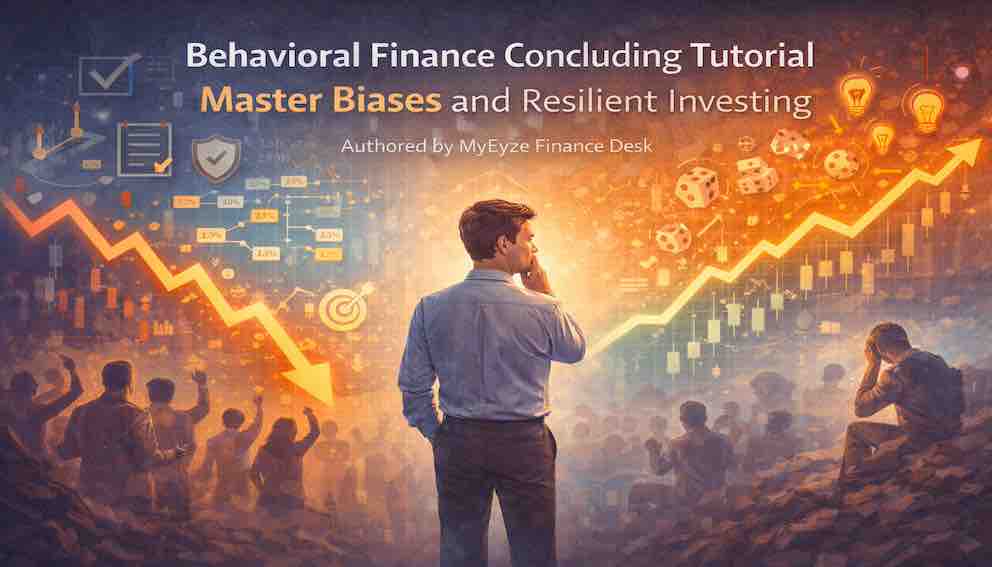
Understanding the Journey
Over the course of this series, we have navigated the intricate landscape of human cognition, emotion, and behavior in investing. We began with the fundamentals of how we think, contrasting fast, intuitive System 1 thinking with slow, deliberative System 2 reasoning. This lens allows us to see how biases—loss aversion, overconfidence, recency bias, confirmation bias, the disposition effect, and the sunk cost fallacy—shape decisions, often invisibly.
We then explored the emotional dynamics of investing. Fear, greed, regret, and mental accounting can overwhelm rational analysis, while the social dimension—herding, peer influence, reputational risk, and the comfort of shared errors—amplifies these impulses. Historical bubbles, from the Dutch Tulip Mania to the Dot-com bubble, illustrate that these behavioral tendencies are neither new nor confined to any single market. They are timeless and pervasive.
Markets as Complex Adaptive Systems
Markets are not just places where prices are set. They are complex systems shaped by how people think and act, the stories they believe, how much leverage and liquidity exist, and how media amplifies emotions. Volatility is not random noise—it reflects fear, confidence extremes, and stress building inside the system. Feedback loops and reflexive behavior can speed up both booms and crashes. When understood this way, volatility becomes less of a reason to panic and more of a signal that helps investors make calmer, better-informed decisions.
Practical Frameworks for Disciplined Investing
Understanding biases is necessary but insufficient. The series emphasized practical frameworks to navigate uncertainty and improve decision quality:
- Process over Prediction: Probabilistic thinking, scenario planning, pre-mortems, and decision trees allow investors to focus on decision quality instead of outcomes. Only about 25% of actively managed funds outperform the market over a decade, underscoring the value of systematic rules over gut-based decisions.
- Structured Inaction: Recognizing that sometimes doing nothing is the most powerful action. This counters the disposition effect, which causes investors to sell winners too early and hold losers too long. Implementing a quarterly rebalancing calendar is a simple, concrete step to enforce disciplined action against these biases.
- Contrarian Positioning: Maintaining emotional resilience when others panic. Frameworks like optionality, barbell strategies, and convexity awareness allow investors to capture upside while protecting against downside. Historical examples—1929, the Japanese bubble, and COVID-19—demonstrate the emotional cost of acting against the crowd without structure.
- Social Immunity: Reducing the impact of herd behavior requires thoughtful environment design, clear internal benchmarks, and awareness of social influence. Research suggests that as little as 5% of informed participants can influence the remaining 95%, underscoring both the strength and the danger of social proof in markets.
These tools provide a tangible way to act amidst uncertainty. They bridge “what” behavioral finance teaches with “how” it can improve investing outcomes, transforming awareness into practice.
Behavioral Finance in Context
Behavioral finance is a lens, not a replacement. It complements fundamental analysis, macroeconomic understanding, valuation, and risk management. Its strength lies in preventing emotional mistakes, improving decision processes, and cultivating a patient, reflective mindset. Pioneers such as Daniel Kahneman, the “grandfather of behavioral finance,” and Hersh Shefrin & Meir Statman, who formalized the disposition effect, provide the academic grounding that informs these frameworks.
Using behavioral finance well is uncommon because it requires ongoing discipline, regular reflection, close study of market history, and learning from experienced investors. The payoff is significant—the ability to stay deliberate when others react emotionally, think clearly under pressure, and protect capital while most investors make preventable mistakes.
Integrating Frameworks for Long-Term Success
Behavioral finance is most powerful when it is combined with other ways of thinking, such as probabilistic thinking, systems thinking, risk management, and thoughtful portfolio design. Together, these approaches help investors stay resilient during periods of volatility, create opportunities for upside while limiting downside, and maintain discipline when emotions run high. They also support the building of portfolios that can adapt and even benefit from uncertainty, rather than break under stress.
Used this way, behavioral finance is not a standalone rulebook. Instead, it acts as a strategic filter that guides decisions, keeps actions aligned with long-term goals, and encourages reflection, scenario planning, and clear pre-commitment before acting.
A Final Word: Build Your Personal System
You have learned the enemy: your own biases, emotions, and susceptibility to social influence. Your most important investment is now the system you build to protect yourself. This includes:
- Processes: Pre-mortems, rebalancing schedules, goal-based reviews
- Awareness: Recognizing emotional triggers, herd pressures, and cognitive blind spots
- Unemotional Systems: Rules and frameworks that enforce discipline
- Environment: Social and informational structures that reinforce thoughtful decision-making
To make this easier to remember, consider the mnemonic PAUSE:
Process | Awareness | Unemotional Systems | Structured Action | Environment
Behavioral finance is not about predicting markets—it is about outsmarting yourself. It is about cultivating patience, discipline, and resilience. It is about making your decisions antifragile, ensuring that you endure and thrive when uncertainty strikes.
The journey does not end here. Observe history, reflect on experience, practice structured inaction, and refine your processes continuously. By doing so, you develop a rare and powerful skill: the ability to navigate markets calmly, consistently, and strategically, while most others are swept away by fear, greed, and collective emotion.
Behavioral finance makes investing not easier, but smarter, more deliberate, and resilient. Master it, and you transform uncertainty from a source of anxiety into a source of opportunity.
About Swati Sharma
Lead Editor at MyEyze, Economist & Finance Research WriterSwati Sharma is an economist with a Bachelor’s degree in Economics (Honours), CIPD Level 5 certification, and an MBA, and over 18 years of experience across management consulting, investment, and technology organizations. She specializes in research-driven financial education, focusing on economics, markets, and investor behavior, with a passion for making complex financial concepts clear, accurate, and accessible to a broad audience.
Disclaimer
This article is for educational purposes only and should not be interpreted as financial advice. Readers should consult a qualified financial professional before making investment decisions. Assistance from AI-powered generative tools was taken to format and improve language flow. While we strive for accuracy, this content may contain errors or omissions and should be independently verified.