Tutorial Categories
Last Updated: January 26, 2026 at 10:30
The Human Story of Money and Markets - World Financial History Series Introduction
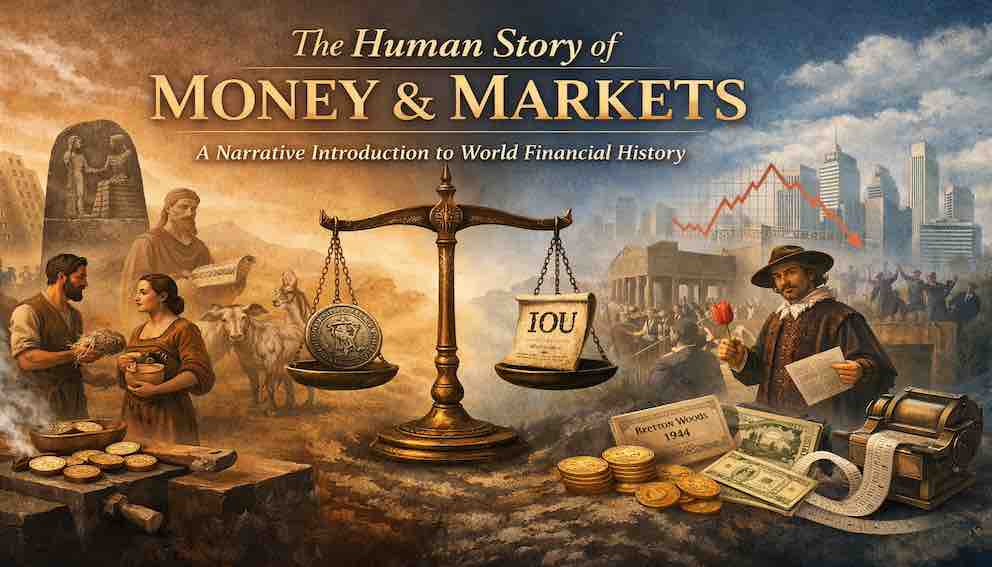
Money and markets didn’t emerge from greed or genius — they emerged from people trying to coordinate under uncertainty. This series traces how trust, credit, law, and belief gave rise to money, markets, and financial power long before modern finance existed. By revisiting ancient codes, early banks, bubbles, crashes, and regime shifts, it shows why financial history feels so familiar even when the tools look new.These patterns reappear because confidence grows easily, trust does not — and long stretches of calm make systems weaker without anyone noticing. This series isn’t about predicting the next crisis, but about recognizing the human dynamics that make them inevitable.
Why Every Financial Age Ends the Same Way
In 1716, France was bankrupt.
A Scottish economist named John Law proposed a radical cure: instead of relying on limited stocks of gold and silver, France would run on paper promises. His new state‑backed bank would print banknotes, lend them into the economy, and let people use those notes as money—turning government debt into spendable cash. At first, it worked spectacularly. Credit was suddenly plentiful, trade revived, and investors poured into his Mississippi Company, whose shares soared more than twentyfold. Paris felt rich again: cafés buzzing, land prices rising, fortunes being made on paper.
But the new system depended on confidence holding up while money creation kept accelerating. Law kept issuing more notes and more shares than the underlying assets and tax revenues could support.
Then, almost overnight, it collapsed. By 1720, daily prices were surging, people rushed to convert paper back into metal, and the bank could not meet the demand. Fortunes evaporated. Riots broke out. John Law fled the country disguised as a woman. The first modern experiment in paper money ended not with a gentle correction, but with panic—because money had been created faster than trust could absorb it—and it left France deeply suspicious of financial innovation for a generation.
We tend to file episodes like this under curious failures of the past. They are not. They are blueprints. Across four thousand years of history, the same pattern returns again and again: innovation, early success, overreach, loss of trust, collapse. Only the instruments change. Human behavior does not.
This series is about that pattern—the recurring rhythm by which money systems rise, markets believe, confidence stretches too far, and trust is rebuilt under new names.
The Quiet Buildup of Fragility
Long periods of stability feel reassuring. That is exactly the danger.
When a financial system runs smoothly for years, people stop testing it.
Trust is no longer questioned. It is simply assumed.
That trust becomes abstract. It spreads across massive institutions—central banks, global markets, complex regulations—instead of resting on relationships you can see and challenge.
Confidence grows faster than the system can deliver.
Risks pile up silently.
Fragility hides inside everyday normalcy.
We’ve seen this before.
Before 1929, easy credit and soaring stock prices convinced everyone that markets were now safer, more rational, even scientific.
Before 2008, sophisticated risk models and years without major crises created certainty that danger was measured, understood, and safely spread around.
In both cases, confidence outran reality.
The system could no longer honor all its promises.
By the time doubt appeared, trust had already stretched beyond breaking.
This wasn’t a failure of intelligence. Nor a lack of effort.
It’s a tension built into every financial system: the gap between what people believe, and what the system can actually sustain.
What This Series Is — and Is Not
This is an introductory series on world financial history.
It is not a list of dates. It is not a textbook in economic theory.
It is a story about how money, credit, markets, and crises took shape—and why they keep breaking in ways we recognize. Finance here is treated less as mathematics and more as people trying to coordinate with each other under uncertainty.
Money is not just a technology.
Markets are not machines.
They are social agreements, built on belief, memory, and trust. And those agreements are far more fragile than they look in calm times.
Each tutorial that follows will anchor these ideas in specific moments where financial systems were stress-tested by real human behavior.
A Structural Map of Financial History
Financial history isn’t chaos.
It has a rhythm.
Across civilizations and centuries, every financial system is trying to solve the same problem:
how to coordinate human activity across time.
Save today. Spend tomorrow.
Lend now. Repay later.
Promise something now that only arrives in the future.
The tools change. The pressure never does.
This series follows that structure.
It begins with barter, which fails not because people are poor or unsophisticated, but because timing rarely aligns. Trade requires two people to want exactly what the other has at the same moment. When needs arrive at different times, value exists but cannot move. Exchange breaks not from scarcity, but from misalignment.
Money emerges as the first true breakthrough. Instead of needing a perfect coincidence of wants, people accept a shared symbol(coins, silver) that represents future claims on goods and services. Trust no longer has to be personal or immediate—it becomes portable. A trader doesn’t need to know who issued the promise, only that others will recognize it later. Symbols now carry value forward through time, allowing strangers to coordinate without knowing each other.
Over time, inflation appears. Money is still accepted, but trust in it becomes uneven. Those who receive new money early can spend it before prices adjust. Those who receive it later face higher prices without higher income. The currency still functions, but its fairness begins to erode. Value doesn’t vanish overnight—it thins quietly. What once felt like shared rules starts to feel tilted.
As trust thins, systems do not collapse all at once. They fracture. Parallel monies, informal workarounds, and substitute stores of value emerge—not as rebellion, but as repair.
Debt predates most monetary systems because coordination across time is unavoidable. Production always comes before payment. Debt is the promise that bridges that gap—today’s risk funded by tomorrow’s return.
Interest changes what that promise means. By putting a price on time, waiting becomes profitable. What began as a temporary bridge turns into a lasting obligation that shifts power toward the lender.
Banking scales the system. It offers access now while using money that will only return later. Growth speeds up—but safety depends on confidence, not cash. When trust holds, banks work. When it breaks, even healthy institutions can fail.
Each solution solves a real problem.
Each introduces a new fragility.
History doesn’t move in circles.
It rhymes because history never escapes the same limits—time, trust, and who controls the promises.This series isn’t about prediction.
It’s about recognition.
A Necessary Correction at the Beginning
Most stories of money start with a comforting myth: first, people bartered; then, they invented money to make it easier.
This story is clean, intuitive, and almost certainly wrong.
Research shows that early communities didn't barter with neighbors. They used informal credit and social memory. You helped build my house, trusting I'd help with your harvest. Exchange was relational, not transactional.
Barter was for strangers. For anyone you couldn't trust.
As trade moved beyond the village, trust couldn't travel. Promises between strangers needed a physical form everyone would accept. Money became that token—not a tool of greed, but a technology of coordination for people who shared no history.
So money didn't evolve to fix barter. It evolved to replace trust.
This is the tension that defines financial history: the endless struggle to scale trust beyond the personal.
Regimes of Money: How Each Rose and Fell
Across history, societies built new monetary systems to replace the ones that had broken before them. Each regime solved a real problem. Each eventually created a new set of problems of its own.
The Age of Sacred Weight (c. 3000–600 BC)
In Mesopotamia, silver by weight served as money. Temples and palaces kept the ledgers, and trust lived in the scales, the records, and the seals. Over time, rulers manipulated measures and diluted the metal, triggering some of the first recorded inflationary spirals.
The Age of Imperial Coinage (c. 600 BC–400 AD)
From Lydia to Rome, value shifted from raw metal content to the authority of the state. Coins carried royal faces as guarantees, turning political power into monetary trust. As wars multiplied and treasuries strained, rulers began shaving down coins and mixing in cheaper metals. Over time, “silver” money was often mostly copper with only a thin surface of precious metal. People noticed. Prices rose, confidence in the currency eroded, and a system built on the ruler’s promise started to fail for the same reason as many others: too much promise, not enough backing.
The Dual Ledgers (Medieval to Renaissance)
Gold and silver anchored the treasuries of kings and city-states. Credit, reputation, and paper promises moved trade. Italian city-states and merchant networks let trust travel through letters, bills, and ledgers instead of heavy coins. These arrangements fractured when war, plague, and political turmoil caused promises to outrun the relationships and institutions that made them believable.
The Gold-Anchor World (1717–1971)
From Isaac Newton’s de facto gold standard for the pound to the Bretton Woods system after 1944, discipline was enforced by metal that governments could not easily create. For a time, this constraint underpinned confidence in currencies and trade. As economies expanded and governments assumed larger social and military obligations, they needed more money than a gold-backed system could safely support. The resulting strain ended with the closing of the gold window in 1971, repeating a pattern seen as early as France’s monetary collapse in 1720.
The Fiat Era (1971–Present)
Today’s money is not backed by metal. It is backed by belief—faith in institutions, governments, and in the simple idea that other people will accept it tomorrow. That makes it very flexible: the amount of money can be increased or reduced to respond to crises or support growth. But it also makes it fragile: when confidence weakens, there is no physical anchor underneath the system to slow or soften the fall.
In this environment, new contenders have appeared. Cryptocurrencies and other digital assets promise money that is scarce by code rather than by law, and payment networks that do not depend on any single state or central bank. Whether they become durable parts of the monetary regime or remain speculative side currents is still unclear. What is clear is the question they are reacting to: in a world of purely faith‑backed money, who can be trusted not to create too much of it, and who bears the cost when that trust is pushed too far?
The rhythm beneath these shifts never really changes:
Innovation → Stability → Overextension → Loss of Trust → Crisis → Reinvention.
This is not just an economic cycle.
It is a human one.
Where the Pattern Breaks Loudly
When trust is stretched too far, it does not fade quietly. It snaps.
Sometimes that break looks like mania.
Sometimes it looks like a bubble, held up by nothing more than shared belief.
Sometimes it becomes a crisis, when markets seize up and confidence vanishes faster than capital.
Sometimes it turns into a financial war, with currencies, debt, and payment systems used as weapons.
Tulip Mania, the South Sea Bubble, the Great Depression, the collapse of Bretton Woods, the Asian Financial Crisis, 2008—different eras, different instruments, the same underlying pattern. These episodes are not exceptions; they are the moments when financial systems show you where their limits really are.
How to Read the World Differently
By the end of this series, finance should look less like charts and jargon, and more like human psychology frozen into institutions and markets.
You will learn to spot:
- The Trust Thermocline – the invisible point where calm confidence flips into doubt, then into panic.
- The Abstraction Trap – when symbols (coins, notes, shares, tokens) are treated as reality itself, until they suddenly are not.
- The Sovereign’s Dilemma – the recurring temptation for money‑creators to solve today’s problems by issuing more money or credit, faster than people’s belief in the system can safely keep up.
You will see these ideas play out in ancient temples, medieval merchant houses, imperial treasuries, gold rooms, central banks, and today’s digital ledgers.
Why This Matters Now
Every regime ends at the moment it feels most permanent.
Long stretches of stability feel safe, and that is exactly when trust stops being questioned. It becomes an assumption, spread across huge, complex systems that no one person can really see or test. Confidence grows faster than the system’s true ability to meet its promises. Fragility sits behind smooth, ordinary functioning. This has happened before—before 1929, before 2008, before almost every reckoning that “no one saw coming.”
You are living through another slow shift: fiat money under strain, central banks testing digital currencies, crypto networks offering new forms of trust, and states using finance as a weapon. The tools are new. The underlying behavior is very old.
This series will not tell you exactly when the next crisis will hit. It will give you a way to see the pattern as it forms.
We begin where this pattern first comes into focus—when simple, direct exchange began to strain. As societies expanded, trading goods face-to-face was no longer enough to carry trust across distance and time. Coordination started to fail quietly. What later generations would call “barter” ran into its limits, revealing a deeper challenge that would shape financial history from then on: how to build and maintain trust beyond the personal.
When barter failed.
About Swati Sharma
Lead Editor at MyEyze, Economist & Finance Research WriterSwati Sharma is an economist with a Bachelor’s degree in Economics (Honours), CIPD Level 5 certification, and an MBA, and over 18 years of experience across management consulting, investment, and technology organizations. She specializes in research-driven financial education, focusing on economics, markets, and investor behavior, with a passion for making complex financial concepts clear, accurate, and accessible to a broad audience.
Disclaimer
This article is for educational purposes only and should not be interpreted as financial advice. Readers should consult a qualified financial professional before making investment decisions. Assistance from AI-powered generative tools was taken to format and improve language flow. While we strive for accuracy, this content may contain errors or omissions and should be independently verified.