Tutorial Categories
Last Updated: January 25, 2026 at 10:30
How Central Banks Emerged from Banking Failure - World Financial History Series
When private banks failed, they did not fail because money disappeared or because managers suddenly became reckless. They failed because the system depended on people trusting that everyone else would wait, even when uncertainty made waiting feel unsafe. Once depositors began to doubt whether others would remain calm, withdrawing early became a sensible response, and those individual decisions quickly overwhelmed institutions that were otherwise sound. Repeated crises taught societies that no private bank could promise liquidity to the entire system at once, especially during moments of collective stress. Over time, that role shifted to the state, not because it was better at banking, but because it could make promises that extended further into the future. The central bank emerged as the institution tasked with holding that promise together when private coordination broke down.
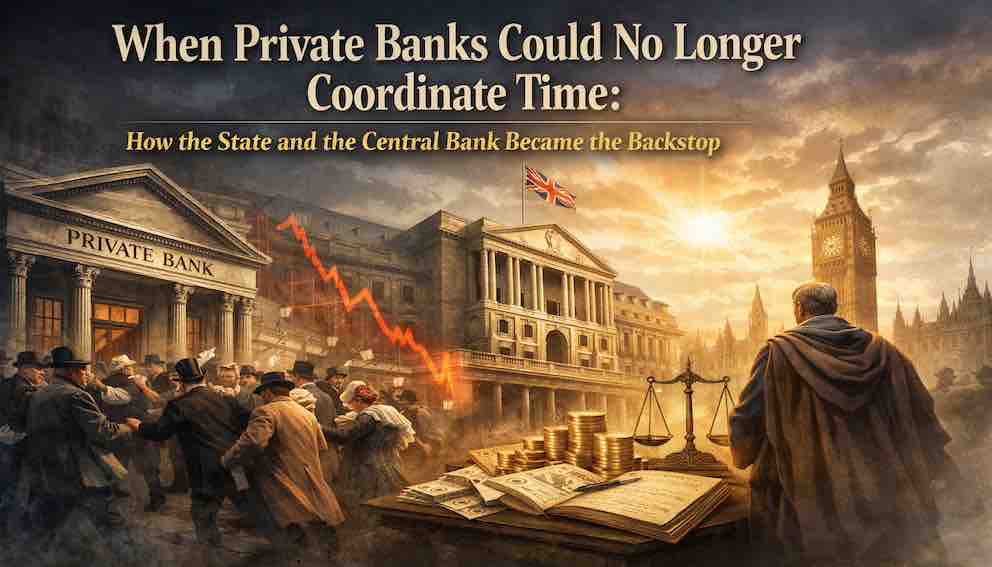
The Reluctant Guardian: How Banking Failure Redefined the Role of the State
Imagine an ancient town with a prized, deep-water well. It’s a place of vitality, used by brewers, bakers, and builders alike. For generations, the well is managed by a local family. They don't own the water, but they’ve built a system of ropes and pulleys, of careful schedules and simple rules. When a drought comes, they ration. When the pulley breaks, they fix it. It’s a private solution to a public need.
Then, a great drought arrives. The water level drops. A quiet anxiety spreads. One baker begins to come at night, drawing more than his share, just to be sure. His neighbor sees this and, fearing the well will run dry, does the same. The logic is contagious. Soon, there’s a line at the well day and night. The well is not empty, but its steady rhythm is shattered. The managing family is powerless to enforce the old schedule in the face of a collective, self-fulfilling fear. In a single week of desperation, a system that worked for a century collapses.
This is the story of the banking panic. The bank is the well. The manager is the banker. The water is trust, liquidity, and credit. It is a system designed for cooperation but vulnerable to the perfectly rational decision to be first in line.
For hundreds of years, financial society accepted this. Panics and crashes were seen as a kind of brutal, natural law. But after the firestorm of a crisis passed, people would look at the ruined economy—the shuttered shops, the lost farms, the broken futures—and ask a quiet, desperate question.
Who guards the well when the drought comes for us all?
This is the story of the answer to that question. It is the story of how the state, reluctantly and imperfectly, became the only force capable of ending the stampede. And it is the story of how that new responsibility did not bring perfect safety, but instead transformed the entire financial landscape, changing what risk looked like and where it hid.
Part I: The Stampede and the Powerless Manager
The last chapter showed us the beautiful, fragile machinery of banking. It’s a time machine, using today’s deposits to fund tomorrow’s growth. But its fatal flaw is psychological.
A bank run is not an accident. It’s a logical trap. If you truly believe your neighbor will withdraw their money tomorrow, the smartest thing you can do is withdraw yours today. Your neighbor, thinking the same about you, does the same. Individually, you are both acting with perfect rationality. Collectively, you create a disaster. The bank, which may be perfectly sound, holding loans for prosperous farms and factories, cannot turn those future promises into cash right now. It dies of a timing mismatch.
For generations, the manager of the well—the private banking system—was left to handle these stampedes. They tried. They formed clubs of banks (called clearing houses) to lend to each other. They pleaded for calm. But in a true, system-wide panic, every member of the club was simultaneously trying to save itself. The private manager was part of the panic, not its solver.
The aftermath was always the same. The strong survived, the weak perished, and the town—the real economy of workers, suppliers, and families—suffered through a credit famine. The crisis was the correction. It was seen as harsh, but natural. A forest fire that cleared deadwood.
But after too many fires, people began to look at the scorched earth and question the wisdom of nature. The social and political cost of this “creative destruction” became too high. The question was no longer if someone should intervene, but who on earth could possibly do it?
Part II: The Unique Power of the "Forever" Promise
The answer, which emerged fitfully across different nations, was always the same: the state.
Why? Not because politicians were wiser bankers or better economists. They weren't. It was because the state possesses a unique kind of power: the power of the "forever" promise.
A private bank can only promise what it has in its vault or can immediately borrow. Its promise is limited. The state’s promise is different. It is backed by three profound powers no private entity can claim:
- The Power to Tax: The state can promise to use future wealth—money not yet earned, crops not yet harvested—to back its word today.
- The Power of Law: The state defines what money is. It can declare that its paper, or its digital credit, is the final, mandatory answer to all debts.
- The Power of the Printing Press (in the last resort): The state controls the source of the final, most trusted form of money. In an absolute emergency, it can create more of this ultimate asset.
This changes the psychology of the stampede at the well. If people believe, deep down, that the state will not let the well run completely dry—that it has a deeper, secret spring it can tap—then the frantic logic breaks. The fear of "if I'm last, I get nothing" is softened by a new thought: "Maybe if I wait, the well will hold." That sliver of faith, that hesitation, is often all that's needed to slow the rush and let reason return.
Part III: The Accidental Guardians
The first institutions we now call central banks were not designed for this role. They were created for the mundane, often self-interested, needs of governments.
- The Bank of England (1694) was born from a war loan to a king.
- The Bank of France (1800) was Napoleon’s tool to bring order after revolutionary chaos.
- The U.S. Federal Reserve (1913) was created only after a dozen brutal panics, culminating in the 1907 crisis where a private banker, J.P. Morgan, had to personally act as a one-man central bank.
They were not appointed as guardians. They were drafted by disaster. Their evolution into the role of crisis manager was a series of reluctant, reactive steps, each taken in the smoking aftermath of a failure. The "guardian" role was never formally defined in a quiet room; it was carved out by each new emergency, reinterpreted with every crisis.
Part IV: The Lesson of London, 1866
The moment this new responsibility became clear happened not in theory, but in the panic-filled streets of London. In 1866, a colossal, trusted financial firm called Overend, Gurney & Company failed. The shock was immediate. Banks, terrified of being next, stopped lending to each other. The system of overnight credit that greased the wheels of global trade froze solid.
The Bank of England hesitated. Was this its fight? As it debated, the crisis deepened. Finally, it acted. It announced it would lend—not to everyone, but to any solvent institution that came to its door with good collateral (like bonds or commercial bills). It wouldn't give away money, but it would swap illiquid promises for the most liquid asset of all: the Bank's own notes.
The effect was psychological magic. The terrifying prospect of a total liquidity drought vanished. The mere belief that cash was available from a source that could not itself run dry began to calm the markets. A journalist named Walter Bagehot witnessed this and later distilled the lesson into the central banker's creed: "In a panic, lend freely, at a high rate, against good collateral."
This was the birth of the "lender of last resort" doctrine. It recognized the panic for what it was: a psychological coordination failure. The central bank's job was to be the one actor that never, ever joined the stampede. By standing still, it gave everyone else permission to stop running.
Part V: The Unseen Transformation
Creating a guardian solved the ancient problem of the stampede. But it did not create a safe system. It created a different system, with new and subtler dangers.
This is often blamed on "moral hazard"—the idea that banks, knowing they will be rescued, take wilder risks. But this is too simple, and it misses the deeper, structural shift.
The real change was this: the presence of a reliable backstop changed the very architecture of finance. It wasn't just that banks chose to be riskier. It was that the old constraints were relaxed.
- Banks could hold less cash. Why keep a huge buffer of idle money if the central bank was the ultimate buffer?
- Credit could expand further. The system could safely stretch its promises further into the future.
- The financial web became denser and more interconnected. Institutions could rely on each other more, because they all ultimately relied on the same guardian.
Risk did not disappear. It migrated. It moved from the surface—visible in frequent, small bank failures—into the core of the system. It became quieter, more complex, and more concentrated. The state and the banks became locked in a tight, sometimes suffocating embrace. Banks filled their vaults with government bonds as "safe" assets. Governments relied on banks to buy their debt. The health of one became inseparable from the health of the other.
The guardian, created to douse fires, now stood at the center of a vast, interconnected forest it had helped to grow. It could prevent small blazes, but it made the conditions ripe for a wildfire that could threaten everything.
Conclusion: The Permanent, Provisional Guardian
The rise of the central bank marks our collective decision to stop accepting the stampede as fate. We appointed a guardian for the well.
But this was not a finale. It was a turning point in an endless story. We traded the frequent, localized collapses of the past for the rare, but catastrophic, systemic crises of the modern era. We did not find perfect stability. We found managed stability—a condition that is always provisional, always being negotiated, and always creating new and unexpected vulnerabilities.
The central bank did not make finance safe. It made it safe enough to become unimaginably vast and complex. Its promise—to stand still when everyone else runs—is the invisible foundation of our financial world. It is a promise that has prevented countless panics, but one that has also allowed risk to grow in the shadows, woven into the very fabric of the system it guards.
Our story of money now enters its modern chapter. It is no longer a tale of coins and vaults, or even of private banks and panics. It becomes a story of management, of constant, delicate tending. Our next chapter asks: what happens when the guardian, born in crisis, is asked to water the garden every single day? When does crisis management become simply… management? And how does this forever change the meaning of the water—the money—itself?
About Swati Sharma
Lead Editor at MyEyze, Economist & Finance Research WriterSwati Sharma is an economist with a Bachelor’s degree in Economics (Honours), CIPD Level 5 certification, and an MBA, and over 18 years of experience across management consulting, investment, and technology organizations. She specializes in research-driven financial education, focusing on economics, markets, and investor behavior, with a passion for making complex financial concepts clear, accurate, and accessible to a broad audience.
Disclaimer
This article is for educational purposes only and should not be interpreted as financial advice. Readers should consult a qualified financial professional before making investment decisions. Assistance from AI-powered generative tools was taken to format and improve language flow. While we strive for accuracy, this content may contain errors or omissions and should be independently verified.