Tutorial Categories
Last Updated: January 25, 2026 at 10:30
How Central Banking Turned Crisis Management Into Everyday Policy - World Financial History Series
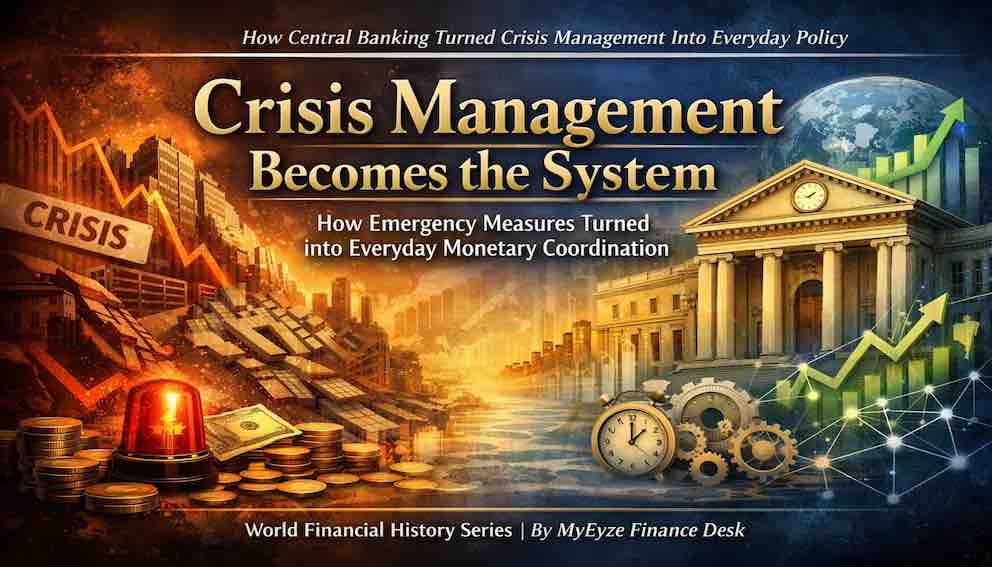
Emergency measures were once designed to stop financial collapse, not to guide everyday economic life. Over time, those tools were reused, normalized, and quietly built into the routine functioning of monetary systems. This chapter traces how specific historical decisions transformed crisis response into continuous management, reshaping expectations about what money is meant to do. In doing so, it shows how stability itself became something that had to be actively produced rather than passively trusted.
How Crisis-Fighting Became a Daily Job
Imagine a town that has always lived next to a wild, unpredictable river. For generations, the townspeople accepted the floods. They built their houses on stilts. They kept their most precious belongings in the attic. When the waters rose, they would retreat to higher ground, wait for the river to recede, and then return to rebuild. The flood was a destructive but natural part of life, a force to be weathered, not controlled.
Then, one terrible year, the flood was too great. The waters didn't just damage homes; they swept away the entire town's seed grain for the next planting season. The community faced not just a rebuilding, but starvation. In the aftermath, the survivors made a decision. They would not just accept the river anymore. They would try to manage it.
At first, they built a small levee, just high enough to stop the most catastrophic flood. It was an emergency measure, a one-time fix. It worked. But then they noticed something. With the levee in place, they felt safe enough to build their houses a little closer to the riverbank, on richer soil. The next time the water rose, they built the levee a little higher. Over the years, what began as an emergency barrier became a permanent part of the landscape. The town’s entire existence, its layout, its economy, now depended on the constant, careful maintenance of that wall. They had traded the acute terror of the flood for the chronic, quiet anxiety of maintaining the dam.
This is the story of modern central banking. It is the story of how the tools built to stop a financial collapse—the levees against panic—slowly, inevitably, became the architecture of everyday economic life. It's the story of how we went from responding to crises to managing an economy, and in doing so, changed the very meaning of money itself.
Part I: The Firefighter's Simple Job
In our last chapter, we met the central bank as the "lender of last resort." Its original role was that of a firefighter. Its job was specific, dramatic, and rare: to show up when a banking panic threatened to burn down the entire financial district.
Think of London in 1866. A major financial house, Overend & Gurney, collapsed. Fear spread like smoke. Banks, afraid of being the next to burn, stopped lending to each other. This was more than a simple loss of wealth; it was a pure coordination failure. The system's ability to move money across time and trust evaporated. The financial system stopped working because everyone, rationally, tried to move at once.
The Bank of England, after some hesitation, stepped in. It announced it would lend cash freely to any solvent bank that came to its door with good collateral (like bonds or property deeds). It wasn't giving money away; it was acting as a temporary pawn shop for the entire banking system.
The effect was psychological magic. The mere promise of a reliable, unlimited source of emergency cash changed expectations and calmed the panic. Banks stopped hoarding. Lending resumed. The fire was out. Crucially, once the smoke cleared, the Bank of England was expected to go back to its normal business. The fire truck was returned to the station. The emergency tools were meant for emergencies only.
For a while, this worked. Crises happened, the firefighter arrived, order was restored. But in the 20th century, the nature of the "fire" began to change. It was no longer just a sudden bank run. It was something slower, deeper, and more politically dangerous: mass unemployment, social collapse, and the erosion of faith in the system itself.
Part II: The Unbearable Choice: Rules vs. Ruin
The first great crack in the old system appeared after World War I. Nations were drowning in war debt. The old rule—the gold standard—demanded discipline. To restore it, countries would have to cut spending, raise interest rates, and accept deflation (falling prices). This meant forcing their battered economies through a wringer of unemployment and bankruptcy to make their currency convertible to gold again.
Britain tried. The Bank of England, under Chancellor of the Exchequer Winston Churchill, returned to the gold standard in 1925 at the pre-war rate. But the economy was too weak. The result was crushing deflation that hammered British industry, especially coal miners, leading to the devastating General Strike of 1926.
Here was the new, terrible dilemma: Do you obey the abstract monetary rule, or do you prevent the real human suffering and political chaos that rule causes?
This was the first philosophical break. The purpose of monetary policy was quietly being redefined. It was no longer just about maintaining the external value of currency (its link to gold). It was increasingly about managing internal conditions: employment, output, social peace. The state had stepped in to stop bank panics; now it was being pulled into the role of preventing economic panics, too.
Part III: The Great Lesson and the Legal Mandate
If the post-WWI period posed the dilemma, the Great Depression delivered the answer with brutal force. In the early 1930s, as American banks were failing by the thousands, the Federal Reserve made a catastrophic choice. To protect the United States' gold reserves, it actually raised interest rates, strangling the economy of the very credit it needed to survive.
It was the ultimate failure of the rule-bound, firefighter model. The firefighter, obeying the rulebook, had turned off the water to save the hose.
The political and social backlash was seismic. It led directly to the Banking Act of 1935. This law didn't just tweak the Federal Reserve; it reinvented it. Power was centralized. Most importantly, its mission was formally expanded. By law, it was now tasked with promoting "maximum employment, stable prices, and moderate long-term interest rates."
This was the moment the firefighter was given a second, permanent job: town planner. The emergency tools—managing interest rates, providing liquidity—were now to be used continuously to guide the entire economy. Crisis prevention was written into the daily job description.
This law also marked a quiet but profound shift in the meaning of money itself. Money was no longer primarily a claim on a fixed amount of gold, governed by rigid external rules. It was becoming a claim on the ongoing judgment and intervention of institutions. Trust in your dollars shifted from trusting a vault of metal to trusting the wisdom and actions of the Federal Reserve's governors. This new reality began to reshape everything: the length of business contracts, the pricing of assets decades into the future, and how everyone—from a homebuyer to a pension fund—perceived risk. Money was now a managed promise, not a constrained commodity.
Part IV: The Fork in the Road: Two Kinds of Gardeners
After World War II, different nations, scarred by different traumas, took this new responsibility in opposite directions.
In Germany, the dominant memory was the hyperinflation of 1923, when money became worthless wallpaper and society unraveled. Their lesson was: the greatest evil is a debauched currency. So, they created the Bundesbank, an institution with legendary independence and a single, fanatical focus: price stability. For the Bundesbank, "management" didn't mean frequent intervention. It meant being a ruthless guardian of a rule. It would raise interest rates painfully high, even if it caused a recession, to kill any hint of inflation. The German people learned to trust this restraint.
In the United States, the dominant memory was the deflation and unemployment of the 1930s. Their lesson was: the greatest evil is a collapsed economy. So, the Fed operated under its dual mandate. "Management" here meant constant adjustment—tweaking interest rates up and down like a thermostat to balance growth against inflation. It was flexible, pragmatic, and deeply involved in the daily weather of the economy.
These were two different visions of the gardener. One saw their job as relentlessly pruning back the dangerous weed of inflation. The other saw their job as carefully nurturing the fragile plant of growth. Both were managing, but they defined the garden's health in fundamentally different ways.
Part V: When the Safety Net Becomes the Floor
As this management became normal, something subtle happened in the minds of everyone in the financial system. The emergency backstop stopped feeling like an emergency measure. It started to feel like part of the landscape—the new ground floor.
Banks began to operate with thinner safety buffers, knowing the central bank was the ultimate cushion. Investors started treating market downturns not as natural events to be feared, but as temporary "dips" to be bought, confident the central bank would step in. The entire system began to build itself on the assumption of continuous support.
This dependency wasn't just national. As global finance grew, so did the reach of these managers. The U.S. Federal Reserve, as guardian of the world's primary currency, found itself not just tending its own garden but providing vital irrigation—through global dollar loans called "swap lines"—to foreign financial systems during storms. The credibility of a few central banks became a global public good, tying gardens across the world together.
This invisible, global dependency was revealed in 2013, in an event called the "Taper Tantrum." The U.S. economy was recovering. The Fed's Chairman, Ben Bernanke, merely suggested the Fed might soon "taper"—or slowly reduce—its extraordinary post-2008 stimulus programs.
The reaction was not rational adjustment; it was a coordinated global freak-out. Markets from Brazil to Indonesia plunged. Interest rates rocketed. It was a panic caused not by a crisis, but by the mere hint that the era of limitless support might end.
The message was clear: in a managed system, the expectation of management is as fundamental as the management itself. The economy had grown so accustomed to the gardener's constant watering that the prospect of a return to normal rain caused a drought scare. This constant smoothing had a side effect: it suppressed the early warning signals. Small stresses that would have forced a business or bank to adjust were now cushioned by policy. This made the system feel calmer on the surface but allowed larger, more complex imbalances to grow quietly in the background, making the true state of the garden harder to diagnose.
Conclusion: The Permanent, Anxious Gardener
We have come to the heart of our modern monetary world. The central bank is no longer just a firefighter or a rule-enforcer. It is a permanent gardener, tasked with tending a vast, complex, and delicate ecosystem.
This shift solved the old problem of catastrophic collapses. But it created a new, more subtle reality. Stability is no longer something we assume will naturally occur. It is something that must be actively produced, every single day, through a thousand small decisions about interest rates, bond purchases, and public statements.
The river has not been tamed. It has been channeled into a carefully maintained canal. And the town's entire existence now depends on the quiet, constant, anxious work of the gardeners who maintain the walls, always watching the sky, always adjusting the sluice gates, forever trading the fear of the flood for the burden of perpetual care.
Our story now turns to a final, crucial question. In this carefully tended garden, how can we tell if the soil is getting tired? If the plants are becoming weak? Because the gardener's constant smoothing muffles the early alarms, the next crisis may not come as a crashing wave, but as a slow seepage. Our next chapter asks: what are the quiet signs—the shortening of contracts, the frantic search for real assets, the silent hoarding of cash—that the gardener's work is getting harder, and the system's need for care is beginning to outstrip even our most diligent efforts?
About Swati Sharma
Lead Editor at MyEyze, Economist & Finance Research WriterSwati Sharma is an economist with a Bachelor’s degree in Economics (Honours), CIPD Level 5 certification, and an MBA, and over 18 years of experience across management consulting, investment, and technology organizations. She specializes in research-driven financial education, focusing on economics, markets, and investor behavior, with a passion for making complex financial concepts clear, accurate, and accessible to a broad audience.
Disclaimer
This article is for educational purposes only and should not be interpreted as financial advice. Readers should consult a qualified financial professional before making investment decisions. Assistance from AI-powered generative tools was taken to format and improve language flow. While we strive for accuracy, this content may contain errors or omissions and should be independently verified.