Tutorial Categories
Last Updated: January 25, 2026 at 10:30
How Monetary Stress Appears Before Crises in Managed Monetary Systems - World Financial History Series
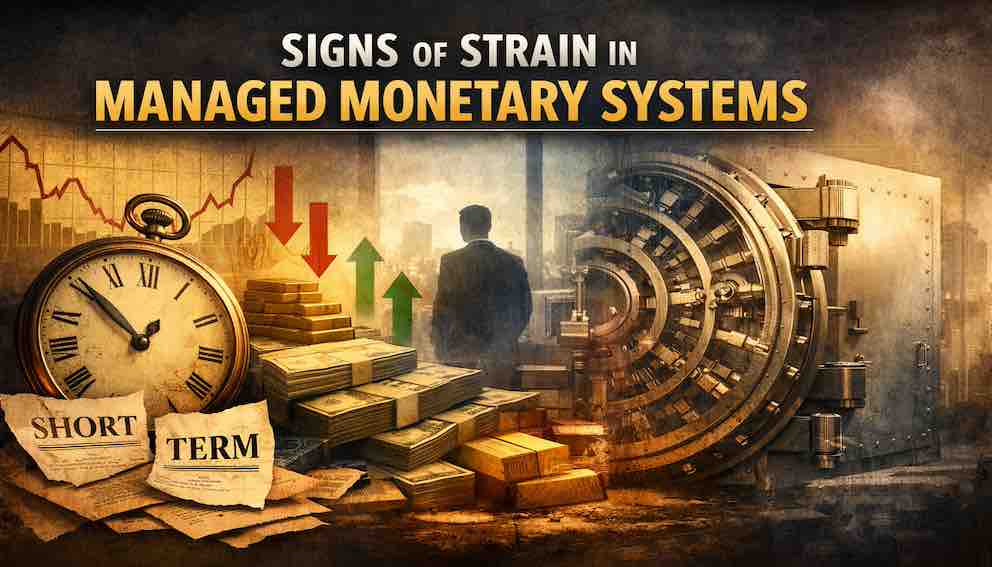
In managed monetary systems, stress rarely announces itself through collapse; it appears first through quiet changes in behavior. Long-term commitments shorten, not because catastrophe is expected, but because future rules feel less reliable. Liquidity is favored even when conditions look calm, reflecting a desire for flexibility rather than fear. Institutions adjust internally before acknowledging strain, preserving confidence while subtly reducing exposure. History shows that by the time instability becomes visible, coordination has already been renegotiated for years.
How to See Stress Before the Break
In 1893, financial stress was deafening. It was the sound of hundreds of depositors shouting outside a bank, demanding their money back before it vanished. A generation later, in 1929, it was the roar of a stock market collapsing floor by floor on a ticker tape.
We built our modern financial system with one main goal: to silence that noise. We installed powerful regulators and central bank backstops. For decades, it seemed to work. The loud, public panics faded.
But here is the great historical lesson we learned too late: silence is not safety. We only changed the way stress sounds. In a system we manage to prevent collapse, stress doesn’t shout. It whispers.
It shows up in quiet changes, not dramatic failures. People stop making long-term plans, not because they expect disaster, but because the future feels less certain. They choose cash and flexibility over big investments, even when things look calm on the surface. Big companies and banks make quiet, defensive moves long before any trouble hits the news.
History shows us that by the time a crisis is obvious, these quiet changes have been happening for years. The real strain is in the behavior, not the headlines.
From Loud Crashes to Quiet Doubts
To understand these quiet signals, think about what they replaced. For most of history, financial stress was loud and obvious: the bank run.
Picture America in the late 1800s. The economy was growing fast, but the banking system was weak. Major financial panics happened again and again.
They often followed a simple pattern. Something would spook people—maybe a big company failed. News would spread. A single, powerful thought would take hold in every depositor's mind: "If I don't get to the bank first, my neighbor will, and my money will be gone."
This was a coordination failure. Each person, acting sensibly to protect themselves, would create the very disaster they feared. They would all rush to pull their money out at once. The banks, which had lent most of that money out for long-term projects like railroads, couldn't pay everyone back immediately. They would fail. The Panic of 1893 saw over 500 banks close, factories shut down, and unemployment soar. The crisis was the warning siren. It was impossible to miss.
Our modern financial system was built to stop this exact problem. We created the Federal Reserve to act as a backstop. We guaranteed deposits. The goal was to make those loud, public collapses a thing of the past.
And it worked. But it created a new challenge. By stopping the loud crashes, we had to learn to listen for much quieter signals of trouble.
Three Quiet Signs of Trouble
Today, a classic bank run is rare. But our basic instincts—uncertainty and self-preservation—haven't changed. When people start to lose trust in the system's stability, they don't run for the doors. They make smaller, quieter adjustments. History shows us three of these adjustments always appear before a modern crisis.
1. Shortening Time Horizons
A healthy economy runs on long-term promises: a 30-year mortgage, a 10-year business loan, a 5-year employment contract. These promises show faith in the future.
When that faith weakens, time itself shrinks. People and businesses pull back from long-term commitments. We saw this clearly in the 1970s. The old system of fixed currency values collapsed, and oil prices exploded. Inflation and interest rates became wild and unpredictable.
The response wasn't panic. It was a quiet retreat. Unions demanded wages that automatically rose with inflation. Businesses refused to sign long-term supply contracts. Banks stopped offering fixed-rate loans. Everyone decided to live in a shorter, more manageable timeline.
The result: The economy becomes fragile. When no one will plan for the long term, small problems cause big shocks, and real growth becomes much harder.
2. The Flight to "Real" Things
The second sign is a quiet shift in what people consider valuable. When trust in money itself—a government's paper promise—starts to fade, people look for value in tangible things.
The most famous example is Weimar Germany in the 1920s, where people needed wheelbarrows of cash to buy bread. But the behavior starts much earlier. It begins as a sensible shift: moving savings from cash into real estate, gold, foreign currency, or durable goods. It's the thought, "I don't trust this paper to hold its value, so I'll own something solid."
The result: This silently warps the economy. Money floods into assets like houses, driving up prices in a bubble. Meanwhile, money drains away from productive investments in new businesses and factories.
3. Hiding Risk in Complexity
The third sign is the rise of overwhelming complexity. When simple trust breaks down, we try to build safety through complicated rules and products.
The best example is the 2008 financial crisis. The core risk—banks giving mortgages to people who couldn't afford them—was simple. But that risk was then sliced, diced, and repackaged into incredibly complex products with names like "collateralized debt obligations." These weren't just for profit; they were a way for everyone in the system to pretend the risk had disappeared.
The result: A catastrophic fog. When the housing market finally turned, no one knew who was actually holding the bad debt. The entire system froze because the simple trust needed for it to function had been replaced by impenetrable complexity.
The Big Players Move First
You won't see these changes on the news right away. The first to react are the insiders—the big banks and corporations.
Long before a crisis is public, they start playing defense quietly. A bank might start hoarding cash and become pickier about who it lends to. A large company might suddenly cancel plans to borrow money for a new factory. They do this in silence to avoid causing panic, but their actions are the earliest tremor of coming stress.
Why Quiet Strain is So Dangerous
These three behaviors are a new kind of problem. In the 1800s, a bank run was a synchronous failure—everyone failed at the same time, in a public drama. Today's strain is an asynchronous failure—a slow, quiet retreat where everyone privately plays it safe.
This is dangerous because it lets huge risks build up unseen. The system looks stable on the surface, so no one fixes the growing problems underneath. It's like a building where every beam quietly weakens by 1% each year. It looks fine until the day it doesn't.
Studies show that even small, unnoticed banking stress can cause a long economic hangover, crushing investment and jobs. We traded the sudden heart attack for a slow-developing chronic illness.
A Pattern As Old as Money
This isn't just a modern flaw. It's a human pattern that repeats under every financial system.
- Under the Gold Standard, the rule was "money equals gold." When people lost faith, they hoarded gold, causing credit to dry up.
- Under Fixed Exchange Rates, the rule was "our currency is pegged to another." When people lost faith, they moved money illegally across borders.
- Today, with Managed Money, the rule is "trust the central bank." When people lose faith, they shorten timelines, buy hard assets, and create complex financial products.
The rule changes, but the human behavior is the same: a retreat into private, defensive actions when shared trust breaks down.
How to Listen for the Whispers
The lesson from history is clear: Don't wait for the crash. Watch for the quiet changes.
Watch for businesses taking on less long-term debt. Watch for money pouring into housing or crypto not for growth, but for safety. Watch for finance becoming so complex that even experts can't explain it.
Our new guardians, like the Federal Reserve, now run "stress tests"—trying to simulate crises before they happen. It's an attempt to listen for these whispers.
The bottom line is this: We didn't make finance safe. We made it quiet. We must learn its new, subtle language of strain, spoken not in crashes, but in the cautious, defensive choices everyone makes when they start to doubt the future.
About Swati Sharma
Lead Editor at MyEyze, Economist & Finance Research WriterSwati Sharma is an economist with a Bachelor’s degree in Economics (Honours), CIPD Level 5 certification, and an MBA, and over 18 years of experience across management consulting, investment, and technology organizations. She specializes in research-driven financial education, focusing on economics, markets, and investor behavior, with a passion for making complex financial concepts clear, accurate, and accessible to a broad audience.
Disclaimer
This article is for educational purposes only and should not be interpreted as financial advice. Readers should consult a qualified financial professional before making investment decisions. Assistance from AI-powered generative tools was taken to format and improve language flow. While we strive for accuracy, this content may contain errors or omissions and should be independently verified.