
Tutorial Categories
Last Updated: January 27, 2026 at 10:30
How Liquid Markets Changed the Way Governments Borrow - World Financial History Series
When government debt became liquid, states were no longer judged only at moments of crisis or default. They were judged every day, through prices set by investors who could exit at any time. This shifted power quietly but decisively: fear alone could raise borrowing costs, while confidence could stabilize regimes. To make this possible, governments built institutions that turned vague promises into visible, enforceable systems of repayment. Money, in this world, stopped being a record of past obligation and became a continuous judgment about future behavior.
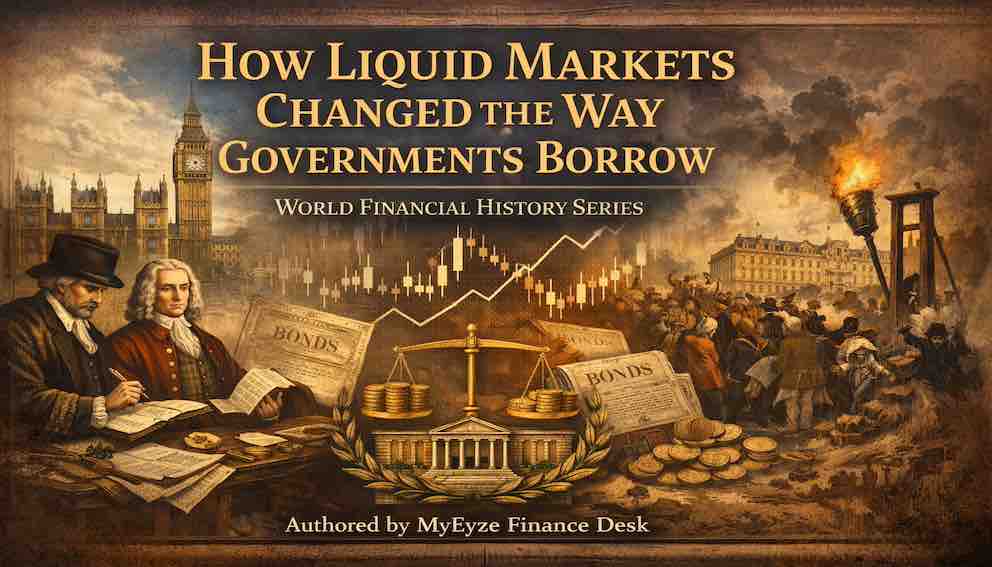
By the late seventeenth century, something quiet but profound was happening in parts of Europe. States were discovering that they could borrow more cheaply, more reliably, and in larger amounts than ever before. At first glance, this looks like a story about clever finance or improved administration. But that explanation misses what really changed.
What changed was behavior.
Once government debt became liquid—once it could be bought and sold easily—states were no longer judged only by their power or their intentions. They were judged continuously by markets. This transformed not just public finance, but the meaning of money itself.
To understand how this happened, we need to slow down and examine how credibility was constructed, how it differed across countries, and how liquidity created a new kind of political constraint.
From Promises to Systems: Making Credibility Visible
For most of history, lending to a ruler was a deeply personal gamble. A king borrowed money. A king repaid—or did not. If circumstances changed, or priorities shifted, lenders had little recourse. Defaults were common, and often brutal. The risk was not abstract. It was personal.
So when we say that some states developed “institutions that made betrayal costly,” we should be precise. This credibility was not cultural. It was engineered.
The Dutch Republic: Turning Promises into Pipelines
In the Dutch Republic, investors did not simply trust that the state would behave well. They could see how they would be paid.
The Dutch created a system in which public debt was backed by specific, predictable taxes—most importantly, excise taxes on everyday goods like beer, salt, and peat. These taxes were organized under a system known as the verponding. Crucially, this revenue was earmarked for debt service.
This mattered for behavior.
Investors were no longer relying on vague assurances or royal goodwill. They could observe a fiscal pipeline: taxes came in regularly, and payments went out regularly. If revenues declined, everyone could see it. If the state tried to divert funds, the breach would be obvious.
Debt, in other words, stopped being a moral promise and became a calculable cash flow.
The consequence was lower interest rates, broader participation, and deeper markets. But the deeper consequence was more subtle: the state began to behave differently because it knew it was being watched.
England: When Debt Became Constitutional
England followed a similar path, but through a different route.
Before 1688, English kings borrowed as individuals. After the Glorious Revolution, something fundamental changed. Debt was no longer the king’s personal obligation. It became the obligation of Parliament.
This shift created what contemporaries called the “Monied Interest”—a growing class of investors whose wealth depended on the government’s financial credibility. These were merchants, bankers, landowners, and institutions holding government bonds.
This changed incentives on both sides.
For investors, lending to the state now meant lending to a political system, not a person. For the state, default was no longer just a financial decision—it was a political betrayal of a powerful constituency whose interests were now aligned with the regime’s survival.
This is why the creation of a funded national debt was not just a financial innovation. It was a constitutional one.
Debt became embedded in governance. To dishonor it would be to destabilize the very coalition that held the system together.
The Dark Mirror: Why France Could Not Do the Same
To understand why this mattered, it helps to look at a country that failed to adapt.
Eighteenth-century France had a larger population and a richer economy than England. Yet it suffered from chronically high borrowing costs and repeated financial crises.
Why?
French state finances were opaque. Revenues were fragmented. Tax collection was often farmed out to private contractors. Obligations could be rewritten by royal decree. Wealth extraction relied heavily on coercion—forced labor, arbitrary levies, and the sale of offices.
From the perspective of investors, this system was unreadable and unstable.
There was no visible fiscal pipeline. No predictable link between revenue and repayment. No political structure tying creditors’ interests to regime survival.
This was not simply inefficiency. It was a failure to adapt to the new logic of liquidity.
As markets elsewhere began to reward transparency, standardization, and credibility, France remained trapped in a system where trust depended on fear and privilege. The result was not just higher interest rates, but eventual collapse.
Exit Becomes Power: The Birth of the Bond Vigilante
Once government debt became liquid, a new kind of actor appeared—even if no one named it at the time.
When bonds can be sold easily, fear alone can trigger exit. Investors do not need to rebel. They do not need to petition. They do not need to coordinate explicitly.
They can simply sell.
This is the birth of what we now call the bond vigilante.
An investor with a ledger and a quill could now exert pressure once reserved for armies and blockades. A collective decision to sell government bonds could raise borrowing costs, drain liquidity, and destabilize state finances.
Governance changed as a result.
Rulers no longer managed only land, armies, and taxes. They had to manage expectations—of people who could leave at any moment.
The consequence was profound: political authority became entangled with market confidence.
A Change in Language, A Change in Meaning
This transformation even changed the words people used.
Earlier rulers spoke of sovereign debt—a personal obligation owed by a ruler. But as these instruments became liquid, tradeable, and standardized, the language shifted to sovereign bonds.
A bond is not a plea. It is a security.
England’s eighteenth-century Consols—perpetual bonds with no maturity date—made this explicit. These were not loans meant to be repaid. They were permanent, tradeable claims on future tax revenue.
Money here is no longer about settling the past. It becomes a continuous judgment about future behavior.
Prices rise or fall not because a debt is repaid, but because confidence shifts.
What Was Learned — And What Was Missed
States learned how to borrow cheaply. They learned how to bind themselves credibly. They learned that transparency and institutional commitment could substitute for brute force.
But something was missed.
Liquidity does not eliminate risk. It relocates it. It turns long-term commitment into short-term judgment. It replaces loyalty with exit.
Once debt becomes a daily referendum, governments become managers of confidence rather than stewards of obligation.
Money, in this world, becomes less a record of past coordination—and more a forecast of future behavior.
The new era of government as a "manager of confidence" created a powerful, permanent client: the state itself. This is what set the stage for what came next: central banks were chartered to act as anchored buyers of government debt, providing a reliable source of wartime and peacetime finance. To maintain this system, they were compelled to become lenders of last resort to prevent financial panics and guardians of price stability as a political necessity. This forged the fragile architecture of nineteenth-century finance—a system where public liquidity and private banking fused, making the central bank's tools of stabilization permanent, and their unintended consequences inevitable.T
he tools designed to stabilize this system will become permanent.
And their unintended consequences will follow.
About Swati Sharma
Lead Editor at MyEyze, Economist & Finance Research WriterSwati Sharma is an economist with a Bachelor’s degree in Economics (Honours), CIPD Level 5 certification, and an MBA, and over 18 years of experience across management consulting, investment, and technology organizations. She specializes in research-driven financial education, focusing on economics, markets, and investor behavior, with a passion for making complex financial concepts clear, accurate, and accessible to a broad audience.
Disclaimer
This article is for educational purposes only and should not be interpreted as financial advice. Readers should consult a qualified financial professional before making investment decisions. Assistance from AI-powered generative tools was taken to format and improve language flow. While we strive for accuracy, this content may contain errors or omissions and should be independently verified.