Tutorial Categories
Last Updated: January 27, 2026 at 10:30
When Stability Becomes a Promise - Price Stability, Politics, and the End of Monetary Neutrality - World Financial History Series
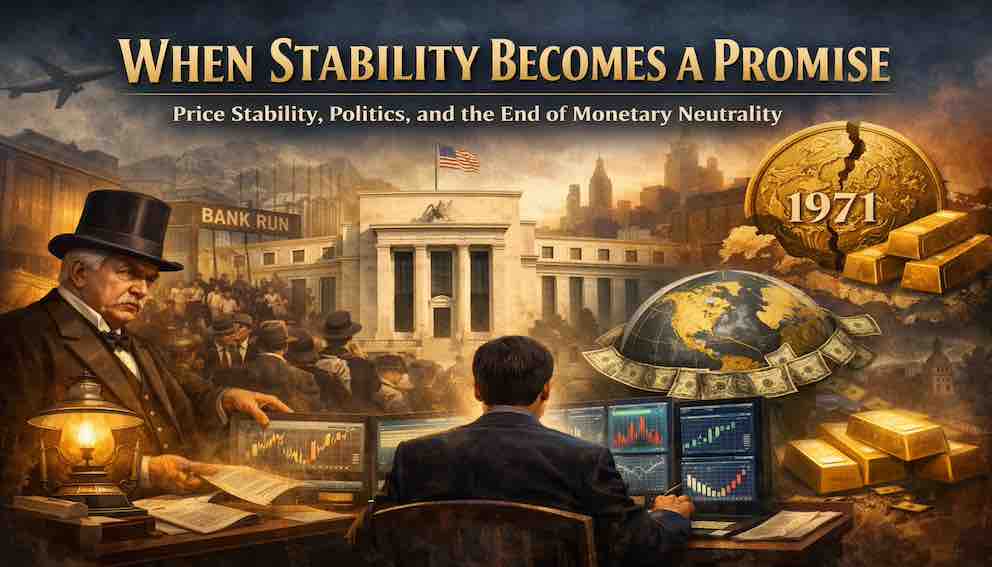
As financial systems became more liquid, crises stopped looking like slow failures and started looking like sudden panics driven by fear. Governments learned that once investors and depositors could exit instantly, confidence mattered more than underlying fundamentals. Over time, preventing visible collapse became a core responsibility of the state, and stability itself turned into a promise that had to be constantly defended. Price stability became central not because inflation was always worse than recession, but because inflation triggered immediate exit and loss of credibility. Money therefore stopped being neutral and became a tool for managing expectations about the future.
Introduction: When Financial Collapse Stops Being Acceptable
For most of history, financial crises were not hidden or managed quietly. They happened out in the open. Banks failed in public. Governments admitted they could not repay their debts. Currencies lost value suddenly and visibly. Ordinary people could see that something had broken.
These events were frightening and often destructive, but they had one important feature: they forced decisions. Losses were recognized. Contracts were rewritten. Power was contested openly. A crisis marked a clear break between what had worked before and what would have to change next.
Over time, however, many governments came to see open financial collapse as something that should never happen. A crisis was no longer treated as a painful but necessary reset. It was treated as proof that authorities had failed in their basic duty to govern.
This change matters enormously. Once collapse itself becomes unacceptable, the goal of the financial system shifts. Instead of allowing crises to resolve problems openly, governments and central banks begin organizing the system around preventing visible breakdown.
This tutorial explains how that shift happened, why price stability became central to it, and how money stopped being neutral and became a political promise.
The New Environment: Liquidity Changes How Risk Feels
By the 1800s, financial systems in many parts of the world had become much more liquid. This meant that financial claims could be bought and sold quickly and easily.
Government debt could be traded instead of being held until maturity. Bank deposits could be withdrawn on demand. Investors could move money across borders with fewer obstacles.
This sounds like progress — and in many ways it was — but it also changed how risk worked.
In older systems, participation meant commitment. Merchants entered joint ventures knowing they would share losses if things went wrong. Credit relationships were personal and difficult to escape. When trouble appeared, people were stuck together and had to negotiate.
Liquidity removed that constraint. Instead of enduring losses, people could leave.
A bondholder could sell.
A depositor could withdraw.
An investor could exit a country entirely.
This changed the main danger in the system. The biggest risk was no longer slow failure due to bad investments. The biggest risk became everyone leaving at once.
When exit is easy, fear spreads faster. A system can fail simply because people believe others are about to leave.
The Core Problem: Fear Moves Faster Than Governments
Governments move slowly. Laws take time. Budgets are debated. Taxes are collected over years. These processes evolved in a world where economic change was gradual.
Financial markets do not wait.
In liquid systems, prices react instantly to expectations. If investors think inflation might rise, bond prices fall immediately. If traders suspect political instability, capital can leave before any policy changes occur.
This creates a serious problem for governments and banks.
For governments, credibility becomes something that is judged continuously. Interest rates on government debt change day by day. A loss of confidence can raise borrowing costs immediately, forcing painful decisions.
For banks, the danger is even sharper. Banks hold long-term assets but owe short-term liabilities. This works only if depositors believe others will not run. Once that belief cracks, even healthy banks can fail.
From the point of view of policymakers, open crisis became terrifying not only because of economic damage, but because it showed the state losing control in public. In democratic societies, where legitimacy increasingly depended on economic stability, this was politically dangerous.
The key issue was simple: panic could now outrun authority.
Early Solutions: Rules as Reassurance
The first response to this problem was to try to limit panic by limiting uncertainty.
Governments attempted to reassure markets by committing to clear, rigid rules that reduced the range of possible outcomes.
The gold standard is the most important example. By promising to convert currency into a fixed amount of gold, governments tried to convince creditors that money would not be devalued for political convenience.
At the time, this made sense. International trade was growing. Capital was mobile. Governments needed a way to signal reliability across borders. Gold provided a simple, widely understood anchor.
But these rules had costs. Maintaining gold convertibility often required high interest rates and deep recessions. Unemployment rose. Political pressure increased.
Eventually, governments broke the rules when survival demanded it.
Markets noticed.
They learned that rules were not absolute. They were conditional.
The Canonical Crisis: Panic of 1907 and the Birth of the Backstop
This tension came to a head in the Panic of 1907 in the United States.
When panic spread through the banking system, there was no central bank to provide emergency liquidity. Instead, the system was saved by J.P. Morgan, who organized private bankers to supply funds and stop the collapse.
The intervention worked — but it was chaotic, improvised, and politically alarming. It revealed that the stability of the entire system depended on a private individual acting under extreme pressure.
The lesson was clear to policymakers: panic must be managed publicly and permanently.
This crisis directly led to the creation of the U.S. Federal Reserve in 1913. The Fed was not created to prevent booms or eliminate risk. It was created to institutionalize crisis management — to make the lender-of-last-resort function a standing feature of the system.
What had been an emergency response became architecture.
Stability was no longer accidental. It was promised.
From Rules to Discretion: Crisis Management Becomes Routine
As financial systems grew larger and more complex, rigid rules proved insufficient. Wars, depressions, and global shocks overwhelmed them.
Governments and central banks increasingly relied on discretion. They lent during crises. They supported markets. They guaranteed institutions.
Each time, they claimed the measures were temporary.
But repetition changed behavior.
Banks took more risk, expecting support.
Investors paid close attention to policy signals.
Governments became hypersensitive to market reactions.
Crisis management stopped being exceptional. It became normal.
Politics Moves Inside Institutions
As this shift occurred, political decisions were reframed in technical language.
Policymakers spoke of “anchoring inflation expectations,” “managing aggregate demand,” and “ensuring orderly market functioning.”
This language made deeply political choices appear neutral and inevitable.
But the choices were still there. They were simply relocated.
What Policymakers Learned — and What They Missed
They learned that visible collapse is destabilizing.
They learned that liquidity accelerates fear.
They learned that credibility must be maintained continuously.
But they did not learn how to manage long-term imbalance without crisis.
They did not learn how suppressed volatility accumulates.
They did not learn how backstops encourage risk-taking.
They did not learn how promises narrow future choices.
Conclusion: Stability as a Fragile Promise
Once stability becomes a promise, it must be defended constantly.
Money becomes less about settling past obligations and more about coordinating future belief.
This promise allows modern systems to function — but it also creates fragility.
Markets take greater risks.
Central banks expand their role.
Credibility becomes the most valuable asset in the system — and the most vulnerable.
That tension defines the modern financial world, and it sets the stage for the next chapter in this history.
About Swati Sharma
Lead Editor at MyEyze, Economist & Finance Research WriterSwati Sharma is an economist with a Bachelor’s degree in Economics (Honours), CIPD Level 5 certification, and an MBA, and over 18 years of experience across management consulting, investment, and technology organizations. She specializes in research-driven financial education, focusing on economics, markets, and investor behavior, with a passion for making complex financial concepts clear, accurate, and accessible to a broad audience.
Disclaimer
This article is for educational purposes only and should not be interpreted as financial advice. Readers should consult a qualified financial professional before making investment decisions. Assistance from AI-powered generative tools was taken to format and improve language flow. While we strive for accuracy, this content may contain errors or omissions and should be independently verified.