
Tutorial Categories
Last Updated: January 27, 2026 at 10:30
Speculation: The Necessary Villain - World Financial History Series
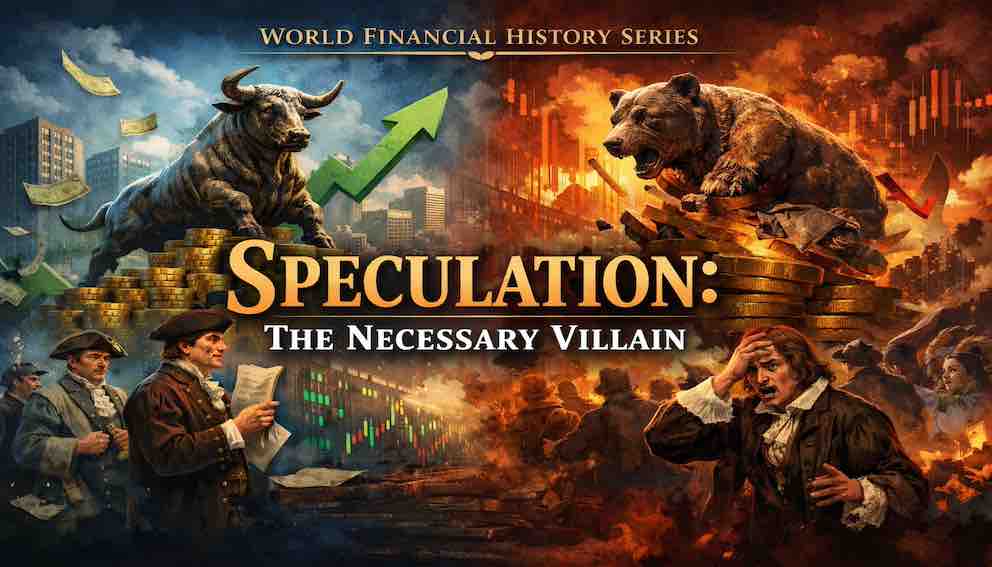
Speculation did not enter financial markets as a moral failure or a distortion. It emerged because liquid markets need people who are willing to trade constantly, hold risk temporarily, and act before long-term certainty exists. In calm times, speculators make markets work by providing liquidity and smoothing prices when others hesitate. In stressful times, the same behavior can amplify fear and momentum, making prices move faster than underlying reality. Societies benefit from speculation for long stretches, then condemn it when its limits become impossible to ignore.
By the time a financial system becomes liquid, speculation is no longer a choice.
It appears even when no one plans for it.
It appears even when governments try to ban it.
It appears even when society insists it is immoral or dangerous.
This is not because markets are broken or corrupted. It is because liquid markets cannot function without people who are willing to trade constantly, hold risk temporarily, and act before long-term certainty exists.
Speculation is not a flaw that sneaks into markets.
It is a role that markets themselves create.
This chapter explains why speculation emerged, why it initially looked helpful, why it later looked dangerous, and why societies repeatedly turn against it—without ever removing the conditions that make it necessary.
Liquidity Solves One Problem and Creates Another
Before liquid markets existed, ownership was slow.
If you owned a business, land, or a trading venture, you expected to hold it for a long time. Selling was difficult. Finding a buyer took time. Prices were negotiated privately and infrequently. Most people did not think in terms of “what could I get today if I sold?”
Liquidity changed all of this.
Once assets could be sold quickly, at visible prices, to strangers, ownership stopped meaning commitment. It started meaning choice. Every owner gained the ability to leave at almost any moment.
That sounds empowering—and it was. But it also created a new problem.
If everyone can decide to sell whenever they want, who is always willing to buy?
If prices are updated constantly, who makes sure trades actually happen?
If long-term investors want to wait, who keeps the market moving in the meantime?
A liquid market only works if there are always people willing to trade, even when others hesitate.
That gap is where speculation enters.
Why Early Markets Needed Speculators Just to Function
The early trading of shares in the Dutch East India Company (VOC) shows this clearly.
VOC shares represented claims on future profits from long, risky overseas voyages. Those profits were uncertain. Ships could be lost. Wars could disrupt trade. Information arrived slowly and unevenly.
Many early investors wanted exposure to trade, not daily price swings. They were willing to wait years for results.
But once shares could be resold, prices began to move frequently. News—real or rumored—changed expectations. Some people wanted out early. Others wanted in only at a lower price.
If the market had relied only on patient investors adjusting their positions occasionally, trading would have stopped for long stretches. Prices would have jumped sharply whenever someone finally agreed to trade. Liquidity would have been unreliable.
Speculators solved this practical problem.
They were willing to buy when others wanted to sell, even if they did not plan to hold for years. They were willing to sell when others wanted to buy, even if they did not oppose ownership in principle.
They made money not by believing deeply in the company, but by managing timing and uncertainty.
In normal conditions, this behavior made prices smoother, trading easier, and exits possible without panic.
At first, speculation looked stabilizing because it was stabilizing.
Speculation Is About Taking Risk Others Do Not Want
It is important to understand what speculators were actually doing.
They were not avoiding risk. They were concentrating it.
Long-term investors faced uncertainty about future profits. Merchants faced uncertainty about cargoes and routes. What speculators took on was price risk—the risk that prices might move before underlying realities became clear.
By holding assets temporarily, speculators absorbed short-term fluctuations that others preferred not to face. They made it possible for different people to hold different kinds of risk.
This role required capital, attention, and a willingness to lose money. Many speculators failed. Bankruptcies were common. This was not easy money.
As markets grew, new tools appeared to support this function: futures, options, and short selling. These instruments allowed people to manage risk without committing to long-term ownership.
Again, this was not recklessness. It was adaptation to a world where prices, time, and uncertainty no longer lined up neatly.
The Social Identity of the “Villain”
Speculators were not just a financial role. They were a social group—and often a disliked one.
In 17th- and 18th-century Amsterdam and London, speculators were known as jobbers or brokers. They operated in coffeehouses rather than counting houses. They traded paper claims rather than physical goods.
To the established merchant class, their profits looked strange. They did not come from ships arriving or goods being sold. They came from price movements—something abstract and hard to see.
This made them appear unproductive, even parasitic.
Across history, speculative roles were often filled by socially marginal or outsider groups. In different times and places, this included Jews in medieval Europe, Scots in 18th-century London, or Greeks in the Ottoman Empire—groups often barred from land ownership or traditional guilds.
These groups were allowed, or pushed, into financial risk-taking. Society benefited from their activity during good times. During crashes, the same groups became convenient targets for blame.
The pattern repeats: speculation is tolerated when it is useful and politically expendable when it fails.
Two Kinds of Speculation, Two Different Effects
Not all speculation works the same way.
One important distinction helps clarify why speculation sometimes stabilizes markets and sometimes destabilizes them.
Market-makers (or jobbers) focus on providing liquidity. They constantly quote prices at which they are willing to buy and sell. Their goal is not to predict big moves, but to earn small profits from many trades. They make it possible for others to trade immediately.
This kind of speculation tends to stabilize markets in normal times.
Position-takers, on the other hand, make directional bets. They buy because they think prices will rise or sell because they think prices will fall. They help markets incorporate information and expectations.
This kind of speculation can stabilize markets when it absorbs panic—but it can also amplify trends when fear or excitement spreads.
As markets grew, position-taking became more prominent, increasing both price discovery and volatility.
When Stabilization Turns Into Amplification
The same mechanisms that smooth markets in calm periods behave very differently under stress.
Speculators watch prices to infer information. Other traders watch speculators’ actions. Over time, prices themselves become signals.
When uncertainty rises, this feedback loop accelerates. Selling causes prices to fall, which causes more selling. Buying attracts buying. Liquidity thins just when it is most needed.
This is not a change in character. It is the same behavior operating in a different environment.
The South Sea Bubble: The Flip in Real Time
The South Sea Bubble of 1720 shows this shift clearly.
The South Sea Company was created to help Britain manage its war debt. Speculative trading in its shares initially helped refinance government obligations—a stabilizing and even public-spirited function.
Speculators provided liquidity for a complex financial innovation: debt converted into equity. This allowed the system to function.
But as excitement grew, speculation shifted from supporting a financial solution to feeding a collective fantasy. New subscription schemes allowed people to buy shares with borrowed money. Prices rose because people expected them to keep rising.
The stock price became less about trade prospects and more about finding someone else willing to pay more.
When confidence broke, the same mechanisms that had supported liquidity accelerated collapse.
The response was moral and legal panic. The Bubble Act attempted to suppress speculation by restricting joint-stock companies. Instead of fixing the structure, it froze useful financial development for decades.
Moral Panic Targets People, Not Structures
Each time this cycle appears, society reacts in familiar ways.
Speculators are accused of gambling, manipulation, or moral failure. Laws target visible behavior. Pamphlets denounce specific groups.
But the underlying need remains.
Liquidity still requires constant trading. Prices still require participants willing to act under uncertainty. Risk still has to go somewhere.
Suppressing speculation does not remove volatility. It moves it elsewhere—often into darker, more fragile corners of the system.
The Necessary Villain
Speculation becomes a villain not because it is unnecessary, but because it exposes uncomfortable truths.
It shows that stability is not natural.
It shows that prices are judgments, not facts.
It shows that risk never disappears—it only moves.
Societies rely on speculation for long periods. When its limits become visible, outrage follows. Regulation tightens. And then, gradually, the same structures recreate the same roles.
Speculation stabilizes—until it doesn’t.
Understanding this does not mean celebrating excess. It means recognizing that liquid, exit-based systems will always produce people who trade uncertainty itself.
Managing that reality is not a moral challenge. It is a political and institutional one.
About Swati Sharma
Lead Editor at MyEyze, Economist & Finance Research WriterSwati Sharma is an economist with a Bachelor’s degree in Economics (Honours), CIPD Level 5 certification, and an MBA, and over 18 years of experience across management consulting, investment, and technology organizations. She specializes in research-driven financial education, focusing on economics, markets, and investor behavior, with a passion for making complex financial concepts clear, accurate, and accessible to a broad audience.
Disclaimer
This article is for educational purposes only and should not be interpreted as financial advice. Readers should consult a qualified financial professional before making investment decisions. Assistance from AI-powered generative tools was taken to format and improve language flow. While we strive for accuracy, this content may contain errors or omissions and should be independently verified.