
Tutorial Categories
Last Updated: January 16, 2026 at 09:30
Why Prices Move More Than Fundamentals - Behavioral Finance Series
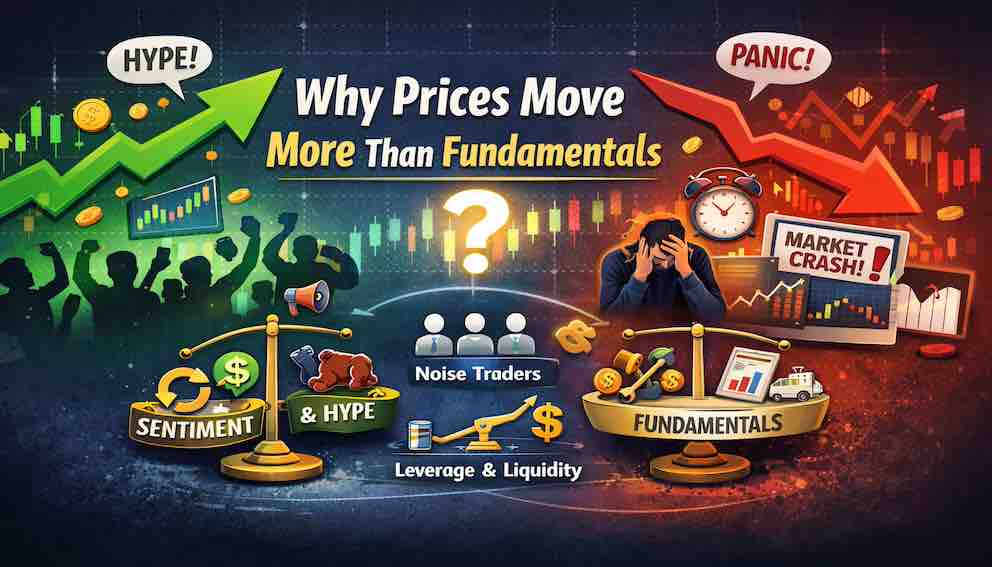
Markets rarely move in perfect lockstep with fundamentals. Stocks surge or plunge on news, sentiment, or even social media hype—often far beyond what earnings or economic data justify. Behavioral finance explains why: investors overreact or underreact, feedback loops between sentiment and prices amplify moves, and structural factors like liquidity, leverage, and momentum intensify swings. Models like the Adaptive Markets Hypothesis and Noise Trader Theory show that markets are evolving ecosystems where human behavior constantly shapes prices. Short-term drivers—sentiment, liquidity, narratives—can dominate, while long-term fundamentals eventually anchor value. Learn how to recognize mispricing, manage volatility, and act deliberately rather than reactively.
A Market That Doesn’t Make Sense
Imagine this: a well-known tech company reports record profits. Analysts say the company is fundamentally strong, its products are selling well, and growth prospects are solid. Yet, the stock plunges the next day. A week later, it rallies sharply with no news.
If you’ve felt confused, frustrated, or even irrationally fearful in such moments, you’ve experienced a key lesson of behavioral finance: markets are not perfectly rational, and prices often move far more than fundamentals would suggest.
How can prices swing wildly, sometimes opposite to logic or earnings reports? Why do bubbles inflate and crash? Understanding these dynamics is essential—not to predict every move, but to navigate markets like a disciplined investor.
Core Theory: Why Prices Deviate from Fundamentals
Traditional finance assumes markets perfectly reflect all information. Prices should equal intrinsic value. Reality is messier. Behavioral finance shows that psychology, social dynamics, and structural market features often drive short-term mispricing.
There are three main mechanisms that explain this:
1. Overreaction and Underreaction
- Investors often overreact to news or recent price changes. A minor earnings miss can trigger a sell-off far bigger than justified.
- Conversely, markets sometimes underreact to slow-developing trends, like gradual technological adoption or demographic shifts. Prices adjust only gradually, creating opportunities for patient investors.
Example: In the late 1990s, early internet companies’ stocks soared far beyond realistic revenue potential—classic overreaction. Meanwhile, companies quietly building strong user bases, like early Amazon, were underappreciated for years.
2. Feedback Loops Between Sentiment and Fundamentals
- Prices influence sentiment, and sentiment influences prices—a self-reinforcing cycle. Optimism attracts buyers, pushing prices up; rising prices create more optimism, attracting yet more buyers. Panic selling works the same way.
Example: The 2008 financial crisis: falling housing prices led to mortgage losses, triggering panic, fire sales, and plummeting prices beyond fundamental reasons.
3. Structural and Social Amplifiers
Several non-psychological forces can magnify price moves:
- Liquidity: A shortage of buyers or sellers can cause prices to gap far beyond any news, independent of psychology.
- Leverage: Borrowed money magnifies gains and losses, accelerating swings.
- Momentum: Trend-following traders can push prices further from intrinsic value.
- Social dynamics: Herd behavior, social proof, and media narratives can inflate bubbles or deepen panics.
Example: Meme stocks like GameStop in 2021 surged far beyond fundamental value, driven by social media, collective enthusiasm, and short-squeeze mechanics.
Refining the Theoretical Core
Two academic models help explain these patterns:
- Adaptive Markets Hypothesis (AMH) – Andrew Lo’s theory treats markets as evolving ecosystems. Prices aren’t always efficient; strategies (trend-following, value investing) rise and fall, and participants adapt based on fear, greed, and experience. Calm periods can erupt into volatility when new participants or conditions emerge.
- Noise Trader Theory – Proposed by Fischer Black and expanded by Andrei Shleifer, it distinguishes between "smart money" (informed traders) and "noise traders" (trading on sentiment, rumors, or irrelevant info). Noise traders can push prices away from fundamental value, creating risk that even smart money cannot fully correct in the short term.
Financial Consequences of Mispricing
When prices deviate from fundamentals:
- For individuals: Emotional reactions—fear, greed, FOMO, regret—lead to buying high, selling low, or abandoning disciplined strategies.
- For markets: Overvaluation can create bubbles, underpricing sudden opportunities or crashes, and overall volatility rises.
- For institutions: Professionals must navigate human-driven swings, using risk management and hedges to survive mispricing events.
Short-Term vs Long-Term Drivers Table
| Price Driver | Typical Time Horizon | Key Influence on Price | Long-Term Anchor |
| Investor Sentiment & Narratives | Short to Medium Term | Can cause massive over/undervaluation (bubbles, panics) | Weak – sentiment is fickle |
| Liquidity & Market Microstructure | Very Short Term | Causes sharp spikes or gaps (flash crashes, squeezes) | Negligible – temporary mechanics |
| Economic & Earnings Fundamentals | Long Term | Determines intrinsic value and cash-generating ability | Strong – drives long-term prices |
Additional point: When prices swing wildly because of emotion and noise, investors expect extra compensation for bearing that uncertainty. This “risk premium for noise” helps explain why stocks—despite being more volatile—have historically delivered higher returns than safer assets like bonds or cash.
Expert vs Novice Behavior
Novice approach: Reacts emotionally. Buys because “everyone is buying,” sells because “it dropped, it must be bad,” chasing recent performance.
Expert approach: Treats mispricing as natural. Experts:
- Look for deviations from intrinsic value using valuation models
- Manage exposure to leverage and liquidity risk
- Avoid herd-driven trades unless systematically advantageous
- Use reflective prompts: Am I buying because fundamentals are strong—or because I fear missing out?
Historical Example: During 2008, value investors with cash and valuation discipline bought distressed assets at discounts, while retail investors panicked and sold.
Expert Practical Toolkit
- Sentiment Gauges: Track CBOE VIX, put/call ratios, AAII or Investors Intelligence surveys to quantify fear and greed extremes.
- Decomposing Price Moves: Ask: Is this move due to interest rate changes, growth expectations, or multiple expansions driven by sentiment?
- Liquidity Analysis: Monitor volume, bid-ask spreads, and market depth to see if moves are fundamental or temporary.
- Volatility Harvesting: Systematically buy more when prices drop and sell when they rise—turning overreactions into an advantage.
Benjamin Graham’s rule: “In the short run, the market is a voting machine; in the long run, it is a weighing machine.”
Practical Mitigation Strategies
- Automate and pre-commit: Dollar-cost averaging, rebalancing schedules, or pre-set buy/sell thresholds.
- Cooling-off periods: Wait 24–48 hours after large swings to reassess decisions.
- Mental models: Probabilistic thinking: prices deviate, but fundamentals often prevail.
- Scenario analysis: Consider best-case, worst-case, and base-case outcomes. Avoid anchoring to recent prices.
- Reflective prompts: Am I overreacting? Is this sentiment-driven? Would I act the same if no one else were watching?
Nuance and Adaptive Use of Mispricing
Mispricing is not inherently bad; it creates opportunities:
- Contrarian investing: Buy undervalued assets ignored by the crowd
- Momentum strategies: Ride trend-driven price moves with controlled risk
- Hedging: Protect portfolios from extreme sentiment swings
Important: Mispricing carries limits. Leverage and speculation can magnify losses; emotional discipline is essential. Systems and rules make volatility manageable.
Clear Takeaway
Markets often move far more than fundamentals justify, driven by human behavior, social dynamics, and structural amplifiers. Mispricing is a feature of how collective psychology interacts with market structures—not a flaw.
Reflective Prompt:
Next time a stock jumps or plunges unexpectedly, ask: How much of this move is fundamentals, and how much is psychology? What rules or systems can I follow to act deliberately rather than reactively?
By understanding why prices move more than fundamentals, investors shift from emotionally reactive participants to disciplined, process-driven navigators, learning from volatility rather than being swept away by it.
About Swati Sharma
Lead Editor at MyEyze, Economist & Finance Research WriterSwati Sharma is an economist with a Bachelor’s degree in Economics (Honours), CIPD Level 5 certification, and an MBA, and over 18 years of experience across management consulting, investment, and technology organizations. She specializes in research-driven financial education, focusing on economics, markets, and investor behavior, with a passion for making complex financial concepts clear, accurate, and accessible to a broad audience.
Disclaimer
This article is for educational purposes only and should not be interpreted as financial advice. Readers should consult a qualified financial professional before making investment decisions. Assistance from AI-powered generative tools was taken to format and improve language flow. While we strive for accuracy, this content may contain errors or omissions and should be independently verified.