
Tutorial Categories
Last Updated: January 16, 2026 at 12:30
Narratives: How Stories Drive Market Cycles - Behavioral Finance Series
Why do stories move markets more than numbers sometimes? Imagine a room full of investors hearing the same compelling story: “This technology will change everything. Buy now, or miss out forever.” Suddenly, prices soar, social media explodes, and even cautious investors feel the pull. In this tutorial, we explore how narratives—powerful stories, shared beliefs, and dominant themes—shape market cycles. We’ll dive into the psychology behind story-driven investing, the lifecycle of market narratives, and tools experts use to separate hype from real opportunity. By the end, you’ll learn how to recognize when a story is influencing your decisions—and how to navigate it with discipline, not emotion.
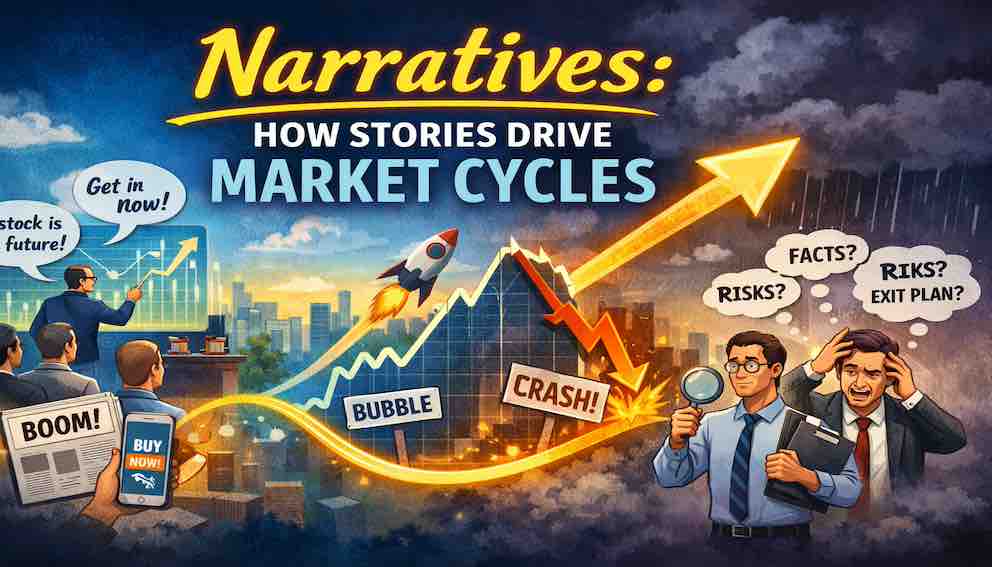
Imagine hearing a story that feels undeniable: “This technology will change everything. Miss it now, and you’ll regret it forever.” Suddenly, everyone around you seems to believe it, prices are rising, and fear of missing out sets in. You’re not just listening—you’re participating in a market movement shaped by a story.
In investing, stories are not just entertainment; they are powerful forces that influence individual decisions and entire market cycles. In this tutorial, we’ll explore how narratives shape markets, why they persist, and how investors—both beginners and experts—can recognize and navigate them.
The Power of Stories in Human Psychology
Humans are wired for stories. Stories simplify complex realities, trigger emotions, and make information memorable. This interacts with several cognitive biases:
- Confirmation Bias: We notice facts that support the story and ignore those that contradict it.
- Herd Behavior: Seeing others act on the story reinforces our own belief and actions.
- Recency & Availability Bias: Vivid examples in a story seem more important than long-term data.
- Emotional Engagement: Stories activate System 1 thinking—fast, intuitive, and emotional—making us more likely to act without careful analysis.
Example: In the late 1990s dot-com bubble, the story “the internet will change everything” dominated. Traditional valuation metrics were often ignored. Companies like Pets.com or Webvan skyrocketed—not because of strong fundamentals, but because the story promised unlimited growth. In 2024-2025, AI story has dominated.
Academic Foundations: Why Narratives Matter
To deepen our understanding, we can anchor narratives in key theories:
- Narrative Economics (Robert Shiller): Popular stories spread like viruses, influencing spending, investing, and collective market behavior. Major events, like the Great Depression or housing bubbles, are driven by contagious narratives.
- Minsky’s Financial Instability Hypothesis: Stability breeds complacency. When markets feel safe, people take more risks. Narratives—like “this time is different”—justify increasingly speculative behavior, often preceding bubbles.
- Reflexivity: A compelling story can change reality, not just describe it. If investors believe a company is “the future,” capital flows in, lowering its cost of capital and enabling growth, which in turn reinforces the story.
These frameworks show that narratives are not superficial—they are structural drivers of market dynamics.
The Lifecycle of a Market Narrative
Narratives evolve in recognizable stages:
| Phase | Description | Example |
| Birth | A new technology, trend, or idea captures imagination. | “AI will replace human labor.” |
| Early Adoption | Visionary investors adopt the narrative. | Select tech investors start buying AI stocks. |
| Mass Adoption / Exuberance | Media, social networks, and companies amplify the story. Fear of missing out spreads. | Reddit forums, FinTwit, CNBC, bullish analyst headlines. |
| Peak & Mania | The narrative becomes unquestioned. Fundamentals are often ignored. | 2021 SPAC craze; dot-com stocks at record multiples. |
| Disillusionment | Reality fails to match expectations, triggering panic and sell-offs. | Pets.com collapse; crypto corrections. |
| Aftermath & Skepticism | Investors reflect, narratives evolve or fade, and lessons are learned. | After the dot-com bubble burst in 2000, investors became extremely cautious about internet and tech stocks. Companies without clear profits or viable business models saw their valuations collapse, while survivors with real earnings and strong fundamentals eventually recovered and thrived. |
Amplifiers in Modern Markets:
- Financial Media & Analysts: Frame news, create buzzwords, and anoint “story stocks.”
- Social Media & Forums: Spread stories virally, forming communities of believers.
- Corporate Communication: Companies craft their own narratives through earnings calls, presentations, and press releases.
- Algorithmic & Quant Funds: Amplify trends indirectly through sentiment analysis and automated trading.
Expert vs. Novice Responses to Narratives
- Novice Investors: Often act emotionally, chasing stories, following the herd, and making impulsive trades. They may buy at peaks or sell at troughs.
- Expert Investors: Systematically evaluate narratives while separating story from facts. They apply rules, scenario planning, risk limits, and structured thinking before acting.
Example: During the 2023–2025 AI surge, novice investors chased headlines, while experts carefully assessed adoption, revenue projections, and competition, taking measured positions without succumbing to hype.
Narrative Analysis: Tools for Disciplined Investing
Experts don’t ignore narratives; they analyze them using practical frameworks:
Narrative Due Diligence: Ask:
- Who benefits from this story?
- What evidence supports it? Is it data-based or anecdotal?
- How testable or falsifiable are its claims?
The Narrative vs. Numbers Matrix:
| Narrative | Numbers | Assessment |
| Strong | Strong | Potential great investment (e.g., early Amazon) |
| Strong | Weak | High risk of speculative bubble (e.g., many SPACs) |
| Weak | Strong | Possible value opportunity if story changes (e.g., stable old-economy stock) |
| Weak | Weak | Avoid |
Tracking Narrative Exhaustion: Signs a narrative may be peaking:
- Story becomes unquestioned dogma
- Valuation metrics are ignored
- Contrary evidence is dismissed
Pre-Mortem for Narratives: Imagine the story collapses in a year. List three plausible reasons. This identifies vulnerabilities before investing.
Rule of Thumb: “Never confuse a great story with a great investment.” Stories entertain; investments require margin of safety and disciplined analysis.
Recognizing Narrative Influence in Your Own Decisions
Reflective prompts for beginners:
- Are you investing because of data, or because the story feels compelling?
- Are friends, social media, or news amplifying your enthusiasm?
- Could a differently framed story make you act differently?
- Are you ignoring warning signs or contradicting evidence?
Even simple self-checks can prevent impulsive trades driven by excitement or fear.
Practical Strategies to Navigate Narrative-Driven Markets
Rules-Based Thinking: Define pre-set investment conditions—valuation thresholds, risk limits, and portfolio allocation rules.
Scenario Planning: Ask “what if” questions: What if adoption is slower than expected? What if competition rises?
Cooling-Off Periods: Pause 24–48 hours before acting on a trending story.
Narrative Awareness Checklist: Evaluate:
- Is the story evidence-based?
- Who benefits from promoting it?
- How might it fail?
- What’s my exit plan?
Diversification & Risk Controls: Avoid concentrated bets on hype.
Reflective Journaling: Track when stories influenced trades; over time, patterns reveal vulnerabilities and strengths.
Riding the early trend: In the late 1990s, some tech companies with solid fundamentals saw their stock prices rise as the internet narrative gained attention. Investors who recognized promising businesses early—before widespread hype—benefited from strong gains. However, once excitement became extreme and speculative buying dominated, prices detached from fundamentals, and latecomers suffered heavy losses.
This communicates that early, informed participation in a narrative driven market can be profitable, while also highlighting the risk of emotional extremes later.
Key Insights and Takeaways
- Narratives shape markets because they shape behavior.
- Stories create feedback loops between perception and price, fueling bubbles and crashes.
- Emotion isn’t the enemy—unexamined emotional responses to stories are.
- Experts harness narratives as signals, not directives, balancing insight with discipline.
Actionable Takeaway: Before acting on a popular market story, pause and ask: Am I acting on conviction or the narrative’s allure? Combine awareness with structured rules, scenario planning, and risk management to capture opportunity without being swept away.
Reflective Prompt: Identify one current market narrative tempting you. Map facts, hype, risks, and a rules-based plan—or decide not to participate.
About Swati Sharma
Lead Editor at MyEyze, Economist & Finance Research WriterSwati Sharma is an economist with a Bachelor’s degree in Economics (Honours), CIPD Level 5 certification, and an MBA, and over 18 years of experience across management consulting, investment, and technology organizations. She specializes in research-driven financial education, focusing on economics, markets, and investor behavior, with a passion for making complex financial concepts clear, accurate, and accessible to a broad audience.
Disclaimer
This article is for educational purposes only and should not be interpreted as financial advice. Readers should consult a qualified financial professional before making investment decisions. Assistance from AI-powered generative tools was taken to format and improve language flow. While we strive for accuracy, this content may contain errors or omissions and should be independently verified.