
Tutorial Categories
Last Updated: January 12, 2026 at 19:45
Why Traditional Finance Fails: The Hidden Psychology Driving Markets – Behavioral Finance Series
Have you ever watched a stock defy every valuation model, or silver and Bitcoin surge 30–40% in a single month with no clear reason? Traditional finance treats us as flawless, rational decision-makers, but real markets consistently tell a different story. In this tutorial, we break down why classical models like P/E ratios, CAPM, and the Buffett Indicator often fail, how cognitive biases and crowd behavior drive markets, and why even legendary investors like Warren Buffett and Michael Burry sometimes sit on cash while others chase a rally and profit from it. From the collapse of LTCM hedge fund in 1990s to the 2008 financial crisis, you’ll see how human psychology shapes real-world investing — and how behavioral finance gives experts the tools to profit where traditional models fall short.
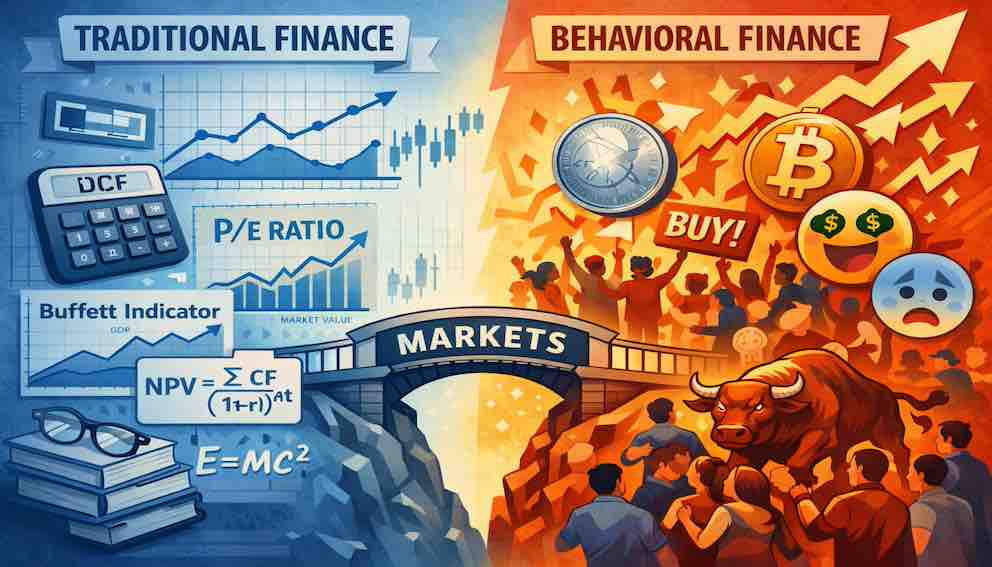
Why Rational Models Fall Short
And Why Behavioral Finance Became Essential
Have you ever carefully planned a budget, only to abandon it for an impulsive purchase? Or watched a stock move in the exact opposite direction of what every rational analysis predicted — or stayed on the sidelines while a market rally unfolded around you?
If the assumptions of traditional finance held true, these surprises wouldn’t exist. Investors would behave like disciplined machines, carefully calculating probabilities and focusing solely on long-term outcomes.
Yet financial markets — and even individual investment decisions — tell a very different story.
Imagine this: in the late 1920s, U.S. stocks entered a period of astonishing gains. From mid‑1928 to their peak in September 1929, major indices like the Dow Jones surged roughly 80%, while valuations soared far above historical norms with investors borrowing on margin to buy more and more. Despite limited changes in underlying economic fundamentals, prices kept climbing — not because of stronger profits, but because investors increasingly bought simply because others were buying. Traditional valuation tools like P/E ratios, discount rates, or cash flow models offered no real explanation for that surge. These weren’t random blips or normal volatility spikes; they were powered by crowd behavior, herding, and emotion‑driven trading. Investors weren’t just reacting to fundamentals — they were reacting to each other, creating momentum that no purely rational model could predict.
This tutorial tackles one of the foundational questions of behavioral finance: Why do traditional, rational models fail to predict or explain how people actually make financial decisions? By the end, you will not only see the limitations of these models but also understand why behavioral insights are essential for real-world investing.
Part 1: The Myth of the Perfect Investor
Before we criticize, let’s give credit where it’s due. The Rational Choice Model is the bedrock of traditional finance and economics. For decades, it provided a beautifully simple framework for understanding markets.
At its core, this model describes Homo economicus (Economic Man):
- Perfectly Self-Interested: Always maximizes personal wealth or utility
- Perfectly Informed: Has access to all relevant information and processes it flawlessly
- Perfectly Disciplined: Makes consistent choices, unaffected by emotions, moods, or framing
- Perfect Calculator: Weighs probabilities and outcomes objectively to select the optimal path
These assumptions underpin virtually all financial tools and models used in investment analysis:
- Price-to-Earnings ratios for stock valuation
- Discounted Cash Flow (DCF) models
- Buffett Indicator (market capitalization to GDP)
- Modern Portfolio Theory (MPT) and CAPM
- Efficient Market Hypothesis (EMH)
Such models are elegant and mathematically precise. They provide a framework to price assets, measure risk, and structure portfolios. Indeed, they work well enough to dominate textbooks and classrooms.
But, as physicist Richard Feynman once said:
“Imagine how much harder physics would be if electrons had feelings.”
Finance has the same challenge: markets are made of humans, not electrons.
Part 2: Where Rationality Cracks
The cracks in the rational model are not minor — they are deep. They appear repeatedly in both bull and bear markets, and often with enormous consequences.
1. Cognitive Limits: We Are Not Perfect Calculators
Rationality imagines investors with limitless brainpower. The real world is different: we operate under bounded rationality, making choices within the limits of our time, attention, and mental processing.
We use mental shortcuts, called heuristics, to make complicated decisions easier. While these shortcuts save time, they can also lead to predictable mistakes, such as:
- Fixating on past price levels (anchoring)
- Giving too much weight to recent events (availability bias)
- Assuming trends will keep going forever (representativeness bias)
Rational models can’t explain why a single striking news story can temporarily outweigh decades of historical data in our decisions.
2. Time-Inconsistent Behavior: We Are Not Perfectly Self-Controlled
Rational models assume our preferences are stable and consistent over time. Behavioral research shows we suffer from present bias:
- We plan to save for retirement but splurge today
- We intend to hold a sound investment strategy but panic-sell during a downturn
This tendency is known as the planning fallacy — we consistently underestimate how long decisions will take or how they will turn out. Even the most logical financial models can’t explain why someone might stick to a solid retirement plan while also giving in to immediate temptations.
3. Social and Emotional Forces: We’re Not Just About Money
Traditional models assume we always act to maximize wealth. In reality, humans are social and emotional, and these feelings often guide our decisions:
- Herding: We follow what others are doing, driven by fear of missing out (FOMO) or social proof.
- Fairness & Reciprocity: We may reject deals that feel unfair, even if they make financial sense.
- Regret Aversion: We sometimes hold losing investments too long or avoid making decisions to escape the pain of future regret.
These forces can overwhelm logic, causing markets to move in ways that traditional models cannot predict.
Part 3: Real-World Examples of Rational Model Failures
Bull Market Failure: Buying High
In strong bull markets, rational metrics often indicate caution:
- Sky-high P/E ratios
- Record Buffett Indicator readings
- Low equity risk premiums
Yet prices often keep rising, driven by narratives, social proof, and momentum.
Example: In the late 1990s, P/E ratios for the S&P 500 exceeded 30 — far above historical averages. Rational models suggested overvaluation, yet investors continued to buy aggressively, fueled by hype about the “new economy.”
Behavioral finance explains this as herding, overconfidence, and trend extrapolation. Experts understand that “buying high” can make sense temporarily when crowd behavior is driving prices higher — a lesson not captured in traditional models.
Bear Market Failure: Selling Low
Rational models suggest buying opportunities when prices fall below intrinsic value.
Example: During March 2020, stocks were priced as if many companies might fail permanently. Traditional metrics suggested long-term investors should rebalance into equities.
Instead, widespread panic selling occurred. Loss aversion and fear dominated, driving prices further down. Rational models failed to account for emotional reactions to extreme uncertainty.
Long-Term Capital Management Hedge Fund Story: A Cautionary Tale
In the 1990s, Long-Term Capital Management (LTCM) Hedge Fund employed Nobel laureates Myron Scholes and Robert Merton to construct highly sophisticated rational models. These models assumed:
- Markets would behave normally
- Mispricings would be arbitraged quickly
- Liquidity and risk correlations were stable
In 1998, the Russian debt default triggered massive herding panic and liquidity shocks. LTCM’s models had no way to account for these human-driven deviations. The fund collapsed, requiring a Federal Reserve-brokered bailout to avoid systemic contagion.
Mathematics was flawless. Human behavior was not.
The 2008 Financial Crisis
Complex mortgage-backed securities were priced assuming:
- Housing prices would never fall nationally
- Defaults were statistically independent
- Investors would act rationally
In reality, social contagion, moral hazard, and investor myopia dominated. Banks and hedge funds acted on short-term incentives and herd dynamics, creating a systemic crisis. Rational models offered no warning — because they ignored how real humans behave under stress and uncertainty.
Rational Investors Who Waited — Right, But Not Always Fully Rewarded
Not all investors blindly follow the crowd. Some, like legendary figures, relied on rational analysis:
- Warren Buffett and Berkshire Hathaway (2025, 1998): Sitting on record cash, they avoided buying into rallies that seemed overvalued according to traditional metrics.
- Michael Burry: Bearish in 2006 and again in 2024, he predicted crashes well before the broader market.
While these investors were “right” from a fundamental perspective, they missed parts of the rally fueled by crowd behavior and momentum. Even the sharpest rational investors are bound by the limits of their models. Fundamentals can indicate value, but they can’t predict the powerful influence of human behavior, crowd momentum, and emotions that often push markets far beyond logical expectations.
The lesson: combining rational frameworks with insights into human psychology can help investors navigate markets more effectively, capturing opportunities that pure logic alone might overlook.
Part 4: The Paradigm Shift — Behavioral Finance in Action
Does this mean rational models are useless? Far from it. They are essential foundations for valuation, risk measurement, and portfolio construction. But they must be complemented by behavioral insights:
- Sentiment and crowd behavior
- Anchoring and loss aversion biases
- Trend and narrative analysis
Most traditional financial tools are built on rational assumptions. Yet expert investors layer behavioral data and insights on top, making decisions such as “buy high, sell higher” when crowding behavior drives temporary price surges — something conventional models alone would never justify.
Behavioral finance does not reject mathematics — it adds the human dimension to the equation.
Part 5: Your Takeaways and Reflection
Key insights from this tutorial:
- While traditional finance models treat us as rational decision-makers, humans are constrained, driven by emotions, and shaped by social forces.
- Markets often deviate from rational expectations in predictable ways during both bull and bear markets.
- Even the most celebrated rational models — like LTCM’s formulas, P/E ratios, and the Buffett Indicator — can fail spectacularly when human behavior is ignored, as events like the 2008 financial crisis showed.
- Expert investors succeed by combining rational frameworks with behavioral insights, recognizing patterns in crowd psychology and emotional dynamics.
This tutorial may leave you asking questions like:
- “Should I invest even when my fundamentals-based models tell me to exit the market?”
- “How can I identify when crowd behavior will drive prices higher or lower than rational value?”
- “Can I systematically use behavioral insights without falling prey to my own biases?”
If you have a curious mind, the next tutorials in this series will answer these questions one by one, exploring biases like loss aversion, overconfidence, and herding, and showing practical ways to improve investment decision-making.
Behavioral finance doesn’t replace rational models — it completes them, providing a richer, more realistic understanding of markets. Once you recognize the predictable irrationality of human behavior, you stop being confused by markets and start understanding them.
Academic References
- Kahneman, D., & Tversky, A. (1979). Prospect theory: An analysis of decision under risk.
- Simon, H. A. (1955). A behavioral model of rational choice. Quarterly Journal of Economics
- Shiller, R. J. (2000). Irrational exuberance (2nd ed.). Princeton University Press.
- De Bondt, W. F. M., & Thaler, R. (1985). Does the stock market overreact? Journal of Finance
About Swati Sharma
Lead Editor at MyEyze, Economist & Finance Research WriterSwati Sharma is an economist with a Bachelor’s degree in Economics (Honours), CIPD Level 5 certification, and an MBA, and over 18 years of experience across management consulting, investment, and technology organizations. She specializes in research-driven financial education, focusing on economics, markets, and investor behavior, with a passion for making complex financial concepts clear, accurate, and accessible to a broad audience.
Disclaimer
This article is for educational purposes only and should not be interpreted as financial advice. Readers should consult a qualified financial professional before making investment decisions. Assistance from AI-powered generative tools was taken to format and improve language flow. While we strive for accuracy, this content may contain errors or omissions and should be independently verified.