
Tutorial Categories
Last Updated: January 19, 2026 at 13:30
Market Psychology Indicators: Reading the Mind of the Market - Behavioral Finance Series
Markets are driven as much by human behavior as by fundamentals. Fear, greed, and optimism ripple through investors, shaping prices and amplifying trends. By observing indicators like volatility, fund flows, margin debt, sentiment surveys, and media narratives, we can gauge the collective emotional state of the market. These signals don’t predict exact movements—they describe the current psychology, revealing extremes, fragility, or euphoria. Integrating them into a simple “Sentiment Dashboard” helps investors reflect on positioning, narratives, and risk without reacting impulsively. Ultimately, understanding market psychology equips us to navigate volatility with patience, perspective, and probabilistic thinking.
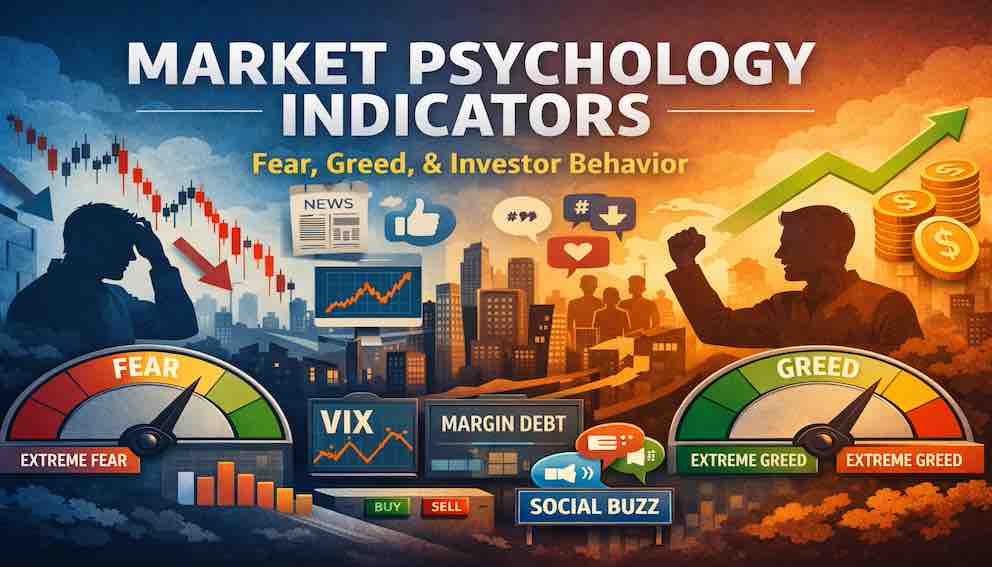
Markets are more than prices, charts, or company fundamentals. At their heart, they are human systems—shaped by billions of individual decisions, cognitive biases, and emotional reactions. Prices move not just because earnings rise or interest rates change, but because fear, greed, optimism, and complacency ripple through investors’ minds. Understanding these underlying psychological currents helps us see why markets overshoot, crash, or rebound in ways that seem surprising when looking only at fundamentals.
This tutorial explains the key indicators that reveal market psychology, how they connect to human behavior, and how to use them as a reflection tool—not as a trading manual. By observing and interpreting these indicators, you can anticipate behavioral extremes, understand market fragility, and think probabilistically about potential outcomes.
Why Market Psychology Matters
Even the most thorough fundamental analysis cannot fully explain market behavior. Prices often overshoot or undershoot intrinsic value, not because fundamentals suddenly change, but because investor psychology dominates short- to medium-term market dynamics.
Consider the Dot-Com Bubble (1999–2000): Companies with no profits or sustainable business models traded at sky-high valuations. Why? Investors believed the story of the “New Economy” and extrapolated short-term trends far into the future. Fundamentals mattered less than the shared narrative and collective confidence.
Similarly, the 2008 Financial Crisis unfolded not merely because of weak financials, but because fear, panic, and forced selling cascaded through leveraged positions. Investor psychology, amplified by leverage, drove market crashes.
Takeaway: Observing the psychology behind market moves provides a systemic lens to understand extreme events before they are fully reflected in prices.
Categories of Market Psychology Indicators
Market psychology indicators fall into quantitative metrics and qualitative signals. Both are needed to form a complete view of investor behavior.
A. Quantitative Indicators
Quantitative indicators measure behavior through numbers and positioning. Here are the key metrics:
Volatility Measures (VIX, Realized Volatility)
- Tracks expected price fluctuations in equity markets. The VIX is often called the “fear index.”
- Example: During March 2020, the VIX spiked above 80 as pandemic panic swept markets. Prices collapsed, liquidity tightened, and fear dominated decision-making.
- Behavioral Link: Fear and loss aversion drive risk-averse behaviors; investors sell quickly and avoid risk, amplifying volatility.
Fund Flows and Asset Allocation Data
- Shows how money moves between equities, bonds, and alternatives.
- Example: In late 2007, equity inflows peaked while housing credit stress was rising—a sign of overconfidence and extrapolation bias in equities. In march 2020, Massive outflows confirmed panic.
- Behavioral Link: Herd behavior and social proof; investors follow the crowd, creating feedback loops.
Margin Debt
- Measures borrowed funds used to buy assets. High debt shows leveraged optimism; rapid deleveraging signals panic.
- Example: Pre-1929, margin debt was extremely high. Falling prices triggered forced margin calls, accelerating the crash.
- Behavioral Link: Overconfidence and recency bias; investors assume trends will continue indefinitely.
Put/Call Ratios
- Compares the number of protective put options to bullish call options.
- Example: Extremely high ratios suggest fear; extremely low ratios indicate complacency.
- Behavioral Link: Loss aversion, herd mentality, and disposition effect.
Insider Activity
- Buying or selling by corporate insiders indicates confidence in company prospects.
- Example: Insider buying during a market slump signals optimism, even if public sentiment is negative.
- Behavioral Link: Contrarian signals; alignment between informed insiders and retail sentiment can reveal extremes.
High-Yield Bond (Junk) Spreads
- Measures credit risk; wider spreads indicate growing fear of defaults.
- Example: In early 2008, widening junk spreads signaled stress before equity markets fully reacted.
- Behavioral Link: System-wide fear, economic stress anticipation.
Options Skew (SKEW Index)
- Tracks the price of out-of-the-money “tail-risk” puts versus at-the-money options.
- Example: Rising SKEW shows investors paying for protection against rare, catastrophic losses.
- Behavioral Link: Catastrophe anxiety, precautionary behavior, latent fear not reflected in general volatility.
B. Qualitative Indicators
Qualitative indicators capture narrative, attention, and collective perception:
Investor Sentiment Surveys
- Examples: AAII, Investors Intelligence.
- Insight: Extremes in bullishness or bearishness often precede reversals.
- Behavioral Link: Crowd psychology; overconfidence vs. capitulation.
Media Coverage & Analyst Reports
- Headlines, article tone, and coverage volume reflect attention and amplification.
- Example: In 1929, newspapers projected perpetual growth while ignoring early warning signs.
- Behavioral Link: Narrative amplification, confirmation bias.
Social Media & Online Forums
- Volume, engagement, and sentiment reveal crowd behavior in real time.
- Example: 2021 meme stock frenzy (GameStop, AMC) was driven almost entirely by online communities.
- Behavioral Link: FOMO, herding, and digital amplification of emotional cycles.
IPO and SPAC Activity
- High issuance of speculative or low-quality companies indicates speculative excess.
- Example: Late 1999 and 2020–2021 saw surges in tech IPOs and SPACs.
- Behavioral Link: Gullibility, overconfidence, extrapolation bias.
Integrating Indicators: The “Sentiment Dashboard” Framework
Indicators are most powerful when synthesized into a coherent view. A simple “Sentiment Dashboard” can help investors answer:
“What is the dominant emotional regime of the market right now?”
Framework Example:
| Category | Example Metrics | What It Measures | Behavioral Regime It Signals |
| Fear & Greed | VIX, Put/Call Ratio | Emotional temperature & hedging | Panic vs. Complacency |
| Positioning & Conviction | Margin Debt, Fund Flows, Insider Activity | How invested and leveraged the crowd is | Overconfidence/Crowding vs. Capitulation |
| Narrative & Attention | Media Tone, Social Media, Google Trends, IPO/SPAC Activity | Prevalence and intensity of stories | Euphoria/Consensus vs. Apathy |
How to Interpret:
- All categories in the same extreme direction: Signals a psychologically extended market (e.g., euphoric optimism or panic).
- Conflicting signals: Suggests transition, confusion, or a market in flux.
- Goal: Build a diagnostic understanding of current market behavior, not precise forecasts.
Smart Money vs. Dumb Money Indicators
Professional investors track divergences between sophisticated and retail participants:
Commercial Hedgers vs. Small Speculators (Futures Markets)
- When commercial hedgers (smart money) are heavily short, and small speculators (dumb money) are heavily long, it often signals over-optimism in the crowd and a potential reversal.
Options Skew (SKEW Index)
- Measures demand for tail-risk protection. Rising SKEW signals fear of rare, catastrophic events even if overall volatility appears low.
High-Yield Spread Dynamics
- Widening spreads between junk bonds and Treasuries reveal credit market stress. Historically, equity markets often follow this fear signal.
Key Takeaway: These indicators can highlight extremes in positioning and caution against following the crowd blindly.
Critical Nuances and Limitations
**Market psychology indicators are descriptive, not predictive:
- They tell you where the market is now, not where it will go.
- Reflexivity problem: High bullish sentiment doesn’t create a market top; it reflects an ongoing trend. Fragility emerges when the crowd is exhausted.
- Extremes can persist: Indicators may remain high or low for months or years in trending markets.
- Digital-age signal fade: Widespread access to sentiment data can reduce predictive value; “dumb money” now sees what “smart money” is doing.
Rule of Thumb: Use indicators to identify zones of fragility or opportunity, not to time precise entries or exits.
Observing, Not Acting: The Investor’s Checklist
The most powerful way to use market psychology indicators is as a reflection tool. Here’s a structured approach:
- Identify Extremes: Which indicators are at 5-year or multi-year highs or lows?
- Check Consensus: Are other indicators in the same category confirming the extreme?
- Seek the Narrative: What story justifies this positioning?
- Recall History: What typically happens after similar setups? (Not immediately, but eventually.)
- Adjust Process, Not Portfolio:
- Check your risk exposure
- Rebalance if needed
- Mentally prepare for volatility
- Avoid adding to the crowd’s error at the worst moment
This approach emphasizes reflection, patience, and probabilistic thinking rather than reactionary trading.
Connecting Indicators to Behavior
| Indicator | Psychological Signal | Possible Cognitive Bias | Historical Example |
| VIX | Rising fear | Loss aversion, recency bias | March 2020 pandemic crash |
| Equity Fund Flows | Crowd optimism | Herding, overconfidence | Late 1999 Dot-Com bubble |
| Margin Debt | Leveraged speculation | Overconfidence, recency bias | 1929 U.S. stock market |
| Put/Call Ratios | Hedging extremes / complacency | Loss aversion, herd behavior | Multiple short-term trend reversals |
| Insider Activity | Contrarian confidence signal | Alignment of knowledge & confidence | 2009 post-crisis recovery |
| Sentiment Surveys | Crowded sentiment | Herding, extrapolation bias | AAII extremes before 1987 crash |
| Media Narratives | Amplification of bias | Confirmation bias, narrative bias | 1920s euphoria, 2000 tech optimism |
| Social Media / Forums | Herding & FOMO | Reputation risk, social proof | 2021 meme stock frenzy |
| IPO/SPAC Activity | Speculative excess | Gullibility, overconfidence | 1999–2000 tech IPO boom, 2020–2021 SPAC boom |
Historical Case Study: 2008 Financial Crisis
Leading indicators:
- Margin debt and leverage rising
- Rapidly expanding housing credit
- Extreme optimism in mortgage-backed securities
Sentiment signals:
- Media stories praised perpetual housing growth
- Investor surveys remained bullish
Outcome: Fear and panic cascaded once defaults rose, amplified by leverage.
Both quantitative (debt, leverage) and qualitative (narrative, sentiment) indicators revealed a market primed for extreme behavior—long before prices collapsed fully.
Contemporary Relevance
Today, these indicators remain critical:
- Volatility indices capture systemic stress in equities, bonds, and crypto.
- Fund flows reveal shifts in risk appetite.
- Sentiment surveys and social media indicate narrative-driven speculation.
- Credit spreads and options skew show real-time fear levels.
By integrating behavioral insight with data observation, investors can form a mental map of the market’s emotional landscape, recognizing extremes and stress points without succumbing to crowd behavior.
Key Takeaways
- Markets are human systems: prices reflect behavior, not just fundamentals.
- Indicators—quantitative and qualitative—reveal underlying psychology.
- Volatility, fund flows, margin debt, put/call ratios, insider activity, sentiment surveys, media narratives, social media, and IPO/SPAC trends all provide insight.
- Historical patterns show how fear, greed, optimism, and complacency amplify market moves.
- Integrating indicators into a Sentiment Dashboard helps identify emotional regimes and extremes.
- Use indicators to reflect and prepare, not to predict exact prices.
- Smart-money vs. dumb-money measures reveal positioning extremes and potential contrarian signals.
- Observing extremes improves probabilistic thinking, emotional resilience, and systemic awareness.
Reflection: By seeing the market through the lens of human psychology, you learn to anticipate fragility, understand momentum, and navigate volatility with discipline and clarity, rather than reacting to noise.
About Swati Sharma
Lead Editor at MyEyze, Economist & Finance Research WriterSwati Sharma is an economist with a Bachelor’s degree in Economics (Honours), CIPD Level 5 certification, and an MBA, and over 18 years of experience across management consulting, investment, and technology organizations. She specializes in research-driven financial education, focusing on economics, markets, and investor behavior, with a passion for making complex financial concepts clear, accurate, and accessible to a broad audience.
Disclaimer
This article is for educational purposes only and should not be interpreted as financial advice. Readers should consult a qualified financial professional before making investment decisions. Assistance from AI-powered generative tools was taken to format and improve language flow. While we strive for accuracy, this content may contain errors or omissions and should be independently verified.