
Tutorial Categories
Last Updated: January 20, 2026 at 08:30
What Market Sentiment Really Tells You - Behavioral Finance Series
Market sentiment is often mistaken for a prediction tool, but it is better understood as a diagnostic one. It does not tell you where prices will go next; it tells you how aligned, confident, and fragile the market system has become. When optimism is widespread, narratives are unquestioned, and volatility is low, markets can appear stable while quietly losing their ability to absorb shocks. Sentiment becomes most informative not when it changes direction, but when disagreement disappears and confidence feels effortless. Used correctly, sentiment helps investors assess vulnerability and risk asymmetry—not time entries or exits.
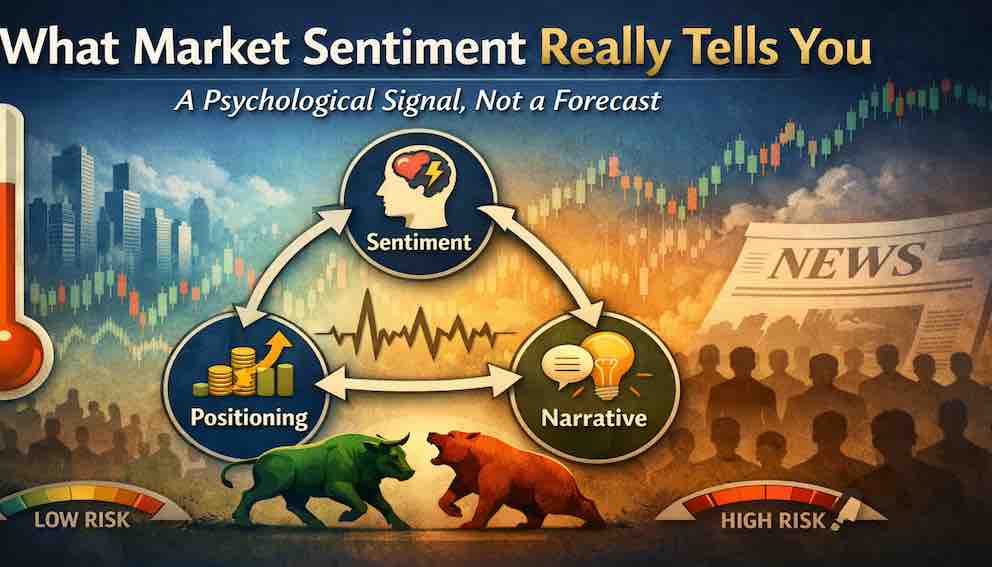
A Psychological Signal, Not a Forecast
Think back to March 2000. The Nasdaq was at an all-time high. Technology stocks seemed unstoppable. Analysts were confident, investors were euphoric, and stories about “the new economy” dominated every conversation. Yet just a few weeks later, prices began a steep decline that would wipe out nearly 78% of the index over the next two years.
Why did this happen? Not because some new information suddenly arrived. It happened because investors had gradually begun to feel the same way—optimistic, confident, and certain together. The collective psychology of the market had shifted, creating a fragile system where even small shocks could trigger large price movements.
Market sentiment tries to measure this shared emotional state. It appears in surveys, positioning data, volatility measures, and headlines about “bullishness” or “fear.” Many treat these metrics as shortcuts: when optimism is high, sell; when fear is extreme, buy. That interpretation is tempting—but mostly wrong.
Sentiment is not a prediction tool. It does not tell you what will happen next. It is a diagnostic tool, revealing how stable or fragile the market system is and how it might respond to surprise.
To use sentiment well, stop asking:
“Is this bullish or bearish?”
And start reflecting:
“What does this emotional setup make the market vulnerable to?”
In this tutorial, we will show how sentiment can provide important insight into market health and fragility, even though it cannot tell us where prices will go next.
Sentiment Is a Thermometer, Not a GPS
Think of market sentiment like a barometer, not a GPS. A barometer tells you the pressure in the atmosphere—it doesn’t tell you exactly where the storm will strike or when. Low pressure signals that a storm could form, but the exact path and intensity are uncertain. Similarly, high optimism or fear shows the “emotional pressure” in markets, but it doesn’t predict the next price move.
High optimism does not automatically mean prices will fall. Low confidence does not guarantee a rebound. What matters is how that emotional state interacts with positioning, narratives, and market structure.
This is why sentiment performs so poorly as a timing signal.
History shows many periods where optimism stayed high—and prices kept rising:
- Technology stocks in the late 1990s
- Housing and credit markets before 2008
- Global equities during long central-bank-supported expansions
- Crypto assets in 2020–2021
In all these cases, sentiment became optimistic early and remained so. Trying to mechanically “fade” sentiment meant fighting a regime, not identifying a turning point.
Sentiment did not mark the top.
It marked the environment.
What Sentiment Actually Measures: Agreement
At its core, market sentiment measures agreement.
Not whether people are right or wrong—but how closely aligned they are in:
- Expectations
- Beliefs
- Narratives
- Emotional responses
When sentiment is mixed, markets contain disagreement. Some investors are optimistic, others cautious. Capital is spread unevenly. Narratives compete. Prices move, but shocks are often absorbed.
When sentiment becomes extreme, disagreement fades.
Skepticism sounds outdated. Caution feels unnecessary. The dominant story feels obvious. Questioning it becomes socially uncomfortable.
This is important because markets need disagreement to stay stable.
Diverse views mean buyers and sellers exist at many prices. When everyone believes the same thing and is positioned the same way, the system becomes fragile. There are fewer marginal buyers, less liquidity, and little room for error.
This is why sentiment is best understood as a fragility indicator, not a directional forecast.
The Sentiment–Positioning–Narrative Feedback Loop
To make this clearer, it helps to formalize the system.
Think of markets as operating through a reinforcing loop made of three elements:
1. Sentiment (Psychology)
This is how people feel collectively—optimistic, fearful, confident, complacent.
2. Positioning (Structure)
This is how money is actually deployed—crowded trades, leverage, low cash levels, heavy use of ETFs or derivatives.
3. Narrative (Information)
This is the dominant story that explains and justifies the sentiment and positioning.
These three elements reinforce each other.
A strong bullish story increases optimism.
Rising optimism leads to more buying and risk-taking.
Crowded buying pushes prices higher.
Higher prices appear to confirm the story.
Round and round it goes.
Sentiment is the psychological readout of this loop. When all three elements become tightly aligned, the market loses its “immune system” of disagreement. That is when fragility builds.
Levels vs. Changes: A Critical Distinction
One of the most common mistakes beginners make is focusing only on how high or low sentiment is, instead of how it is changing.
High optimism by itself tells you very little.
What matters is the direction and speed of change, relative to positioning and expectations.
Consider two situations:
Situation A: Optimism is high and still rising
New participants are entering. Narratives are spreading. Confidence is expanding. Trends can persist much longer than skeptics expect.
Situation B: Optimism is high but no longer improving
Everyone who wants to believe already does. The story is fully absorbed. Prices may still rise—but the system has lost flexibility.
Professional investors often pay attention to this rate of change—sometimes called the “second derivative.” A market where sentiment is improving from pessimistic to neutral is very different from one where sentiment is deteriorating from optimistic to neutral, even if the headline level looks the same.
This is why sentiment works best as context, not a trigger.
Sentiment and Narrative Saturation
Sentiment cannot be separated from stories.
Every major market cycle has a dominant narrative:
- “This time is different.”
- “Central banks have eliminated recessions.”
- “Technology has changed the rules.”
- “Housing never falls nationally.”
As long as a narrative is spreading, sentiment naturally improves. But narratives eventually saturate. Once everyone who can believe does believe, the story loses its power to attract new capital.
At that point, markets do not need bad news to fall.
They only need less good news than expected.
This explains why major market peaks often feel calm, not dramatic. Volatility is low. Confidence is high. Risk feels distant. Sentiment is not shouting “sell.” It is quietly indicating that surprise has become dangerous.
Volatility Suppression and the Illusion of Stability
One of the most important warning signs in markets is the combination of:
- High confidence
- Low volatility
Low volatility feels safe. But from a systems perspective, it can signal hidden risk.
Periods of low, stable volatility often encourage leverage, risk-taking, and complacency. This undermines stability rather than strengthening it—a phenomenon sometimes called the volatility paradox.
When volatility is suppressed while sentiment is optimistic, markets are vulnerable to discontinuous moves. When something breaks—liquidity, policy expectations, earnings assumptions—the adjustment is sudden, not gradual.
This is why crashes feel fast. Not because sentiment changed overnight, but because the system had no shock absorbers left.
Why Simple Contrarianism Fails
Many investors are taught to “do the opposite of the crowd.” This sounds wise but is incomplete.
Extreme optimism can persist for good reasons: innovation, policy support, genuine growth. Fighting it reflexively is not insight—it is impatience.
True contrarian thinking asks deeper questions:
- Why does the consensus exist?
- What assumptions does it depend on?
- Where might it fail at the margins?
Being early is not the same as being right.
Markets are most dangerous when everyone agrees not just on direction, but on why that direction is inevitable.
Sentiment as a Map of Fragility
If sentiment does not predict prices, what does it help with?
It helps you understand risk shape.
Sentiment shows you:
- Where positioning is crowded
- Where narratives are unquestioned
- Where volatility is artificially low
- Where upside is limited and downside is asymmetric
A euphoric market does not have to fall—but it is more vulnerable to surprise.
A fearful market does not have to rise—but it often becomes more resilient to bad news.
This reframes the investor’s question from:
“Will prices go up or down?”
To:
“How fragile is this system?”
A Practical Diagnostic: Assessing the State of the Loop
Experienced investors do not look at sentiment alone. They assess the entire feedback loop.
When sentiment looks extreme, ask:
Positioning:
Is optimism confirmed by crowded trades, high leverage, or low cash levels?
Narrative:
Is the dominant story descriptive of the present, or predictive of guaranteed future gains? Is skepticism mocked or engaged with?
Volatility:
Is volatility suppressed despite high confidence? Suppressed volatility in optimistic regimes often precedes sharp breaks.
Liquidity:
Who is buying? Long-term discretionary investors—or leveraged flows, ETFs, and forced rebalancing?
These questions turn sentiment into a systemic health check.
Sentiment and Market Regimes
Sentiment extremes often mark regimes, not turning points.
Broadly:
- High sentiment + low volatility: Momentum and complacency dominate. Trends persist. Contrarians struggle.
- Sentiment reversal + rising volatility: Stress and transition. Correlations spike. Liquidity matters more than valuation.
- Low sentiment + high uncertainty: Recovery and rewiring. Selective opportunities emerge, but patience is required.
Sentiment does not tell you when a regime will change.
It tells you how much potential energy has built up for change.
The Discipline Sentiment Requires
Perhaps the greatest value of sentiment analysis is internal.
Extreme sentiment pressures you.
Optimistic markets reward participation and punish caution. Pessimistic markets reward skepticism and punish patience. Sentiment reveals when emotional alignment with the crowd is easiest—and therefore most dangerous.
Learning to observe sentiment without reacting to it builds emotional resilience.
It encourages restraint when others rush.
Humility when others feel certain.
Optionality when narratives feel complete.
This discipline is quiet and unglamorous. But over long horizons, it is one of the most durable advantages an investor can develop.
What Market Sentiment Ultimately Teaches
Market sentiment does not predict the future.
It reveals the present emotional and structural condition of a complex system.
Used well, it helps you:
- Recognize fragility without forecasting collapse
- Understand confidence without sharing it
- Separate consensus from truth
- Observe markets without becoming absorbed by them
In a world obsessed with signals and certainty, sentiment offers something more valuable: perspective.
And perspective is often what survives when predictions fail.
About Swati Sharma
Lead Editor at MyEyze, Economist & Finance Research WriterSwati Sharma is an economist with a Bachelor’s degree in Economics (Honours), CIPD Level 5 certification, and an MBA, and over 18 years of experience across management consulting, investment, and technology organizations. She specializes in research-driven financial education, focusing on economics, markets, and investor behavior, with a passion for making complex financial concepts clear, accurate, and accessible to a broad audience.
Disclaimer
This article is for educational purposes only and should not be interpreted as financial advice. Readers should consult a qualified financial professional before making investment decisions. Assistance from AI-powered generative tools was taken to format and improve language flow. While we strive for accuracy, this content may contain errors or omissions and should be independently verified.