
Tutorial Categories
Last Updated: January 20, 2026 at 08:30
Why Volatility Is Psychological, Not Just Statistical - Behavioral Finance Series
Volatility is more than just a number—it shows fear, greed, and uncertainty at work in the market. Periods of calm can be misleading, hiding leverage, crowded trades, and fragile consensus, while sudden spikes reveal stress and panic. Volatility tends to come in waves because human behavior moves in cycles, which are amplified by leverage, crowded positions, and liquidity effects. Beyond visible price swings, hidden volatility—like the volatility of volatility—can signal underlying weaknesses that may erupt unexpectedly. By seeing volatility as a psychological and systemic phenomenon, investors develop patience, understand regime shifts, and build a framework for thoughtful, rather than reactive, positioning.
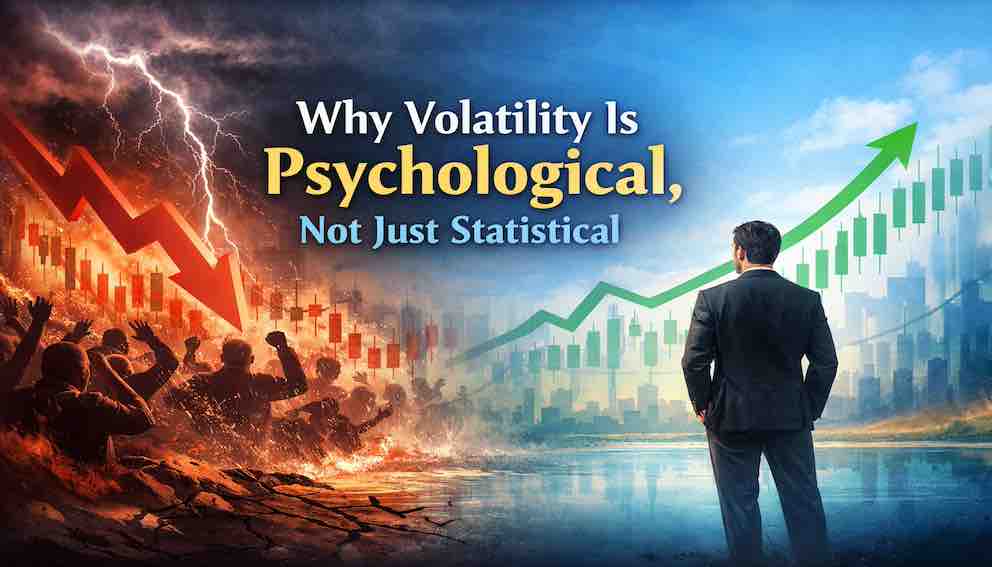
Volatility as Emotion, Not Just Numbers
In October 1987, the U.S. stock market experienced what would later be called “Black Monday.” On a seemingly normal Monday morning, the Dow Jones Industrial Average plunged by over 22% in a single day—the largest one-day drop in history. Analysts scrambled for explanations, and newsrooms filled with fear-driven headlines. Yet just days before, the market had seemed calm and orderly. What changed so quickly wasn’t the fundamentals—it was human emotion, amplified by leverage, crowding, and panic.
Most investors think of volatility as a number—a measure of how much prices move over time. You hear terms like standard deviation, beta, or VIX, and it seems purely mathematical. But if you’ve watched a market crash or a sudden rally, you know that volatility is not just numbers on a screen. It is fear, greed, and uncertainty made visible.
Volatility tells us how humans collectively react to risk. Prices move not just because of fundamentals, but because of what people believe, fear, and hope. Seeing volatility this way helps investors focus on risk, system fragility, and emotional awareness instead of chasing formulas or “market timing.”
Volatility Clusters Around Emotion
Volatility doesn’t appear evenly. Markets have bursts of calm followed by sudden swings. This happens because human emotions—and the strategies we use to act on them—tend to cluster.
Economists model this with Heterogeneous Agent Models (HAMs). Imagine a market with three types of traders:
- Fundamentalists focus on intrinsic value
- Chartists follow trends
- Noise traders act unpredictably
When most traders act the same way, volatility stays low. But if a shock causes many to switch strategies at once, a cascade occurs, and prices swing violently. This is why volatility comes in bursts rather than a steady line.
Another formal model is ARCH/GARCH, which shows mathematically that periods of calm are followed by periods of stress—exactly what we see when fear and uncertainty rise.
Key takeaway: Volatility is not random—it’s the visible echo of collective human behavior.
Low Volatility Can Be Dangerous
Calm markets feel safe, but often hide risks. Investors become overconfident, take on more leverage, and crowd into similar trades. This creates hidden fragility, even when prices seem stable.
Economists call this the Volatility Paradox: because catastrophic events are rare, volatility looks low—until the rare event occurs and explodes violently. This is also known as a “peso problem” in finance: rare risks aren’t reflected in normal market moves.
Examples:
- Pre-1987 crash: Markets were calm, but leverage and risk concentration made the system fragile.
- 2008 financial crisis: Low volatility masked risky mortgage positions; panic revealed hidden stress.
Lesson: Low volatility is not safety. It’s a warning that the system may be quietly building pressure.
Reflexivity, Leverage, and Feedback Loops
Markets don’t just reflect events—they amplify them. Prices influence behavior, and behavior feeds back into prices. This creates self-reinforcing cycles:
- Leverage Feedback: A price drop raises perceived risk. Leveraged investors reduce exposure to meet risk limits, forcing more selling, which pushes prices down further—a vicious cycle linking perception to action.
- Crowding: When many pursue the same strategy, small shocks trigger outsized moves.
- Liquidity: Thin markets exaggerate price swings, especially during stress.
This is called the Volatility Feedback Effect. It shows that volatility is both an outcome of human behavior and a driver of further behavior.
Visible vs. Hidden Volatility
We see volatility in price swings, charts, or the VIX—but there is also hidden volatility, which is invisible until stress reveals it. Examples include:
- Leverage concentration: Many investors borrowing to invest magnifies stress
- Liquidity mismatch: Assets may seem liquid until everyone tries to sell
- Volatility of volatility (Vol-of-Vol): Even if VIX is low, jumps in its volatility signal unstable underlying conditions
Hidden volatility builds silently beneath calm markets. Understanding it helps investors anticipate systemic fragility before it becomes obvious.
Volatility as a Signal of Regime Shifts
Volatility can act as a warning light for sudden changes in the market, known as regime shifts. These are moments when markets move abruptly from calm to panic—or from fear to relief—and they rarely happen gradually. Understanding these signals helps investors anticipate stress, even before it becomes obvious in prices.
Historical examples make this clear:
- 1929 crash: Markets appeared calm, but hidden leverage and speculative bets made the system fragile. When panic struck, prices fell sharply.
- 2008 financial crisis: Low volatility hid risky mortgage positions. Once confidence collapsed, volatility surged, revealing the fragility of the system.
- Flash crashes: Very short-term technical or structural weaknesses in markets can cause sudden, dramatic drops.
Professional investors don’t just rely on simple measures like the VIX level. They study the volatility surface, which shows how option prices vary depending on strike price and expiration date. Two important patterns to watch:
- Volatility Skew/Smile: When fear rises, out-of-the-money put options become much more expensive than calls. This shows that investors are paying for “insurance” against extreme losses.
- VIX Term Structure: Normally, futures on the VIX for later dates trade higher than near-term contracts (contango). During panic, this flips—near-term VIX exceeds long-term VIX (backwardation), signaling that stress is expected to be immediate.
Rule of thumb: A high VIX shows the market is under stress, but the shape of the volatility curve reveals what kind of stress investors fear most and for how long. Observing this carefully gives insight into potential regime shifts before they fully unfold.
Linking Volatility to Minsky’s Financial Instability Hypothesis
Volatility fits neatly into Minsky’s stages of financial cycles:
- Hedge stage: Stable, fundamentals-driven volatility
- Speculative stage: Volatility suppressed by confidence and leverage
- Ponzi stage: Fragility peaks; volatility explodes in a “Minsky Moment”
Understanding volatility this way lets investors see where a market is in its cycle, not just the current number on the screen.
Practical Reflection: A Volatility-Aware Positioning Framework
Rather than reacting blindly, investors can use regime-aware strategies. Here’s a simplified framework:
| Volatility Regime | Psychological Driver | Systemic Characteristic | Recommended Investor Approach |
| Suppressed Volatility | Complacency, Greed | Leverage builds, correlations compress | Reduce fragility, favor quality assets, add cheap tail hedges |
| Rising Volatility | Uncertainty, Doubt | Correlations break, deleveraging begins | Preserve capital, hold cash, observe for dislocations |
| High/Spiking Volatility | Fear, Panic | Liquidity evaporates, forced selling dominates | Provide liquidity if possible, execute pre-defined buys |
| Declining Volatility | Relief, Exhaustion | Stress recedes, liquidity returns | Gradually rebuild positions, phase out expensive hedges |
Key idea: Don’t react to volatility as a number. Observe the regime, diagnose the system, and execute a pre-defined playbook for that regime.
Conclusion: Volatility as Human Expression
Volatility is more than math. It is emotion and psychology made visible, a mirror of collective fear, greed, and uncertainty. Calm markets can hide fragility; spikes reveal it. By understanding volatility this way, investors gain:
- Patience and emotional resilience
- Intuition for regime shifts
- Awareness of hidden risk beneath the surface
- Ability to position themselves thoughtfully, rather than reactively
Volatility is not something to fear or chase—it is information about the health and fragility of the market system. Observing it carefully is an act of reflection, not speculation.
About Swati Sharma
Lead Editor at MyEyze, Economist & Finance Research WriterSwati Sharma is an economist with a Bachelor’s degree in Economics (Honours), CIPD Level 5 certification, and an MBA, and over 18 years of experience across management consulting, investment, and technology organizations. She specializes in research-driven financial education, focusing on economics, markets, and investor behavior, with a passion for making complex financial concepts clear, accurate, and accessible to a broad audience.
Disclaimer
This article is for educational purposes only and should not be interpreted as financial advice. Readers should consult a qualified financial professional before making investment decisions. Assistance from AI-powered generative tools was taken to format and improve language flow. While we strive for accuracy, this content may contain errors or omissions and should be independently verified.