
Tutorial Categories
Last Updated: January 15, 2026 at 14:30
Experiential Bias in Investing: When Personal Experience Shapes Your Financial Decisions - Behavioral Finance Series
Our personal experiences—whether a sudden market gain or a painful loss—often shape our financial decisions more than objective data. This is experiential bias. In investing, it can lead us to chase trends, overweight familiar assets, or avoid opportunities altogether. Learn how to recognize when your past is guiding you, and discover practical strategies to turn experience into insight rather than bias.
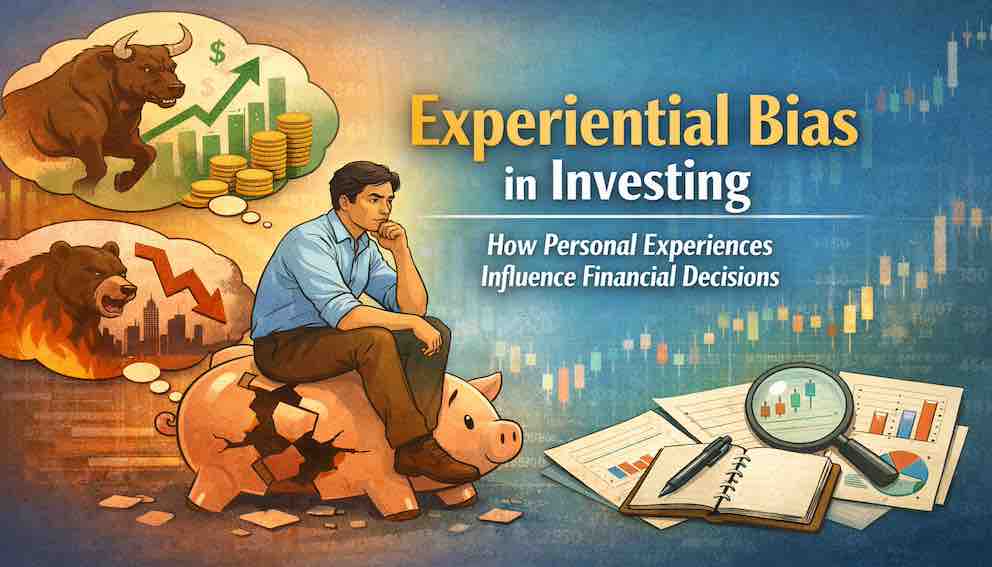
Imagine this: In 2008, Jay saw his father’s stock portfolio crash during the financial crisis. He swore he would never invest in equities and parked his savings in a fixed deposit instead. Fast forward to 2023—Jay watches tech stocks soar and feels uneasy, despite decades of evidence showing equities outperform cash over the long term. Jay’s financial decisions are being guided not by data, but by his personal experience.
This is experiential bias: the tendency to overweight personal experiences—especially vivid or recent ones—over statistical reality or objective evidence. It is a subtle, pervasive bias that can quietly shape saving, investing, and spending decisions, often leading to missed opportunities or unnecessary risks.
Core Theory: What is Experiential Bias?
At its heart, experiential bias is a psychological shortcut. The human brain relies on System 1 thinking—fast, intuitive, and emotion-driven—especially when evaluating risk or reward. Experiences that are emotionally charged, personally relevant, or recent carry disproportionate weight in our decisions, while statistical evidence or abstract probabilities (System 2 thinking) may be undervalued.
Key Features:
- Vividness and Salience: We remember emotionally strong experiences more than dry data. A single market loss feels louder than decades of consistent gains.
- Recency Effect: Recent personal events dominate our memory, making us more sensitive to short-term trends.
- Anecdotal Shortcut: Humans are natural storytellers. We understand the world through narratives—who succeeded, who failed, and why. As a result, a single vivid story from someone we know often feels more “real” than thousands of anonymous data points, even when those data points are far more reliable. This is the anecdotal shortcut at work.
Instead of asking, “What does the full body of evidence suggest?”, our mind asks a faster question:
“Do I know someone this happened to?”
- If the answer is yes, that story becomes a powerful stand-in for reality.
Example:
Suppose Arjun bought shares of a small technology company just before a strong earnings report and saw the stock rise 80% in a year. That single success becomes his mental benchmark for investing skill. When broader evidence suggests diversified index funds outperform most stock pickers over time, Arjun still concentrates his portfolio in a few speculative stocks—believing his experience proves he can “spot winners.”
Financial Consequences of Experiential Bias
Experiential bias can manifest in multiple ways across personal finance and investing:
Overweighting Certain Asset Classes
- After experiencing a sharp market gain in technology stocks, investors may allocate disproportionately to tech, ignoring diversification principles.
- Historical Example: During the late 1990s dot-com boom, many investors who experienced rapid gains in tech assumed these returns were “normal,” leading to overexposure and eventual losses when the bubble burst.
Trend Chasing & Timing Mistakes
- Recent personal experiences drive momentum chasing. If someone profited from short-term trading, they may continue trading aggressively, believing past luck or skill predicts future gains.
- Example: Investors who earned quick returns in Bitcoin in 2017 rushed back in 2020–2021, underestimating volatility, solely because of their past wins.
Ignoring Statistical Evidence
- Experiential bias can override evidence-based rules. Investors may resist long-term equity investing after experiencing a personal loss, even though historical returns show equities outperform bonds over decades.
- Example: A retiree who lost money in a market crash may stay in cash for safety, sacrificing potential gains from decades of compounding.
Behavioral Asymmetry
- Positive experiences can lead to overconfidence and underestimation of risk; negative experiences can lead to excessive caution. Both extremes distort rational allocation.
Expert vs Novice Behavior
Novice Investor:
- Makes decisions based on vivid personal wins or losses.
- Tends to chase hot assets or avoid markets that previously caused pain.
- Relies on anecdotal evidence from peers or media headlines.
Expert Investor:
- Recognizes personal experience as a signal, not truth.
- Uses structured frameworks to filter emotion-driven decisions.
- Relies on historical data, diversification, and decision rules to guide allocations.
Example Contrast:
- Novice: After losing money in a single stock, stops investing altogether.
- Expert: Reviews the loss, asks if it reflects personal misjudgment or market noise, adjusts allocation rules, and maintains a diversified portfolio.
Mitigation Strategies: Turning Experience into Insight Without Bias
Structured Decision Frameworks
- Use predefined rules for asset allocation, rebalancing, and position sizing.
- Example: “I will never allocate more than 5% of my portfolio to a single high-volatility stock, regardless of prior gains.”
Historical Data Analysis
- Complement personal experience with long-term statistical evidence.
- Example: Review 20–30 years of stock market data before judging the risk of equities.
Decision Journals
- Document investment decisions, rationale, and emotional state.
- Over time, patterns emerge showing which decisions were experience-driven vs. rule-driven.
Pre-Commitment Devices
- Automate contributions to retirement accounts, index funds, or ETFs to prevent short-term experience from derailing long-term plans.
Scenario Simulation
- Consider “alternative histories”: How would you have reacted if past experiences were different? This helps reveal how much decisions rely on personal memory vs. objective reality.
Nuance & Debate
Experiential bias isn’t inherently bad. Personal experience can:
- Help you recognize patterns that raw data may miss.
- Make lessons memorable, encouraging better behavior after mistakes.
- Make you more aware of the markets and guide you where to look for relevant data and how to interpret the data.
Trade-off: Over-relying on experience can distort risk perception. Experts often integrate experience as one input among many, weighting it appropriately without letting it dominate decisions.
Reflective Prompts
Ask yourself:
- Are my current financial decisions influenced by a single past gain or loss?
- Am I ignoring historical evidence because it contradicts my personal story?
- How would an impartial advisor evaluate my choices without knowing my past experiences?
Clear Takeaway
Experiential bias reminds us that memory and emotion shape financial decisions—sometimes at the cost of rationality. The goal isn’t to erase experience but to design systems, rules, and habits that prevent past gains or losses from hijacking future choices. Structured frameworks, historical perspective, journaling, and pre-commitment are your allies in turning personal experience into insight rather than bias.
Actionable Reflection: Before your next major financial decision, pause. Write down the influences driving you. Ask: “Am I reacting to evidence or just my past experiences?” Let this self-check guide disciplined, informed investing.
About Swati Sharma
Lead Editor at MyEyze, Economist & Finance Research WriterSwati Sharma is an economist with a Bachelor’s degree in Economics (Honours), CIPD Level 5 certification, and an MBA, and over 18 years of experience across management consulting, investment, and technology organizations. She specializes in research-driven financial education, focusing on economics, markets, and investor behavior, with a passion for making complex financial concepts clear, accurate, and accessible to a broad audience.
Disclaimer
This article is for educational purposes only and should not be interpreted as financial advice. Readers should consult a qualified financial professional before making investment decisions. Assistance from AI-powered generative tools was taken to format and improve language flow. While we strive for accuracy, this content may contain errors or omissions and should be independently verified.