
Tutorial Categories
Last Updated: January 29, 2026 at 10:30
Understanding Financial Management - Financial Management Series
Financial management is much more than keeping the accounting books or preparing reports—it is the art and science of making decisions about money, risk, and time. This tutorial explains financial management as a decision-making system, distinct from accounting or economics, and explores how it links uncertainty, value, and human behavior. Through everyday examples—from households to non-profit organizations—you’ll discover why financial management matters to every entity that handles resources. Whether you are a student, a finance professional, or someone managing a small business, you’ll gain a clearer understanding of how finance drives decisions that shape both organizations and lives.
Let’s begin with a simple question: What comes to mind when you hear the phrase financial management? If you’re like most people, you probably picture spreadsheets filled with numbers, monthly budget reports, or perhaps an accountant meticulously balancing books at the end of the quarter. These images are not wrong, but they capture only the surface—the paperwork and the processes—while missing the heart of the matter entirely. True financial management is less about documenting what has already happened and more about navigating the uncertain journey of what comes next.
It is the thoughtful art and the disciplined science of making decisions about money. These decisions must be made when the future is unclear, resources are limited, and human nature plays its unpredictable part. In this tutorial, we will gently unpack this idea, moving step-by-step from common misconceptions to a clear, practical understanding of how financial management works as a decision-making system that touches every organization and every life.
Introduction: Seeing the Forest, Not Just the Trees
It is easy to confuse financial management with the tools it uses. We see budgets, profit-and-loss statements, and cash flow forecasts, and we assume that creating these documents is the end goal. But think of it this way: a map is not the journey. A map is a tool that helps you plan your journey, anticipate turns, and avoid dead ends. Financial statements are similar; they are maps of past terrain, essential for orientation, but they are not the act of traveling forward. The real work of financial management begins when you lay that map on the table and ask, "Given where we've been, which path should we take tomorrow?" This shift in perspective—from recorder of history to guide for the future—is the first and most important step in understanding this field.
This distinction is crucial, not just for finance professionals, but for anyone who makes decisions with resources. A small business owner deciding whether to hire a new employee, a family saving for a child’s education, or a non-profit director planning a community project—all are practicing financial management. They are all looking at their current resources, considering potential futures, and making choices under conditions of uncertainty. Before we dive into any formulas or theories, we need to settle into this broader view: financial management is, at its core, a framework for making better choices with money over time.
The Core Purpose: A System for Decision-Making
To make this idea concrete, let’s imagine a small, family-owned bakery that has just had its best year ever. The accountant, doing essential work, will provide a clear report: sales were up 20%, costs were controlled, and a tidy profit now sits in the bank. The numbers are accurate, and the story of the past year is told. Now, the owners—acting as financial managers—face the real question. What does that profit mean for tomorrow?
Should they use the money to buy a second, larger oven to increase capacity? Should they renovate the storefront to attract more customers? Perhaps they should set it aside as a safety net for slower months, or maybe even take a well-earned bonus. Each option opens a different door to a different future. Buying the oven involves a large upfront cost with the hope of higher future sales. Renovating might attract new customers but could disrupt current business. Saving the money provides security but forgoes potential growth.
Financial management is the structured process of thinking through these choices. It provides the questions to ask: What are the potential costs and benefits of each option, not just next month, but over the next several years? How certain are we about those future sales? What is the opportunity cost—what do we give up by choosing one path over another? What makes this process unavoidable is that resources are always finite, even in successful organizations, which means choosing one future necessarily means declining another. This is not just about picking good projects; it is about ranking them and making difficult trade-offs when not all good projects can be funded. The bakery’s dilemma, scaled up in complexity, is the same one faced by every company, government, and institution in the world. It is the universal challenge of allocating scarce resources—money, time, effort—toward the most valuable ends.
Clarifying the Landscape: What Financial Management Is Not
A helpful way to sharpen our understanding is to clarify what financial management is not. It is often lumped together with related fields, but its focus is distinct.
It is not Accounting. Think of accounting as the art of history. An accountant’s primary duty is to create a precise, fair, and standardized record of financial events that have already occurred. They answer questions like: How much did we sell last quarter? What were our exact expenses? What do we own, and what do we owe, as of today? Their work results in financial statements—the balance sheet, the income statement—which are like a detailed biography of the business up to this moment. Financial management, in contrast, uses that biography to write the next chapter. It takes the historical facts provided by accounting and uses them as the foundation for forecasts, plans, and decisions. If accounting tells you that you have £50,000 in the bank, financial management asks what that £50,000 should become.
It is not Economics. Economics is a wide-lens social science. It studies how entire societies, markets, and countries allocate resources. It explores broad forces like inflation, unemployment, and interest rates, often dealing in aggregates and theories. Financial management is more focused and applied. It takes the big-picture rules described by economics—for example, the idea that raising interest rates generally cools down borrowing—and applies them to the specific, micro-level decisions of a single organization. If economics explains the climate, financial management is about planning the farm’s planting schedule within that climate.
It is not (Just) Investing. The world of investing, with its stock tickers and portfolio charts, is the part of finance that gets the most glamour and attention. However, investing is primarily about choosing where to place money that already exists—which stocks or bonds to buy. Corporate financial management, which is our focus here, operates a stage earlier. It is about creating the assets that investors then choose from. When the management of a company decides to build a new factory, develop a drug, or launch a streaming service, they are making an investment decision inside the firm. They are deciding how to use the company’s resources to create future value. The investor then decides whether to buy a piece of that company based on the wisdom of those internal decisions. So, while related, investing and corporate financial management are different sides of the same coin: one chooses assets, the other creates them.
The Three Pillars: The Heart of the Matter
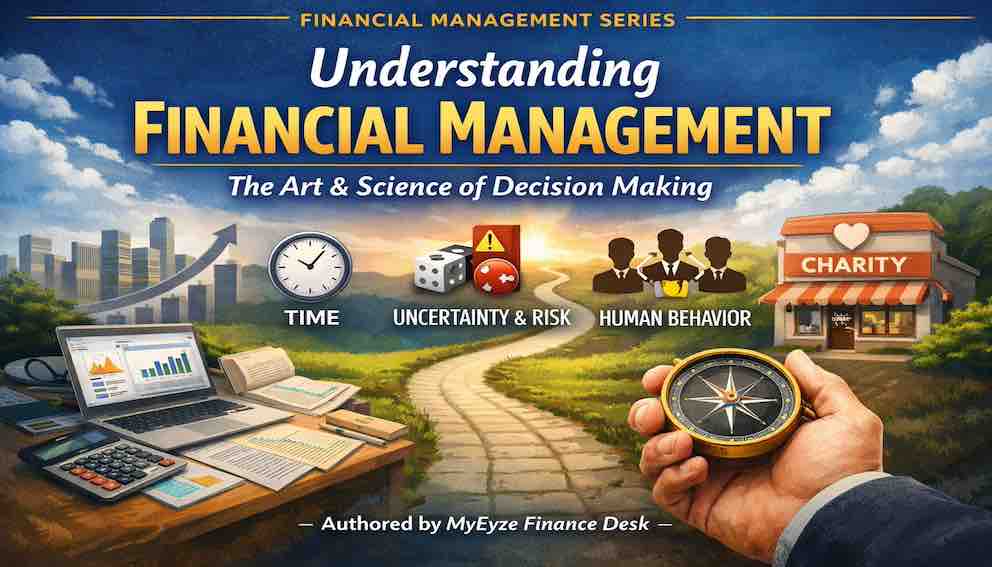
Once we see financial management as a forward-looking decision system, we find that it constantly grapples with three intertwined realities: Time, Uncertainty, and Human Behavior. Every financial decision, regardless of context or scale, can be understood as an attempt to reconcile these three forces at once. These are not just topics in a textbook; they are the fundamental dimensions within which every financial choice is made.
The First Pillar: The Time Value of Money. This is the most logical of the three, and it states a simple truth: money available today is worth more than the identical sum promised in the future. Why? Not simply because of inflation, but because money in hand today can be put to work. If you have £100 today, you can invest it. If you can earn a 5% return, that £100 will grow to £105 in a year. Therefore, a guaranteed promise of £105 in one year is essentially worth £100 to you today. This principle forces every financial decision to be a comparison across time. A business cannot just say a new machine will generate £200,000 over ten years; it must calculate what that future £200,000 is worth in today’s pounds, so it can be fairly compared to the £50,000 cost of the machine now. This process of "discounting" future cash flows to their "present value" is the foundational arithmetic of finance.
The Second Pillar: Uncertainty and Risk. Now, let’s complicate the first pillar with a dose of reality. In our example, we assumed a guaranteed 5% return or a guaranteed future payment. But in the real world, few things are guaranteed. That new machine might break down. The market for your product might dry up. The reliable customer who promised a big order might go out of business. This is where uncertainty enters, and its measurable counterpart is called risk—the likelihood that the actual outcome will differ from what you expect. Financial management doesn’t try to eliminate risk; that’s impossible. Instead, it seeks to understand it, measure it, and ensure that any risk taken is adequately compensated. This is why a safe government bond might pay 2% interest, while a loan to a risky new tech startup must offer 12%. The higher potential return is the reward for tolerating the higher chance of loss. A financial manager’s job is to ask: does the potential return from this new project sufficiently reward us for the unique risks we are taking?
The Third Pillar: Human Behavior and Incentives. Finally, we must acknowledge that financial decisions are made by people, not calculators. And people are wonderfully, frustratingly human. We are prone to overconfidence in good times, panic in bad times, and a tendency to follow the crowd. We also face conflicts of interest. This leads us to the important concept of the agency problem. In a company, the managers (the "agents") who run day-to-day operations are supposed to act in the best interests of the owners or shareholders (the "principals"). But what if a manager avoids a risky but potentially brilliant project because failure might hurt their reputation, even if it would be great for the shareholders? Or what if they spend company money on a lavish office for themselves? These are failures of alignment. Therefore, a critical part of financial management is designing systems—like thoughtful compensation plans, performance metrics, and governance controls—that align human incentives with the long-term goals of the organization. It recognizes that a perfect mathematical model will fail if it doesn’t account for the people who must execute it.
A Tapestry Example: The Personal Education Decision
To see these three pillars woven together in a familiar context, consider a young professional named Maria debating whether to get an MBA.
- Time: She must pay significant tuition and living expenses now (a large, immediate cash outflow) in the hope of earning a higher salary for the next 30 years of her career (a long stream of future cash inflows). To make a rational choice, she shouldn’t just add up those future salaries; she must discount them to today’s value to see if the investment is worthwhile.
- Uncertainty: The future is riddled with "what-ifs." What if she doesn’t enjoy the program? What if the job market is weak when she graduates? What if she doesn’t get the salary boost she expects? This uncertainty is the risk of her investment. She must decide if the potential reward is high enough to make this personal and financial risk acceptable.
- Human Behavior: Maria’s decision will not be purely mathematical. It will be influenced by her optimism, her fear of debt, advice from friends and family, and her personal career dreams. A good financial analysis will inform her choice, but it cannot make the choice for her. It is a tool to clarify trade-offs, not eliminate them.
This personal decision mirrors, in a simpler form, the exact calculus a corporation uses when deciding to invest in research and development or a new market. The scale is different, but the structure of the problem—weighing present costs against uncertain future benefits within a human context—is identical.
Why This Logic is Universal
A final, important point is that this financial logic is not confined to for-profit corporations chasing shareholder wealth. It is a universal logic of resource allocation. A charity managing a donation budget, a university planning a new campus library, or a city council funding a new park—all are engaged in financial management. Their goal might be social impact or public service rather than profit, but the core questions remain: How do we use our limited resources today to create the greatest possible value (however "value" is defined) in the future? They must still plan for the long term, manage risk (like funding shortfalls or construction delays), and design systems to ensure resources are used responsibly towards the mission. The tools of financial management provide the discipline to turn noble intentions into sustainable, effective reality.
Conclusion: From Abstract Concept to Practical Compass
In this tutorial, we have taken a slow walk through the fundamental nature of financial management. We started by moving past the image of spreadsheets and reports to discover a dynamic decision-making system. We distinguished it from the historical record-keeping of accounting, the broad-scale analysis of economics, and the asset-selecting activity of investing. Most importantly, we explored the three pillars that give the discipline its depth and realism: the Time Value of Money, which connects present and future; the management of Uncertainty and Risk, which demands a reward for facing the unknown; and the understanding of Human Behavior and Incentives, which grounds theory in the reality of how people actually make choices.
Financial management, therefore, is best understood as a powerful compass rather than a detailed map. It doesn’t predict the future, but it provides a disciplined way to navigate toward it. It transforms the overwhelming complexity of an uncertain world into a structured set of questions and comparisons, bringing clarity to the difficult choices faced by individuals, businesses, and institutions every day. As we move forward in this series, every tool we encounter will make more sense if it is treated not as an answer machine, but as a disciplined way of asking better questions. In our next tutorial, we will begin to use this compass, learning how to apply the time value of money to value simple investments and set the stage for understanding the true worth of any financial decision.
About Swati Sharma
Lead Editor at MyEyze, Economist & Finance Research WriterSwati Sharma is an economist with a Bachelor’s degree in Economics (Honours), CIPD Level 5 certification, and an MBA, and over 18 years of experience across management consulting, investment, and technology organizations. She specializes in research-driven financial education, focusing on economics, markets, and investor behavior, with a passion for making complex financial concepts clear, accurate, and accessible to a broad audience.
Disclaimer
This article is for educational purposes only and should not be interpreted as financial advice. Readers should consult a qualified financial professional before making investment decisions. Assistance from AI-powered generative tools was taken to format and improve language flow. While we strive for accuracy, this content may contain errors or omissions and should be independently verified.