
Tutorial Categories
Last Updated: February 16, 2026 at 10:30
Financial Strategy as an Integrated System: Connecting Investment, Financing, and Risk Decisions Across Time
Imagine a master gardener tending a vast estate. She does not plant trees without considering their shade on the vegetable beds. She does not dig a pond without knowing how it will drain the adjacent fields. She does not build a wall without understanding which direction the winter winds blow. Every decision is connected to every other decision. The garden is not a collection of independent projects. It is a system. This is how financial strategy should be understood. In this tutorial, we explore how investment, financing, and risk decisions are interconnected, how trade-offs across time influence outcomes, and how a capital allocator mindset and coherent financial narrative guide integrated strategy. Through vivid examples and practical guidance, you will learn how to see the system rather than isolated choices.
Introduction: Seeing the Whole, Not Just the Parts
Throughout this series, we have explored discrete financial decisions:
- Raising capital and balancing debt and equity.
- Managing working capital and optimizing cash flows.
- Evaluating investments using discounted cash flows.
- Managing risk exposures and hedging uncertainty.
These are essential skills. Mastery of them in isolation, however, is not sufficient. A manager may approve a project that meets the hurdle rate without realizing it consumes liquidity needed for future growth. She may finance a project cheaply today, creating refinancing risk tomorrow. She may hedge a specific risk, while inadvertently exposing the organization elsewhere.
This is the paradox of specialization: the sharper the focus on individual trees, the easier it is to lose sight of the forest. Financial strategy is the work of seeing the forest—the system of interconnected decisions that determines long-term value and resilience.
The Three Domains of Financial Strategy
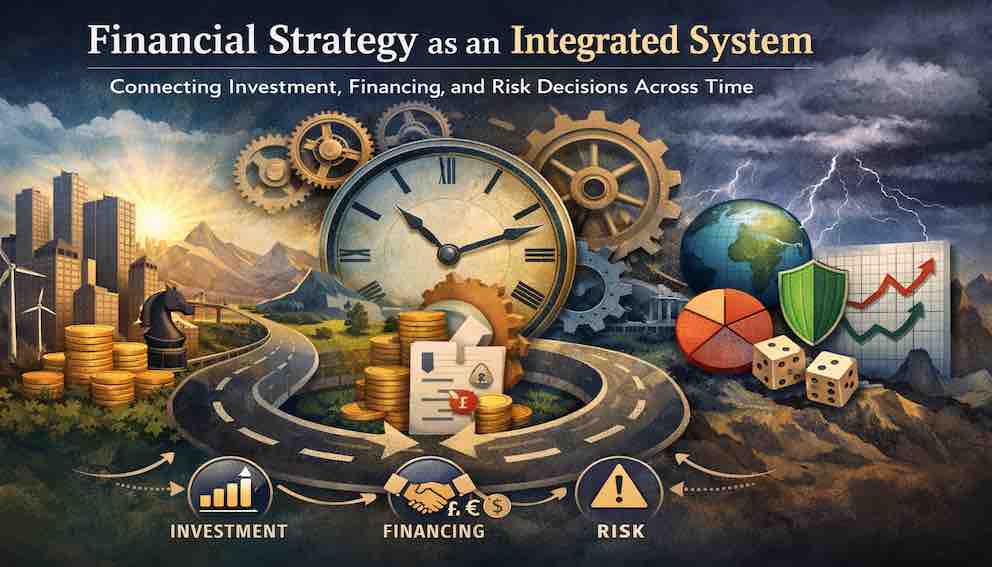
Financial strategy integrates three tightly coupled domains: Investment, Financing, and Risk.
Investment Decisions
Investment decisions determine what the company will become. They allocate capital to:
- Projects and initiatives.
- Acquisitions or divestitures.
- Technology, infrastructure, and long-term capabilities.
Every investment commits resources today to generate value in the future. But investments also create financing requirements and risk exposures. For example, building a factory abroad may generate returns for years but exposes the company to currency risk, operational complexity, and capital constraints.
Financing Decisions
Financing decisions determine how investments are funded. They include:
- Raising debt or equity.
- Managing repayment schedules and interest costs.
- Preserving financial flexibility for unforeseen opportunities.
A financing decision does more than cover immediate needs. It constrains what can be done next. Borrow too much today, and future projects may be impossible or prohibitively expensive. Rely too heavily on equity, and control may dilute or stakeholders may question efficiency.
Risk Decisions
Risk decisions determine which uncertainties the company will bear and which it will transfer. Examples include:
- Hedging currency, interest rate, or commodity exposure.
- Maintaining cash buffers for downturns.
- Diversifying investments and revenue streams.
Risk management is not about eliminating uncertainty. It is about understanding exposures, preserving capacity to act, and controlling the impact of adverse events. Risk decisions also interact with investment and financing: hedging can free up borrowing capacity, while aggressive risk-taking may reduce willingness to invest in new projects.
How Decisions Interconnect
To visualize the connections, consider this flow of decision interactions:
Investment → Financing
- Every investment requires funding.
- The size, timing, and type of investment determine how much debt or equity is needed and when.
Financing → Investment
- Current debt levels and repayment obligations limit future investment capacity.
- Equity issuance or retained earnings allocation affects available cash for other projects.
Investment & Financing → Risk
- Projects and financing choices create exposures to operational, market, and financial risks.
- Example: a leveraged acquisition increases debt and amplifies cash flow volatility.
Risk → Investment & Financing
- Hedging, insurance, or buffers reduce volatility and may expand capacity to invest or borrow.
- Retaining risk increases caution in allocating capital or borrowing.
Thinking in this flow allows managers to see how decisions cascade through the system, rather than focusing only on immediate returns or isolated metrics.
Trade-Offs Across Time
Financial strategy is inherently multi-period. Every decision involves a trade-off between the present and the future:
- Investment trade-offs: Cash spent today is unavailable for other projects but may generate returns in the future.
- Financing trade-offs: Borrowing provides liquidity now but creates obligations later. Issuing equity avoids debt but dilutes future earnings.
- Risk trade-offs: Hedging or maintaining buffers costs money today but reduces uncertainty tomorrow.
Short-termism is the trap where immediate benefits dominate long-term consequences. It may look rational—discounted cash flows, executive incentives, and market pressures all favor the present—but it leads to fragile strategies if the future is ignored.
A deliberate integrated strategy does not avoid these trade-offs. It makes them explicit, conscious, and consistent, balancing immediate pressures against long-term objectives.
The Capital Allocator Mindset
Integrated strategy requires a mindset shift from specialist to capital allocator.
Key characteristics:
- Holistic: Evaluates decisions as part of the portfolio, not in isolation.
- Dynamic: Recognizes that today’s choices shape tomorrow’s possibilities.
- Opportunity-Cost Aware: Every deployment consumes alternative uses of capital.
- Humble About the Future: Maintains optionality and buffers for uncertainty.
- Accountable: Takes ownership of decisions and consequences.
Illustrative contrast:
- Executive A: Evaluates each investment, financing, and risk decision independently. Decisions are defensible but may conflict when combined.
- Executive B: Evaluates how each decision interacts with other commitments, capacity, and risks. Decisions may be the same or different, but the thinking is systemic.
The capital allocator sees the forest, not just the trees.
Constructing a Financial Narrative
A financial narrative explains how decisions fit together and what they aim to achieve. It communicates intent, enforces coherence, and disciplines future choices.
Example:
"We are increasing R&D spending from 8% to 12% of revenue, funded by operational efficiencies and moderate leverage. Near-term earnings will decline, but long-term positioning will secure market leadership. Risks have been stress-tested, and balance sheet resilience maintained. Progress will be monitored against key milestones, and investments reassessed if objectives are not met."
This narrative links investment → financing → risk → time → stakeholder communication in one coherent story.
Framework for Integration
When facing any significant decision, mentally walk through three dimensions:
Domain Integration:
- How does this affect our investment capacity?
- How does this affect financing flexibility and cost of capital?
- How does this affect risk exposures?
Time Integration:
- Immediate effects: cash flow, liquidity, leverage.
- Medium-term effects: strategic positioning, operational capability.
- Long-term effects: optionality, sustainability, resilience.
Narrative Integration:
- Does this decision reinforce our financial story?
- Does it communicate our priorities clearly to stakeholders?
- If the decision conflicts with the narrative, is the narrative or decision in error?
This can also be visualized as a text-based decision map:
Decision X:
→ Investment impact: consumes capital for Project Y
→ Financing impact: uses available debt capacity
→ Risk impact: introduces currency exposure
→ Time impact: short-term cost vs long-term optionality
→ Narrative fit: aligns with stated growth strategy
Case Study: Midwest Industrial
Midwest Industrial faced a choice between gradual growth (Option A) or accelerating automation (Option B). The company had cash, moderate earnings, and strategic opportunities.
Integrated Strategy Execution:
- Investment: Phased £50M automation program, starting with highest-impact facility.
- Financing: Internal cash and dividend reductions for Phase 1; Phase 2 funded by cash flow and moderate debt if successful.
- Risk Management: Execution risk mitigated by phased implementation; demand risk mitigated by liquidity buffer.
- Time Consideration: Short-term earnings impact communicated to shareholders as strategic investment.
- Narrative: Clear explanation linking investment, financing, and risk to long-term market positioning.
Outcome:
- Improved productivity and quality.
- Maintained financial flexibility and investment-grade rating.
- Resilience during 2020 pandemic downturn.
- Long-term competitive advantage achieved.
This illustrates how integrated strategy converts good individual decisions into systemic success.
Conclusion: The System, Not the Sum
Financial strategy is not a collection of optimized decisions. It is the coherent integration of investment, financing, and risk across time, guided by a financial narrative and executed with a capital allocator mindset.
Key takeaways:
- Decisions in isolation are not enough; integration is essential.
- Trade-offs across time must be explicit and deliberate.
- Capital allocator perspective ensures systemic thinking and opportunity awareness.
- Financial narratives communicate strategy, enforce coherence, and discipline future actions.
- The framework of domain, time, and narrative integration helps managers consistently make systemic decisions.
The tools—cash flow analysis, capital structure theory, risk measurement, governance, ethics, technology—are instruments. Integration is the work of strategy, not of models or analysis alone.
When executed well, the organization becomes resilient, flexible, and positioned for sustainable long-term growth. The system is the strategy. The strategy is the system.
About Swati Sharma
Lead Editor at MyEyze, Economist & Finance Research WriterSwati Sharma is an economist with a Bachelor’s degree in Economics (Honours), CIPD Level 5 certification, and an MBA, and over 18 years of experience across management consulting, investment, and technology organizations. She specializes in research-driven financial education, focusing on economics, markets, and investor behavior, with a passion for making complex financial concepts clear, accurate, and accessible to a broad audience.
Disclaimer
This article is for educational purposes only and should not be interpreted as financial advice. Readers should consult a qualified financial professional before making investment decisions. Assistance from AI-powered generative tools was taken to format and improve language flow. While we strive for accuracy, this content may contain errors or omissions and should be independently verified.