Tutorial Categories
Last Updated: January 29, 2026 at 19:30
Understanding Inflation – A Complete Guide
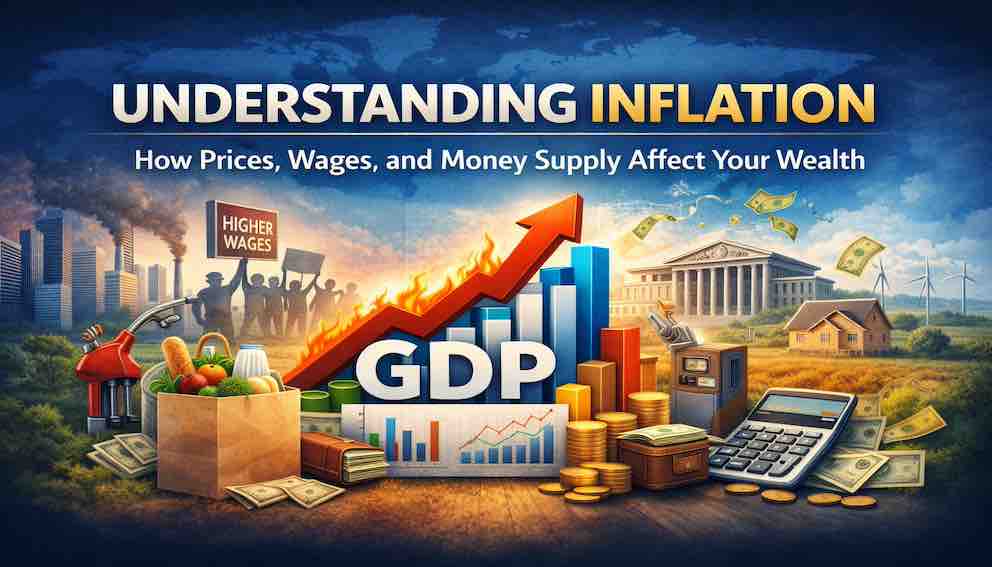
Understanding Inflation: Inflation is more than just rising prices—it affects how much your money can buy, how debts and savings change, and how the economy grows. Prices move because of factors like money supply, spending habits, expectations, and wages. This guide explains the key ideas, from the Quantity Theory of Money (MV = PY) to real interest rates, types of inflation, and who benefits or loses, helping you see the full picture behind the numbers.
Introduction: Inflation in Everyday Life
Have you noticed the price of your morning coffee going up, or that your favorite streaming service just raised its subscription—or that you’re paying more at the grocery store? This steady rise in prices across the economy is inflation, the economic force that changes the value of your money over time. It affects everything you spend on—from your weekly groceries and rent, to gas at the pump, and even the investments you rely on for retirement. Even if your paycheck increases, if prices rise faster, you're effectively earning less.
Inflation doesn't just impact individuals—it affects businesses, investors, and government policies. The Federal Reserve constantly monitors it to decide whether to raise or lower interest rates, influencing loans, mortgages, and credit cards.
In this tutorial, we'll break down what inflation is, why it happens, how it is measured, the different types, and its economic and financial implications.
What Is Inflation?
At its core, inflation is the general and sustained increase in prices across an economy over time.
Let us break this down:
- General Increase in Prices: A true inflationary environment affects most goods and services, from groceries and gas to rent and entertainment. It’s not just one product getting more expensive.
- Across the Economy: It touches nearly everyone: consumers, businesses, investors, and the government. This is why central banks track it closely.
- Sustained Over Time: Inflation is measured as an ongoing trend, not a one-time spike. It can be moderate and gradual, as seen in many stable economies, or it can accelerate rapidly during periods of crisis, leading to high or hyperinflation where prices change daily.
The Spectrum of Inflation Experiences
- During the 2010s, the United States experienced moderate inflation: prices rose steadily at 2-3% annually, allowing households and businesses to adjust gradually.
- Hyperinflation example: Zimbabwe in the late 2000s experienced hyperinflation, where prices doubled almost daily and the local currency rapidly lost all value.
Why Inflation Happens: Money and Expectations
At its core, inflation is about too much money chasing too few goods. Economists explain this through the foundational theory: The Quantity Theory Of Money:
MV=PY
Where:
- M = Money supply (how much money is circulating)
- V = Velocity of money (how fast money changes hands)
- P = Price level (overall prices in the economy)
- Y = Real output (quantity of goods and services produced)
In plain language:
- If the money supply grows faster than the economy can produce goods and services, prices tend to rise.
- Conversely, if the economy produces more goods (Y grows) or money circulates more slowly (V falls), prices might remain stable even if the money supply increases.
Example: Imagine a small town where 100 loaves of bread are sold for $1 each, so everyone spends $100 in total. Now, the town prints an extra $100, but the number of loaves stays the same. With more money chasing the same amount of bread, prices rise—each loaf now costs $2. This simple scenario shows how increasing the money supply without more goods can drive inflation.
⚠️ Important nuance: This doesn’t mean “printing money always causes inflation.” Real-world factors like productivity, velocity of money, and external trade all influence the outcome. The Quantity Theory simply highlights the fundamental link between money and prices.
🧠 The Role of Expectations
Inflation is driven not only by current prices, but by what people expect prices to do next. Once people believe inflation will rise, their actions can make it happen.
- Workers ask for higher wages to keep up with expected price increases.
- Businesses raise prices in advance to cover higher future costs.
- Investors demand higher returns to avoid losing purchasing power.
When many people act this way at the same time, expectations become self-fulfilling, pushing inflation higher even before costs actually rise.
Why expectations matter:
- Anchored expectations: If people trust the central bank to control inflation, wage and price increases stay moderate, and inflation remains stable.
- Unanchored expectations: If that trust breaks down, wage and price hikes reinforce each other, leading to rapid and unpredictable inflation.
📌 Key implication: Inflation can accelerate even without new shocks—simply because people expect it to. This is why managing expectations is a central bank’s most powerful (and fragile) tool.
How Inflation Is Measured
Inflation isn’t something you can see directly—it has to be measured using statistics. Governments track price changes over time with price indices, which provide a snapshot of how the cost of living is changing.
Price Indices: Same Inflation, Different Viewpoints
Inflation can be measured at different points in the economy. Price indices answer different questions, even though they all track prices.
Consumer Price Index (CPI): “What households feel”
What it measures: Prices of goods and services households buy directly—food, rent, fuel, healthcare, transport, and entertainment.
Perspective: The consumer’s wallet.
Key features:
- Uses a fixed basket of goods, so it reflects the cost of maintaining the same lifestyle.
- Heavily influenced by essentials like rent and food, which households can’t easily avoid.
Why it matters:
- Determines cost-of-living adjustments (e.g., pensions, benefits).
- Closely matches people’s lived experience of inflation.
📌 Think of CPI as: Inflation you feel at the checkout counter.
Wholesale Price Index (WPI): “What businesses face first”
What it measures: Prices of goods at the producer or wholesale level—raw materials, fuel, metals, agricultural products.
Perspective: The cost of production before goods reach consumers.
Key features:
- Excludes retail services and consumer markups.
- Sensitive to commodity prices and supply shocks.
Why it matters:
- Acts as an early warning signal.
- Rising production costs often get passed on to consumers later.
📌 Think of WPI as: Inflation in the supply chain before it hits households.
Personal Consumption Expenditures (PCE): “What people actually spend”
What it measures: PCE measures the prices of what people actually buy, adjusting for changes in spending habits over time, unlike CPI which uses a fixed basket of goods.
Perspective: The economy-wide spending pattern.
Key features:
- Adjusts for substitution (people switching to cheaper alternatives).
- Covers a broader range of expenditures, including those paid on behalf of households (e.g., employer-provided healthcare).
Why it matters:
- Preferred by the Federal Reserve for policy decisions.
- Provides a smoother, more stable inflation trend.
📌 Think of PCE as: A measure of inflation that reflects how people actually change their spending when prices rise.
CPI often runs ~0.3–0.5% higher than PCE due to fixed basket vs. substitution effects. Fed targets 2% PCE → equivalent to ~2.4% CPI. Critics argue CPI better reflects 'felt' inflation (heavy housing weight), while PCE understates it for lower-income groups.
📌 Key insight:
- CPI tells you how inflation feels.
- WPI tells you where inflation starts.
- PCE tells policymakers how inflation is evolving after behavior adjusts.
This is why households talk about CPI, businesses watch WPI, and central banks focus on PCE.
Headline vs Core Inflation (In Simple Terms)
Headline inflation includes all prices—especially volatile items like food and energy. It reflects the inflation people feel day to day.
Core inflation excludes food and energy to filter out short-term price swings and show the underlying trend.
Why this distinction matters:
- Policymakers use core inflation to avoid overreacting to temporary shocks (like oil spikes).
- Households experience headline inflation, because food and energy are unavoidable expenses.
How It Fits Together
- Indices (CPI, WPI, PCE) provide the raw price data.
- Headline vs core are ways of interpreting that data.
- Policy focus: Central banks prefer PCE core inflation for interest-rate decisions, while households—especially renters and lower-income earners—often feel CPI headline inflation more directly.
📌 Key takeaway: Core inflation guides policy, but headline inflation shapes lived reality. Understanding both explains why official inflation targets can feel disconnected from everyday experience.
Types of Inflation: Understanding Why Prices Rise
Inflation can start in different ways. Understanding where it begins helps explain why prices rise—and why inflation sometimes fades quickly while other times it lingers.
1. Demand-Pull Inflation
“Too much spending, not enough supply”
What causes it: During economic upswings, job creation and rising incomes increase spending by households, businesses, and governments. Inflation emerges when this surge in demand outpaces the economy’s ability to produce goods and services.
Example: After COVID lockdowns ended, households had savings and stimulus money and rushed to spend on travel, goods, and services. But factories, workers, housing, and supply chains were still constrained. Prices rose because sellers couldn’t expand supply fast enough.
Key idea: Prices rise because demand grows faster than supply.
(Strong growth alone doesn’t cause inflation—capacity limits do.)
Money connection: Even without excessive money printing, inflation can occur if spending accelerates faster than output. Easy credit can amplify this effect.
2. Cost-Push Inflation
“It becomes more expensive to make things”
What causes it: Inflation arises when production costs increase due to supply shocks or higher input costs—such as energy, transportation, raw materials, or labor—forcing businesses to raise prices.
Example: In 2021, fuel prices and global shipping costs surged due to supply disruptions. Transporting food, furniture, and electronics became more expensive, so retailers passed those costs on to consumers.
Other common sources:
- Energy shortages or wars
- Natural disasters disrupting supply
- Trade barriers or tariffs raising input costs
- Regulations or restrictions that limit supply (e.g., zoning laws affecting housing)
Key idea: Prices rise because it costs more to produce goods and services—even if demand hasn’t increased.
Money connection: Cost-push inflation can start from shocks like oil price jumps or supply disruptions. It becomes persistent only if enough money and credit are in the system—otherwise higher costs reduce demand and prices stabilize.
3. Built-In Inflation (Wage-Price Spiral)
“Prices rise because everyone expects them to”
What causes it: When inflation lasts long enough, people begin to expect prices to keep rising. Workers demand higher wages to protect purchasing power, and businesses raise prices to cover higher wage costs—reinforcing inflation.
Example: Delivery workers receive pay raises to keep up with rising living costs. The delivery company raises prices to cover wages. Other businesses face higher costs and raise prices too. Workers across the economy then demand higher pay, repeating the cycle.
Key idea: Prices rise because expectations and behavior lock inflation in.
Money connection: Expectations alone cannot sustain inflation. Wage-price spirals persist only if money growth allows higher spending to continue.
Big Picture Takeaway
- Demand-pull: Prices rise because spending is too strong
- Cost-push: Prices rise because production costs increase
- Built-in: Prices rise because inflation has become expected
- Most real-world inflation episodes involve a combination of all three, reinforced—or restrained—by monetary policy.
Is Inflation Always Bad?
Inflation often has a bad reputation, but it isn’t always harmful. What matters is how high it is and how stable it remains.
- Deflation (falling prices): Discourages spending, weakens revenues, slows growth (e.g., Japan).
- Very high inflation: Creates instability—prices rise faster than wages, savings lose value, planning becomes difficult.
- Moderate inflation (2% in US): Supports steady growth and helps the economy function smoothly.
Why Moderate Inflation Helps (Macroeconomic Functions)
- Avoiding the Deflation Trap: When people expect prices to keep falling, they delay purchases—why buy today if it will be cheaper tomorrow? Moderate inflation reverses this incentive, encouraging households and businesses to spend and invest, which supports demand, production, and jobs.
- Labor Market Flexibility: Wages are hard to cut in nominal terms, meaning employers rarely reduce the dollar amount on paychecks even when economic conditions change. With moderate inflation, firms can adjust real wages by giving smaller raises rather than outright pay cuts. This helps businesses adapt to changing conditions while avoiding layoffs and morale problems.
- Debt Relief: Inflation gradually lowers the real value of debt. Borrowers—households, firms, and governments—repay loans with money that is worth less than when the debt was taken on, making debt easier to manage and reducing the risk of widespread defaults.
📌 Key takeaway: Moderate, predictable inflation helps the economy function smoothly.
Distributional Effects of Inflation: Who Gains and Who Loses
Inflation does more than raise prices—it reshuffles purchasing power across the economy. Even moderate inflation is not neutral: it benefits some groups while negatively affecting others.
Inflation as a Wealth Transfer
Inflation doesn’t affect everyone equally—it shifts purchasing power across the economy.
- Savers lose: Cash and low-interest savings buy less over time as prices rise.
- Debtors gain: Loans are repaid with money that is worth less than when it was borrowed.
- Asset owners benefit: Stocks, real estate, and other real assets often rise with inflation, frequently faster than wages, favoring those who already own assets.
- Lower-income households are hit harder: They spend a larger share of income on essentials like food, energy, and rent—items that tend to inflate faster and are hard to substitute.
Evidence: High inflation is associated with widening income and wealth inequality. Even moderate inflation can quietly favor asset holders because asset prices often adjust more quickly than wages.
📌 Key takeaway: Inflation redistributes wealth in predictable ways while also serving macroeconomic roles such as avoiding deflation and easing real wage adjustment. This is why inflation can feel very different depending on your savings, debts, assets, and income.
Inflation vs Interest Rates: Understanding Real Returns
One of the most important concepts is the real interest rate—the return you actually earn after accounting for inflation:
- Real Interest Rate = Nominal Rate − Inflation
- Example: Fixed Deposit (FD) rate = 6%, Inflation = 7% → Real return = –1%
Even though your bank account grows in nominal terms, your purchasing power actually falls. This simple calculation highlights why understanding inflation is crucial for financial planning: earning interest isn’t enough if inflation outpaces it.
📌 Key takeaway: Always consider real returns to see whether your wealth is truly growing.
A Long-Run Perspective on Inflation and Money
Over the past century, money in most countries has steadily lost purchasing power due to inflation. This isn’t accidental. Modern economies are built around low but persistent inflation, rather than perfectly stable prices. As a result, prices tend to rise over long periods, even if inflation fluctuates year to year.
One reason is chronic government deficits. Many governments spend more than they collect in taxes, financing the gap through borrowing. During crises—wars, financial collapses, pandemics—central banks often step in to stabilize the economy by lowering interest rates and expanding the money supply. These actions can prevent deeper recessions, but they also tend to raise the overall price level over time.
Because government debt is mostly issued in nominal terms, inflation gradually reduces its real burden. In effect, rising prices make past debts easier to service. This creates a structural bias toward policies that tolerate moderate inflation rather than prolonged deflation.
What this means in practice:
Over long horizons, holding only cash or low-yield savings usually leads to a loss of purchasing power, while assets tied to real economic activity—such as businesses, real estate, or productive capital—have historically been more likely to keep pace with or exceed inflation. Debt, when used conservatively and sustainably, has often been a tool that benefits from this inflationary backdrop, because repayments are made with money that is worth less over time.
📌 Key insight: Inflation is not just a short-term phenomenon—it is a long-term feature of modern economic systems. Understanding this helps explain why wealth tends to shift away from cash holders and toward asset owners over time, and why managing inflation risk is central to long-term financial outcomes.
The Role of Central Banks
Central banks play a crucial role in keeping inflation under control. Institutions like the Federal Reserve (US), European Central Bank, the Bank of England (UK), and the RBI (India) use monetary policy to influence how much money flows through the economy.
Their most powerful tool is interest rates.
- When inflation rises too quickly, central banks raise interest rates. Borrowing becomes more expensive, spending slows, and inflationary pressure eases.
- When inflation is too low or the economy is weak, they lower interest rates to encourage borrowing, spending, and investment.
Central banks control the amount of money in the economy, often using open market operations.
- The central bank buys or sells government bonds in the financial markets.
- Buying bonds: The central bank pays banks, giving them more cash. Banks can then lend more easily → more money flows into the economy → can boost spending and investment.
- Selling bonds: Banks give cash to the central bank in exchange for bonds → take money out of the system → borrowing becomes harder → slows down spending and inflation.
📌 Key idea: Central banks balance price stability with economic growth.
Why Inflation Can Persist Even When Central Banks Act
Central banks actively try to control inflation, but prices can keep rising for several reasons:
- Data Lag: Inflation is measured using economic data that is collected and reported with a delay. By the time policymakers see rising prices, the economy may have already changed.
- Policy Lag: Even after deciding to act, central banks implement changes gradually. Interest rate hikes or other measures take months to ripple through borrowing, spending, and investment.
- Expectations: If households, workers, and firms expect higher inflation in the future, they adjust their behavior—workers demand higher wages, businesses raise prices—which can reinforce inflation even as central banks tighten policy.
- External Shocks: Events outside the central bank’s control—like oil price spikes, global supply disruptions, or natural disasters—can push prices up faster than policy can react.
- Structural Factors: Long-term trends such as labor shortages, aging populations, or persistent fiscal deficits can create inflationary pressures that require more than short-term monetary measures to address.
📌 Key takeaway: Controlling inflation is a slow, delicate process. Even with vigilant central banks, lagging data, gradual policy implementation, expectations, and external shocks can cause inflation to persist.
Common Myths About Inflation
- ❌ "Inflation is caused by corporate greed": While firms set prices, sustained economy-wide inflation requires macroeconomic drivers—excess demand or money supply growth. "Greed" is constant; it can't explain changes in inflation rates.
- ❌ "Inflation only hurts poor people": Inflation reshapes purchasing power across all income groups. Lower-income households feel it fastest. For middle- income groups higher everyday costs reduce disposable income. Businesses deal with higher operating expenses and planning uncertainty.
- ❌ "Saving money is always safe": Without considering inflation, "safe" savings can lose significant purchasing power over decades.
✔ Reality: Inflation is complex; understand it via data and theory, not moral narratives.
Conclusion: Why Understanding Inflation Matters
Inflation silently shapes:
- Your daily life – what you can afford today
- Your financial future – what your savings will be worth tomorrow
- The economy – through interest rates, investments, and policy
Ignoring inflation is risky; understanding it empowers you to make smarter financial decisions. Inflation isn’t inherently good or bad—it’s an economic reality. Knowing how it works, how it affects you, and how to navigate it is the key to protecting wealth and planning a secure financial future.
References
- Friedman, M. (1963). Inflation: Causes and Consequences.
- Mankiw, N. G. (2020). Principles of Economics (9th ed.).
- Federal Reserve Economic Data (FRED). https://fred.stlouisfed.org
- U.S. Bureau of Labor Statistics – Consumer Price Index. https://www.bls.gov/cpi/
- Bank of Japan – Deflation and Economic Policy. https://www.boj.or.jp/en/research/
- Bank of England – Monetary Policy Reports. https://www.bankofengland.co.uk/monetary-policy
- IMF Working Papers – Zimbabwe Hyperinflation, 2008. https://www.imf.org
About Swati Sharma
Lead Editor at MyEyze, Economist & Finance Research WriterSwati Sharma is an economist with a Bachelor’s degree in Economics (Honours), CIPD Level 5 certification, and an MBA, and over 18 years of experience across management consulting, investment, and technology organizations. She specializes in research-driven financial education, focusing on economics, markets, and investor behavior, with a passion for making complex financial concepts clear, accurate, and accessible to a broad audience.
Disclaimer
This article is for educational purposes only and should not be interpreted as financial advice. Readers should consult a qualified financial professional before making investment decisions. Assistance from AI-powered generative tools was taken to format and improve language flow. While we strive for accuracy, this content may contain errors or omissions and should be independently verified.