
Tutorial Categories
Last Updated: March 4, 2026 at 10:30
Tulip Mania in the Dutch Republic: What This Speculative Episode Teaches About Markets, Coordination, and Human Behavior
Tulip Mania in the seventeenth-century Dutch Republic is often told as a story of madness, a moment when rationality vanished and people traded houses for flowers. The historical record tells a more careful and more interesting story. Tulip prices rose and fell within a sophisticated commercial society that already understood futures contracts, credit, and speculation. When we look closely, we see not irrationality but coordination—people trying to anticipate one another in a thin, trust-based market. This tutorial reframes Tulip Mania as a social coordination event and explains what it still teaches modern investors about bubbles, timing, and collective belief.
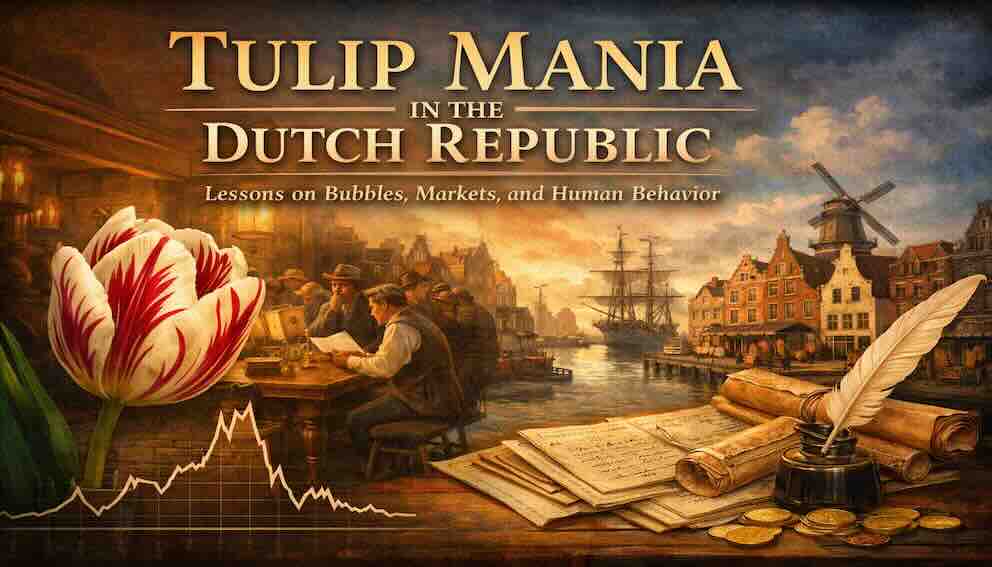
A Winter Auction in Haarlem
In early 1637, in the city of Haarlem, merchants gathered in a tavern to trade tulip contracts. The ground was frozen, so no bulbs changed hands. Instead, traders bought and sold slips of paper—promises to deliver specific bulbs months later, after they were lifted from the soil in summer.
A man named Claes buys a contract for a rare striped bulb, agreeing to pay 1,200 guilders in June. He puts down a small earnest payment. Before he leaves, another buyer offers him 1,600 guilders for the same contract. Claes sells. He has just made 400 guilders without ever touching a tulip.
Within weeks, prices for certain rare varieties would fall sharply. Some contracts would go unpaid. A legend would be born that people sold houses for flowers. For centuries, this episode would be cited as proof that markets can descend into collective insanity.
The scene feels dramatic. But the deeper story is quieter and more structural. To understand what really happened, we must look at how people coordinate their expectations in uncertain markets.
The Human Core: Coordination Under Uncertainty
At its heart, Tulip Mania was about coordination. It was about people trying to guess what other people would do tomorrow.
When you buy a stock today, you are not only judging its future cash flows. You are also estimating how other investors will value those cash flows next year. That second layer—anticipating others' anticipation—is what makes markets complex.
In the 1630s, tulips were a new luxury in the Dutch Republic. Certain varieties displayed rare color patterns caused by a virus. These patterns made them beautiful and scarce. Scarcity and beauty are a powerful combination.
Prices rose not simply because people loved flowers. Prices rose because people observed that others were willing to pay more than before. Each buyer had to decide whether the next buyer would pay even more.
This is the first and most important lesson: bubbles arise from coordination risk, not inherent irrationality. Participants act rationally based on available information, betting that collective belief will persist. The problem is miscoordination when that belief shifts suddenly, not individual folly. This applies to any asset where resale expectations outweigh intrinsic use—whether tulips in the 1630s, status symbols today, or hype-driven technology stocks.
Tulip Mania becomes clearer when we see it not as madness, but as a fragile agreement about future prices.
Tulips as Status and Speculation
A wealthy merchant in Amsterdam might buy a rare tulip contract not for gardening, but for status. Owning a rare variety signaled taste and access. In a commercial society where fortunes were made in trade rather than inherited, new symbols of refinement carried weight.
The tulip was well suited to this role. It was exotic. It reproduced slowly. Its striking patterns could not be easily replicated. A rare bulb was a conversation piece.
If the merchant buys a contract for 1,000 guilders and later sells it for 1,500, he profits without ever touching soil. This is speculation. But speculation here is not gambling in the abstract sense. It is a rational attempt to profit from rising demand in a market where supply is fixed.
Three layers combined in the tulip market:
First, tulips had real aesthetic and social value.
Second, supply was naturally constrained.
Third, futures contracts allowed trading without immediate physical exchange.
Here we see a second lesson: thin-market dynamics amplify volatility. When you combine scarcity, status signaling, and financial innovation, you create conditions for explosive upside but fragile downside. Price discovery becomes difficult in thin markets, so swings are sharp but often contained. The same dynamics appear today in markets for rare art, collectibles, or cutting-edge technology where supply cannot quickly meet demand.
The Role of Futures Contracts
Many trades were not for bulbs in hand, but for bulbs to be delivered months later. These forward contracts were informal agreements enforceable through social and legal norms.
Suppose a grower agrees in January to deliver a bulb in June for 1,200 guilders. The buyer puts down a small earnest payment. Before June, the buyer resells the contract for 1,600. The contract changes hands several times, each time at a higher price.
As long as prices rise, everyone appears solvent.
If prices fall, the final holder may refuse to complete the purchase. Courts and local authorities debated how strictly to enforce these contracts. In many cases, settlements were negotiated at a fraction of the original value.
This illustrates another lesson: financial tools boost liquidity but add fragility. Forward contracts enabled speculation without physical delivery, creating chains of obligation. Rising prices masked risks; falling prices exposed them. Modern equivalents include derivatives, margin trading, and tokenized assets. Leverage always appears sustainable in euphoria but turns dangerous when confidence falters.
Putting Tulips in Proportion
It is easy to imagine that the entire Dutch economy hung in the balance. That image is misleading.
The Dutch Republic was the commercial center of Northern Europe. Dutch ships dominated the Baltic grain trade and the East Indies spice trade. The Amsterdam exchange handled bills of exchange across the continent. The Dutch East India Company was capitalized at more than six million guilders—many times the value of the entire tulip trade.
Tulip trading was a sideshow. It involved a relatively small number of participants, many of them wealthy merchants who could absorb losses. The amounts, while large in personal terms, were modest compared to maritime commerce or the VOC's capitalization.
This matters because it teaches a crucial distinction: scale and systemic exposure determine danger. Tulip Mania was a modest sideshow in a booming economy. Losses stayed localized because contracts were not deeply embedded in credit or banking systems. A frenzy can burn speculators without burning the economy unless it cascades through credit channels. This is what distinguishes it from later bubbles tied to sovereign debt, like the South Sea Bubble, or from crises involving broad leverage and collateral, like 2008.
The Crash: From Euphoria to Hesitation
In early February 1637, a routine auction in Haarlem reportedly failed to attract buyers at expected prices. Word spread. If buyers were no longer willing to bid at yesterday's levels, then yesterday's contracts looked expensive.
Imagine holding a contract to buy a bulb for 2,000 guilders when similar bulbs now trade at 1,200. You might hesitate to complete the purchase. If others hesitate, liquidity dries up.
The shift can begin with one cautious buyer. Then another. Soon sellers outnumber buyers. Prices drop further. More holders cut losses. The movement becomes self-reinforcing.
This is the coordination problem again. Rising markets are supported by shared confidence that someone else will pay more. Falling markets begin when that belief weakens. The change is not gradual. It is sudden.
Here we see the Trust Thermocline in action—the invisible threshold where calm confidence flips into doubt, then into panic. In early 1637, that point was crossed when the Haarlem auction failed to attract expected bids. Before, stability. After, reversal. The people in the market did not know they were approaching the boundary until they had passed it.
The Dutch economy did not collapse. Losses were limited. Many participants absorbed setbacks. Contracts were settled at reduced penalties rather than rigid enforcement. Here we see the Sovereign's Dilemma: authorities faced a choice between rigid enforcement that might spread distress, and flexible settlement that would absorb losses locally. They chose flexibility.
Later writers, particularly in the nineteenth century, amplified the story into a moral tale. Charles Mackay's Extraordinary Popular Delusions cemented the image of a nation gone mad, adding details with no basis in records. Modern scholars like Peter Garber have questioned whether tulip prices were truly detached from fundamentals or simply reflected extreme rarity.
This points to another lesson: history's exaggerated moral tales mislead us. The popular accounts amplified drama to teach lessons about folly. In reality, many "insane" prices were tied to genuine rarity, forward contracts, and negotiated settlements. We should avoid knee-jerk "bubble equals madness" labels and recognize that we are prone to the same dynamics.
The Abstraction Trap
Throughout this episode, we see another pattern: the Abstraction Trap. Contracts for future delivery became detached from the underlying bulbs. Men traded slips of paper representing promises, and those promises changed hands many times. As long as everyone believed, the paper claims moved like concrete wealth. When belief wavered, people remembered that paper was just promises. Its value evaporated faster than any bulb could possibly decline.
This trap appears whenever financial innovation creates distance between symbols and reality. It happens with derivatives, with mortgage-backed securities, with digital tokens. The abstraction is useful—it allows liquidity and risk-sharing—but it also creates vulnerability. When trust breaks, the gap between symbol and substance becomes visible instantly.
Why Tulip Mania Is Misunderstood
The popular story: ordinary citizens traded homes for bulbs. Fortunes vanished overnight. Markets are prone to madness.
This version is memorable but incomplete.
First, many highest recorded prices referred to rare varieties negotiated in specific contexts, not typical market prices.
Second, contracts were forward agreements, not cash paid immediately. Many participants never paid the full amounts recorded.
Third, enforcement was flexible. Authorities allowed negotiated settlements, softening the blow.
The Dutch were not unsophisticated. They understood risk and uncertainty. The idea that they suddenly lost reason is less plausible than that they misjudged how long coordination would hold.
We prefer clean moral stories. A bubble is easier to teach with villains and fools. It is harder to explain as a coordination event in a sophisticated society experimenting with new tools. The moral version makes us feel superior. The coordination version implicates us in the same dynamics.
Tulip Mania was an early case of rapid price appreciation in a thin market where value depends partly on shared belief. When we describe bubbles as collective insanity, we distance ourselves. When we describe them as coordination events, we recognize we are embedded in similar dynamics.
That recognition is more uncomfortable. It also makes us better investors.
A Modern Reflection: The AI Market Today
Consider the current excitement around artificial intelligence. Companies racing to develop large language models, investors pouring capital into startups, valuations reaching heights that assume decades of dominance.
Ask yourself the same questions the tulip traders faced:
What is coordinating these buyers? A narrative about technological transformation. Belief that AI will reshape industries. Fear of being left behind. Status signaling—companies announce AI strategies to show they are forward-looking.
Supply is constrained in its own way. Cutting-edge chips are scarce. Top researchers are rare. The infrastructure requires massive capital.
Financial innovation amplifies the dynamic. Venture capital, public market enthusiasm, and leverage all feed the cycle.
Now ask: what would break this coordination? A failed product launch? Regulatory action? A shift in interest rates that changes the cost of capital? A realization that monetization is slower than expected?
These are not predictions. They are the kinds of questions Tulip Mania trains us to ask. The technology may be genuinely transformative. The question is how much of today's prices reflect durable value creation, and how much reflect shared expectation that someone else will pay more tomorrow.
Practical Investor Humility
What does Tulip Mania teach us about investing today?
First, distinguish durable value creation from momentum sustained by shared expectation. Not every rising price is a bubble. But when you see rapid appreciation in a thin market, ask what is coordinating buyers.
Second, ask the question that matters most: what would break this coordination? A failed auction. A missed earnings target. A regulatory change. A shift in sentiment. The specific trigger matters less than knowing that coordination can break.
Third, use diversification and caution to manage coordination risk. It is not anomalous. It is inherent in markets where resale expectations matter. You cannot eliminate it. You can only acknowledge it and build portfolios that survive its occasional appearance.
Fourth, recognize that you are not immune. The people in that Haarlem tavern were not fools. They were participants in a coordination game that turned against them. The same tendencies to extrapolate trends, seek cues from others, and assume the crowd knows something you don't—these are human, not historical.
Conclusion: What We Learned From the Tulips
In a Haarlem tavern, merchants traded contracts for flowers they would not see for months. Prices rose because others were willing to pay more. Prices fell when that willingness hesitated. The economy endured. The legend grew larger than the event.
From this episode, we draw several lessons:
Bubbles arise from coordination risk, not irrationality. Participants act rationally given their information. The problem is miscoordination when belief shifts.
Thin-market dynamics amplify volatility. Scarcity, status, and financial innovation create explosive upside and fragile downside.
Scale determines danger. Tulip Mania was a sideshow because it wasn't embedded in credit systems. Contrast with sovereign debt bubbles or banking crises.
Financial tools add fragility. Futures, margin, and derivatives create chains of obligation that look sustainable until they don't.
The three lenses help us see fragility: the Trust Thermocline (where calm flips to panic), the Abstraction Trap (symbols detached from reality), and the Sovereign's Dilemma (choosing between enforcement and stability).
Moral tales mislead. The popular image of madness obscures a more instructive story about coordination and uncertainty.
Practical humility follows. Distinguish durable value from momentum. Ask what breaks coordination. Diversify. Recognize your own susceptibility.
The names and instruments change. The underlying human behavior does not. Tulip Mania teaches us to ask better questions—not to predict the next crisis, but to recognize the patterns that make crises possible.
In the next tutorial, we will examine the South Sea Bubble and the Mississippi Bubble, where coordination attached itself to sovereign debt and national balance sheets. The stakes will be higher. The pattern will feel familiar.
Further Reading
- Famous First Bubbles by Peter Garber
- Manias, Panics, and Crashes by Charles Kindleberger
- Extraordinary Popular Delusions and the Madness of Crowds by Charles Mackay
- The Tulip Mania by Mike Dash
About Swati Sharma
Lead Editor at MyEyze, Economist & Finance Research WriterSwati Sharma is an economist with a Bachelor’s degree in Economics (Honours), CIPD Level 5 certification, and an MBA, and over 18 years of experience across management consulting, investment, and technology organizations. She specializes in research-driven financial education, focusing on economics, markets, and investor behavior, with a passion for making complex financial concepts clear, accurate, and accessible to a broad audience.
Disclaimer
This article is for educational purposes only and should not be interpreted as financial advice. Readers should consult a qualified financial professional before making investment decisions. Assistance from AI-powered generative tools was taken to format and improve language flow. While we strive for accuracy, this content may contain errors or omissions and should be independently verified.