
Tutorial Categories
Last Updated: March 4, 2026 at 10:30
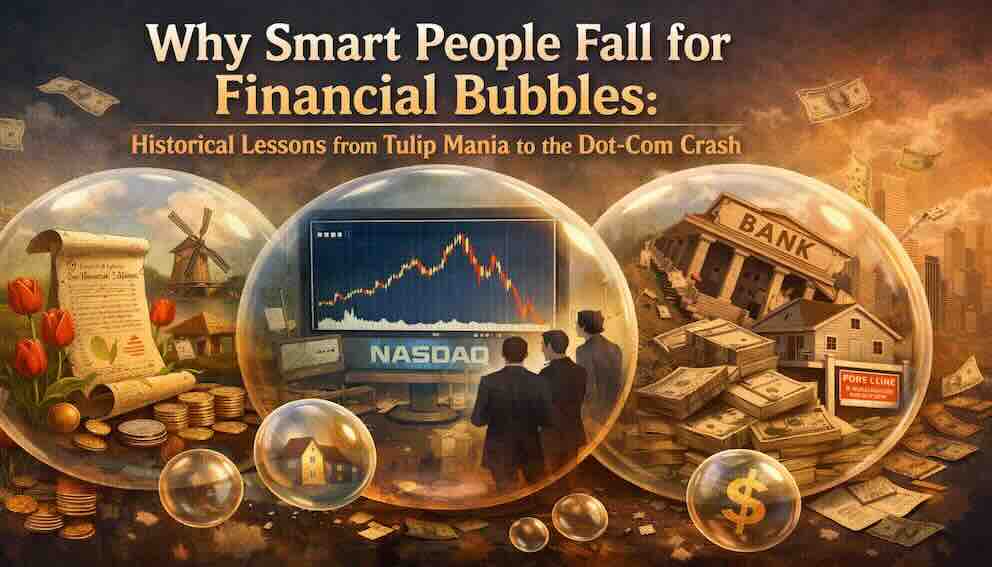
Why Smart People Fall for Financial Bubbles: Historical Lessons from Tulip Mania to the Dot-Com Crash
Financial bubbles are often described as episodes of mass foolishness, yet history shows that many participants were intelligent, educated, and professionally successful people. This tutorial explains why smart investors repeatedly fall for bubbles, from Tulip Mania to the Dot-com bubble and the Global Financial Crisis. We examine how intelligence can amplify conviction, how incentives and coordination pressures distort judgment, how leverage magnifies both gains and losses, and why elite institutions fail in similar ways across centuries. The focus is on human behavior rather than formulas. The goal is to understand the structure of bubbles so that we can recognize their recurring patterns.
A Pattern That Repeats Across Centuries
In the late 1990s, many highly educated investors poured money into internet companies with little or no profit. In the mid-2000s, senior bankers and economists supported complex mortgage securities built on rising housing prices. In earlier centuries, experienced merchants and political leaders invested heavily in speculative ventures tied to new trade opportunities or scarce goods.
These were not episodes driven only by ignorance. They were driven by shared belief, incentives, and the powerful human desire to move with the crowd rather than against it. The deeper question is not why foolish people speculate. The real question is why intelligent people, who understand risk and history, repeatedly become convinced that "this time is different."
The answer lies partly in genuine uncertainty. During periods of technological or structural change, no one knows with confidence how new industries will evolve. The internet did transform commerce. Housing markets did rise for years. Financial innovation did spread risk more broadly. The difficulty lies in distinguishing durable transformation from transient enthusiasm. Intelligent people can disagree, and both sides can offer plausible arguments.
Intelligence Amplifies Conviction
During Tulip Mania, rare tulip bulbs in the Dutch Republic reached extraordinary prices. Many participants were merchants and traders accustomed to sophisticated contracts and international commerce. They were not strangers to risk. They operated in one of the most advanced financial systems of their time.
As prices rose steadily, explanations developed. Tulips were scarce. Wealth in the Republic was expanding. Demand from affluent buyers appeared stable. Each argument reinforced the idea that high prices were reasonable. A merchant could point to rising prices as evidence that his analysis was correct.
A similar pattern appeared during the Dot-com bubble. Analysts argued that traditional valuation metrics did not apply to internet companies because network effects and rapid adoption would produce dominant platforms. Some of these arguments had merit. The internet did transform commerce. However, valuation models often relied on optimistic growth assumptions extending far into the future. Amazon's stock rose from around $2 in 1997 to over $80 in 1999, despite minimal profits, because investors projected decades of dominance. Notably, Amazon eventually grew into and beyond those valuations, but only after surviving a brutal bear market that wiped out most dot-com companies. The presence of a genuine long-term winner did not justify the prices of the hundreds of companies that failed.
The key principle is that intelligence does not automatically prevent error. It often strengthens belief. A skilled analyst can construct detailed arguments supporting a rising market. When prices confirm those arguments for several years, conviction deepens. The more capable the mind, the more elaborate the defense can become.
Psychologists refer to this as motivated reasoning. In simple terms, once we adopt a view, our thinking skills often work to defend it rather than to challenge it. Rising prices provide continuous reinforcement, making the story feel increasingly correct.
In modern markets, the same pattern appears when investors use complex models to justify high valuations in fast-growing sectors. Intelligence makes the argument more persuasive, both to others and to oneself. The very sophistication of the reasoning can mask its fragility.
The Safety of the Crowd and Career Incentives
Before the Global Financial Crisis, large financial institutions accumulated mortgage-backed securities linked to housing markets. Internally, some professionals expressed concern about lending standards and housing valuations. Yet exposure continued to expand.
Consider a mid-level risk manager at a major bank in 2006. He sees that underwriting standards have deteriorated. Borrowers with poor credit are receiving loans with minimal documentation. He raises concerns. His superiors acknowledge the risks but note that competitors are making even more aggressive loans. If the bank pulls back, it will lose market share. If the housing market continues rising, the cautious bank will underperform.
One reason for continued exposure lies in career risk. If a portfolio manager avoids a booming sector while competitors profit, underperformance becomes visible and costly. Clients may leave. Compensation may decline. On the other hand, if the entire industry participates and the bubble bursts, losses are shared. No single manager is blamed for a systemic event.
This is a coordination problem. Each individual may privately recognize risk, but no one wants to step aside too early. Acting cautiously in a rising market can appear foolish for a long time. Acting with the crowd feels safer, even if the long-term risk is higher.
The same dynamic was visible during the South Sea Bubble. Members of the British political and financial elite invested as share prices climbed. As more prominent figures joined, social proof reinforced confidence. Declining to participate carried reputational cost. A politician who stood aside while colleagues enriched themselves risked appearing out of touch.
This dynamic continues today. Professional investors are judged relative to peers. When a sector leads the market, resisting it requires not only analytical conviction but also tolerance for short-term underperformance. Intelligence does not eliminate these pressures. It may even sharpen awareness of the professional consequences of dissent.
Leverage: The Hidden Engine of Fragility
Throughout history, leverage has amplified every major bubble. Leverage is simply borrowed money used to increase exposure. It appears in many forms, but its effects are consistent.
In the housing boom, leverage operated at multiple levels. Homebuyers borrowed most of the purchase price, often with little or no down payment. Banks borrowed heavily to fund their lending. Investment banks created structured products that were themselves leveraged, using borrowed money to amplify returns on mortgage pools. A small decline in house values could wipe out the thin equity cushion at each level.
In Tulip Mania and the South Sea Bubble, leverage took the form of forward contracts and installment purchases. Buyers paid only a fraction of the price upfront, agreeing to settle the rest later. As long as prices rose, this leverage magnified gains. When prices fell, those who had promised future payments could not meet their obligations.
During the dot-com era, margin debt expanded dramatically. Investors borrowed against their existing portfolios to buy more shares. Margin debt in the U.S. reached record levels in early 2000, just before the crash.
The mechanics of leverage are straightforward but dangerous. Rising prices encourage borrowing because the returns on borrowed capital appear to dwarf the interest cost. Borrowing pushes prices higher, which encourages more borrowing. When prices reverse, the process works in reverse. Lenders demand more collateral. Borrowers must sell assets to meet margin calls. Selling pushes prices lower. More margin calls follow.
This forced liquidation explains why bubbles do not deflate gently. They rupture. The same leverage that amplified gains during the rise amplifies losses during the fall. The system becomes fragile because the debts remain fixed while asset values decline.
Liquidity and the Greater Fool Dynamic
When markets feel liquid, risk feels lower. If an investor believes they can exit at any time, holding an expensive asset seems safer. Shares trade daily. There is always a buyer. The illusion of continuous liquidity makes speculation feel rational.
This belief is often wrong because liquidity disappears during stress. In a panic, sellers vastly outnumber buyers. Bid-ask spreads widen. Some assets become untradeable at any reasonable price. The exits that seemed available during calm moments vanish exactly when they are needed most.
This connects to what is sometimes called the "greater fool theory." Investors may not believe an asset is fairly valued at current prices. But they believe that someone else will buy it at a higher price tomorrow. The strategy works as long as a greater fool appears. When the chain breaks, the last holder bears the loss.
During the dot-com bubble, many investors knew valuations were stretched. They continued buying because momentum was strong and they expected to sell before the peak. This is not irrational given the incentives. It is a rational response to a momentum-driven market, but it depends entirely on timing. Those who exit early capture gains. Those who exit late absorb losses.
The illusion of liquidity makes this strategy feel safer than it is. If you believe you can always sell, the risk of being the last holder seems remote. When everyone believes that, the eventual rush for the exits becomes more crowded.
Abstraction and the Illusion of Control
In the early 2000s, mortgages were pooled into securities and divided into tranches with different risk levels. These instruments were rated and sold globally. Investors relied on statistical models that estimated default probabilities based on historical data.
At the level of an individual borrower, risk is concrete. Income can fall. Payments can be missed. A family in Ohio with an adjustable-rate mortgage faces real pressures. When loans are bundled and transformed into structured products, risk becomes abstract. It appears in spreadsheets and probability distributions. The human reality recedes behind the model.
Abstraction creates a sense of control. Models seem precise. Historical data provides comfort. Yet models depend on assumptions. In the years before the crisis, many models assumed that nationwide housing prices would not decline significantly at the same time. That assumption proved fragile. Between 2006 and 2009, U.S. house prices fell by roughly 30 percent nationally, something that had not occurred since the Great Depression.
A similar abstraction occurred during the dot-com period. Investors discussed user growth, market share, and potential future dominance rather than current earnings. The focus shifted from concrete cash flow to projected scale. As long as prices rose, the abstraction felt justified. Pets.com had compelling brand awareness but no path to profitability. Investors focused on the story rather than the mechanics of the business.
Intelligent investors are often comfortable with complex models. They understand probability and risk metrics. The challenge arises when confidence in the model exceeds attention to underlying economic reality. If lending standards deteriorate or competitive dynamics shift, historical relationships may break down.
The core issue is not that models are useless. Models are essential tools. The danger appears when the map is mistaken for the terrain. Intelligence increases trust in well-constructed maps. Bubbles often form when the terrain changes faster than the models can adapt.
Success, Feedback, and Growing Confidence
Most bubbles begin with genuine success. Early internet companies did grow rapidly. Amazon's revenue increased from under $150 million in 1997 to over $2.8 billion in 2000. Housing prices did rise for years before 2007. Early investors in speculative ventures often realized significant gains.
Repeated positive outcomes build confidence. When an investor experiences several years of strong returns, it is natural to attribute at least part of that success to skill. Analytical frameworks appear validated. Strategies seem robust. A venture capitalist who backed Yahoo! in 1996 and sold in 1998 may reasonably believe he understands internet investing.
This self-reinforcing dynamic has been called reflexivity. Prices influence behavior, and behavior influences prices. Rising prices attract capital, which funds expansion, which supports further price increases. The feedback loop creates momentum that can persist for years.
The difficulty lies in separating skill from favorable conditions. Rising markets can make many approaches look effective. If prices are climbing broadly, even aggressive strategies may appear disciplined. A strategy of buying any internet-related stock would have produced excellent returns in 1998 and 1999.
During the late stages of the dot-com expansion, many investors had track records of extraordinary gains. Critics warning of overvaluation faced a difficult audience. Those who had prospered could point to years of data supporting their approach. Their conviction was grounded in experience, not in blind optimism.
This pattern is often described as overconfidence bias, but the underlying dynamic is simpler. Repeated success creates trust in a pattern. When the environment changes, that trust may persist longer than it should. Investors who made fortunes in tech stocks in the late 1990s often continued buying through early 2000, convinced that another rally would follow.
Positive feedback loops intensify this process. Rising prices attract more capital. More capital pushes prices higher. Each cycle reinforces belief in the underlying story. Intelligence helps articulate why the story remains valid, even as valuations stretch.
Time Horizon Mismatch
Another structural feature of bubbles is the mismatch between time horizons. Investors operate on shorter horizons than the asset's true risk horizon. Fund managers are evaluated quarterly. Borrowers plan to refinance before risks materialize. Politicians focus on election cycles.
This mismatch encourages behavior that looks rational in the short term but proves disastrous over longer periods. A trader who buys an overvalued stock and sells it a month later at a higher price has made a profitable decision, regardless of the stock's long-term prospects. The structure of rewards favors those who ride the momentum, not those who question it.
During the housing boom, many participants assumed they would refinance or sell before resetting interest rates became problematic. Mortgage brokers, borrowers, and investment banks all operated on the assumption that they would exit before the risks materialized. This is individually rational but collectively fragile.
Understanding time horizon mismatch helps explain why bubbles persist despite widespread awareness of risks. The people who see the risks may not be the ones who will bear the consequences when they materialize. Those who will bear the consequences may not see the risks until too late.
Elite Failure as a Structural Feature
Across centuries, elite institutions have participated in bubbles. During the South Sea episode, prominent political figures were involved. The Master of the Mint, the Postmaster General, and numerous Members of Parliament held shares. During the dot-com era, leading venture capital firms backed companies with uncertain business models. Kleiner Perkins and Sequoia invested in dozens of startups that later failed. Before the global financial crisis, major banks and rating agencies endorsed mortgage-related securities. Goldman Sachs, Merrill Lynch, and Moody's all rated and sold products that later collapsed.
Elite failure is not accidental. Elites operate within networks of trust and competition. When respected institutions validate a trend, skepticism diminishes. Trust in peers substitutes for independent verification. If Goldman Sachs is selling collateralized debt obligations, the buyer assumes Goldman has done its homework.
At the same time, competition among elites can encourage risk-taking. If rival firms report strong returns, the pressure to match performance increases. Falling behind carries reputational and financial cost. In 2006, Citigroup's CEO famously remarked that "as long as the music is playing, you've got to get up and dance."
These forces are structural. They do not depend on the intelligence of individuals. In fact, high levels of expertise can increase confidence in collective judgment. When many capable people agree, disagreement feels extreme. The consensus itself becomes evidence.
History suggests that bubbles are not anomalies caused by a few reckless actors. They are recurring outcomes of human coordination under uncertainty. Intelligence, incentives, abstraction, leverage, and early success combine to produce powerful waves of shared belief.
Why "This Time Is Different" Feels Plausible
Every bubble generates a narrative about why traditional rules no longer apply. These narratives are not obviously absurd at the time. They contain partial truths.
During the dot-com era, the internet really was transformative. E-commerce grew from nothing to billions in sales. Online advertising became a major industry. The mistake was not recognizing the transformation; it was assuming that the transformation would happen quickly enough to justify any price.
During the housing bubble, financial innovation really did spread risk more broadly than before. Mortgage-backed securities allowed global capital to fund local lending. The mistake was assuming that diversification eliminated systemic risk rather than just redistributing it.
These narratives are compelling because they rest on genuine change. Smart people adopt them because they are partially right. The partial truth masks the fragility.
This pattern recurs because human cognition seeks coherence. A story that explains rising prices and incorporates real change is more satisfying than a story that says "prices are rising for no reason." The coherent story reinforces participation. The skeptical story feels cynical and disconnected from observed reality.
The Investor's Dilemma: Knowing and Acting
Even when an investor recognizes a bubble, acting on that recognition is difficult. Markets can remain irrational longer than one can remain solvent, as Keynes famously noted.
Consider a fund manager in late 1999 who believes internet stocks are overvalued. If he sells or shorts, he may face immediate losses as prices continue rising. His clients may redeem capital. His career may suffer. By the time the bubble bursts, he may no longer be managing money.
This is not irrational caution. It is rational response to real incentives. The structure of professional money management rewards short-term alignment with the crowd, even when long-term risks are clear.
Individual investors face similar pressures. The social cost of sitting out a rising market can be significant. Friends boast of gains. Media celebrates new millionaires. The feeling of missing out is psychologically painful.
Intelligence does not eliminate this pain. It may intensify it, because the intelligent investor understands exactly what he is missing.
Conclusion: Intelligence Is Not Immunity
Looking across episodes such as Tulip Mania, the South Sea episode, the dot-com surge, and the global financial crisis, a consistent pattern emerges. Intelligent, experienced individuals participated in systems that magnified collective conviction. They operated within incentives and social structures that rewarded participation during the rise.
The central tension in every bubble is that markets reward alignment with a rising trend while penalizing early caution. Intelligence strengthens analysis, but it can also strengthen attachment to a narrative. Leverage amplifies gains during the rise and losses during the fall. Liquidity creates an illusion of safety that vanishes under stress. Time horizons misalign, encouraging participants to push risks into the future.
Several lessons emerge for investors, not as bullet points but as themes for reflection.
Intellectual skill requires self-doubt, especially in environments where positive feedback is continuous. The same abilities that build compelling cases for rising markets can lock you into those cases too long. Humility is not the absence of intelligence; it is intelligence applied to one's own limitations.
Incentives matter more than analysis. Professional investors who are judged relative to peers will find it difficult to resist a rising trend, even when they recognize the risks. This is not a character flaw. It is a structural reality.
Leverage is always dangerous because it transforms small declines into catastrophic losses. The gains during the rise feel like validation. The losses during the fall feel like betrayal. Both are mechanical consequences of borrowing.
Abstraction hides reality. Complex models and distant projections can obscure the concrete risks embedded in businesses and loans.
Success creates confidence that outlasts its foundation. Strong returns in a rising market feel like validation, even when they result from favorable conditions rather than skill. Distinguishing between the two requires constant vigilance.
Elite consensus is not safety. When respected institutions all agree, skepticism becomes socially costly but analytically valuable. The crowd can be wrong even when the crowd is brilliant.
The "this time is different" narrative always contains truth. The error is assuming that truth justifies any price. Discerning how much change matters, and how quickly it will arrive, is the investor's perpetual challenge.
Understanding these patterns offers a way of seeing that resists the pull of collective conviction, that recognizes the structure beneath the story, and that remembers, even in the midst of euphoria, that intelligence is not immunity.
Further Reading
- Extraordinary Popular Delusions and the Madness of Crowds by Charles Mackay – the classic, though read with awareness of its limitations
- Manias, Panics, and Crashes by Charles Kindleberger – the definitive historical survey
- Irrational Exuberance by Robert Shiller – on the psychological foundations of bubbles
- Thinking, Fast and Slow by Daniel Kahneman – on cognitive biases
- The Smartest Guys in the Room by McLean and Elkind – on the Enron collapse
- Too Big to Fail by Andrew Ross Sorkin – on the 2008 crisis
- The Alchemy of Finance by George Soros – on reflexivity and feedback loops
About Swati Sharma
Lead Editor at MyEyze, Economist & Finance Research WriterSwati Sharma is an economist with a Bachelor’s degree in Economics (Honours), CIPD Level 5 certification, and an MBA, and over 18 years of experience across management consulting, investment, and technology organizations. She specializes in research-driven financial education, focusing on economics, markets, and investor behavior, with a passion for making complex financial concepts clear, accurate, and accessible to a broad audience.
Disclaimer
This article is for educational purposes only and should not be interpreted as financial advice. Readers should consult a qualified financial professional before making investment decisions. Assistance from AI-powered generative tools was taken to format and improve language flow. While we strive for accuracy, this content may contain errors or omissions and should be independently verified.