Tutorial Categories
Last Updated: March 4, 2026 at 10:30
The Anatomy of a Bank Run: Historical Panics and Financial Fragility
How trust, perception, and human behavior have shaped the world's most dramatic financial crises
In October 1907, a failed speculation in copper sent thousands of New Yorkers rushing toward the Knickerbocker Trust Company, demanding their money back. Within hours, one of the city's largest financial institutions had collapsed. Within days, the entire American banking system teetered on the edge. Bank runs are not merely historical curiosities—they reveal the fundamental fragility at the heart of finance. When depositors lose confidence, their collective decisions can destroy even solvent institutions, turning temporary liquidity problems into permanent failures. From the Panic of 1907 to the Great Depression to the 2008 financial crisis, bank runs have repeatedly demonstrated that in banking, perception can become reality faster than balance sheets can adjust. Understanding these events is essential for anyone who wants to grasp how money, trust, and human psychology interact in the financial system.
Introduction
There is a scene that has repeated itself dozens of times across centuries and continents.
A bank lobby that was calm yesterday is tense today. People speak in whispers. They check their watches, then the line ahead of them, then their watches again. Feet shuffle toward the teller windows. Behind the counters, clerks count cash with increasing urgency, watching the line grow longer than any they have seen before.
By midday, the line has spilled onto the sidewalk. By evening, the doors are closed. An institution that seemed permanent has vanished, its name already being painted over by receivers.
What unfolds in those hours is not merely a financial event. It is a psychological drama, a collective action problem, and a reminder that the entire edifice of modern banking rests on something that cannot be measured in dollars or gold: trust.
To understand financial history, you must understand bank runs. Not because they happen every day—they do not—but because they illuminate the forces that are always present beneath the surface.
The Panic of 1907
The story begins on a Tuesday morning in October 1907, with two speculators named F. Augustus Heinze and Charles Morse. They had been attempting something that had ruined many before them: cornering the copper market.
Their scheme involved buying massive quantities of United Copper Company stock, hoping to drive up the price and squeeze short sellers. But the corner failed. The price collapsed. And Heinze and Morse had borrowed heavily from banks to fund their speculation.
One of those banks was the Knickerbocker Trust Company, the third largest trust in New York City. When news of its exposure to the failed scheme spread, depositors did not wait to investigate the details. They did not ask whether the bank's other assets were sufficient to cover the losses. They simply lined up outside Knickerbocker's magnificent marble headquarters on Fifth Avenue, demanding their money back.
The scene was orderly at first. But order can mask panic. By midday, the bank had paid out eight million dollars—a staggering sum in 1907. By afternoon, it had suspended operations.
What the Panic Revealed
The Knickerbocker run exposed something fundamental about banking. Depositors did not wait to determine whether the bank was solvent. They acted on the possibility of loss, not the probability. And in acting, they made their fears self-fulfilling. A bank that might have survived with time to liquidate its assets gradually could not survive the sudden demand for eight million dollars in cash.
The panic did not stop at Knickerbocker's doors. Other trusts faced runs. The stock market plunged. Interest rates skyrocketed as banks hoarded cash. The entire financial system teetered.
And there was no central bank to stop it. The Federal Reserve would not exist for another six years. In its absence, one man stepped into the breach: J.P. Morgan, the seventy-year-old financier who had already built the modern American corporation.
Morgan gathered the leading bankers in his library, locked the doors, and forced them to pool resources. For days, he worked around the clock, assessing which institutions were worth saving, arranging emergency loans, calming nerves. At one point, he reportedly kept a group of reluctant bankers in his library until dawn, refusing to let them leave until they agreed to backstop the system.
The panic eventually subsided. But the lesson was clear: the financial system needed a backstop. That lesson led directly to the creation of the Federal Reserve in 1913.
The Banking Crisis of 1930–1933
The Panic of 1907 was severe, but it was contained. The banking crisis of the early 1930s was something else entirely.
It began quietly in November 1930, with a cluster of bank failures in the South. By December, the crisis had reached New York. The Bank of United States—despite its name, a private commercial bank with branches throughout the city—faced a run. On December 11, it failed.
This was not a small institution. The Bank of United States held over two hundred million dollars in deposits and served more than four hundred thousand depositors, many of them immigrants and working-class families who lost everything.
What the Bank of United States Failure Revealed
The failure demonstrated how runs could spread through interconnected institutions. The Bank of United States had correspondent relationships with dozens of smaller banks across the country. When it failed, those banks faced losses. Some failed in turn. Others faced runs as depositors wondered which institutions might be next.
The contagion accelerated through 1931 and 1932. By early 1933, the banking system had essentially ceased to function. States had declared bank holidays to stop the runs. Incoming president Franklin Roosevelt faced a nation where people had lost faith in the very institutions that held their life savings.
Between 1930 and 1933, more than nine thousand American banks failed. Depositors lost their savings by the millions. The money supply—technically M2 and M3, which include bank-created deposits—contracted by roughly one-third. This was not merely a side effect of the Depression; it was a central cause. Each failed bank destroyed deposits, reducing purchasing power, curtailing lending, and slowing economic activity.
Roosevelt's first act was to declare a national bank holiday, closing every bank in the country for days. When they reopened, only those deemed sound were permitted to resume operations. And in his first fireside chat, Roosevelt spoke directly to the American people: "I can assure you that it is safer to keep your money in a reopened bank than under the mattress."
The line revealed something essential. Roosevelt was not making a technical argument about balance sheets. He was speaking about fear itself—about the psychology that had driven the runs. He understood that confidence had to be restored before the system could function.
The New Deal also created the Federal Deposit Insurance Corporation, which originally guaranteed deposits up to $2,500—enough to protect most ordinary savers. Today, the limit is $250,000. Deposit insurance broke the logic of self-fulfilling panics. If your money is insured, you have no reason to run, even if you hear rumors. The insurance does not prevent bank failures, but it prevents the cascading withdrawals that turn isolated problems into systemic crises.
Northern Rock, 2007
For decades after the New Deal, bank runs seemed like a relic of history. Deposit insurance had done its work. Then, in September 2007, television screens across Britain showed images that had not been seen in generations: long lines of depositors snaking down the streets of Newcastle, waiting to withdraw their money from Northern Rock.
Northern Rock was a British mortgage lender that had grown rapidly by funding itself not through deposits but through wholesale borrowing in financial markets. When the American subprime crisis froze global credit markets, Northern Rock could no longer roll over its short-term funding. It turned to the Bank of England for emergency support.
When news of the emergency loan leaked, depositors drew their own conclusions. They did not parse the technical distinctions between a liquidity problem and a solvency problem. They saw a bank in trouble, and they ran.
What Northern Rock Revealed
The Northern Rock run was, in some ways, an echo of 1907 and 1930. The same psychology, the same lines, the same self-fulfilling dynamic. But it also revealed something new. Northern Rock's fundamental vulnerability was not to depositor runs—that was the symptom, not the disease. Its vulnerability was to a wholesale funding run, a withdrawal of short-term credit from other financial institutions.
This was a warning that the world had changed. The banking system of the twenty-first century relied on funding sources that did not exist in 1907 or 1933. And those sources could disappear just as quickly as depositors.
The Shadow Bank Run of 2008
The warning went unheeded. One year later, the warning became reality.
In September 2008, Lehman Brothers failed. The next day, the Reserve Primary Fund, a large money market fund, "broke the buck"—its shares fell below one dollar in value because of losses on Lehman debt.
Money market funds, a type of ‘shadow bank’—financial institutions that operate like banks but without deposit insurance—had always been considered as safe as bank accounts. Institutional investors parked cash there overnight, treating it as essentially equivalent to deposits. But because these funds lacked insurance, when the Reserve Primary Fund ‘broke the buck,’ investors did what depositors had always done: they ran
But there were no lines. The withdrawals happened electronically, billions of dollars moving in hours. Within days, the entire money market industry faced collapse. This would have frozen short-term credit for corporations across the economy, cutting off the funding that paid payrolls and suppliers.
The government intervened with emergency guarantees. But the episode revealed an uncomfortable truth: wherever there is a mismatch between short-term liabilities and long-term assets, the potential for runs exists. The structure matters more than the label. Shadow banks, money funds, repo markets—all can experience runs, even if they have no teller windows.
What the Shadow Bank Run Revealed
The 2008 crisis showed that the dynamics of bank runs had migrated to new parts of the financial system. The same structural vulnerability—funding long-term assets with short-term liabilities—existed in institutions that were not called banks. And when confidence evaporated, the same dynamics played out, but at speeds and scales that would have astonished the depositors lining up outside Knickerbocker in 1907.
The Structural Vulnerability That History Reveals
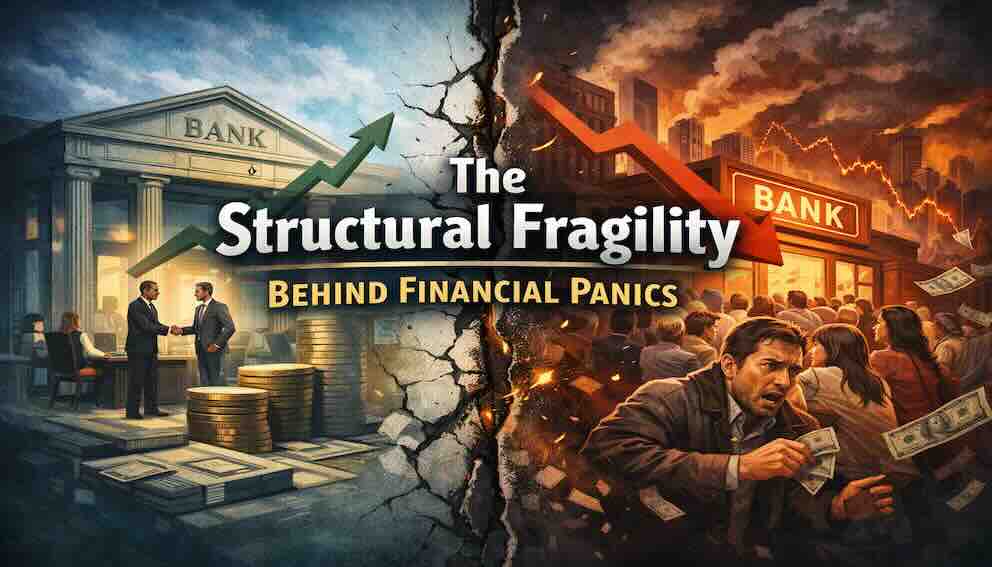
Looking across these events—1907, 1930–1933, 2007, 2008—a pattern emerges. The institutions differ. The eras differ. The technologies differ. But the underlying structure is the same.
Banks take money that can be withdrawn at any moment—deposits, overnight loans, short-term credit—and turn it into loans that cannot be called in quickly—mortgages, business loans, long-term investments. This transformation is economically essential. It is what allows savings to become investment, what allows a baker to buy an oven, what allows a family to buy a home.
But it is also inherently fragile. The transformation creates a mismatch. And that mismatch means that confidence is not merely a nice addition to the banking system; it is the foundation on which everything rests.
When confidence holds, the system works. Depositors do not all withdraw at once. The bank can hold its loans to maturity. The money supply expands. The economy grows.
When confidence breaks, the system fails. Depositors rush to withdraw. Banks must sell assets at fire-sale prices. Losses mount. Money is destroyed. The economy contracts.
This is the lesson that history teaches. Runs are not caused by corrupt bankers or foolish depositors, though both can appear in the stories. They are caused by the structure of banking itself. The vulnerability is built in.
What History Built — The Safeguards
Each crisis taught a lesson. Each lesson built a safeguard.
The Panic of 1907 taught that the system needed a lender of last resort. No single private banker, no matter how powerful, could be expected to stabilize the system every time. The Federal Reserve was created in 1913 to provide emergency liquidity when confidence evaporated.
The banking crises of 1930–1933 taught that lender of last resort was not enough. Banks could still fail, and when they failed, depositors lost everything. That loss itself became a source of runs. The FDIC was created in 1933 to guarantee deposits, breaking the logic of the depositor's dilemma.
The crises of 2007–2008 taught that these safeguards, designed for traditional banks, did not cover the shadow banking system. Money market funds, repo markets, and other institutions had grown up outside the regulatory framework. When runs hit them, the same dynamics played out. Post-crisis regulation extended safeguards to new parts of the system.
Today's safeguards include:
- Deposit insurance that protects most depositors and removes the incentive to run.
- Central bank lending that provides emergency liquidity to solvent institutions.
- Capital requirements that force banks to hold buffers against losses.
- Liquidity requirements that ensure banks have enough easily-sold assets to meet withdrawals.
- Stress testing that forces banks to prove they can survive severe scenarios.
These safeguards are not foolproof. They cannot eliminate the fundamental fragility that comes from transforming short-term deposits into long-term loans. But they reduce the likelihood of runs and contain the damage when runs occur.
Conclusion: What History Teaches
The Panic of 1907 taught that without a central bank, the system is vulnerable to cascading failures. The banking crisis of 1930–1933 taught that without deposit insurance, runs become self-fulfilling. Northern Rock taught that the old vulnerabilities still existed, even in modern systems. The shadow bank run of 2008 taught that the same dynamics could appear in new places.
Each crisis revealed the same underlying truth: banking is inherently fragile because it transforms short-term deposits into long-term loans. Confidence matters as much as capital. And when confidence evaporates, even sound institutions can fail.
For anyone who wants to understand financial history, bank runs are essential. They strip away complexity and reveal the foundations: trust, perception, and the human behavior that shapes markets. They remind us that money is not just numbers on a screen. It is a social institution, built on beliefs about the future, vulnerable to the very human tendency to panic.
And they remind us that in banking, as in so much of life, the greatest danger is often not what we know, but what we fear.
Further Reading
- “Manias, Panics, and Crashes” by Charles P. Kindleberger – A classic study of financial crises across history.
- “Fragile by Design” by Charles W. Calomiris & Stephen H. Haber – Explains why banking systems are prone to instability.
- “Lords of Finance” by Liaquat Ahamed – Chronicles central bankers’ roles in early 20th-century crises.
- “Other People’s Money” by John Kay – A modern perspective on banking, regulation, and systemic risk.
About Swati Sharma
Lead Editor at MyEyze, Economist & Finance Research WriterSwati Sharma is an economist with a Bachelor’s degree in Economics (Honours), CIPD Level 5 certification, and an MBA, and over 18 years of experience across management consulting, investment, and technology organizations. She specializes in research-driven financial education, focusing on economics, markets, and investor behavior, with a passion for making complex financial concepts clear, accurate, and accessible to a broad audience.
Disclaimer
This article is for educational purposes only and should not be interpreted as financial advice. Readers should consult a qualified financial professional before making investment decisions. Assistance from AI-powered generative tools was taken to format and improve language flow. While we strive for accuracy, this content may contain errors or omissions and should be independently verified.