
Tutorial Categories
Last Updated: March 4, 2026 at 10:30
1929 and the Great Depression: How Policy Failures Turned a Market Crash into a Global Catastrophe
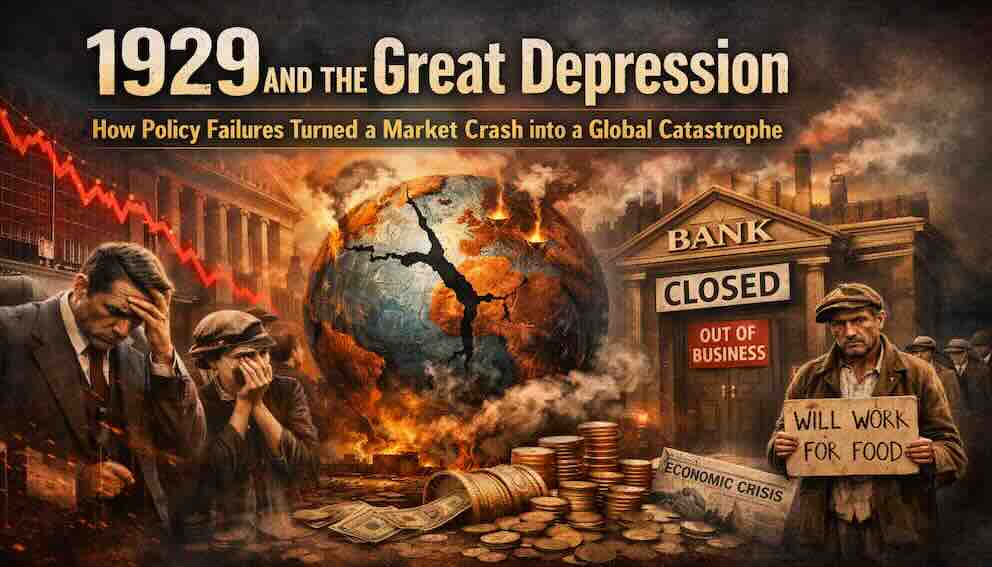
The stock market crash of October 1929 remains the most famous financial collapse in modern history. Yet the crash itself did not create the Great Depression. That distinction belongs to what followed: a cascade of policy failures that transformed a sharp but survivable market correction into a decade of economic devastation. By examining the interplay of speculation, banking panics, monetary rigidity, debt deflation, and protectionist trade policies, we uncover the deeper lesson for investors—that markets can recover from almost anything except sustained policy error.
Introduction: The Day the Jazz Age Stopped
On the morning of October 24, 1929—Black Thursday—the ticker at the New York Stock Exchange ran hours behind. Brokers shouted orders that could not be filled. Men who had been millionaires at breakfast stood outside their clubs that evening, unable to pay for a cab ride home. The Roaring Twenties, it seemed, had ended in a single week of panic.
That image has fixed itself in historical memory. Yet it obscures something essential. The crash of 1929 did not cause the Great Depression. Stock markets had crashed before—in 1873, in 1893, in 1907—and the economy had recovered. What turned this crash into a catastrophe was not the fall in prices but the response to that fall. The decisions made in Washington, at the Federal Reserve, and in capitals across Europe transformed a financial panic into the deepest economic collapse the modern world has known.
To understand why, we must go back before the crash, into the strange optimism of the 1920s, and then forward through the series of policy errors that turned a bad year into a lost decade.
The Architecture of the 1920s Boom
In the decade before the crash, American industry genuinely transformed itself. Automobiles replaced horse-drawn carriages. Radios brought news and entertainment into living rooms. Refrigerators, washing machines, and vacuum cleaners became common in urban homes. Productivity rose sharply, and corporate profits rose with it.
This genuine prosperity created a psychological climate in which risk appeared to have diminished. If industry was growing, if wages were rising, if the future seemed brighter than the past—why would markets not rise forever?
The stock market became the focus of this optimism. Not only wealthy financiers but ordinary clerks, schoolteachers, and factory workers began purchasing shares. They bought because they saw their neighbors getting rich. They bought because newspapers reported rising prices as though they were natural events, like weather. They bought because the narrative of a "new era" had taken hold.
But beneath this optimism, a more fragile structure was being built. Many investors bought stocks on margin—borrowing money from their brokers to purchase shares. The typical margin requirement in 1929 was only 10 percent. An investor could control $1,000 worth of stock with just $100 of their own money.
To understand what this meant, consider what leverage does. When you buy a stock with your own money, a price decline is painful but survivable. If the stock falls 20 percent, you still own 80 percent of your investment. You can wait for it to recover.
With borrowed money, the math changes. If you put up $100 of your own money and borrow $900 to buy $1,000 worth of stock, you have 10-to-1 leverage. A 10 percent decline in the stock reduces its value to $900—exactly what you owe. Your $100 is gone. You own nothing.
Now imagine thousands of investors in this position. When prices fall, they get margin calls: brokers demand more cash or force them to sell. They have no choice. They sell immediately, pushing prices down further. Those lower prices trigger margin calls for the next layer of investors. The selling feeds on itself.
By the summer of 1929, margin debt had reached extraordinary levels. The stock market had become a pyramid of borrowed money.
October 1929—The Crash Itself
The crash did not arrive without warning. Industrial production had peaked in June 1929 and begun a slow decline. Construction had been weakening for years. Consumer debt was high. But stock prices, detached from these underlying realities, continued climbing through the summer.
In September, the market wavered. Then, in October, it broke.
Black Thursday, October 24, saw panic selling that overwhelmed the exchange's capacity to process trades. A group of prominent bankers, led by Thomas Lamont of J.P. Morgan, attempted to stabilize the market by pooling money and buying shares conspicuously. For a moment, it seemed to work. Prices steadied.
But the stability was temporary. The following Tuesday, October 29, remains the single worst day in stock market history. More than sixteen million shares changed hands—a staggering volume for an era before electronic trading—and prices collapsed. By mid-November, the market had lost nearly half its value from the September peak.
The human toll was immediate. Fortunes disappeared. Margin calls wiped out families who had borrowed to participate in prosperity. Yet even this devastation did not make the Depression inevitable. Markets had fallen this far before. The question was what would happen next.
Banking Panics and the Federal Reserve's Failure
The answer came in waves of bank failures that began in late 1930 and continued through 1933.
To understand why banks failed, we must recall how banking works. Banks take deposits, which they must be able to return on demand, and they lend that money out, often for years. In normal times, only a fraction of depositors want their money at once. In panics, everyone wants their money at once, and the bank cannot satisfy them because the money is tied up in loans.
When a bank fails, depositors lose their savings. But the damage goes further. The money that depositors thought they had—the deposits they relied on for purchases and payments—simply vanishes. The money supply contracts. Businesses that depended on bank loans to meet payroll or buy inventory find those loans called in or not renewed. They lay off workers. The laid-off workers cannot buy goods. The businesses that sold those goods lose revenue. The cycle feeds itself.
Between 1930 and 1933, roughly nine thousand American banks failed—about one-third of all banks in the country. Depositors lost $1.3 billion in savings, a staggering sum at the time.
The Federal Reserve had been created in 1913 precisely to prevent this kind of cascade. It was designed to act as a lender of last resort—to provide liquidity to sound banks facing temporary runs, so that panic did not destroy solvent institutions. During the early 1930s, it did the opposite.
Instead of injecting money into the banking system, the Federal Reserve allowed the money supply to contract by roughly one-third between 1929 and 1933. From a peak of about $26 billion in 1929, the money supply fell to around $19 billion by early 1933. It raised interest rates in 1931, when Britain left the gold standard, fearing that the dollar would come under pressure. It stood by while thousands of banks failed, believing that "liquidation" was necessary to purge unsound practices from the system.
This was not malice. It was doctrine. Many officials at the Fed believed that depressions were natural correctives, that intervention only prolonged suffering, that the proper response to crisis was to let weak institutions fail. They were wrong, and their error turned a severe recession into the Great Depression.
Debt Deflation—The Vicious Spiral
To understand why the Fed's contraction was so destructive, we must introduce a mechanism that the economist Irving Fisher identified in 1933, the year after he lost his own fortune in the crash. Fisher called it "debt deflation."
Imagine a farmer who borrows $1,000 in 1929, when wheat sells for $1 per bushel. The farmer plans to repay the loan with the proceeds from future harvests. In 1932, wheat prices have fallen to $0.60 per bushel. The farmer still owes $1,000, but now must sell nearly twice as much wheat to repay the same nominal debt. This is not merely hardship. It is a mathematical trap.
As prices fall, the real burden of debt rises. Borrowers who seemed solvent when prices were higher become insolvent when prices fall. They default on their loans. Banks, which counted on those repayments, fail. The bank failures reduce the money supply further. Prices fall more. The spiral feeds itself.
Fisher's insight was that deflation does not simply reflect economic weakness—it actively creates more weakness. It turns liquidity problems into solvency crises. It punishes those who borrowed in good faith. It destroys the balance sheets of households, farms, and businesses that had nothing to do with stock market speculation.
This debt-deflation spiral was the hidden engine of the Depression's depth. The Fed's contraction did not just remove money from the economy. It triggered a chain reaction in which falling prices made debt unbearable, which caused defaults, which destroyed banks, which reduced the money supply further, which made prices fall more. By 1933, the spiral had run for three years.
The Gold Standard's Rigid Grip
The Federal Reserve's contractionary stance was not entirely a matter of choice. It operated within the constraints of the international gold standard, a system that bound currencies to fixed quantities of gold.
Under the gold standard, countries maintained fixed exchange rates. If a country lost gold reserves, it had to raise interest rates to attract capital back. If a country tried to stimulate its economy by lowering rates, it risked capital outflows and gold losses that would threaten its currency peg.
In the early 1930s, these constraints proved catastrophic. As banks failed and confidence crumbled, people converted deposits into currency and, in some cases, gold. The United States lost gold. To stem the outflow, the Federal Reserve raised interest rates in 1931—the worst possible response to a deepening depression, but a response dictated by the logic of the gold standard.
Other countries faced similar dilemmas. The countries that left the gold standard earliest—Britain in 1931, Sweden and Japan soon after—recovered earlier. The countries that clung longest to gold—the United States until 1933, France until 1936—suffered prolonged depressions. The contrast could not be starker. Britain's industrial production began recovering in 1932. American production continued falling until March 1933.
The lesson was that rigid adherence to any monetary framework, regardless of circumstances, prevents the flexible response that crises require. When the rules themselves become the enemy of recovery, the rules must change.
The International Debt Web—How the Depression Became Global
The Depression did not remain confined to the United States because the 1920s had built an international financial system that depended on continuous American lending.
The architecture of the 1920s rested on a fragile triangle:
- American banks lent money to Germany.
- Germany used that money to pay reparations to Britain and France, as required by the Versailles Treaty.
- Britain and France used those reparations payments to repay their war debts to the United States.
This circular flow meant that dollars traveled from New York to Berlin to London and Paris and back to New York. As long as American lending continued, the system functioned. When the crash came and American lending stopped, the entire structure collapsed.
Germany, deprived of American loans, could no longer pay reparations. Its economy, already fragile, slid into crisis. In 1931, the Austrian bank Credit-Anstalt failed, triggering banking panics across Central Europe. Germany imposed capital controls. Britain, facing gold outflows, abandoned the gold standard.
France compounded the problem by accumulating enormous gold reserves in the late 1920s and early 1930s without expanding its money supply. This meant that gold was being sterilized—removed from circulation—rather than supporting price stability or growth. French policy imposed deflationary pressure on every country that remained on gold.
By 1931, the crisis was truly global. The banking systems of Central Europe had collapsed. British trade was devastated by the collapse of world commerce. American banks, which had lent to Germany and Austria, faced new losses. The Depression fed upon itself across borders.
The Smoot–Hawley Tariff and the Destruction of Trade
As the economy weakened, political pressure grew for protection. American industries, facing falling demand, wanted barriers against foreign competition. Farmers, devastated by falling crop prices, wanted tariffs on agricultural imports. Congress responded with the Smoot–Hawley Tariff Act, signed into law by President Herbert Hoover in June 1930.
The tariff raised duties on thousands of imported goods to historically high levels. Its supporters argued that it would protect American jobs and preserve American prosperity. Its effects were the opposite.
Other countries retaliated immediately. Canada, Spain, France, Italy, and Switzerland imposed new tariffs on American goods. Global trade, already weakening, collapsed. Between 1929 and 1934, world trade declined by approximately two-thirds.
To understand what this meant, return to our wheat farmer. Before the tariff, that farmer might have sold grain to European buyers, who paid in currency that could be used to purchase American goods. After the tariff and retaliation, the European buyers could no longer afford American wheat, and the farmer could no longer sell to them. The farmer's income fell. The farmer defaulted on loans. The local bank, which held those loans, weakened. The contraction spread.
Protectionism did not cause the Depression, but it deepened and prolonged it. It destroyed the international cooperation that might have eased recovery. It turned an American crisis into a global one, and a global crisis into a series of retaliatory trade wars that left no nation better off.
The Human Scale of Collapse
These policy failures—banking collapse, monetary contraction, debt deflation, rigid adherence to gold, trade destruction—had human consequences that statistics can only suggest.
By 1933, unemployment in the United States reached approximately 25 percent. For those who kept their jobs, wages fell sharply. Industrial production had fallen by half. Thousands of banks had failed, and with them, the savings of millions of families.
Men who had worked steadily for decades found themselves standing in bread lines. Families were evicted from their homes. Farmers, unable to sell their crops at any price, watched their land repossessed by banks. In cities, soup kitchens and shantytowns—called "Hoovervilles" in bitter honor of the president—became common sights.
The psychological toll matched the economic one. People who had believed in progress, who had trusted banks, who had saved for their children's futures, lost not only their money but their faith in the system itself. This loss of faith would shape American politics for a generation, creating demands for reform that culminated in the New Deal.
And in Europe, the consequences were even darker. The Depression destabilized fragile democracies. In Germany, unemployment reached 30 percent. The political center collapsed. By 1933, the same year Franklin Roosevelt took office in Washington, Adolf Hitler became chancellor in Berlin. The economic catastrophe of the early 1930s did not cause World War II, but it created the conditions in which extremism could flourish.
The New Deal—A Different Kind of Response
When Franklin D. Roosevelt took office in March 1933, the banking system had largely ceased to function. Many states had declared bank holidays to prevent further runs. The atmosphere was one of desperation.
Roosevelt's response was not a single coherent plan but a series of experiments, some successful, some less so. What mattered was the shift in philosophy. Instead of allowing liquidation to run its course, the federal government would act.
The first act was the bank holiday itself. Roosevelt closed all banks for several days, allowing time to examine their condition and reopen only those deemed solvent. Then, in his first fireside chat, he explained directly to the American people what was happening and why their deposits would now be safe.
The creation of the Federal Deposit Insurance Corporation guaranteed deposits up to a certain amount, eliminating the incentive for depositors to run at the first sign of trouble. Banks that reopened under this guarantee were far less vulnerable to panic.
The abandonment of the gold standard in 1933 allowed monetary expansion. The dollar was devalued, prices began to rise, and deflation—the silent killer of debtors—was reversed. Farmers could sell their crops again. Businesses could plan again.
Public works programs created jobs. The Civilian Conservation Corps put young men to work in national forests. The Works Progress Administration built roads, bridges, and schools across the country.
Financial regulation followed. The Securities Act of 1933 and the Securities Exchange Act of 1934 required disclosure from companies issuing stock and created the Securities and Exchange Commission to oversee markets. The Glass–Steagall Act separated commercial banking from investment banking, limiting the risks that banks could take with depositor funds.
Yet the New Deal was not an unqualified success. Some programs, like the National Recovery Administration, attempted to fix prices and wages in ways that may have delayed recovery by limiting competition. Business investment remained weak throughout the 1930s, in part because of uncertainty about new regulations and taxes. Unemployment, while reduced from its 1933 peak, remained above 10 percent until the war mobilization of the early 1940s.
Full recovery came not from New Deal programs but from the massive government spending of World War II. This does not invalidate the New Deal's achievements—deposit insurance and the SEC remain foundations of financial stability—but it suggests humility about what policy can accomplish once a depression has taken hold.
Debating the Causes—A Note on Historical Interpretation
The interpretation offered here emphasizes monetary policy, banking failures, and debt deflation. This view, associated most prominently with Milton Friedman and Anna Schwartz's monumental A Monetary History of the United States, has been enormously influential. It shaped the Federal Reserve's response to the 2008 crisis and remains the dominant framework for understanding the Depression's depth.
But it is not the only view. Some economic historians, such as Peter Temin, have argued that the Depression began with a collapse in consumption and investment unrelated to monetary policy—a real shock that monetary expansion could not have prevented. Others have emphasized the role of structural factors: agriculture was already depressed in the 1920s, income inequality suppressed consumer demand, and the rapid growth of consumer durables created a saturation point.
More recent scholarship has explored the "credit channel" through which bank failures disrupted lending even to sound borrowers. Ben Bernanke, before his tenure as Federal Reserve chair, argued that the destruction of banking relationships and credit intermediation amplified the downturn in ways that simple monetary aggregates do not capture.
These debates need not be resolved here. What matters is that the Depression was overdetermined—many factors pushed in the same direction. Monetary policy errors made it worse. Banking failures made it worse. Debt deflation made it worse. International monetary rigidities made it worse. Protectionism made it worse. The catastrophe was the sum of these failures, not any single one.
Why This Matters Now—2008 and Beyond
The institutions that emerged from the Depression—deposit insurance, the SEC, active central banking—were designed to prevent a recurrence. For decades, they succeeded. Banking panics of the 1930s variety became rare. Monetary policy became more flexible. Trade, while never completely free, expanded enormously.
The 2008 financial crisis tested this system. When the investment bank Lehman Brothers failed in September 2008, panic spread through global markets. Money market funds experienced runs. Interbank lending froze. The world stood on the edge of another 1930s-style collapse.
This time, policymakers responded differently. The Federal Reserve injected massive liquidity into the banking system. It opened emergency lending facilities. It cut interest rates to zero. The Treasury guaranteed money market funds. Congress passed a bank rescue program. The contrast with 1930–1933 could not be starker.
The lesson had been learned. Central banks now know that letting the money supply collapse is catastrophic. They know that bank failures must be contained. They know that deflation is a poison. The ghost of 1929 guided their hands.
Yet the underlying vulnerabilities remain. Leverage can still accumulate. Confidence can still waver. Policymakers can still make mistakes, though perhaps different ones. And new threats have emerged—sovereign debt, climate change, geopolitical fragmentation—that the Depression-era toolkit may not address.
The investor who studies 1929 sees not a distant event but a recurring possibility. They ask not only whether a company is sound but whether the system itself is sound. They watch not only earnings reports but central bank behavior, trade policy, and the subtle accumulation of leverage that precedes all crashes.
Conclusion: Crashes Are Inevitable; Depressions Are Not
The stock market crash of 1929 was a severe shock, but it need not have become the Great Depression. What turned a market correction into a global catastrophe was a series of policy failures—banking panics allowed to spread, monetary contraction permitted to continue, debt deflation left to spiral, a rigid gold standard that prevented flexibility, protectionist tariffs that strangled trade, and an international debt structure that collapsed when American lending stopped.
These failures were not inevitable. They were choices, made by people operating within the frameworks they understood. The Federal Reserve believed liquidation was healthy. Congress believed tariffs would protect jobs. The guardians of the gold standard believed defending currencies was paramount. They were wrong, and their errors shaped the lives of millions and the destiny of nations.
The central lesson for investors is not that markets are dangerous, though they are. It is that the institutional framework matters. A sound company can fail if the banking system collapses. A diversified portfolio can be destroyed if trade wars spiral. A long-term plan can be upended if monetary policy turns contractionary.
Crashes are inevitable. They have happened throughout financial history and will happen again. But depressions are not. They are the result of policy choices—choices that can be made well or made poorly. The investor who understands this watches not only prices but policies. They know that the line between a crash and a catastrophe is drawn not in markets but in the halls of government, and that line is drawn by human decisions.
In today's world, with debt levels higher than they were in 1929 and trade tensions resurgent, the question is not whether another crash will come. It will. The question is whether policymakers will repeat the errors of the 1930s or remember the lessons learned at such terrible cost.
Further Reading
- Milton Friedman and Anna Jacobson Schwartz, A Monetary History of the United States, 1867–1960 (1963). The foundational argument that Federal Reserve contraction turned a recession into a catastrophe. Dense but essential.
- Ben S. Bernanke, Essays on the Great Depression (2000). Expands beyond monetarism to explore how the destruction of banking relationships amplified the downturn. Shaped the 2008 policy response.
- Charles P. Kindleberger and Robert Aliber, Manias, Panics, and Crashes: A History of Financial Crises (1978, with later editions). Places 1929 in the centuries-long pattern of credit expansion, euphoria, and panic.
- Irving Fisher, The Debt-Deflation Theory of Great Depressions (1933). The original articulation of how falling prices increase real debt burdens, turning liquidity problems into solvency crises.
- Liaquat Ahamed, Lords of Finance: The Bankers Who Broke the World (2009). A highly readable narrative focusing on the central bankers of the era and the decisions that led to global collapse.
About Swati Sharma
Lead Editor at MyEyze, Economist & Finance Research WriterSwati Sharma is an economist with a Bachelor’s degree in Economics (Honours), CIPD Level 5 certification, and an MBA, and over 18 years of experience across management consulting, investment, and technology organizations. She specializes in research-driven financial education, focusing on economics, markets, and investor behavior, with a passion for making complex financial concepts clear, accurate, and accessible to a broad audience.
Disclaimer
This article is for educational purposes only and should not be interpreted as financial advice. Readers should consult a qualified financial professional before making investment decisions. Assistance from AI-powered generative tools was taken to format and improve language flow. While we strive for accuracy, this content may contain errors or omissions and should be independently verified.