
Tutorial Categories
Last Updated: March 5, 2026 at 10:30
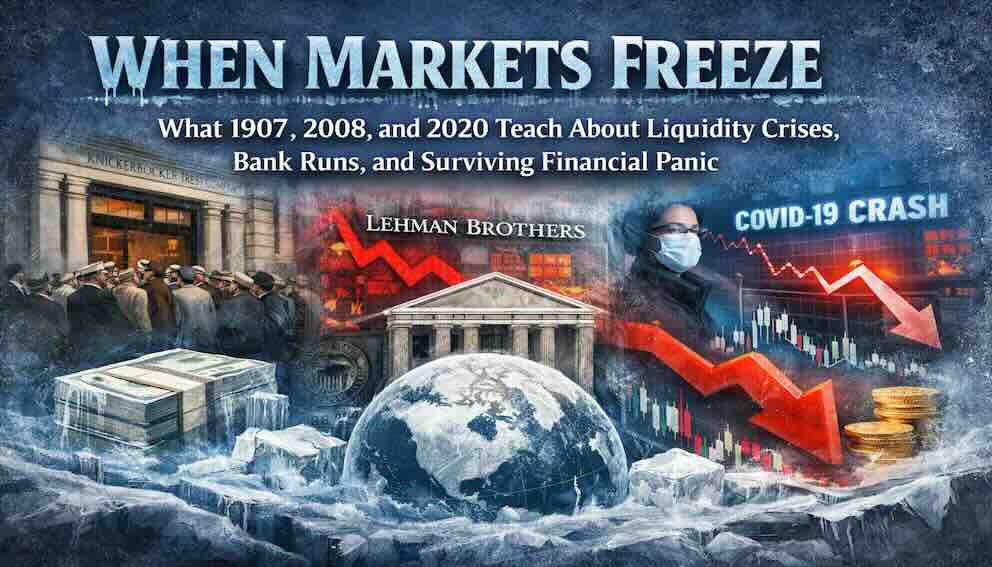
When Markets Freeze: What 1907, 2008, and 2020 Teach About Liquidity Crises, Bank Runs, and Surviving Financial Panic
Financial markets do not usually collapse because companies suddenly become worthless. They collapse because liquidity disappears and investors can no longer buy or sell assets at reasonable prices. By examining three major crises—the Panic of 1907, the Global Financial Crisis of 2008, and the COVID-19 crash of 2020—we discover how liquidity evaporates before value does, how leverage accelerates collapse, how policymakers restore confidence, and what disciplined investors can learn about surviving when markets freeze.
Introduction: When Markets Go Silent
There is a silence that falls over financial markets when something has gone wrong. The screens still flash. The news ticker still runs. But the usual rhythm has stopped. Offers to buy that appeared moments ago have vanished. Sellers who expected to exit find themselves trapped. The machine is still running, but it is no longer functioning.
In normal times, selling a stock is like turning on a tap. You decide, you click, and the transaction happens. The price you get is almost exactly what you saw on the screen. You do not think about the buyers. They are always there.
Then panic comes, and the tap runs dry. Sellers crowd the exits, but the buyers have melted away. Prices fall not because the companies behind them have suddenly become worthless, but because the mechanism that connects buyer and seller has broken down. The market has frozen.
To understand why this happens and how investors can respond, we will walk through three historical episodes separated by decades but united by a common dynamic: the Panic of 1907, the Global Financial Crisis of 2008, and the COVID-19 crash of 2020. Each reveals something essential about liquidity—the invisible lifeline that keeps markets alive—and what happens when it disappears.
The Panic of 1907—When There Was No Central Bank
Let us begin in New York, in October 1907, at a moment when the American financial system had no Federal Reserve, no deposit insurance, and no formal mechanism for stopping a panic.
The crisis began with a speculative scheme. A group of investors attempted to corner the market in the stock of the United Copper Company. When the scheme failed, it brought down several banks that had financed it. Among the institutions caught in the fallout was the Knickerbocker Trust Company, the third-largest trust in New York.
The trusts of 1907 were an early form of what we now call shadow banking—institutions that performed bank-like functions, borrowing short and lending long, but faced lighter regulation than traditional banks. They had grown rapidly during the preceding years of stability, taking on more leverage and making riskier loans. When the copper scheme collapsed, depositors realized how fragile these institutions had become.
News of Knickerbocker's troubles spread quickly. Depositors lined up outside its doors on Fifth Avenue, demanding their money. Within hours, the trust had paid out millions and was forced to suspend operations. Fear spread to other trusts. If Knickerbocker could fail, perhaps other institutions could fail. Depositors rushed to withdraw from trusts that had no connection to the original speculation.
The underlying economy of the United States had not suddenly collapsed. Factories still operated. Railroads still moved goods. Farms still produced crops. But the banking system, which provided the credit that kept these activities running, was freezing. Banks could not convert their loans into cash quickly enough to meet depositor demands.
Consider a simple illustration. Imagine a bank with $100 in deposits. It keeps $10 in cash and lends out $90. If $20 of depositors demand their money back, the bank must sell some of those loans quickly. But loans cannot be sold instantly at full value. The bank takes a loss. That loss reduces its capital. That reduction makes remaining depositors more nervous. The spiral feeds itself.
There was no central bank to step in. The only person with enough credibility to stop the panic was J. P. Morgan, the elderly financier who had dominated American banking for decades. Morgan gathered the leading bankers in his library and essentially locked them in a room until they agreed to pool resources and support troubled institutions. He personally examined balance sheets, decided which institutions were solvent but illiquid, and raised money to keep them afloat.
The panic subsided, but the lesson was not lost. The following years saw the creation of the Federal Reserve System in 1913, designed explicitly to act as a lender of last resort—to provide liquidity when private markets could not. The architects of the Fed had learned that in a crisis, the distinction between insolvency and illiquidity matters less than the speed of the response.
The Global Financial Crisis of 2008—Complexity, Solvency, and Contagion
Move forward a century, to a world of derivatives, mortgage-backed securities, and global capital flows. The instruments had changed, but the underlying dynamic remained the same, though with important new dimensions.
The crisis of 2008 is often remembered as a story about bad mortgages and reckless lending. Those elements were present, but they were not the immediate cause of the market freeze. The freeze happened because of how banks funded themselves and because solvency problems in one part of the system infected the whole.
In the years before the crisis, financial institutions had come to rely heavily on short-term borrowing. They would borrow money overnight from money market funds and other lenders, using their assets as collateral. This rolling short-term funding worked as long as lenders remained confident. Investment banks like Lehman Brothers and Bear Stearns operated with leverage ratios exceeding 30-to-1, meaning that a decline of just over 3 percent in asset values could wipe out their equity.
When housing prices began to fall and mortgage defaults rose, the value of mortgage-backed securities became uncertain. Some of these securities were genuinely impaired. The solvency problem was real. But the crisis became systemic when funding liquidity dried up.
When confidence broke, lenders refused to roll over the short-term loans. This was a run, but not the kind of run with depositors lined up outside a bank. It was a silent run conducted through computers and wire transfers. The repo market—where much of this borrowing took place—began to seize up. Institutions that had relied on daily access to cash suddenly found themselves unable to borrow.
To raise cash, they had to sell assets. But when many institutions sell the same kinds of assets at the same time, prices collapse. The collapse in prices creates losses. The losses raise questions about solvency. The questions about solvency make lenders even less willing to lend. The spiral fed itself.
This is what happened to Lehman Brothers in September 2008. When the government allowed Lehman to fail, the panic intensified. The money market fund industry, which had been considered virtually risk-free, experienced its own run when the Reserve Primary Fund "broke the buck"—meaning its shares fell below the promised $1 net asset value. The commercial paper market, which provides short-term funding to corporations, froze.
The response came from the Federal Reserve and the Treasury. The Fed opened emergency lending facilities, guaranteeing money market funds and providing liquidity to strained markets. It cut interest rates to zero. It eventually launched programs to buy assets directly. The message was clear: the central bank would provide liquidity wherever it was needed.
Unlike 1907, the 2008 crisis involved genuine solvency impairment. Many mortgage-backed securities were not merely temporarily illiquid; they were permanently impaired. But the panic that spread through the financial system was a liquidity crisis layered on top of a solvency crisis. The two interacted to produce the worst collapse since the Great Depression.
The COVID-19 Crash of 2020—Exogenous Shock and Unprecedented Response
The most recent example arrived with terrifying speed in March 2020, and it was different in kind from the previous two.
When governments around the world announced lockdowns to contain the spread of COVID-19, investors faced an unprecedented shock. No one knew how long the shutdowns would last. No one knew which businesses would survive. Uncertainty overwhelmed markets.
Unlike 1907 and 2008, this crisis did not emerge from financial imbalances built up over years. The trusts of 1907 had grown recklessly. The housing bubble of 2008 had inflated for half a decade. But 2020's freeze was triggered by an external event—a pandemic. The financial system had entered 2020 with higher capital requirements and liquidity buffers installed after 2008, yet vulnerabilities remained. Corporate debt levels were historically high, and some leveraged strategies had quietly accumulated. Resilience and fragility coexisted.
Stocks fell faster than at any point in history, including 1929. But the most revealing stress occurred in markets that were supposed to be safe. Even United States Treasury bonds, the most liquid asset in the world, experienced moments of dysfunction. Bid-ask spreads widened. Trades became difficult to execute. The market for corporate bonds, where companies go to raise funding, nearly froze.
Why did this happen, even in Treasuries? Several factors converged. Hedge funds had been running highly leveraged basis trades that exploited tiny price differences between Treasury securities. When volatility exploded, those trades unwound violently. Dealers' balance sheets, constrained by post-2008 regulations, could not absorb the massive wave of selling. And investors around the world, desperate for cash, sold whatever they could sell, including their safest assets.
The Federal Reserve responded with even greater speed and force than in 2008. It cut rates to zero. It restarted emergency lending programs. It announced that it would purchase corporate bonds directly—something it had never done before. It signaled, in every possible way, that it would provide unlimited liquidity to keep markets functioning. It effectively became the buyer of last resort, not just for banks but for entire markets.
Within months, markets recovered. The economy, while damaged, avoided a complete financial collapse. The V-shaped recovery in asset prices was unlike anything seen after 2008. The lesson was stark: without the Fed's intervention, the liquidity freeze of March 2020 could have become something far worse.
The Architecture of Liquidity—Market Liquidity and Funding Liquidity
To understand these crises deeply, we must distinguish between two forms of liquidity that interact in moments of stress.
Market liquidity is what most investors think of when they hear the word. It is the ability to sell an asset without moving the price against you. When market liquidity is high, you can exit positions easily. When it vanishes, you are trapped.
Funding liquidity is different. It is the ability to borrow cash against your assets. Banks, investment firms, and hedge funds rely on funding liquidity to operate. They borrow short-term money, using their securities as collateral, and use that cash to finance larger positions.
In normal times, these two forms of liquidity reinforce each other. You can borrow because your collateral is liquid. And because you can borrow, you do not need to sell.
In a crisis, the relationship reverses. When lenders fear that collateral values may fall, they stop lending. Funding liquidity dries up. Now you must sell assets to raise cash. But if many investors sell at once, market liquidity collapses. Prices fall. Falling prices make lenders even more reluctant to lend. Funding liquidity dries up further.
This spiral is the engine of every severe financial panic. It was present in 1907, when trusts could not borrow and had to sell assets, driving down prices and causing more runs. It was present in 2008, when the repo market froze and investment banks were forced into fire sales. It was present in 2020, when hedge funds unwound leveraged positions and dealers could not absorb the selling.
Post-2020 Echoes—The Lessons Applied and Tested
The story did not end in 2020. The years that followed tested the system again.
In 2022 and 2023, as the Federal Reserve raised interest rates at the fastest pace in decades to fight inflation, new stresses emerged. The rapid rise in rates created large unrealized losses on bond portfolios held by banks. These losses were not a problem as long as banks could hold the bonds to maturity. But they became a problem when depositors grew nervous.
In March 2023, Silicon Valley Bank failed in what became the fastest bank run in American history. Depositors, able to communicate through messaging apps and move money with a few clicks, withdrew $42 billion in a single day. The bank had plenty of assets, but they were mostly long-term bonds that had fallen in value as rates rose. To meet withdrawals, it would have had to sell those bonds at a loss.
The bank's bonds would have paid in full over time. But it did not have the time. This is the boundary between liquidity and solvency: when you cannot wait for value to be realized, liquidity risk becomes solvency risk.
The Federal Reserve and FDIC intervened, guaranteeing all deposits—even those above the insurance limit—to stop the panic from spreading. The episode revealed that liquidity risks persist even after decades of reform. The speed of information and money movement has transformed the nature of runs. And leverage takes many forms, including duration mismatch, where banks borrow short-term deposits to fund long-term bonds.
The Common Thread—Liquidity, Leverage, and the Crisis of Belief
Across these episodes, a pattern emerges that reveals why liquidity vanishes so quickly.
In normal times, investors hold assets because they believe they can sell them later if needed. This belief supports liquidity. When fear spreads, investors begin to doubt that buyers will be available tomorrow. That doubt encourages them to sell today, while selling is still possible.
If many investors act on this fear at once, the number of sellers overwhelms the number of buyers. Prices fall. Falling prices create more fear, which creates more selling. In this feedback loop, liquidity evaporates.
Notice that this process does not require any fundamental deterioration in the value of the underlying assets. It requires only a shift in expectations about what other market participants will do. A bank run happens because depositors believe other depositors will withdraw. A market freeze happens because sellers believe other sellers will exit. Both are coordination problems dressed in different clothing.
This is why policymakers focus on restoring confidence. When market participants believe that liquidity will be available—that they can sell if they need to—the urgency to sell immediately diminishes. The panic subsides.
How the System Evolved—And the Theory Behind It
Each crisis reshaped the financial system. The reforms were direct responses to specific failures.
After 1907, the creation of the Federal Reserve gave the United States a lender of last resort. The panic had shown that relying on a private banker was not sustainable.
After 2008, the Dodd-Frank Act imposed higher capital requirements, stress tests, and new resolution authorities. The crisis had shown that leverage had become extreme and that some institutions were "too big to fail."
After 2020, the Fed's toolkit expanded further. It began purchasing corporate bonds directly, signaling that it would backstop not just banks but entire markets.
Behind these interventions lies a principle articulated 150 years ago by Walter Bagehot, the British journalist and financial thinker. In a panic, Bagehot argued, a central bank should lend freely, at a penalty rate, against good collateral. Lend freely to stop the panic. Charge a penalty rate to prevent reckless borrowing. Accept good collateral to ensure the loans are safe. This rule explains why central banks intervene, and also why they sometimes let firms fail. It is not about saving everyone. It is about supporting liquidity without rewarding recklessness.
The cost of intervention is moral hazard. When markets believe the central bank will always step in, they may take more risk. After 2008, markets assumed the Fed would intervene again. In 2020, intervention was faster and broader. In 2023, all deposits at Silicon Valley Bank were guaranteed. Each rescue reinforces the expectation of future rescues. This tension—between stopping panic and encouraging recklessness—has no perfect resolution. Policymakers must balance the immediate crisis against the long-term incentives they create.
What Each Crisis Teaches About the Other
Comparing these episodes reveals important distinctions that deepen our understanding.
1907 and 2008 both involved shadow banking—lightly regulated institutions that had grown rapidly during periods of stability. Both required intervention by a lender of last resort—private in 1907, public in 2008. But 2008 was far more complex. The instruments were more opaque. The interconnections were global. And the solvency problems were real.
2020 was different again. The shock was external. Yet the freeze still happened, because the demand for cash in a moment of extreme uncertainty overwhelmed even the most liquid markets. This teaches us that liquidity crises are not only caused by financial excess. They can be triggered by any event that causes a sudden, collective desire for cash.
The recovery patterns also differed. After 1907, the creation of the Fed reshaped the system. After 2008, regulation tightened. After 2020, the Fed's role expanded further. The 2023 banking turmoil added another lesson: the speed of runs has accelerated. Digital communication means that depositors can move money in seconds. The old assumption that bank runs would unfold over days no longer holds.
Liquidity crises are not uniquely American. The 1997 Asian Financial Crisis involved funding in foreign currency drying up. The 2010–2012 European sovereign debt crisis saw government bond markets freeze. The mechanism is universal, even if the details differ.
What Individual Investors Can Learn
For the long-term investor, these episodes offer lessons that are both practical and psychological.
Maintain personal liquidity. The worst time to sell is when you are forced to sell. Investors who keep emergency savings, avoid excessive leverage, and structure their portfolios so that they are not dependent on selling during a panic can wait for markets to recover.
Understand that price and value are not the same. During a liquidity crisis, prices reflect urgency, fear, and forced selling—not careful analysis of long-term earning power. The decline itself is not evidence that the asset is permanently impaired.
Diversify across asset types and geographies. While correlations increase during panics, not all assets behave identically. Government bonds often rise when stocks fall. Cash provides optionality.
Recognize the pattern. When headlines scream of collapse, when pundits declare the end of capitalism—these are the moments when liquidity crises are in full flower. Recognizing the pattern does not make the fear disappear, but it can provide enough distance to avoid panic selling.
Respect the role of policy. Central banks and governments have learned from history. Their interventions in 2008 and 2020 were faster and more aggressive than in earlier eras. This does not guarantee they will always succeed, but it means that betting on total systemic collapse is a bet against powerful institutional learning.
Watch for leverage. The most dangerous situations are those where leverage is hidden or unacknowledged. When you hear that hedge funds are running "basis trades," that banks have large "duration gaps," that private equity is using "subscription lines"—these are forms of leverage that can amplify a crisis.
Understand the difference between funding liquidity and market liquidity. If you own assets directly and have no debt, you only need market liquidity. If you borrow against your assets, you need funding liquidity as well. The latter is far more fragile.
The Difference Between Freezes and Fundamentals
One of the most important distinctions for any investor is the difference between a liquidity crisis and a fundamental crisis.
In a fundamental crisis, the underlying earning power of companies and economies is permanently impaired. Industries vanish. Business models become obsolete. Recovery requires genuine restructuring and may take years or decades. The Great Depression was such a crisis, though it also involved severe liquidity collapse.
In a liquidity crisis, the underlying earning power remains largely intact, but the financial machinery that supports it has temporarily broken. Banks are not lending. Buyers are not buying. Sellers are desperate. Once the machinery is repaired, activity resumes and values recover. The panic of 1907 was such a crisis. 2020 was such a crisis. 2008 was a hybrid—solvency problems in housing layered with a systemic liquidity freeze.
The challenge is that in the moment, the two feel identical. Prices fall just as fast. Fear spreads just as widely. The headlines are just as terrifying. The only way to distinguish them is through analysis—and through the study of history.
Conclusion: The Freeze Will Come Again
The Panic of 1907, the Global Financial Crisis of 2008, and the COVID-19 crash of 2020 are separated by more than a century of financial evolution. The institutions have changed. The instruments have multiplied. The speed of trading has accelerated beyond imagination. Yet the underlying dynamic remains constant.
Markets freeze when liquidity disappears. They freeze when funding liquidity dries up and forces asset sales that destroy market liquidity. They freeze when leverage turns small declines into forced liquidations. They freeze when collective belief in the availability of buyers suddenly evaporates.
For the prepared investor, these moments are not disasters. They are tests. Tests of whether you understand the difference between price and value. Tests of whether you have maintained enough liquidity to avoid forced selling. Tests of whether you can hold steady when everyone around you is losing composure.
The freeze will come again. It always does. The question is not whether it will arrive, but whether you will recognize it for what it is—a crisis of liquidity, not necessarily a crisis of value—and whether you have positioned yourself to survive it.
Those who do survive are not always the smartest investors or the most sophisticated traders. They are the ones who understood that markets do not collapse because companies become worthless overnight. They collapse because liquidity vanishes, and they recover because it returns.
The ultimate lesson of financial history is not that markets are fragile. It is that confidence is fragile. And liquidity is confidence made visible. The investor who understands this does not merely survive freezes—they prepare for them.
Further Reading
- Walter Bagehot, Lombard Street: A Description of the Money Market (1873). The classic text on the lender of last resort principle, still relevant after 150 years.
- Robert F. Bruner and Sean D. Carr, The Panic of 1907: Lessons Learned from the Market's Perfect Storm (2007). The definitive narrative of the crisis and its resolution.
- Ben S. Bernanke, The Federal Reserve and the Financial Crisis (2013). Lectures from the former Fed chair on the central bank's role in 2008 and beyond.
- Andrew Ross Sorkin, Too Big to Fail: The Inside Story of How Wall Street and Washington Fought to Save the Financial System—and Themselves (2009). A gripping hour-by-hour account of the 2008 crisis.
- Neil Irwin, The Alchemists: Three Central Bankers and a World on Fire (2013). Explores how central banks responded to the 2008 crisis and its aftermath.
- Charles P. Kindleberger and Robert Aliber, Manias, Panics, and Crashes: A History of Financial Crises (1978, with later editions). Places liquidity crises in the broader context of financial history.
About Swati Sharma
Lead Editor at MyEyze, Economist & Finance Research WriterSwati Sharma is an economist with a Bachelor’s degree in Economics (Honours), CIPD Level 5 certification, and an MBA, and over 18 years of experience across management consulting, investment, and technology organizations. She specializes in research-driven financial education, focusing on economics, markets, and investor behavior, with a passion for making complex financial concepts clear, accurate, and accessible to a broad audience.
Disclaimer
This article is for educational purposes only and should not be interpreted as financial advice. Readers should consult a qualified financial professional before making investment decisions. Assistance from AI-powered generative tools was taken to format and improve language flow. While we strive for accuracy, this content may contain errors or omissions and should be independently verified.