Tutorial Categories
Last Updated: March 5, 2026 at 10:30
A Pattern Repeated: How Inflation Unfolds Across the Ages
Inflation is often described as rising prices, but history shows that it is something much deeper and more dangerous: it is a silent redistribution of wealth and a breach of public trust. From the slow debasement of silver coins in the Roman Empire to the explosive hyperinflation of Weimar Germany, and from the 1970s inflation crisis to the post-2020 surge, the pattern is disturbingly similar. Governments under pressure choose to dilute money rather than confront painful political realities, and ordinary citizens pay the price in ways they do not immediately see. This tutorial explores how inflation actually works, why it repeatedly emerges during crises, why scholarly debates complicate simple explanations, and why it can be understood as a universal betrayal pattern in financial history.
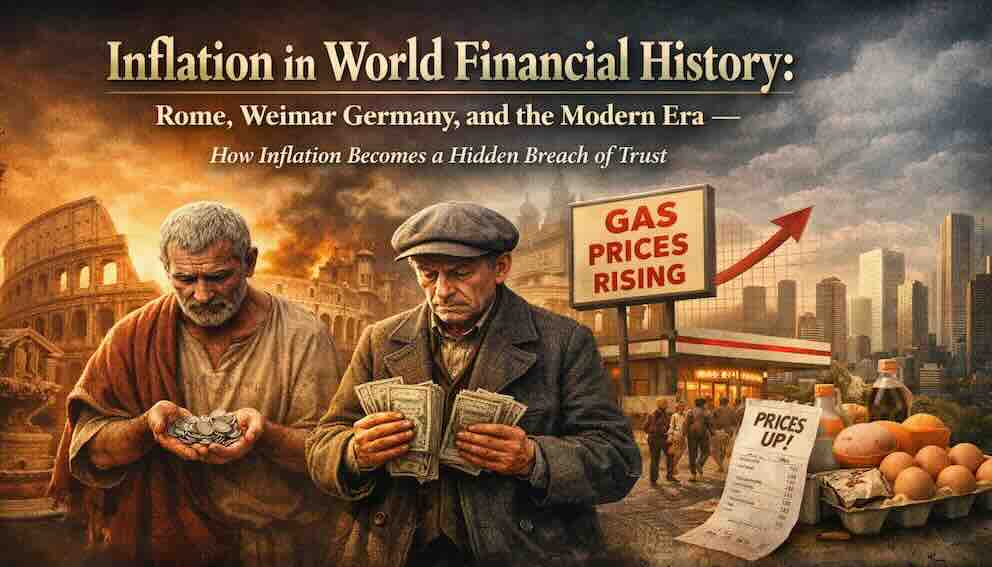
Across two thousand years, from a Roman farmer discovering that his carefully saved denarii no longer buy what they once did, to a German clerk in 1923 rushing to spend his wages before they lose value, to a modern household noticing grocery bills steadily rising, the experience is strikingly similar: money loses purchasing power not merely because of fate or accident, but because of policy choices made under pressure by those in authority, and in each case it is ordinary people, not decision-makers, who quietly absorb the consequences.
This tutorial explores what inflation really is, how it works, why it keeps happening, and why scholars sometimes disagree about its causes.
How Inflation Actually Happens
Before examining history, we need to understand the basic mechanism. Inflation has a simple definition: it occurs when the supply of money grows faster than the supply of goods and services.
Imagine a small village with only one hundred coins in circulation. The village bakes one hundred loaves of bread each day. If every loaf sells for one coin, the system is stable.
Now imagine that the village leader decides to mint one hundred new coins. Suddenly, there are two hundred coins chasing one hundred loaves. Bakers notice that everyone seems to have more coins. They raise their prices. Eventually, the price of bread settles at around two coins per loaf.
This is inflation in its simplest form. More money chasing the same goods means higher prices.
But this is only the beginning. In real economies, two additional factors matter greatly.
The first is velocity. This refers to how quickly money changes hands. If people expect prices to rise, they spend money faster. A coin that once changed hands once a week might now change hands three times a week. This effectively increases the money supply even further because the same coin is doing more purchasing.
The second is expectation. If people believe inflation will continue, they demand higher wages. Businesses raise prices preemptively. A self-fulfilling cycle can emerge where inflation feeds on itself.
This is the mechanical reality beneath the human stories. Now let us see how it played out across major historical episodes, while acknowledging that each case contains complexities scholars continue to debate.
The Roman Empire — Silver Coins and Silent Taxation
The Denarius and Its Promise
The denarius, introduced around 211 BCE, became the backbone of Roman currency. For ordinary Romans, soldiers, and merchants across the Mediterranean, the denarius carried a simple promise: it contained a certain amount of silver. You could weigh it, feel its heft, and know its value.
This was not abstract trust. It was tangible.
In the early Republic and early Empire, this system worked well. Rome's conquests brought enormous quantities of precious metals into the treasury. When generals defeated enemies, they brought back gold and silver. When provinces were added, they paid tribute. Expansion itself funded the state.
When the Conquests Stopped
Eventually, Rome stopped expanding. The borders became fixed. The flow of fresh plunder slowed to a trickle. But the costs of empire did not shrink. The army still needed pay. Roads needed repair. Grain had to be distributed to keep the urban population content. Emperors needed to buy loyalty.
At this point, Roman leaders faced a choice familiar to every government in history. They could raise taxes openly, which would anger landowners and merchants. They could cut spending, which would weaken the military and risk rebellion. Or they could find a hidden solution.
They chose the hidden solution. They began debasing the currency.
How Debasement Worked
Debasement meant reducing the silver content in coins while keeping the same face value. A denarius that once contained nearly pure silver gradually became mixed with copper or bronze. The coins looked similar. They carried the same imperial markings. But they contained less of what made them valuable.
This did not happen overnight. Under Nero, in the first century CE, the silver content began a slow decline. Over the next two hundred years, particularly during the Crisis of the Third Century, debasement accelerated dramatically. By the time of Diocletian, a denarius contained barely any silver at all.
A crucial factor accelerated this process: military competition between rival emperors. During the third century, the empire fragmented as generals proclaimed themselves emperor in different regions. Each needed to pay his troops. If one emperor debased currency to afford more soldiers, others had to follow or lose their armies. Inflation became competitive and self-reinforcing.
Unlike modern central banking systems, the Roman monetary system lacked coordinated control over credit, banking, and money velocity, which makes direct comparisons imperfect.
It is important to note that Roman debasement was not purely fiscal malfeasance. Scholars point to multiple interacting factors. Plagues in the second and third centuries reduced population and economic output, creating real supply shortages that would have pushed prices up regardless of coin content. Mines in Spain and elsewhere declined in output, making silver physically scarcer. Some debasement may have been a response to prior instability rather than its cause.
Additionally, the relationship between debasement and inflation was not straightforward. Prices rose unevenly across the empire. In some regions, people adapted by using barter, older coins, or local tokens. The debasement that looks like a single policy from the center played out differently in the lives of provincials and farmers.
What remains clear is that the cumulative effect eroded trust. Whether through imperial choice or compounding crises, the currency that had once been reliable became less so. The Roman farmer who saved denarii for decades did not need to understand monetary theory to feel the consequences.
Weimar Germany — When Inflation Becomes Hyperinflation
The Weight of War and Defeat
If Rome shows us gradual debasement over centuries, Weimar Germany shows us what happens when inflation accelerates beyond control in mere years.
Germany after World War I faced an impossible situation. But the story actually begins earlier, during the war itself. The imperial government under Kaiser Wilhelm II financed much of the war through borrowing and money creation rather than taxation. By 1918, inflationary pressure was already present.
The war exhausted the country financially. The government had borrowed enormous sums, expecting victory to bring resources that would cover the debts. Instead, defeat brought humiliation and, more concretely, reparations.
The Treaty of Versailles imposed payments that staggered the imagination. Germany was to compensate the victorious powers for the entire cost of the war. The sums were so vast that no one could realistically calculate how they might be paid.
The new democratic government, fragile and contested from both left and right, faced brutal choices. Raising taxes to meet reparations would crush an already weakened economy and enrage voters. Cutting spending would mean abandoning promises to veterans, civil servants, and the poor. Defaulting on reparations risked French occupation.
The Path to Catastrophe
The government turned to the printing press. The Reichsbank increased the money supply to pay government obligations and to purchase foreign currency needed for reparations.
At first, inflation seemed manageable. Prices rose, but not catastrophically. Some people even benefited. Borrowers could repay debts with cheaper money. Business owners with inventory saw the nominal value of their assets rise. Exporters found German goods cheap for foreign buyers.
But inflation has a psychological dimension. Once people expect rising prices, behavior changes. Workers demand higher wages more frequently. Businesses raise prices preemptively. People rush to spend money because holding it means watching it shrink.
In 1923, the situation spiraled into nightmare. French and Belgian troops occupied the Ruhr valley in response to missed reparations payments. The German government encouraged passive resistance: workers went on strike, and the state promised to pay their wages. This was a domestic policy choice—financing resistance through unlimited money creation—that dramatically accelerated the spiral.
With production halted and the government printing money to support strikers, hyperinflation exploded.
The role of reparations versus domestic choices remains debated. Some scholars emphasize that reparations imposed an impossible external burden, making some form of crisis unavoidable. Others point to domestic fiscal irresponsibility—the decision to fund passive resistance rather than negotiate, the reliance on Reichsbank loans rather than taxation—as the critical amplifier.
More recent perspectives, influenced by modern monetary theory, suggest a different framing: inflation resulted from the government paying ever-higher prices for foreign currency and reparations, with money printing as consequence rather than cause. In this view, the crisis was fundamentally about Germany's need to acquire foreign exchange, not simply about domestic money supply.
What is not debated is the human cost. By November 1923, a loaf of bread cost 200 billion marks. Savings accumulated over decades became worthless. Middle-class families who had been prudent found themselves destitute. The moral fabric of society frayed as long-term planning no longer made sense. This economic trauma created conditions for political extremism in the following decade.
The 1970s — Inflation in Modern Democracies
Between Weimar and today lies a crucial episode: the inflation crisis of the 1970s in the United States and Europe. This period shows high inflation in developed democracies without collapse into hyperinflation, and it demonstrates how institutions can lose credibility and regain it.
The Origins
In the late 1960s, the United States faced rising inflationary pressure. President Lyndon Johnson pursued both Vietnam War spending and Great Society social programs without raising taxes sufficiently. The money supply expanded.
At the same time, the Bretton Woods system was breaking down. When President Nixon closed the gold window in 1971, the last formal constraint on monetary expansion disappeared.
Then came the oil shocks. In 1973 and again in 1979, oil prices quadrupled.
Here, perspectives diverge. The mainstream view emphasizes Vietnam/Great Society spending, oil shocks, and unanchored expectations as interacting causes. But some scholars emphasize supply shocks—oil, food—as primary, with monetary policy accommodating rather than causing inflation. Others, like Barsky and Kilian, argue that oil prices themselves were partly endogenous to loose monetary policy and global demand boom before 1973. The oil shock was not simply an external meteor; it was connected to the very conditions that created inflation.
What is clear is that by the mid-1970s, Americans had come to expect inflation. Workers demanded cost-of-living adjustments. Businesses raised prices routinely. The phrase "inflationary psychology" entered common usage.
This is the point where expectations become unanchored. When people expect prices to rise, they act in ways that make prices rise. It becomes embedded in behavior.
Inflation in the United States peaked at over 13% in 1980. In Britain, it exceeded 20%. These were not Weimar-level numbers, but they were deeply destabilizing.
The Volcker Shock
In 1979, Paul Volcker became chairman of the Federal Reserve. He believed that restoring credibility required painful action. The Fed raised interest rates dramatically—the prime rate reached 21.5% in 1981.
This caused a severe recession. Unemployment rose. Businesses failed. But inflation broke. By 1983, inflation had fallen to around 3%.
The 1970s episode reinforces a key principle: trust can be restored, but only through visible discipline. It also shows that modern institutions, while imperfect, have tools to manage inflation that earlier eras lacked.
The Modern Era — The Post-2020 Surge
A Recent Test
The period since 2020 offers a fresh case study. In 2021-2023, inflation surged in the United States and globally, peaking at over 9% in the U.S. This was the highest inflation in forty years.
The causes were complex and remain debated. Pandemic disruptions snarled supply chains. Fiscal stimulus, in the U.S. and elsewhere, put money in people's pockets. Monetary policy remained accommodative. Then Russia's invasion of Ukraine disrupted energy and food markets.
What made this episode different from the 1970s was expectations. Despite the surge, long-term inflation expectations remained relatively anchored. People believed that central banks would eventually bring inflation down. This belief allowed the Federal Reserve to raise interest rates sharply—the fastest tightening cycle since Volcker—without causing a deep recession. By 2024, inflation had declined significantly.
This episode highlights several dimensions worth noting. First, the debate over causes reflects the same tensions seen in earlier periods: supply-shock advocates versus demand-stimulus advocates. Second, it shows the importance of anchored expectations—the credibility built over decades proved valuable. Third, it raises questions about fiscal dominance: if government debt continues growing, will future policymakers be willing to raise interest rates when needed? It describes a situation where monetary policy becomes subordinated to fiscal needs—where central banks cannot raise interest rates because higher rates would increase government borrowing costs and threaten debt sustainability.
Some economists worry that the next inflation episode may be harder to manage if debt levels constrain policy. Others point to the surprisingly painless disinflation of 2023-2024 as evidence that the modern framework is robust.
Broader Dimensions Often Overlooked
Inequality and Redistribution
Inflation always redistributes wealth, and it tends to do so in systematic ways. Those who own assets—real estate, stocks, commodities—can often hedge against inflation. Those who rely on wages or fixed incomes find their purchasing power eroding. This means inflation typically widens inequality.
Wage-Price Spirals Then and Now
The 1970s saw elements of wage-price spiral, with strong unions able to demand cost-of-living adjustments. The modern era shows limited spiral dynamics, partly because unions are weaker and labor markets structured differently. This matters for how inflation behaves.
Global Transmission
Inflation today is globalized. When the U.S. expands money supply, dollars flow worldwide. When energy prices spike due to war, every importing country feels it. No nation is an island in monetary affairs.
The Deflation Contrast
This tutorial focuses on inflation, but deflation—falling prices—also destroys trust, though differently. In the 1930s, deflation punished debtors, caused bank failures, and prolonged depression. The comparison reminds us that price stability, not simply low inflation, is the goal.
Inflation as a Universal Pattern
Across Rome, Weimar Germany, the 1970s, and the post-2020 episode, a recurring structure becomes visible. The speed and severity differ, but the pattern repeats because it is embedded in politics, economics, and human psychology.
First, pressure builds. Governments face demands that exceed available resources.
In Rome, pressure came from military costs after conquests ended. In Weimar, from war debts and crushing reparations. In the 1970s, from Vietnam spending and oil shocks. In the 2020s, from pandemic shutdowns and supply disruptions. The triggers differ, but the condition is constant: the gap between what governments owe and what they can readily extract grows uncomfortably wide.
Second, leaders turn to monetary accommodation. Sometimes this is deliberate, as when Roman emperors reduced silver in coins. Sometimes it is a constrained response to crisis. Weimar funded passive resistance because the political alternative seemed worse. The Federal Reserve in the 1970s accommodated inflation for years before confronting it. Central banks in the 2020s kept rates low through the pandemic, judging inflation risks secondary to depression risks. Whether chosen or forced, the result is the same: the money supply expands.
Third, redistribution occurs quietly. Inflation shifts resources in predictable directions without public debate.
Debtors gain. Roman landowners who borrowed denarii benefited as coins grew lighter. Weimar industrialists watched their real obligations evaporate. American homeowners with fixed mortgages in the 1970s saw debt shrink with each year of inflation.
Savers lose. The Roman farmer who stored denarii watched purchasing power drain away. The German clerk who saved for retirement found his accounts worthless in months. The modern pensioner feels the erosion each time she visits the grocery store.
The transfer is never voted on, but its effects are real.
Fourth, expectations become decisive. If people believe price increases are temporary, they behave calmly. If they expect continued erosion, they change behavior in ways that intensify inflation.
Workers demand higher wages in advance. Firms raise prices preemptively. Lenders insist on higher interest rates.
In Weimar, this psychology spiraled into catastrophe as people rushed to spend money before it lost value. In the 1970s, cost-of-living adjustments were baked into contracts and price increases became routine. In the post-2020 surge, by contrast, long-term expectations remained anchored. Households believed central banks would eventually bring inflation down. That belief proved self-fulfilling when the Fed raised rates and inflation declined without deep recession.
When expectations anchor, shocks can be absorbed. When they unanchor, inflation accelerates beyond its initial cause.
Fifth, credibility either erodes or endures. Once confidence weakens, restoring it requires visible discipline, often accompanied by recession and political backlash.
Rome never restored its currency. Weimar restored stability only after introducing a new currency backed by harsh discipline. The 1970s required Volcker to raise rates to historic highs, triggering a severe recession that broke inflation. The post-2020 episode suggests that credibility built over decades can provide resilience, but that resilience must be maintained.
Preserving credibility requires central banks to make unpopular decisions, to raise rates before elections if necessary, to prioritize long-term stability over short-term convenience. This is difficult because the political rewards for restraint are invisible while the costs are immediate.
This structure appears in slave-based empires, fragile democracies, industrial superpowers, and the globalized twenty-first century. Wherever money exists as a store of value, these dynamics await.
Conclusion: The Deeper Lesson
Inflation is not a historical accident confined to unstable regimes. It is a recurring challenge when societies face financial strain.
The deeper issue concerns the social contract embodied in money. Every society eventually faces pressure. Wars occur. Recessions unfold. Pandemics disrupt. The test is how institutions respond when trade-offs become unavoidable.
Do leaders confront costs openly through taxes or spending restraint, or do they let purchasing power erode quietly? Do institutions maintain discipline when it becomes politically uncomfortable? Do they preserve contracts across generations?
When monetary stability is quietly sacrificed, short-term relief may be achieved, but long-term credibility weakens. Once eroded, restoring confidence demands far greater effort than maintaining it. Volcker proved restoration possible, but only through pain. Weimar proved how far things can go before restoration becomes unthinkable.
The Roman farmer, the German clerk, the 1970s homeowner, and the modern household inhabit different centuries, yet their experiences share a common structure. They saved, planned, and trusted that money would hold value. Sometimes that expectation was honored. Sometimes it was breached. When it failed, the consequences were lived, not abstract.
That is why inflation remains one of the most consequential forces in financial history. It is not only about prices rising. It is about how societies handle pressure, how institutions respond to temptation, and how the promise embedded in money is either preserved or quietly diluted.
Further Reading
- Christopher Howgego, Ancient History from Coins (Routledge, 1995). A readable introduction to what coins tell us about ancient economies.
- Adam Fergusson, When Money Dies: The Nightmare of the Weimar Hyperinflation (William Kimber, 1975). The classic narrative account, deeply human and accessible.
- Gerald D. Feldman, *The Great Disorder: Politics, Economics, and Society in the German Inflation, 1914-1924* (Oxford University Press, 1993). The definitive scholarly treatment.
- Liaquat Ahamed, Lords of Finance: The Bankers Who Broke the World (Penguin Press, 2009). Beautifully written group biography of interwar central bankers, with lessons for later periods.
- Barry Eichengreen, Globalizing Capital: A History of the International Monetary System (Princeton University Press, 3rd edition, 2019). Essential context for understanding modern central banking.
- Niall Ferguson, The Ascent of Money: A Financial History of the World (Penguin Press, 2008). Wide-ranging and accessible, with excellent sections on inflation as trust breakdown.
About Swati Sharma
Lead Editor at MyEyze, Economist & Finance Research WriterSwati Sharma is an economist with a Bachelor’s degree in Economics (Honours), CIPD Level 5 certification, and an MBA, and over 18 years of experience across management consulting, investment, and technology organizations. She specializes in research-driven financial education, focusing on economics, markets, and investor behavior, with a passion for making complex financial concepts clear, accurate, and accessible to a broad audience.
Disclaimer
This article is for educational purposes only and should not be interpreted as financial advice. Readers should consult a qualified financial professional before making investment decisions. Assistance from AI-powered generative tools was taken to format and improve language flow. While we strive for accuracy, this content may contain errors or omissions and should be independently verified.