
Tutorial Categories
Last Updated: March 5, 2026 at 10:30
Financialization: When Finance Became the Master of the Global Economy
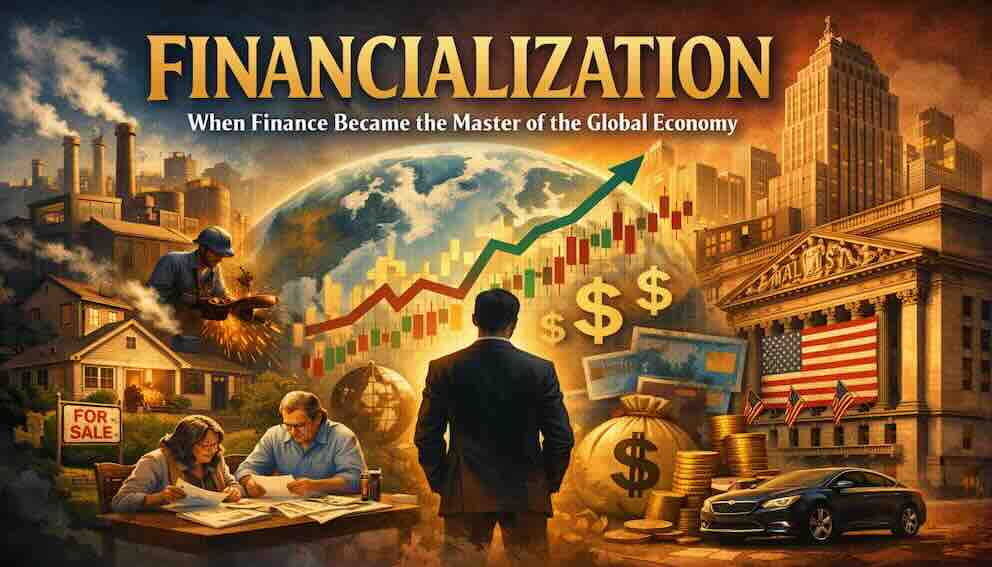
How did we get from a world where banks built factories to one where Wall Street runs the show? This tutorial explores the seismic shift known as financialization. We begin with the inflation crises of the 1970s, trace the radical policy responses, and examine how corporations, households, and governments were transformed. Along the way, we consider scholarly debates about what financialization really means and how it reshaped inequality and power. This is the story of how finance became the master of the global economy—and why it matters today.
Introduction: The World That Broke in the 1970s
In the summer of 1979, Paul Volcker became chairman of the Federal Reserve. He was about to do something that would change modern history.
At that moment, the American economy was in crisis. Prices were rising relentlessly. A gallon of milk that cost $1.50 in 1970 cost $2.50 by 1979. Workers demanded higher wages. Companies raised prices further. It was a spiral with no end.
At the same time, the economy was sputtering. Factories operated below capacity. Unemployment crept upward. This combination—rising prices and rising unemployment—had seemed impossible. They called it stagflation.
By 1979, inflation was running at 11 percent. The dollar was collapsing. The postwar order, which had delivered steady growth for a generation, was unraveling.
Volcker believed he knew what to do. He would raise interest rates to levels never seen before. He would squeeze inflation out of the system by making it too painful to borrow, invest, or demand raises.
"The standard of living of the average American has got to decline," he told his colleagues. When the Fed announced its new policy in October 1979, the effects were exactly what Volcker had predicted.
The Volcker Shock
The Federal Reserve controls the federal funds rate—the rate at which banks lend to each other overnight. When the Fed raises this rate, banks raise the rates they charge everyone else.
By 1981, Volcker had pushed the rate to 20 percent. Let that sink in. Twenty percent interest means that if you borrowed $10,000, you owed $2,000 per year just in interest.
The consequences were brutal. The construction industry collapsed. Auto sales plummeted. Farmers couldn't service their debts. In the industrial Midwest, factories closed by the hundreds.
Unemployment climbed to 10.8 percent by the end of 1982. More than ten million Americans were out of work. This was the Volcker Shock. A deliberate, engineered recession. Designed to break inflation.
And it worked. By 1983, inflation had fallen to 3 percent. But the cure was extraordinarily painful.
The Volcker Shock had two lasting consequences.
First, the Federal Reserve emerged as the most powerful economic actor in the country. From this point forward, financial markets and central banks—not elected governments—would set the terms of economic life.
Second, twenty percent interest rates made finance itself extraordinarily profitable. If you had money to lend, you could earn enormous returns simply by holding government bonds. No factories required. No workers needed.
Why take the risk of building something when you could park your money and earn double-digit returns? The incentive structure of the entire economy shifted. Capital flowed toward finance because finance offered the highest returns with the lowest apparent risk. This is where we begin to glimpse what financialization means.
What Is Financialization?
Financialization is not a term you will find in standard economics textbooks. It comes from critical scholarship that tries to understand how the structure of capitalism changes over time.
The sociologist Greta Krippner defines it as "a pattern of accumulation in which profits accrue primarily through financial channels rather than through trade and commodity production."
Let's translate that.
In the decades after World War II, the American economy generated profits primarily through making things. General Motors made money by building cars. U.S. Steel made money by producing steel. Banks played a supporting role.
By the end of the twentieth century, this had changed. Profits increasingly flowed through financial channels. Non-financial corporations like General Electric derived growing shares of their income from their finance divisions. GE Capital, at its peak, contributed nearly half of the company's profits. Financial firms themselves grew enormously. In 1950, the financial sector accounted for about 10 percent of domestic corporate profits. By 2000, it accounted for more than 30 percent.
But financialization is not just about where profits come from.
For corporations, it meant a shift in priorities. Under pressure from shareholders, companies began distributing more profits to investors through dividends and share buybacks. In 1980, non-financial corporations spent about 4 percent of their cash flow on buybacks. By the late 1990s, that figure had risen to more than 30 percent. Money that might have built factories was instead used to prop up stock prices.
For households, it meant growing dependence on credit and asset markets. As wages stagnated, families maintained their living standards by borrowing. Credit card debt exploded. Mortgage debt exploded. Student loans became normal. Retirement shifted from guaranteed pensions to market-dependent 401(k)s. Ordinary people were now directly exposed to financial markets.
For governments, it meant new constraints. Capital could now move instantly across borders. Any policy that frightened investors could trigger capital flight, currency depreciation, and economic crisis. Governments found themselves governing for the "bond market vigilantes."
All of these changes are dimensions of the same underlying process. Financialization is the name we give to that process.
Was It Really New?
Before going further, we need to ask: was the late twentieth century truly a unique break? Or a return to patterns that had existed before?
Scholars have identified four phases in the United States over the twentieth century.
Phase One: Early Financialization (1900–1933). The financial sector was large and powerful. Stock market speculation was rampant. The Great Crash of 1929 brought this phase to an end.
Phase Two: Transition (1933–1945). The New Deal reined in finance. Banking was strictly regulated. Finance was pushed to the margins.
Phase Three: De-Financialization (1945–1973). Under the regulated postwar order, the financial sector shrank. Production took precedence over speculation. This was the era of the "managerial corporation."
Phase Four: Complex Financialization (1973–Present). The period we are exploring.
What makes this historical perspective important? It shows that the main features of financialization were already in place in the early 1900s. The shareholder orientation. The financial innovations. The speculative excess. All had precedents. The postwar era of regulated, production-oriented capitalism was the historical exception, not the rule.
The Volcker Shock, in this reading, was not the cause of financialization. It was the trigger that ended the exceptional postwar period and allowed older patterns to reassert themselves.
The Shareholder Revolution
If the Volcker Shock made finance profitable, the shareholder revolution of the 1980s made finance dominant within the corporation itself.
The Old Way
In the postwar decades, the typical large American company was run by professional managers. Shareholders were numerous and scattered. They had little ability to influence management. Executives pursued multiple goals: steady growth, market share, good relations with workers. Maximizing the stock price was only one objective among many.
This system was called managerial capitalism. It was not perfect. But it provided stability. Workers shared in productivity gains. Investment horizons were long.
Friedman's Challenge
Beginning in the 1970s, this system came under attack. The intellectual leader was Milton Friedman. In a famous 1970 essay, Friedman argued that corporate executives are employees of the shareholders. Their only responsibility is to maximize profits. Any diversion of resources to social purposes was, in his view, a form of theft.
"There is one and only one social responsibility of business," Friedman wrote: "to use its resources and engage in activities designed to increase its profits."
Within a decade, this idea had become conventional wisdom.
The Raiders
The 1980s saw an explosion of hostile takeovers. Corporate raiders like Carl Icahn would identify undervalued companies, borrow enormous sums, and buy them outright. Once in control, they broke companies apart, sold divisions, slashed costs, and fired workers. The goal was to extract value quickly. If the stock price rose, they sold and moved on. The threat of takeover disciplined every public company. Even well-run firms had to keep their stock prices high.
Stock Options and Buybacks
The result was a relentless focus on short-term performance. Companies cut research and development. They laid off workers. They began buying back their own shares to prop up stock prices. To align executives with shareholder interests, companies began compensating leaders with stock options. By the end of the 1990s, stock options accounted for more than half of CEO compensation.
The people running companies now had the same incentives as Wall Street traders: maximize the stock price, no matter the long-term cost.
A Concrete Example
Consider General Electric. For decades, GE made appliances, light bulbs, and jet engines. But by the 1990s, its most profitable division was GE Capital, which provided financial services. At its peak, GE Capital contributed nearly half of the company's profits. The company that had built factories was now, in large part, a bank.
Deregulation
While the corporation was being transformed from within, the financial system was being transformed from without.
The Big Bang
In the United Kingdom, the "Big Bang" of 1986 abolished fixed commissions, opened the London Stock Exchange to foreign firms, and replaced face-to-face trading with electronic screens. In a single day, the City of London became a global, twenty-four-hour marketplace.
The Repeal of Glass-Steagall
In the United States, the key event was the repeal of the Glass-Steagall Act in 1999. Glass-Steagall had erected a wall between commercial banking (taking deposits) and investment banking (trading stocks). The logic was simple: deposits insured by the government should not be put at risk by speculative trading.
Its removal allowed the creation of financial supermarkets that combined lending, trading, and insurance under one roof. These institutions were too big and too complex to be easily regulated. They were also, as we would later discover, too big to fail.
Securitization
The most important innovation was securitization.
In the old model, a bank made a loan and held it until repaid. The bank had every incentive to be careful.
In the new model, a bank made a loan, bundled it with thousands of others, and sold the bundle to investors. The bank earned fees but bore no risk if the borrower defaulted.
This created a moral hazard. Why check carefully if you're not going to hold the loan? Securitization was presented as a way to spread risk. In practice, it spread risk so widely that no one knew where it ultimately resided.
PaFrom Wage Earners to Financial Subjects
While Wall Street transformed, ordinary households underwent their own quiet revolution.
Two Families
Consider a unionized manufacturing worker in 1965. His wages support a family. He expects to retire with a guaranteed pension. He rarely uses credit. His relationship with finance is simple and distant.
Now consider a middle-class family in 2000. Both parents work. Wages have stagnated, so two incomes are needed. They own a home but have refinanced twice to extract equity. They carry credit card debt. They have student loans. Their retirement is in a 401(k), which means their future depends on the stock market. Ordinary people were no longer just wage earners. They became simultaneously investors, debtors, and risk managers.
What Changed
Several forces drove this shift.
Credit cards expanded dramatically. In 1970, less than 20 percent of families had a credit card. By 2000, more than 70 percent did. Mortgage refinancing became common. Households treated their homes as ATMs. Student loan markets grew. College costs rose faster than incomes. Borrowing became the only way to get a degree. The pension system shifted. In 1975, about 40 percent of private-sector workers had guaranteed pensions. By 2000, that figure had fallen to about 20 percent. The share with only 401(k)s had risen to more than 40 percent.
Employers liked this shift because it transferred risk from them to workers. If the market performed poorly, that was the worker's problem.
But it also meant that workers now had a direct stake in financial markets. When the market boomed, they felt richer and spent more. When it crashed, they felt poorer and cut back.
Financial volatility now directly affected the broader economy.
A Deeper Theory — Stagnation and Finance
Thus far, we have told a story centered on policy choices. But some scholars argue for a deeper structural driver.
The Stagnation Thesis
In the Marxist tradition, economists like Paul Sweezy argue that mature capitalism has a persistent tendency toward stagnation. Giant corporations generate enormous surpluses but lack profitable outlets for productive investment. Markets become saturated. New capacity isn't needed.
What happens to this surplus? It flows into finance. The financial sector expands not because of deregulation alone. It expands because it serves as a necessary outlet for capital that cannot find profitable employment in production.
Financialization, in this view, is "the other side of the coin of long-term real stagnation."
What This Explains
This helps explain something puzzling. Why did financialization accelerate precisely when the underlying economy was slowing down?
From the 1970s onward, growth rates declined. Real wages stagnated. Investment in productive capacity weakened. Yet the financial sector boomed.
Stagnation drives capital into finance. Financial expansion temporarily props up demand and asset prices, masking the underlying stagnation. But it also builds up fragilities—debt, leverage, speculation—that make the system increasingly unstable.
In this reading, financialization is not a policy mistake that can be easily reversed. It is a structural adaptation to a deeper disease.
Global Finance and the Crises
Financialization went global. The consequences were most dramatic in emerging markets.
Mexico, 1994
Throughout the early 1990s, Mexico was a darling of international investors. Foreign money poured in, much of it in short-term bonds denominated in dollars. In December 1994, investors worried about Mexico's trade deficit. They began to sell. The central bank ran out of reserves. The peso collapsed. Because the bonds were in dollars, the Mexican government now owed far more than anticipated. Only an emergency U.S. loan prevented default.
A pattern was established: capital inflows, speculative boom, sudden reversal, devastating crisis.
Asia, 1997
The same pattern repeated in Asia in 1997. Thailand, Indonesia, South Korea—all had been hailed as economic miracles. All had borrowed heavily in dollars.
When investor sentiment turned, capital fled. Currencies collapsed. Companies that had borrowed in dollars couldn't repay. The IMF imposed harsh austerity, deepening the recessions.
The Asymmetry
These crises revealed a fundamental asymmetry. When capital flowed from rich countries to poor countries, it was celebrated. When it flowed out, poor countries bore the consequences. Rich countries and their financial institutions, protected by their central banks and the IMF, largely escaped unscathed.
Finance had become global, but its governance remained national—and deeply unequal
Debating the Evidence
Recent scholarship has begun to question some core assumptions of the financialization literature.
The Central Claim
The claim under scrutiny is that non-financial corporations undertook a "financial turn"—that they shifted from production to generating profits through financial channels. Researchers have pointed to the increased size of financial asset holdings by non-financial corporations as proof.
A Different Interpretation
Recent work argues that this inference may be unwarranted. The growth is almost entirely in cash and short-term investments—"cash piles." These appear to be driven not by a speculative turn, but by two factors.
Precautionary savings. Smaller, younger, research-intensive firms hold more cash to protect against uncertainty.
Tax arbitrage. Large multinationals accumulate offshore cash piles to avoid repatriation taxes.
Both have nothing to do with a financial turn in accumulation. They suggest corporations are still oriented toward production, even as they hold larger cash balances.
What This Means
This does not mean financialization is a myth. Other dimensions remain important: shareholder payouts, governance norms, household financialization, policy constraints. But the idea that non-financial corporations have become financial firms in disguise is now in doubt.
The Two Inflations and Inequality
By the end of the century, a strange divergence had occurred.
The Inflation That Died
The inflation of goods prices—the kind that terrified everyone in the 1970s—was dead. Globalization brought cheap manufactured goods. Central banks kept wage pressures in check. The price of your television was stable, even falling.
The Inflation That Was Born
But a new inflation had taken its place: asset inflation. The price of stocks, bonds, and real estate began its long, relentless climb.
If you owned a home or had a 401(k), you got richer. Your wealth grew from asset ownership, not labor. If you didn't own assets—if you were young or your wages had stagnated—you were locked out.
Four Channels of Inequality
First, capital gains rise faster than wages. Asset owners see wealth compound. Wage earners see slow growth.
Second, executive compensation ties to stock prices. The CEO-to-worker pay ratio soared from twenty-to-one in 1965 to over three-hundred-to-one by 2000.
Third, the financial sector pays extraordinarily high wages. Talent concentrates in a small segment of the economy.
Fourth, tax policy favors capital income over labor income. Capital gains are taxed at lower rates than wages.
Financialization reshapes the entire distribution of income and wealth.
2008 — The Logical Culmination
By the early 2000s, the system had become dangerously unstable.
How Housing Changed
In the old system, a local bank made a mortgage and held it for thirty years. The bank had every incentive to be careful. In the new system, that mortgage was bundled with thousands of others and sold to investors. The bank earned fees but bore no risk.
Moral hazard followed. Why verify income if you're not holding the loan?
The Race to the Bottom
Lenders offered loans with no down payment, no documentation, teaser rates. Borrowers took them, believing prices would keep rising. Rating agencies, paid by the banks, gave these securities high ratings. Investors bought them eagerly.
The Collapse
When housing prices stopped rising, borrowers couldn't refinance. They defaulted. The securities became worthless. Banks that had borrowed heavily to invest faced collapse. In September 2008, Lehman Brothers filed for bankruptcy. The global financial system froze.
The Bailout
Governments bailed out large banks. Ordinary homeowners faced foreclosure. For many, this felt like an injustice. Banks had taken risks, reaped profits, and were rescued. Ordinary people, who played by the rules, lost their homes.
The 2008 crisis was not an accident. It was the logical culmination of decades of financialization.
What Financialization Got Right
Financialization had benefits.
It tamed the inflation that devastated savers in the 1970s. It allowed capital to flow to productive uses. It funded innovation. It democratized investment through pension funds and mutual funds. It provided credit to millions previously excluded.
Modern economies need complex financial systems. The question is balance. When finance serves production, it supports long-term growth. When production serves finance, short-term gain displaces long-term investment. Speculation displaces production. Inequality widens.
By the end of the century, that balance had tilted.
Conclusion: Living in a Financialized World
We began with Paul Volcker and the interest rate shock of 1979. That event marked the end of the postwar order and the beginning of a new era.
In the decades that followed, finance expanded in every direction. Corporations reoriented around shareholder value. Households became entangled with markets. Governments found themselves constrained. The financial sector captured an ever-larger share of profits.
This transformation was not entirely new. The early twentieth century had its own era of financial dominance. The postwar decades were the exception.
Scholars continue to debate the precise nature of this transformation. Was it driven by policy or deeper stagnation? Did corporations truly turn to finance? These debates matter. They shape how we understand our problems and what to do about them.
What is not in dispute is that the world changed. Something more volatile, more unequal, more finance-driven emerged.
This history is not just in the past. It explains the wealth of the financial sector. The precariousness of the middle class. The power of central bankers. The fury of populist movements.
But financialization is not a law of nature. It is a human creation. New arrangements can emerge. The question is how finance should be governed. How we ensure it serves society rather than dominates it.
Understanding how finance became the master is the first step toward building something better.
Further Reading
- Krippner, Greta. Capitalizing on Crisis. Harvard University Press, 2011.
- Epstein, Gerald, ed. Financialization and the World Economy. Edward Elgar, 2005.
- Davis, Gerald F. Managed by the Markets. Oxford University Press, 2009.
- Tooze, Adam. Crashed. Viking, 2018.
About Swati Sharma
Lead Editor at MyEyze, Economist & Finance Research WriterSwati Sharma is an economist with a Bachelor’s degree in Economics (Honours), CIPD Level 5 certification, and an MBA, and over 18 years of experience across management consulting, investment, and technology organizations. She specializes in research-driven financial education, focusing on economics, markets, and investor behavior, with a passion for making complex financial concepts clear, accurate, and accessible to a broad audience.
Disclaimer
This article is for educational purposes only and should not be interpreted as financial advice. Readers should consult a qualified financial professional before making investment decisions. Assistance from AI-powered generative tools was taken to format and improve language flow. While we strive for accuracy, this content may contain errors or omissions and should be independently verified.