Tutorial Categories
Last Updated: March 8, 2026 at 10:30
The 2008 Crisis: Misaligned Incentives and the Failure of Risk Ownership
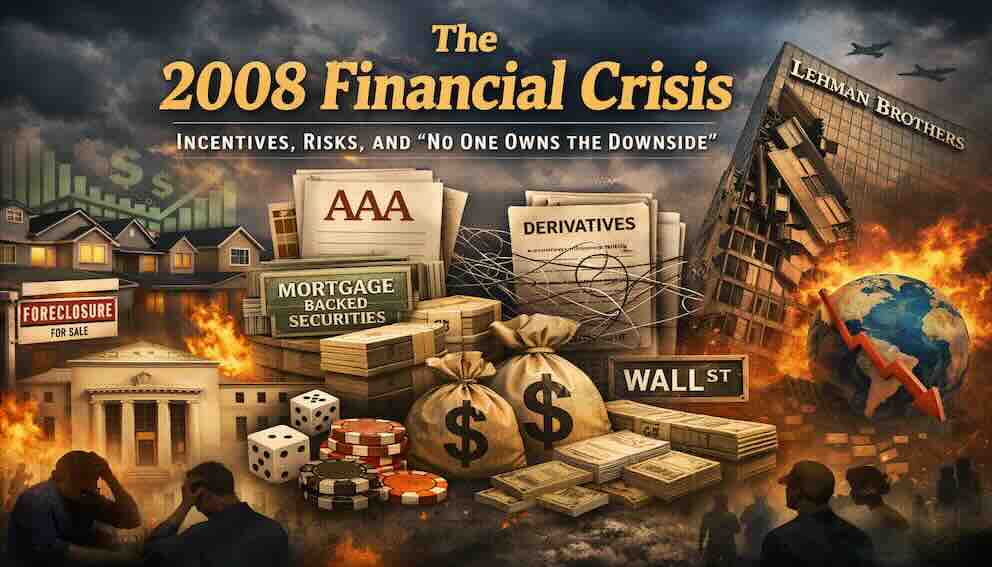
The 2008 Global Financial Crisis was not simply a story of bad loans or falling house prices. It was a story about incentives that encouraged risk while allowing people to avoid responsibility for failure. Banks made loans they did not intend to keep. Investors bought securities they did not fully understand. Rating agencies gave high grades to products built on fragile foundations. At every stage of the financial chain, profits were privatized while losses were quietly shifted elsewhere. This tutorial explains how the crisis unfolded, why "no one owned the downside," and what this failure teaches us about risk, psychology, and regulation.
Introduction: A Crisis Built on Incentives, Not Accidents
The Global Financial Crisis of 2008 is often told as a story of bad mortgages and Wall Street greed. But beneath those easy explanations lies a deeper truth: the crisis was not the result of a few bad actors or isolated mistakes. It was the logical outcome of a system whose basic structure rewarded short-term gain while shielding participants from long-term consequences.
In simple terms, the system encouraged risk-taking but did not require risk ownership.
When we look at the collapse of Lehman Brothers, the rescue of AIG, and the interventions by the Federal Reserve, we see events that appear sudden and chaotic. But beneath those headlines was a slow-building story about incentives, psychology, global capital flows, and misplaced trust.
To understand why the crisis unfolded as it did, we must follow the chain of financial decisions step by step. At each step, we ask: who benefits if things go well, and who suffers if things go badly?
The Global Savings Glut — Why Money Was Everywhere
Before we examine American housing policy or Wall Street bonuses, we must understand a deeper force: the world was awash in money looking for a home.
Starting in the late 1990s, a massive shift occurred in global capital flows. Emerging economies—particularly China and oil-exporting nations—began generating enormous surpluses. China's export-led growth model produced vast dollar earnings. Oil exporters saw revenues surge. These countries did not have developed financial systems to invest this money at home. Instead, they bought safe assets abroad, especially U.S. Treasury bonds.
This phenomenon was later called the global savings glut, a term coined by then-Fed Governor Ben Bernanke. The effect was profound. Trillions of dollars flowed into the United States, pushing down long-term interest rates regardless of what the Federal Reserve did with short-term rates.
Consider what this meant. From 2004 to 2006, the Fed raised short-term interest rates seventeen times. Normally, long-term rates would rise as well. But they did not. They remained remarkably low. This was the "conundrum" that puzzled even Fed Chair Alan Greenspan at the time.
These low long-term rates made mortgages cheap. They encouraged borrowing. They pushed investors to search for higher yields, which led them toward riskier assets like mortgage-backed securities. The global savings glut did not cause the crisis alone, but it created the fuel that would later ignite.
The Domestic Response — Low Rates and Housing Policy
The global glut was not the only source of cheap money. Domestically, the Federal Reserve had lowered short-term rates aggressively after the dot-com bubble burst and the September 11 attacks. By 2003, the federal funds rate stood at just 1 percent.
These low rates served their purpose: they stimulated borrowing and growth. But they also encouraged a housing boom. When mortgages are cheap, more people buy homes. When more people buy, prices rise.
At the same time, government policy encouraged home ownership. For decades, both political parties had promoted expanding access to housing credit. Fannie Mae and Freddie Mac, the government-sponsored enterprises that bought and guaranteed mortgages, were given affordable housing goals. They were encouraged to increase lending to lower-income borrowers.
Critics on one side argue that these goals forced Fannie and Freddie into risky lending. Mainstream analysis suggests the private sector's role was far larger. But what matters for our story is that multiple forces—global capital, domestic monetary policy, and political encouragement—converged to create a powerful push toward more lending, more borrowing, and higher prices.
Securitization — Turning Mortgages into Tradable Products
To understand the crisis, we must understand how mortgages changed.
Traditionally, when a bank made a mortgage loan, it kept that loan on its books. If the borrower failed to repay, the bank absorbed the loss. This created natural discipline. Since the bank would suffer if the loan failed, it had an incentive to evaluate the borrower carefully.
By the early 2000s, this model had shifted dramatically. The new model was called securitization.
Here is how it worked. A bank would originate a mortgage. Then, instead of holding it, the bank would sell it to an investment bank. The investment bank would bundle thousands of mortgages together into a pool. This pool would then be sliced into pieces called mortgage-backed securities. Finally, these securities would be sold to investors around the world.
Consider a simple analogy. Imagine a factory that produces machines but does not provide warranties and does not keep ownership after sale. If the factory earns profit immediately upon sale and bears no responsibility if the machine breaks down later, the factory may prioritize volume over quality. Sell as many machines as possible. Let someone else worry about whether they last.
This was essentially the situation in mortgage lending. Banks earned fees for originating loans. They earned more fees for selling them. The long-term performance of the loan became someone else's problem.
The incentive had shifted from making good loans to making many loans.
The Shadow Banking System — Banks Without Safety Nets
As securitization grew, a parallel financial system emerged alongside traditional banking. This was the shadow banking system.
Traditional banks take deposits, which are insured by the government. They have access to emergency lending from the Federal Reserve. They are regulated and examined.
Shadow banks—investment banks, money market funds, special investment vehicles—did not have these protections. They funded themselves not with insured deposits, but with short-term borrowing in wholesale markets. They issued commercial paper. They borrowed overnight in the repo market. They relied on investors who could flee at the first sign of trouble.
This created a vulnerability that few recognized. Shadow banks were performing the same functions as traditional banks—maturity transformation, liquidity transformation—but without the safety net. They were, in effect, banks that could run out of money if their lenders lost confidence.
And that is exactly what happened. When housing prices began to fall, investors refused to roll over short-term funding. The shadow banking system experienced a classic bank run, but one invisible to the public. Instead of depositors lining up outside branches, lenders simply stopped lending overnight.
Subprime Lending — Expanding Risk Under Optimism
As demand for mortgage-backed securities increased, lenders needed more mortgages to package and sell. To meet this demand, lending standards were relaxed.
Subprime loans were extended to borrowers with weaker credit histories, lower incomes, or limited documentation. Some loans required no proof of income at all. These were called "liar loans" even by people in the industry.
Other loans featured adjustable interest rates. They would start low—teaser rates—making the monthly payment affordable. After two or three years, the rate would reset much higher. The borrower's payment could double overnight.
Why would anyone take such a loan? Because everyone assumed housing prices would keep rising. If the payment became unaffordable, you could refinance using your home's increased value. Or you could sell at a profit.
A Human Story
Consider a hypothetical borrower named Maria. In 2005, Maria worked as a hairdresser earning $35,000 per year. A mortgage broker offered her a loan to buy a small house for $200,000. The initial monthly payment was $800—stretching but possible. The broker assured her that house prices were rising fast. In two years, she could refinance or sell at a profit.
Maria did not fully understand that her payment would reset to $1,400 after two years. She did not know that her income had not been verified. She only knew that she could own a home, and everyone said prices only go up.
By 2007, Maria's payment had reset. House prices had stopped rising. She could not refinance because she had no equity. She could not sell without taking a loss. She defaulted. The house went into foreclosure.
Maria's story was repeated millions of times across the country.
Credit Rating Agencies — The Seal of Approval
Investors need a way to evaluate risk. They cannot investigate thousands of individual mortgages themselves. So they rely on ratings.
Agencies such as Moody's and Standard & Poor's assigned ratings to mortgage-backed securities. These ratings told investors how safe the securities were supposed to be.
Many of these securities received high ratings, including the coveted AAA rating. AAA traditionally signified very low risk—the same rating given to U.S. government bonds.
But here is the problem. The rating agencies were paid by the issuers of the securities. The same banks that created the mortgage-backed securities also paid for the ratings.
This payment structure created a conflict of interest. If a rating agency assigned a lower rating, the issuer could take its business to a competitor. Over time, competition among rating agencies encouraged optimistic assessments.
Investors around the world trusted these ratings. Pension funds, banks, and insurance companies bought securities that appeared safe on paper. They did not understand the underlying mortgages. They relied on the AAA stamp.
This trust was misplaced. The securities were built on fragile assumptions, but the ratings gave no hint of the danger.
Leverage — Amplifying Gains and Losses
Large financial institutions increased their use of leverage. Leverage means borrowing money to increase the size of investments.
Here is how leverage works. Suppose you have $10 million of your own money. You borrow another $90 million, so you have $100 million to invest. If your investments rise by 10 percent, you make $10 million. That doubles your original capital—a 100 percent return.
But if your investments fall by 10 percent, you lose $10 million. Your original capital is wiped out.
Leverage magnifies profits. It also magnifies losses.
Investment banks such as Lehman Brothers operated with extremely high leverage ratios. Some had as little as $3 of capital for every $100 of assets. This meant that even a modest decline in asset values could wipe out their capital.
Financial institutions justified high leverage because models suggested that housing prices would not decline significantly nationwide. Those models were based on recent data from a period of rising prices. They did not account for what might happen if the underlying assumption proved false.
Derivatives and the AIG Problem
As mortgage securities multiplied, another layer of complexity emerged: derivatives.
A derivative is a contract whose value is derived from something else. In this case, the most important derivative was the credit default swap. Think of it as insurance. An investor who owned a mortgage-backed security could buy a credit default swap from someone else. If the security defaulted, the swap seller would pay the investor.
AIG, a massive insurance company, sold enormous amounts of this protection. It collected premiums for years while the housing market boomed. But it did not set aside sufficient capital to cover potential losses. When defaults surged, AIG faced obligations it could not meet.
The government ultimately committed more than $180 billion to AIG's rescue. This was not because AIG was too big to fail. It was because AIG was too interconnected to fail. Its failure would have triggered losses at every major bank that had bought protection from it.
Derivatives did not cause the crisis. But they amplified it by creating hidden chain reactions. When one institution failed, it threatened to pull down others that had relied on its promises.
Regulatory Blind Spots — What the Watchdogs Missed
With hindsight, the most striking failure was that regulators did not see the crisis coming. This was not because they were incompetent. It was because they were looking in the wrong places.
Before 2008, macroeconomic models focused on inflation and unemployment. They did not track leverage in the shadow banking system. They did not monitor the interconnectedness of derivatives. They did not ask what would happen if housing prices fell nationwide.
Federal Reserve meeting transcripts from 2004 to 2006 show limited discussion of housing finance risks. Officials noted rising prices but assumed localized bubbles, not systemic danger. The possibility that a housing downturn could trigger a global financial crisis was simply not on their radar.
This was a failure of what sociologists call sense-making. Regulators lacked the conceptual tools to interpret the data in front of them. They saw individual trees—rising house prices, growing mortgage volumes—but missed the forest.
The Turning Point — Housing Prices Begin to Fall
By 2006 and 2007, housing prices began to level off. Then they began to decline.
As adjustable-rate mortgages reset to higher rates, many borrowers could not make payments. They could not refinance because their homes were worth less than they owed. They could not sell without taking a loss.
Defaults increased. Foreclosures increased.
As defaults increased, the value of mortgage-backed securities declined. These securities, once rated AAA, were now worth far less than investors had paid.
Since many institutions were heavily leveraged, even small price declines created large losses. A 5 percent drop in asset values could wipe out 50 percent of a bank's capital.
Because these securities were widely distributed, no one knew exactly who held how much risk. Banks became suspicious of one another. Lending between banks slowed dramatically. If you did not know whether your counterparty was solvent, you stopped lending.
This was the beginning of the panic.
Part Eleven: Lehman Brothers — The Collapse That Changed Everything
In September 2008, Lehman Brothers filed for bankruptcy.
Lehman had invested heavily in mortgage-related securities. It had used enormous leverage. When housing prices fell, its losses mounted. It could not find a buyer. It could not borrow enough to survive.
The government let Lehman fail.
This decision marked a critical moment. Until Lehman, investors had assumed that major institutions would be rescued if necessary. When Lehman was allowed to collapse, it demonstrated that even major firms could fail.
Panic spread quickly. If Lehman could fail, who was safe? Money market funds, supposed to be nearly risk-free, suffered runs. Lending froze entirely. The financial system came to a halt.
Part Twelve: "No One Owned the Downside"
Let us pause and trace the chain of incentives.
Mortgage brokers earned fees upfront and bore no long-term risk. They were paid for volume, not quality.
Banks originated loans and quickly sold them. They earned fees but transferred the risk.
Investment banks packaged these loans into securities. They earned fees but did not hold them.
Rating agencies evaluated the securities. They were paid by the issuers and faced competitive pressure to give high ratings.
Investors bought the securities. They relied on ratings and assumed diversification would protect them.
AIG sold insurance but did not hold sufficient capital.
Executives received bonuses tied to short-term profits, not long-term stability.
At every stage, someone benefited from the transaction. At no stage was anyone clearly responsible if the loans failed.
This is what we mean when we say no one owned the downside. Profits were privatized. Risk was transferred, diluted, and ultimately concentrated in institutions deemed too interconnected to fail.
When losses finally emerged, they did not fall on the brokers who made the loans. They did not fall on the bankers who packaged the securities. They fell on shareholders who lost everything, on homeowners like Maria who were evicted, on taxpayers who funded bailouts, and on workers who lost their jobs.
Part Thirteen: The Global Dimension — Contagion Without Borders
The crisis spread rapidly beyond the United States.
European banks had purchased American mortgage securities. They faced heavy losses. Some, like Northern Rock in Britain and Fortis in Belgium, required rescue.
But the transmission went deeper. European banks had borrowed heavily in U.S. dollar markets. When those markets froze, they could not roll over their short-term debt. They faced dollar shortages even if their underlying assets were sound.
Countries with fragile banking systems were hit hardest. Iceland's three largest banks collapsed within days. The Icelandic economy contracted by more than 10 percent.
The crisis also exposed sovereign vulnerabilities. When governments bailed out banks, their own debt levels soared. This eventually triggered the European sovereign debt crisis, threatening Greece, Ireland, and Portugal for years afterward.
Global trade contracted sharply. Unemployment rose. In the United States, unemployment peaked at 10 percent. In Spain, it exceeded 25 percent.
Deeper Currents — Inequality and Stagnation
Beyond the immediate causes, longer-term structural shifts made the crisis possible.
Since the 1970s, inequality had risen sharply. The top earners captured an increasing share of national income. Wealth concentrated at the top. This created a problem: the wealthy had more money to invest than they could spend. That money needed somewhere to go. It flowed into assets—stocks, bonds, and eventually housing.
At the same time, non-financial corporations began hoarding cash rather than investing in new factories or hiring. They became net savers rather than net borrowers. This added to the pool of capital searching for returns.
These trends fed the global savings glut. They pushed down interest rates. They encouraged the search for yield. They created the conditions in which the housing bubble could grow.
This is not to say inequality caused the crisis. But it was part of the background—a deep current that made the system more vulnerable.
The Bailouts and Their Critics
When the crisis hit, the government responded with extraordinary measures. The Troubled Asset Relief Program authorized $700 billion to rescue banks. The Federal Reserve created emergency lending facilities. AIG was bailed out. Money market funds were guaranteed.
These actions prevented a complete collapse. But they also created deep resentment.
Many Americans saw banks being rescued while homeowners faced foreclosure. They saw executives who had driven their firms to the brink walk away with millions. They saw profits privatized and losses socialized.
Critics argue that the bailouts created moral hazard—the expectation that future failures will also be rescued. They argue that the government should have forced losses onto bondholders rather than protecting them. They argue that the unfairness of the response sowed seeds of political anger that would erupt years later.
These criticisms have force. The bailouts were necessary to prevent depression. But they were also deeply unfair, and that unfairness had lasting consequences.
Lessons from 2008
The crisis teaches us several enduring lessons.
First, incentives matter more than intentions. If the system rewards volume over quality, you will get volume. If it rewards short-term profits over long-term stability, you will get fragility.
Second, complexity can obscure risk, but it cannot eliminate it. The securities were so complex that even sophisticated investors did not understand them. But the risk was still there.
Third, leverage magnifies both confidence and fear. The same mechanism that amplifies returns also amplifies disaster.
Fourth, psychology matters. Herd behavior, overconfidence, and denial of rare events all contributed to the boom.
Fifth, when losses are not clearly assigned, they migrate to the public. If no private actor is responsible for the downside, the cost ultimately falls on taxpayers.
Sixth, policy choices create the environment for risk. The crisis was not purely a market failure; it was also a governance failure.
Seventh, global forces matter. The savings glut from emerging markets created conditions that domestic policy alone could not counteract.
Eighth, stability can breed instability. The long period of calm before the crisis encouraged the risk-taking that made the crisis possible.
Reforms and Unfinished Business
After the crisis, governments implemented reforms.
Banks were required to hold more capital. Standardized derivatives were moved to clearinghouses with margin requirements. Stress tests required banks to prove they could survive severe conditions. New oversight bodies were created to monitor systemic risk.
But questions remain. Has leverage simply moved to less regulated parts of the financial system? The shadow banking sector has grown enormously. Are we sure that too-big-to-fail institutions are now safe? The largest banks are larger than before.
Have we addressed the global imbalances that fueled the crisis? Not really. China's surplus has shrunk, but capital continues to flow across borders in unpredictable ways.
Have we solved the problem of moral hazard? The government's response demonstrated that when push comes to shove, the system will be protected. That lesson has not been forgotten.
These questions will be answered by the next crisis, whatever form it takes.
Conclusion: What We Learned from the Crisis of Incentives
The 2008 crisis was not merely a housing crash or a banking panic. It was a systemic failure rooted in incentives that encouraged risk-taking without responsibility.
At every stage, profits were privatized while risks were transferred. Mortgage brokers earned fees without bearing default risk. Banks originated loans they did not keep. Rating agencies issued favorable assessments to please clients. Investors trusted ratings that proved worthless. AIG sold insurance without sufficient capital.
We learned that global capital flows can create conditions for bubbles far from their origin. We learned that shadow banking can replicate the vulnerabilities of traditional banking without the safeguards. We learned that regulators can miss what they are not looking for. We learned that financial innovation without accountability creates fragile structures. We learned that when no one owns the downside, the downside eventually belongs to everyone.
The reforms that followed aimed to ensure institutions hold more of their own risk. Whether they are sufficient remains debated. What is not debatable is the fundamental lesson: incentives shape outcomes. When rewards are disconnected from responsibility, the seeds of the next crisis are quietly planted.
Further Reading
- Tooze, Adam. Crashed: How a Decade of Financial Crises Changed the World. Viking, 2018.
- Bernanke, Ben. The Courage to Act: A Memoir of a Crisis and Its Aftermath. W.W. Norton, 2015.
- Lewis, Michael. The Big Short: Inside the Doomsday Machine. W.W. Norton, 2010.
- McLean, Bethany, and Joe Nocera. All the Devils Are Here: The Hidden History of the Financial Crisis. Portfolio, 2010.
- Financial Crisis Inquiry Commission. The Financial Crisis Inquiry Report. 2011.
- Gorton, Gary. Slapped by the Invisible Hand: The Panic of 2007. Oxford University Press, 2010.
About Swati Sharma
Lead Editor at MyEyze, Economist & Finance Research WriterSwati Sharma is an economist with a Bachelor’s degree in Economics (Honours), CIPD Level 5 certification, and an MBA, and over 18 years of experience across management consulting, investment, and technology organizations. She specializes in research-driven financial education, focusing on economics, markets, and investor behavior, with a passion for making complex financial concepts clear, accurate, and accessible to a broad audience.
Disclaimer
This article is for educational purposes only and should not be interpreted as financial advice. Readers should consult a qualified financial professional before making investment decisions. Assistance from AI-powered generative tools was taken to format and improve language flow. While we strive for accuracy, this content may contain errors or omissions and should be independently verified.