
Tutorial Categories
Last Updated: March 8, 2026 at 10:30
How Stories Move Markets: A Cross-Era History of Narrative Economics and Why Belief Precedes Price
Imagine you are at a dinner party, and someone tells you a compelling story about a new technology that will change the world. You don't fully understand it, but the enthusiasm is contagious. You go home and check the stock price. It has already doubled. You feel a pang of regret. This feeling—this gut reaction to a story and a price chart—is the invisible engine of financial history. But is the story causing the price movement, or is it merely the language we use to describe deeper forces? This tutorial explores the relationship between narrative and market behavior, from John Law's Mississippi scheme to cryptocurrency. We will examine how collective belief shapes economic reality while also grappling with the limitations of narrative explanations. The goal is not to replace economic analysis with storytelling, but to understand how the two are inseparably intertwined.
When we try to understand financial markets, we instinctively turn to numbers. Price-to-earnings ratios, GDP growth, interest rate curves—these are the measurements we rely on, the data we trust. They give us the illusion of precision, of control. And they are not wrong. These numbers matter.
But they are not the whole story.
Beneath these charts, reports, central bank announcements, there is something more fundamental: human beings making decisions based on what they believe will happen next. And what people believe is shaped, more than anything else, by the stories they hear and tell.
The economist Robert Shiller, in his foundational work on narrative economics, argues that these contagious stories are primary drivers of economic fluctuations . An interest rate cut does not affect the economy directly. It affects the economy because we have a shared story about what a rate cut means—that it stimulates growth, that it makes borrowing cheaper. The belief in the mechanism is what gives the mechanism its power.
Yet we must be careful. To say stories matter is not to say they are the only thing that matters. The relationship between narrative and economic reality is not simple causation, but complex mutual influence. Stories shape how we interpret events, and events shape which stories we tell.
In this tutorial, we will explore this relationship through four vivid historical episodes. Each story will reveal a different facet of how narratives move markets. By the end, we will see a recurring pattern—what we might call the Belief Cycle—that has operated across centuries, from the salons of Paris to the trading floors of Wall Street.
John Law and the Mississippi Bubble (France, 1719–1720)
The Story: A Nation in Debt, A Visionary with a Plan
To understand how narratives shape markets, we must begin in France in 1715. King Louis XIV had died, leaving the country mired in debt after decades of war. The treasury was empty. Confidence in the currency had evaporated. The nation needed a miracle .
Enter John Law, a Scottish financier with a vision. Law was a persuasive salesman—some might say a convicted murderer who had fled England after a duel—but he was also a serious economic thinker. He proposed a radical solution: a national bank that would issue paper money backed by land and trade, not gold. This would stimulate commerce and retire the national debt .
Law's grand narrative was irresistible. He would create a trading company, the Compagnie d'Occident, with exclusive rights to develop the vast Louisiana territory in North America. The company's shares would be exchanged for government debt. Investors were told of mountains of gold and silver waiting to be mined, of fur trades and fertile lands. The Mississippi Valley was portrayed as an El Dorado.
The story spread through Parisian salons and coffee houses. It was simple: France would be saved, and those who invested early would share in the riches. It was concrete: investors could visualize ships returning laden with treasure. It was emotionally resonant: it offered hope to a nation exhausted by war and debt. And it offered a role for the listener: anyone could become part of the national renewal.
The Machinery of Narrative
Here we see the first principles of narrative economics in action.
A story must be simple. Law's narrative distilled complex fiscal policy into a compelling promise: invest in the Mississippi Company, and you will share in America's boundless wealth.
A story must be concrete. The image of silver-laden ships was vivid and memorable.
A story must be emotionally resonant. Law tapped into desperation and hope—a population desperate for solutions and hopeful about the future.
A story must offer a role for the listener. Ordinary citizens could become shareholders in the national project.
A story must be validated by observable events. As Law's bank stabilized the currency and the company's shares rose, the narrative seemed confirmed. Early investors profited handsomely, drawing in more capital.
Credit as Amplifier
But Law understood something crucial: narratives alone are not enough. They need fuel. Law controlled the royal bank, which meant he could print money. He flooded the economy with paper currency, much of it used to purchase company shares. This created the ultimate feedback loop: the story of Mississippi wealth drove share demand; the central bank printed money to finance that demand; rising prices validated the story; validation drew more investors; and the cycle repeated .
By early 1720, share prices had soared from 500 livres to over 10,000 livres. The Rue Quincampoix, where shares were traded, became a scene of frenzy. Aristocrats rubbed shoulders with servants. Fortunes were made overnight.
The Collapse
But the Louisiana territory, it turned out, held no silver. The promised wealth was fiction. As investors gradually realized that dividends would never match the astronomical share prices, confidence wavered. Those who understood the gap between story and reality began selling quietly. When the Prince de Conti, angered by Law's refusal to sell him more shares, sent three wagon-loads of paper money to the bank demanding gold, the fragility of the system was exposed.
The narrative reversed with stunning speed. The same networks that spread stories of wealth now spread panic. Share prices collapsed. By the end of 1720, Law had fled France in disgrace, and thousands of investors were ruined.
What This Story Reveals
The Mississippi Bubble introduces us to two fundamental insights. First, narratives can be deliberately engineered—Law was not just riding a wave; he created the entire system. Second, credit amplifies narrative. Easy money allowed the story to scale far beyond what fundamentals could justify. The story gave direction to speculation; cheap credit gave it magnitude .
The Railway Mania (Britain, 1840s)
The Story: Technology Transforms a Nation
More than a century later, a different kind of mania swept across Britain. The Industrial Revolution was in full swing, and railways were the transformative technology of the age. The Liverpool and Manchester Railway, opened in 1830, had proven spectacularly successful, carrying both passengers and freight with unprecedented efficiency .
By the mid-1840s, the economy was booming. The Bank of England had cut interest rates, making government bonds less attractive and driving investors toward riskier assets. A new, increasingly affluent middle class had emerged, with savings to invest and a hunger for opportunity .
The railway narrative was simple and powerful: the iron horse would shrink distances, connect cities, and generate immense profits. Newspapers, enjoying their own boom in circulation, were filled with railway advertisements, optimistic revenue projections, and stories of instant fortunes .
Crucially, the Bubble Act—passed after the South Sea disaster of 1720 to restrict new business ventures—had been repealed in 1825. Anyone could now form a company, issue shares, and submit a railway bill to Parliament. And submit they did. In 1846 alone, Parliament authorized 263 new railway companies, with proposed routes totalling 9,500 miles—more than half the length of the modern UK network .
The Mechanism: Easy Entry, High Leverage
Here we see the next element of the narrative machinery.
Social proof expanded participation. As stories of ordinary people growing wealthy circulated through newspapers and conversation, the fear of missing out spread. The railway boom became something everyone was talking about, and when everyone is talking, it feels safe to join. The 10 percent deposit made participation possible for families of modest means—they could now act on the social proof that told them this was the opportunity of a lifetime.
The media amplifies the story. The railway press boomed alongside the railways themselves. Prospectuses made lofty claims. Promoters exaggerated potential revenues. The distinction between genuine opportunity and speculative fantasy blurred.
Stories mutate and detach from constraints. The original insight—that railways could transform transport—mutated into the belief that every proposed line would succeed. Promoters proposed routes connecting sparsely populated regions with no commercial traffic. Investors, caught in the frenzy, stopped asking fundamental questions.
Fraud and Manipulation
This story also introduces a darker element: deliberate deception. The most colorful figure of the mania was George Hudson, the "Railway King." Hudson was a Member of Parliament who had built a railway empire by amalgamating small companies and rationalizing routes. But his success rested on fraud: he paid dividends not from profits, but from new capital—a Ponzi scheme before the term existed . When the bubble burst, his empire collapsed, and thousands who had trusted him lost everything.
The End of the Mania
In late 1845, the Bank of England raised interest rates. Money began flowing out of railways and back into bonds. Share prices leveled off, then fell. Companies called in the remaining 90 percent of share payments, and families who had invested their life savings found themselves unable to pay. Many lost everything .
Yet unlike the Mississippi scheme, the Railway Mania left something tangible behind. About two-thirds of the proposed lines were eventually built—some by the original companies, others bought up cheaply by larger competitors after the crash. The British railway network, the backbone of the nation's transport for more than a century, was the enduring legacy of the frenzy .
What This Story Reveals
The Railway Mania teaches us about democratic participation in speculation, the amplifying power of media, and the role of fraud in fueling bubbles. It also introduces a tension we will see repeatedly: narratives are both necessary and dangerous. They were necessary to fund the railway network that transformed Britain. They were dangerous because they detached from reality, causing immense suffering when the reckoning came.
The Nifty Fifty (United States, 1960s–1970s)
The Story: "One-Decision Stocks"
By the late 1960s, American investors had developed a new conviction: some companies were so strong, so dominant, so fundamentally sound that they could be bought at any price and held forever. These were the Nifty Fifty—a group of about fifty large-cap growth stocks including IBM, Xerox, Coca-Cola, McDonald's, and Walt Disney .
The narrative was seductive. These weren't speculative startups or untested technologies. They were the bluest of blue chips, household names with decades of earnings growth and seemingly unassailable market positions. Investors called them "one-decision stocks": you only had to decide to buy them once; you never had to decide to sell .
This was the illusion of permanence—the belief that certain companies had transcended the normal rules of valuation. Price-to-earnings ratios of 50, 60, even 100 times earnings were justified because these companies would grow into them. Traditional metrics were dismissed as outdated. This time, it was different.
The Competing Narrative
Yet even at the height of the frenzy, competing narratives existed. Value investors—followers of Benjamin Graham's disciplined approach—pointed to the absurdity of paying 170 times earnings for Xerox. They warned that no company, however excellent, could justify such valuations indefinitely .
But their story lacked emotional traction. In a rising market, caution sounds like foolishness. The skeptics were dismissed as dinosaurs who didn't understand the new economy of stable growth.
The Empirical Challenge: Measurement and Prediction
Here we must introduce an uncomfortable truth about narrative economics. While the Nifty Fifty story was clearly powerful, its effects are difficult to measure with precision. Robert Shiller's approach—counting word frequency in newspapers—captures the theme but not the full emotional arc. We can track mentions of "one-decision stocks," but we cannot quantify the conviction behind those words .
Moreover, narrative economics struggles with prediction. The Nifty Fifty story didn't tell us which companies would subsequently struggle, nor the exact trigger for the downturn. When inflation surged and economic conditions deteriorated in 1973–74, the stocks fell sharply—the group lost more than 60% of its value . But which part of that decline was justified by changing fundamentals, and which was overshoot?
Remarkably, when economist Jeremy Siegel examined the Nifty Fifty's performance 25 years later, he found that their long-term returns matched the broader market. The high valuations of 1972, he argued, were largely justified by subsequent earnings growth . This suggests a more complex picture: the narrative may have been directionally right but cyclically exaggerated. Investors who bought at the peak and held for decades did fine. Those who bought at the peak and panicked at the bottom did not.
What This Story Reveals
The Nifty Fifty episode illuminates the illusion of permanence—the belief that some assets have transcended risk. It shows how competing narratives persist even during manias, though they lack emotional momentum. And it forces us to confront the limitations of narrative economics as a predictive tool. Stories help us interpret the past and understand the present, but they do not give us reliable forecasts.
The Housing Bubble and the 2008 Crisis
The Story: Safety as Certainty
The most devastating financial crisis since the Great Depression was built on a simple story: housing prices never fall nationally. This was not presented as speculation or even as a strong probability but as an immutable fact.
The story was repeated by real estate agents, mortgage brokers, financial advisors, and even the Chair of the Federal Reserve. It was embedded in the risk models of global banks and the credit ratings of complex securities. When a bond was rated AAA, that rating was a story in letter form—a story telling the world that this security was as safe as U.S. Treasury bonds.
The Institutionalization of Narrative
Here we see something new: a narrative so deeply embedded in institutions that it was no longer questioned. The story wasn't just in the newspapers; it was encoded in:
- Lending standards: Mortgage brokers originated loans to borrowers with no income, no job, no assets—"NINJA loans"—because rising prices would protect them if borrowers defaulted .
- Securitization: Investment banks packaged these loans into complex securities and sold them globally.
- Ratings agencies: Moody's and Standard & Poor's assigned AAA ratings to trillions of dollars of mortgage-backed securities, despite not fully understanding the underlying risks.
- Government policy: Fannie Mae and Freddie Mac were encouraged to expand homeownership, further fueling demand.
Between 2000 and 2006, U.S. home prices doubled. Mortgage debt grew from $5 trillion to over $10 trillion. Behind this stood the Federal Reserve's low-rate policy following the 2001 recession, flooding the economy with cheap credit .
Reflexivity in Action
This is where George Soros's theory of reflexivity (that prices don't just reflect an underlying reality—they can actively change that reality) becomes visible. As home prices rose, it improved bank balance sheets, which encouraged more lending, which made housing appear more affordable, which drove prices higher. The feedback loop created its own reality. From the inside, it looked rational—because rising prices seemed to confirm the assumptions on which the system was built .
The Austrian school of economics offers a complementary explanation. Economists like Ludwig von Mises and Friedrich Hayek would argue that the Federal Reserve's artificial suppression of interest rates distorted price signals, funneling too much capital into housing and creating malinvestments that were bound to fail when rates normalized . In this view, the narrative was symptom, not cause—the language used to describe a structural imbalance created by monetary policy.
The Collapse
When housing prices stalled in 2006 and began to decline in 2007, the narrative shattered. The assumption that had underpinned the entire edifice—that national housing prices never fall—was revealed as false. Defaults rose. Securities plunged. Institutions that had borrowed heavily against these securities faced collapse .
When Lehman Brothers failed in September 2008, panic spread across global markets. The story of permanent safety was replaced by its opposite: the entire financial system was a house of cards. Fear became universal. Credit markets froze. Governments intervened on an unprecedented scale, nationalizing banks and guaranteeing money market funds.
What This Story Reveals
The housing bubble shows how a narrative can become so institutionalized that it operates beneath conscious awareness. It demonstrates reflexivity—the two-way feedback between belief and reality. It introduces the Austrian emphasis on monetary policy as a structural driver. And it illustrates the critical tension of narrative economics: stories are necessary to fuel innovation and growth, but when they detach from reality, they create systemic fragility.
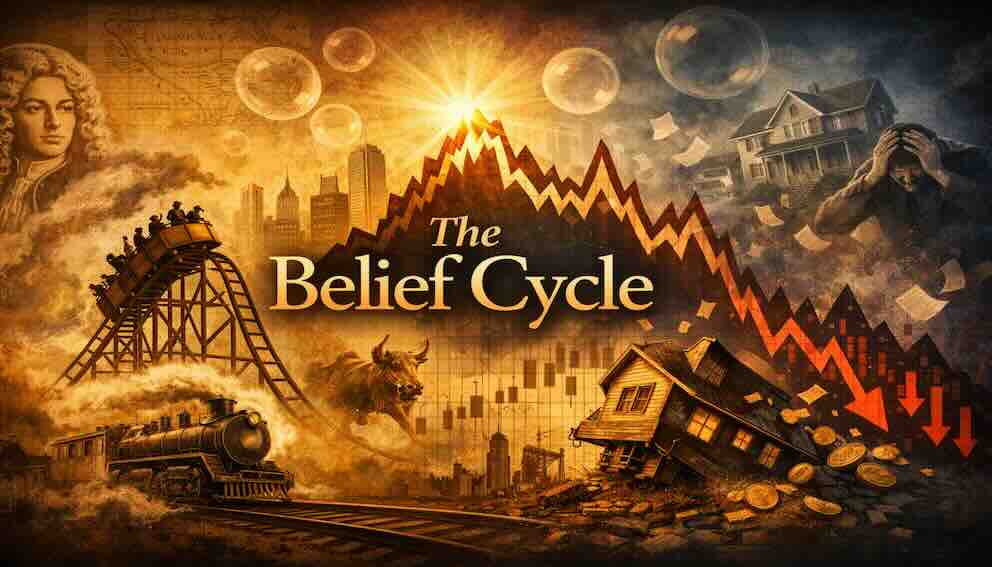
The Belief Cycle
Looking across these four episodes—John Law's Mississippi scheme, the Railway Mania, the Nifty Fifty, and the Housing Bubble—a clear structure emerges. We might call this the Belief Cycle.
Stage One: A real innovation or imbalance emerges. Every major financial narrative attaches itself to something genuine: Louisiana territory with real potential, railways that genuinely transformed transport, dominant companies with real earnings, housing demand that was genuinely growing. The seed of truth is essential for credibility.
Stage Two: A simple, emotional story explains it. The complexity of reality is distilled into a memorable narrative that offers identity and emotion. "Invest in the Mississippi Company and share in America's wealth." "Railways will make you rich." "One-decision stocks." "Housing prices never fall."
Stage Three: Early price increases validate the story. When early adopters profit, their success is interpreted as confirmation. Rising price becomes evidence the story is true.
Stage Four: Social proof expands participation. Seeing others get rich creates fear of missing out. The story spreads through social networks, reaching people who would never have considered investing otherwise.
Stage Five: Credit amplifies the movement. Borrowed money allows the narrative to scale. Law printed money. Railway investors bought on margin with 10% down. Nifty Fifty investors borrowed through margin accounts. Homebuyers borrowed through exotic mortgages. Monetary policy shapes the availability of this credit.
Stage Six: The story detaches from constraints. The narrative mutates into more extreme form. "Louisiana has potential" becomes "Louisiana is El Dorado." "Railways are transformative" becomes "every railway will succeed." "Strong companies are good investments" becomes "price doesn't matter." "Housing demand is growing" becomes "prices never fall." The original insight is lost.
Stage Seven: A trigger event undermines confidence. The Prince de Conti demands gold. The Bank of England raises rates. Inflation surges. Housing prices stall. Something punctures consensus. Skeptical narratives suddenly gain traction. Trigger events often reveal fragility that already existed. They do not cause bubbles; they expose structural strain.
Stage Eight: The narrative reverses faster than fundamentals change. The same networks that spread optimism now spread fear. Belief collapses. Prices fall. Margin calls force selling. The downward spiral mirrors the upward one.
The Critical Tension
Narratives are both necessary and dangerous. They are necessary because without stories, innovation would never get funded. Railways, the internet, homeownership—all required investors to believe in futures that did not yet exist. Narratives channel capital toward the new.
They are dangerous because stories can detach from reality. When belief feeds on itself, when rising prices become the only validation needed, narrative becomes bubble. The same mechanism that funds progress also creates crises.
This tension cannot be resolved, only managed—by individuals cultivating awareness of the stories they inhabit, and by societies building institutions that moderate extremes.
Living in the Story
What does this mean for market participants? It means cultivating double vision. Double vision here means holding enthusiasm and skepticism simultaneously.
Look at the numbers—balance sheets, interest rates, valuation metrics. That anchors you in reality that narratives can obscure.
Look at structural conditions—monetary policy, credit availability, regulation—that shape which narratives flourish and how far they run.
Listen to the stories. Ask: What is the dominant narrative? Who tells it? Why is it spreading? What emotion does it tap?
Ask about competition: What counter-narratives exist? Why aren't they spreading? What would reverse the dominant story?
Ask about your own role: How are you actively constructing the stories you inhabit? Could you imagine different futures?
Hold all this with humility. Narrative economics is not predictive. It cannot tell when a bubble will burst. It offers a framework for interpretation—a way of seeing that sharpens perception of forces shaping markets.
The goal is not immunity to stories—impossible—but consciousness of the stories we inhabit. To recognize when a narrative feeds on its own success. To understand that when belief precedes price, it creates opportunity and profound risk.
Conclusion: Markets as Human Dramas
Financial history, through the narrative lens, is not mistakes to mock but human dramas to understand. From John Law's Mississippi scheme to the housing bubble of 2008, the pattern repeats because human nature repeats.
We are not cold calculators of value. We are storytellers seeking meaning, connection, belonging. We act not on the world as it is, but on the world as we imagine it could be. Our imaginations are shaped by stories we hear, tell, and construct.
The lesson is not that narratives are dangerous and should be ignored—they cannot be, because they constitute economic life. The lesson is that narratives must be examined, questioned, held alongside numbers and structures.
When we understand that belief precedes price—while also understanding monetary conditions that amplify belief, institutional contexts that shape it, competing explanations that challenge it—we understand something fundamental: markets are not mechanical but human systems. And human systems, for all their complexity and occasional madness, are the only kind we have.
The goal is not to transcend our storytelling nature. It is to become more conscious of the stories we inhabit—to see them clearly, question them honestly, imagine alternatives, and remember that prices move because people believe. And when belief changes, markets change with it—and history begins its next chapter.
Further Reading
Shiller, Robert J. Narrative Economics. Princeton, 2019.
Kindleberger, Charles P., and Robert Z. Aliber. Manias, Panics, and Crashes. Palgrave Macmillan, 2015.
Minsky, Hyman P. Stabilizing an Unstable Economy. McGraw-Hill, 2008.
Soros, George. The Alchemy of Finance. Wiley, 1987.
Galbraith, John Kenneth. The Great Crash 1929. Houghton Mifflin, 1954.
Reinhart, Carmen M., and Kenneth S. Rogoff. This Time Is Different. Princeton, 2009.
Akerlof, George A., and Robert J. Shiller. Animal Spirits. Princeton, 2009.
Beckert, Jens. Imagined Futures. Harvard, 2016.
About Swati Sharma
Lead Editor at MyEyze, Economist & Finance Research WriterSwati Sharma is an economist with a Bachelor’s degree in Economics (Honours), CIPD Level 5 certification, and an MBA, and over 18 years of experience across management consulting, investment, and technology organizations. She specializes in research-driven financial education, focusing on economics, markets, and investor behavior, with a passion for making complex financial concepts clear, accurate, and accessible to a broad audience.
Disclaimer
This article is for educational purposes only and should not be interpreted as financial advice. Readers should consult a qualified financial professional before making investment decisions. Assistance from AI-powered generative tools was taken to format and improve language flow. While we strive for accuracy, this content may contain errors or omissions and should be independently verified.