
Tutorial Categories
Last Updated: March 8, 2026 at 10:30
Fear and Greed in Financial History: How Market Cycles Repeat From Railway Mania to the 2008 Crisis
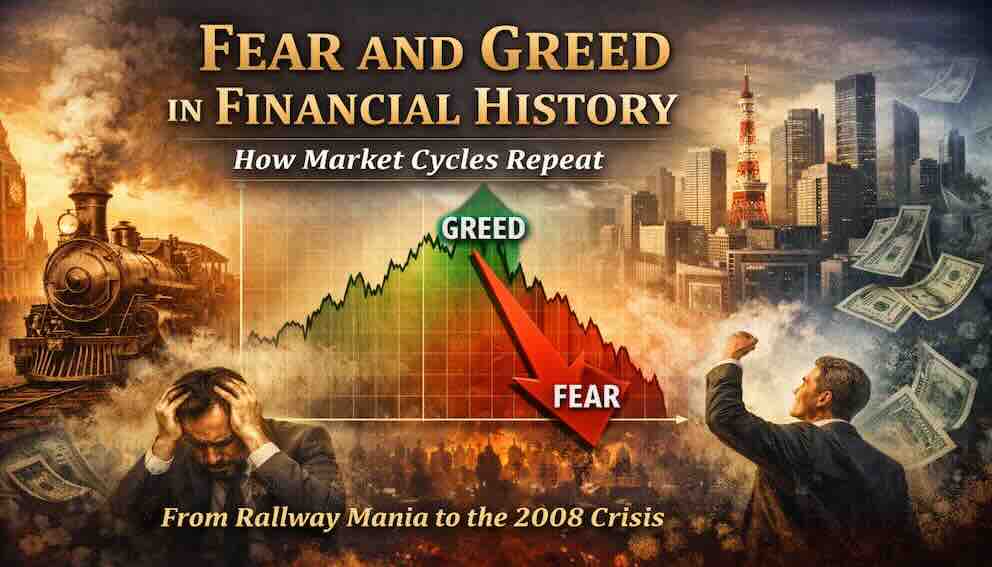
Imagine watching a stock you sold continue to climb without you. The feeling is visceral—regret, envy, and the conviction that you must not miss the next opportunity. This feeling, repeated across millions of investors across centuries, is the invisible engine of market cycles. From Britain's railway boom in the 1840s to Japan's bubble in the 1980s and the 2008 crisis, markets follow remarkably similar patterns: optimism becomes excitement, excitement becomes euphoria, euphoria gives way to fear, and fear becomes despair. Yet these cycles are not purely psychological. They are shaped by credit, amplified by leverage, accelerated by media, and reinforced by institutions that forget the past. The goal is not to eliminate these emotions—which is impossible—but to recognize them and navigate with greater awareness.
Introduction: Markets as Emotional Systems
When we study financial history, we often focus on numbers—interest rates, earnings, GDP growth—because they are measurable and visible. But beneath every price chart lies something more fundamental: human emotion.
Markets are not mechanical systems operating on pure logic. They are human systems, populated by people who feel hope, excitement, euphoria, fear, and despair. The numbers we analyze are not abstract data points; they are the footprints of emotional herds in motion.
Each crisis appears unique—driven by different technologies, different policies, different institutions. But a longer view reveals recurring emotional phases. Optimism intensifies into excitement, excitement hardens into euphoria, euphoria turns into denial, then fear, then panic, and finally despair—until the cycle gradually resets toward hope.
These phases do not unfold evenly. They build slowly in the early stages and accelerate rapidly near the end. Bubbles form over years but collapse in months. Time itself behaves asymmetrically in financial cycles.
The economist Hyman Minsky offered a powerful insight into this recurring instability when he observed that stability itself breeds fragility. Long periods of calm encourage households, firms, and banks to take on increasing risk. Debt accumulates quietly. Leverage expands. Financial structures grow more complex and more interconnected. What appears safe becomes increasingly vulnerable beneath the surface.
In this tutorial, we trace these emotional phases through history and examine how psychology, human behaviour, and collective memory combine to produce the recurring structure of financial cycles. But emotion alone does not create booms and busts. Psychology operates within a financial architecture shaped by credit, amplified by leverage, accelerated by media, and reinforced by institutions that often forget the past. Human behavior provides the spark, but the structure of the system determines how large the fire becomes.
The Birth of Greed — When Innovation Turns Into Speculation
Greed rarely appears at the beginning of a cycle. This is crucial to understand. Every great boom begins with something real. There is always genuine innovation, genuine productivity, or genuine economic transformation that justifies initial optimism. The error is not in recognizing opportunity, but in assuming that opportunity has no limits.
The Railway Mania of 1840s Britain
In the 1840s, Britain was at the center of the Industrial Revolution. Railways were a transformative technology, as world-changing in their time as the internet would be 150 years later. They reduced travel times dramatically, connected cities, facilitated trade, and created entirely new industries. The expansion of railway networks was a powerful development.
When railway companies began to list shares on the London market, investors saw genuine opportunity. Early lines were profitable, and share prices rose. Rising prices created visible success stories. A man who invested £100 in a promising railway could watch his holding double within months. These stories attracted more investors. As more capital flowed into railway projects, Parliament authorized thousands of miles of new track.
Here we see the emotional transition in its purest form. The initial optimism was rational. The technology was real. The need was real. But gradually, enthusiasm detached from practical evaluation. Investors began to assume that every railway line would succeed, even those connecting sparsely populated regions with little commercial activity. Shares were purchased not because of detailed analysis of projected earnings, but because they had been rising. The question shifted from "Is this a good investment?" to "Will someone else pay more for it tomorrow?"
This moment represents the transition from optimism to excitement, and from excitement toward euphoria. Greed did not arise from foolishness at the outset. It grew from success. When early gains confirmed expectations, confidence strengthened. As confidence strengthened, caution weakened. The man who had been prudent with his first investment became speculative with his second.
The railway boom also demonstrated the power of media amplification, even in an era before mass electronic communication. Newspapers and pamphlets circulated stories of instant fortunes. Promoters issued optimistic prospectuses exaggerating potential revenues. Social networks carried tales of wealth from London to the countryside. The contagion of enthusiasm moved through these channels with remarkable speed for the time.
When construction costs escalated and revenues disappointed, the bubble burst. Many investors who had entered late, drawn by the stories of early fortunes, faced heavy losses. The railway tracks were built—much of Britain's network dates from this era—but the prices paid for shares had far exceeded any reasonable estimate of their value.
Some economic historians note that railway speculation was concentrated among wealthy investors and that the economic disruption was less severe than legend suggests. The underlying infrastructure continued to provide value for generations. This critique actually strengthens the emotional analysis. Even among sophisticated investors, the same psychological pattern emerged. And the fact that the railways were genuinely transformative explains why the narrative was so compelling. The most dangerous speculation attaches itself to real progress.
The Japanese Asset Bubble of the 1980s
More than a century later, a similar emotional pattern unfolded on the other side of the world. During the 1980s, Japan experienced rapid economic growth, technological advancement, and global trade expansion. Japanese corporations like Toyota, Sony, and Honda were admired worldwide for their efficiency and innovation. The Japanese economic model was studied, praised, and envied.
By the late 1980s, asset prices had risen to extraordinary levels. The Nikkei 225 index of leading Japanese stocks reached nearly 39,000 at the end of 1989—a level it has never sustainably exceeded since. Real estate prices in Tokyo surged so dramatically that at the height of the boom, the land value of the Imperial Palace was said to exceed the entire real estate value of California. This was not literally true, but the fact that such a comparison could be repeated tells us something about the emotional atmosphere.
The underlying economy was genuinely strong. Japanese companies were global leaders. Productivity was high. Exports flourished. But speculation magnified expectations beyond reasonable limits. Corporations held shares in one another, creating a web of cross-holdings that inflated balance sheets. Banks extended generous credit against rising collateral values. The rising prices themselves became the justification for further borrowing.
Again, greed did not appear suddenly. It evolved gradually as prosperity reinforced belief. Investors assumed that Japan's economic model was permanently superior—that Western economies could never match its combination of industrial policy, corporate loyalty, and export discipline. This was the "this time is different" belief in its purest form, the euphoric stage where caution is abandoned entirely.
When prices finally began to decline in 1990, the shift in sentiment was severe. The Nikkei collapsed—falling nearly 80 percent from its peak over the following years. The lost decade became two lost decades. Real estate values fell so far that loans written at the height of the boom remained underwater for a generation.
This episode demonstrates that advanced economies with sophisticated institutions are not immune to emotional cycles. Japan in the 1980s had better data, better regulation, and better communication than Victorian Britain. None of it prevented the cycle. The psychology of rising prices creating greater confidence operates universally.
The Illusion of Permanence — "This Time Is Different"
As a boom progresses into its euphoric phase, a particularly dangerous belief emerges. Investors begin to think that historical limitations no longer apply. They convince themselves that structural changes have permanently eliminated risk. This is the moment when caution is abandoned entirely.
The Nifty Fifty Era in the United States
In the late 1960s and early 1970s, American investors became enamored with a group of large, well-established companies that were considered unstoppable. These firms—including IBM, Xerox, Coca-Cola, and Procter & Gamble—were labeled the "Nifty Fifty." They were described as "one-decision stocks," implying that investors could buy them at any price and hold them indefinitely.
The logic seemed compelling. These companies were dominant in their industries, profitable, globally recognized, and seemingly immune to competition. Why worry about valuation when you own a piece of American economic permanence?
However, as enthusiasm intensified, valuations rose to levels that left no margin for disappointment. Some of these stocks traded at fifty or sixty times earnings. The assumption was that their growth would continue forever, that their dominance could never be challenged.
When inflation surged and economic conditions deteriorated in the 1970s, stock prices fell sharply. Even excellent companies suffered dramatic declines because expectations had been unrealistic. Xerox, which had traded at over 170 times earnings at the peak, fell by more than 70 percent. Investors who had bought at the top waited years, sometimes decades, to recover their capital.
The emotional error was in assuming that strong businesses justified any price. The illusion of permanence blinded investors to valuation risk—to the simple truth that even the best company becomes a poor investment if purchased at a high enough price.
Value investors at the time pointed to the excessive valuations. They were dismissed as dinosaurs who didn't understand the new economy of stable growth. This pattern repeats in every cycle. The skeptics are always there, but their voices are drowned out by the emotional momentum of the crowd. The illusion of permanence is not an intellectual error but an emotional one—a feeling that this time, finally, uncertainty has been conquered.
The U.S. Housing Bubble and the Crisis of 2008
A similar illusion unfolded during the U.S. housing boom of the early 2000s. For years, home prices had risen steadily across the country. Many people began to believe that housing prices could not decline nationally. This was not presented as speculation but as fact, as immutable as gravity.
The belief had consequences. Mortgage lending standards loosened because lenders assumed that rising prices would protect them even if borrowers defaulted. Complex financial products were created to distribute mortgage risk across global markets, and these products received high credit ratings because the underlying assumption was that housing was safe.
Financial institutions became heavily exposed to mortgage-related securities. Lehman Brothers, Bear Stearns, Merrill Lynch—all built balance sheets that assumed housing prices would continue rising. As long as prices rose, the system appeared stable. Defaults were rare, and when they occurred, rising prices allowed borrowers to refinance or sell at a profit.
Here we must also acknowledge the role of deliberate manipulation. The originate-to-distribute model created perverse incentives: mortgage brokers earned commissions for originating loans but bore no risk if those loans defaulted. Some lenders actively marketed predatory loans to vulnerable borrowers. Investment banks packaged these loans into securities whose risks were obscured by complex structures and complicit rating agencies. Fraud was not merely a sideshow; it was central to the bubble's expansion.
When housing prices stalled and began to decline, the structure proved fragile. The assumption that national housing prices were permanently stable turned out to be false. Defaults rose, securities plunged in value, and institutions that had borrowed heavily against these securities faced collapse. When Lehman Brothers failed in September 2008, panic spread across global financial markets.
The illusion of permanence is one of the most dangerous phases in a market cycle. It encourages leverage, reduces caution, and creates systemic vulnerability. The belief that "this time is different" is not confined to inexperienced investors. It infects central bankers, regulators, and the leaders of financial institutions.
The Emotional Bottom — When Fear Becomes Overwhelming
While peaks are dramatic and draw attention, bottoms are psychologically more intense. At a market bottom, optimism has disappeared entirely. Losses feel permanent. Uncertainty dominates every decision. The future appears not merely uncertain but threatening.
The Panic of 1873
The Panic of 1873 began with financial failures in Vienna and spread quickly through the interconnected banking systems of Europe and America. Excessive investment in railroads and infrastructure, combined with speculative financing, had created fragility across continents. When the Vienna Stock Exchange crashed in May, confidence evaporated. Major banks in Germany and Austria failed. The panic crossed the Atlantic in September when the banking house of Jay Cooke & Company—financier of the Northern Pacific Railway—collapsed.
What followed was a prolonged economic downturn often referred to as the Long Depression. Banks closed. Railroads went bankrupt. Unemployment rose. In the United States, the panic triggered a political crisis over monetary policy that would shape elections for a decade. Investors who had once believed in endless expansion faced years of stagnation. The emotional atmosphere was heavy and uncertain—not the sharp panic of a sudden crash, but the grinding despair of a slow collapse.
Recovery, when it came, was gradual and uneven. The businesses that survived the downturn emerged stronger, but the emotional scars lasted for years. And from the wreckage emerged institutional change: the panic of 1873 was one of the crises that eventually led to the creation of the Federal Reserve in 1913, as policymakers recognized the need for a lender of last resort.
The Market Bottom of 1932
During the Great Depression, the American economy contracted with a severity that had never been seen before. By 1932, the Dow Jones Industrial Average had fallen nearly 90 percent from its 1929 peak. Banks failed by the thousands. Unemployment reached 25 percent.
At that moment, few people believed recovery was near. The prevailing sentiment was despair. Many questioned whether capitalism itself could survive. The certainties of the 1920s—the belief in permanent prosperity, in technology as salvation, in the wisdom of markets—had been replaced by their opposites.
Yet 1932 marked the beginning of gradual recovery. Economic reforms were implemented. Confidence, slowly and unevenly, returned. Over time, growth resumed. Investors who purchased at the depths of pessimism—those who could overcome the emotional weight of the moment—eventually experienced significant gains.
The institutional response to the Depression reshaped American finance for generations. The Glass-Steagall Act separated commercial and investment banking. The Securities and Exchange Commission was created to oversee markets. Deposit insurance protected savers. These reforms did not eliminate cycles, but they muted their extremes—until memory faded and regulations were relaxed decades later.
The emotional bottom felt unbearable precisely because fear was universal. When everyone around you expects the worst, it takes extraordinary independence to imagine anything else.
March 2009: Modern Despair
In early 2009, after the collapse of Lehman Brothers and months of severe financial instability, global markets reached a low point. The S&P 500 had fallen more than 57 percent from its 2007 peak. Headlines discussed the possibility of systemic collapse. Governments were intervening in unprecedented ways, nationalizing banks and guaranteeing money market funds.
At the time, uncertainty was overwhelming. Would the financial system hold? Would the recession turn into a depression? Was this the end of American economic dominance? These questions were not abstract; they were the daily stuff of news and conversation.
However, March 2009 marked the beginning of a prolonged expansion in global equity markets. The recovery was driven in part by aggressive policy responses—near-zero interest rates, quantitative easing, fiscal stimulus—that had not been available in earlier eras. The Federal Reserve and other central banks acted as lenders of last resort on a scale never seen before.
This highlights an important asymmetry in market bottoms. Some recoveries are quick, propelled by policy intervention. Others, like Japan's, drag for decades because the underlying debt overhang is not addressed. The emotional experience of a bottom may be similar, but the institutional and policy context determines how long the despair lasts.
The recovery of 2009, like all recoveries, was invisible at the moment of maximum despair. The investor who bought at the bottom did not know it was the bottom. They only knew that prices were lower than they had been, that fear was pervasive, and that the future was unknowable.
Why Cycles Persist — Memory, Fraud, Media, and Global Forces
One might reasonably assume that with better data, faster communication, and more sophisticated regulation, market cycles would diminish. The evidence suggests otherwise.
Memory and Amnesia. Financial memory is short. Those who lived through a crash are cautious; they remember the feeling of watching wealth evaporate. But those who did not experience the crash inherit only stories, not feelings. They assume this generation is smarter, better regulated, more sophisticated. This generational turnover ensures that every cycle contains the seeds of the next. As Minsky observed, stability breeds instability.
Fraud and Manipulation. Critics of Minsky rightly note that his framework underplays deliberate fraud. In the railway boom, promoters issued misleading prospectuses. In the 1920s, manipulation pools rigged stock prices. In the 2000s, mortgage lenders originated loans they knew would fail, and rating agencies assigned top ratings to securities whose risks they barely understood. Fraud amplifies greed by creating the illusion of safety—an illusion that shatters when exposed, accelerating the transition from denial to panic.
Media Acceleration. The speed of emotional contagion has increased dramatically. In the railway era, news traveled by post. In 1929, by radio and newspaper. In 2008, by 24-hour cable news and the internet. Today, algorithms push emotionally charged content to maximize engagement—amplifying greed during booms and fear during crashes. The emotional phases remain the same, but they now unfold much faster.
Global Variations. These patterns are not confined to Western markets. The Asian Financial Crisis of 1997 showed how fear spreads through emerging economies with devastating speed. Capital that flowed into Thailand, Indonesia, and South Korea during years of optimism fled just as quickly when confidence cracked. Currency collapses, banking crises, and IMF interventions followed. These episodes share the same emotional architecture but with added dimensions: currency risk, dependence on foreign capital, and vulnerability to sudden stops.
Living With the Cycle
What does this mean for market participants? It means cultivating a different kind of awareness.
We cannot eliminate fear and greed. They are constitutive of markets, not impurities within them. But we can learn to recognize the phases. Are we in early optimism, where genuine progress justifies enthusiasm? Or have we moved into euphoria, where rising prices become the primary reason to buy? Are we hearing the "this time is different" narrative? Are we experiencing the overwhelming fear of a bottom?
We can look to sentiment indicators that quantify emotional extremes. The VIX spikes during panic. Investor sentiment surveys show when optimism has become excessive. Media analysis tracks the prevalence of bubble narratives. These tools do not predict the future, but they help us locate ourselves in the cycle.
We can manage leverage, recognizing that borrowed money amplifies emotion along with returns. We can maintain liquidity, holding reserves to act when others cannot. We can diversify across time as well as assets, investing gradually to reduce timing risk. And we can remember that fraud and manipulation are recurring features—when returns seem too good to be true, they often are.
The goal is not to transcend our emotional nature. That is impossible. The goal is to become more conscious of it—to feel the fear and greed, to recognize them for what they are, and to make decisions that reflect not just the emotion of the moment but the accumulated wisdom of history.
Conclusion: The Enduring Architecture of Markets
The pattern repeats because human nature repeats. Hope becomes optimism. Optimism becomes excitement. Excitement becomes euphoria. Euphoria gives way to fear, then panic, then despair. And eventually, hope begins again.
Innovation sparks rational optimism. Success strengthens confidence. Confidence evolves into speculation. Speculation creates fragility. Fraud and media amplify the excess. Leverage magnifies the movement. When expectations fail, fear replaces greed with remarkable speed. Institutions respond with reforms that gradually erode as memory fades. The cycle completes itself and begins again.
Yet not every bottom brings quick recovery. Japan's decades of stagnation contrast with 2009's policy-driven rebound—reminding us that institutional context matters. The lesson is not that buying at the bottom always works, but that selling at the bottom is almost always wrong.
Markets are human systems. Technology changes. Institutions evolve. But the emotional forces that drive cycles remain constant. We are not the first to feel regret at missed opportunity, confidence during a rising market, or fear when prices fall.
By understanding these emotional universals, we equip ourselves not to eliminate volatility—which would be like trying to eliminate weather—but to navigate it with greater patience and awareness. We learn to ask not just "What is the price?" but "What is the feeling behind the price?"
Financial history teaches something humbling: the emotions that move markets today moved them in 1840, in 1929, in 1989, and in 2008. Understanding this does not make us rich, but it makes us wiser. And in markets, as in life, wisdom is the rarest and most valuable asset of all.
Further Reading
- Kindleberger, Charles P., and Robert Z. Aliber. Manias, Panics, and Crashes. Palgrave Macmillan, 2015.
- Minsky, Hyman P. Stabilizing an Unstable Economy. McGraw-Hill, 2008.
- Galbraith, John Kenneth. The Great Crash 1929. Houghton Mifflin, 1954.
- Shiller, Robert J. Irrational Exuberance. Princeton University Press, 2000.
- Reinhart, Carmen M., and Kenneth S. Rogoff. This Time Is Different. Princeton University Press, 2009.
- Akerlof, George A., and Robert J. Shiller. Animal Spirits. Princeton University Press, 2009.
- Soros, George. The Alchemy of Finance. Wiley, 1987.
- Roubini, Nouriel, and Stephen Mihm. Crisis Economics. Penguin Press, 2010.
- Lewis, Michael. The Big Short. W.W. Norton, 2010.
About Swati Sharma
Lead Editor at MyEyze, Economist & Finance Research WriterSwati Sharma is an economist with a Bachelor’s degree in Economics (Honours), CIPD Level 5 certification, and an MBA, and over 18 years of experience across management consulting, investment, and technology organizations. She specializes in research-driven financial education, focusing on economics, markets, and investor behavior, with a passion for making complex financial concepts clear, accurate, and accessible to a broad audience.
Disclaimer
This article is for educational purposes only and should not be interpreted as financial advice. Readers should consult a qualified financial professional before making investment decisions. Assistance from AI-powered generative tools was taken to format and improve language flow. While we strive for accuracy, this content may contain errors or omissions and should be independently verified.