
Tutorial Categories
Last Updated: March 9, 2026 at 10:30
Cryptocurrency in Historical Context: Hard Money, Financial Manias, and the Recurring Question of Trust
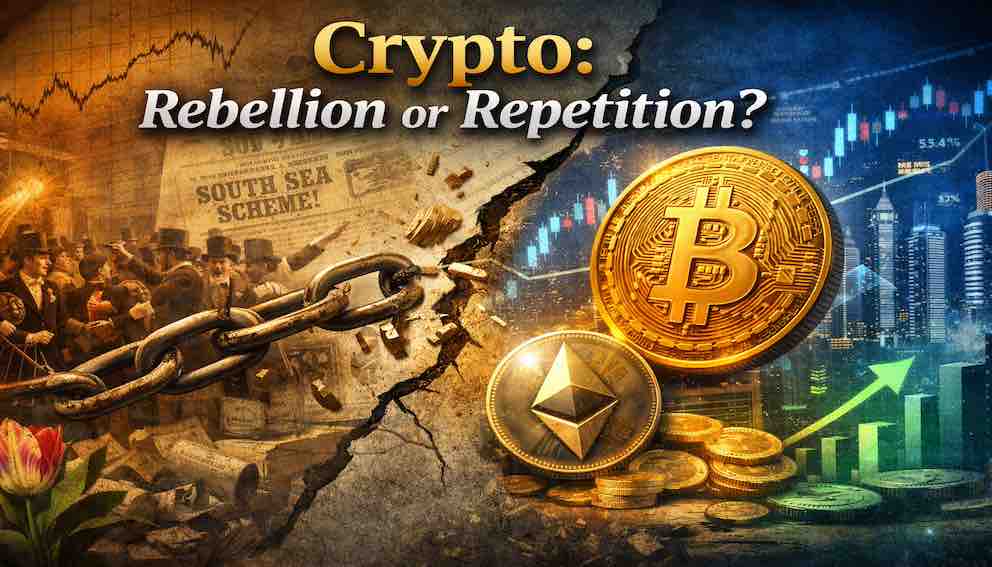
Imagine three historians in a room. Place a copy of the Bitcoin white paper on the table. One calls it ancient—the latest battle in a 2,000-year war between hard money and sovereign power. Another calls it predictable—the Bicycle Mania with better marketing, the same human folly wearing new clothes. The third calls it unprecedented—a genuine rupture in how humans solve the problem of trust. They are all looking at the same object. They are all experts. They cannot agree. This tutorial does not tell you which one is right. Instead, it gives you their tools. By the end, you will see crypto not as a single story, but as a prism—one that reveals different histories depending on how you hold it to the light. You will also understand why credit, leverage, regulation, and sovereignty matter more than the headlines suggest.
Introduction: The Historian's Dilemma
Every generation believes its financial controversies are unique. We argue about Bitcoin with the same intensity our grandparents argued about the gold standard, and their grandparents argued about central banking, and their grandparents argued about whether paper money was even legal.
But here is the uncomfortable truth that historians carry with them: the arguments are not unique. The patterns recur. The characters change costumes, but the play remains the same.
Or does it?
Maybe that is too clever. Maybe the historians who insist everything repeats are missing something real. Maybe this time really is different.
This tutorial offers you a way out of that endless debate. Instead of asking "Is crypto a bubble or a revolution?"—a question that forces you to choose sides before you understand the stakes—we are going to ask a different question: What does crypto look like through three different historical lenses?
Each lens is a way of seeing financial history. Each one selects different evidence, emphasizes different patterns, and arrives at a different conclusion. By holding all three together, you will see the complexity for yourself.
But before we begin, a note. Financial history is not just about currencies and prices. It is about credit—the expansion and contraction of debt that amplifies every boom and deepens every bust. It is about leverage—the borrowed money that turns speculation into systemic crisis. It is about regulation—the slow, grinding process by which the state absorbs and transforms every financial rebellion. And it is about sovereignty—the ancient connection between money and the power of nations.
Keep these forces in mind as we proceed. They will appear in every lens, whether the historians acknowledge them or not
Lens One: The Monetary Metalens — Crypto as the Return of Hard Money
Let us begin with the oldest lens. It focuses on a single question: Who controls the money supply, and why should anyone trust them?
The Argument
Financial history, seen through this lens, is a 2,000-year war between two kinds of money.
On one side stands hard money: scarce, rule-bound, resistant to human manipulation. Hard money does not ask you to trust politicians. It asks you to trust arithmetic. Its supply is fixed, or grows slowly according to predictable rules. It protects savers. It disciplines governments. Its advocates speak the language of integrity, permanence, and moral restraint.
On the other side stands soft money: flexible, politically managed, expandable in times of crisis. Soft money asks you to trust institutions. It allows governments to respond to emergencies, to stimulate economies, to manage the business cycle. Its advocates speak the language of flexibility, compassion, and pragmatic response to changing circumstances.
This war never ends. It only changes terrain.
The Evidence
The Roman Denarius
Walk with me to ancient Rome, in the early days of the Empire. The denarius is a silver coin about the size of a modern dime. It contains nearly pure silver. It is hard money. For centuries, Romans trust it because they can see its value in their hands.
But empires are expensive. Armies require payment. Borders require defense. Emperors require monuments. Gradually, almost imperceptibly, the denarius begins to change. Later emperors, facing fiscal pressure, start mixing base metals into the silver. The coin looks the same. But when you hold it, it feels lighter. When you spend it, it buys less.
By the third century, the denarius is almost entirely copper with a thin silver wash. The hard money is gone. The soft money revolution—the expansion of supply to meet political demands—is complete. Romans do not riot over monetary theory. They simply notice that prices rise, that savings evaporate, that the currency they trusted now betrays them.
The Gold Standard Era
Fast forward to the nineteenth century. The hard money argument has returned, this time dressed in the language of classical liberalism. The gold standard spreads across the industrializing world. Currencies are convertible into gold at fixed rates. Governments cannot print their way out of trouble. The system is rigid, unforgiving, and deeply credible.
Between 1870 and 1914, international trade explodes. Capital flows across borders with unprecedented freedom. Investors trust that the pound in London, the franc in Paris, and the mark in Berlin all represent the same underlying reality: a claim on real gold.
But rigidity has costs. When economies falter, governments cannot respond. When banks fail, no lender of last resort can create liquidity. The gold standard survives World War I but limps through the 1920s and collapses in the 1930s, a casualty of the Great Depression.
1971: The Final Break
The definitive victory of soft money arrives on August 15, 1971. President Nixon closes the gold window. The dollar is no longer convertible. From this moment forward, every major currency is fiat—backed not by metal, but by the full faith and credit of the issuing government.
To soft money advocates, this is liberation. Central banks can now manage economies actively. They can respond to crises. They can prevent depressions.
To hard money advocates, this is the final betrayal. Money has become pure politics. Its value depends entirely on the restraint of the people who control the printing presses.
Through This Lens, What Is Crypto?
Bitcoin appears in 2009 with a fixed supply of 21 million coins. The number is not arbitrary. It is a declaration of war. Satoshi Nakamoto (their identity has never been confirmed), looked at the financial crisis of 2008 and saw the soft money system at its worst: banks bailed out, money printed, savers punished. The response was to build a currency that no government could debase, no central bank could expand, no politician could manipulate.
The Paradox
But here is the problem. Hard money says: trust no human. Trust the rules.
Who writes the rules? Who maintains them? The Roman denarius had rules until an emperor ignored them. The gold standard had rules until a war made them unbearable. The rules held until they didn't— because humans decided other concerns mattered more.
Bitcoin's rule is 21 million coins, no exceptions. But that rule exists only because humans run the software, maintain the network, and agree the rule matters. If enough humans walk away, the rule dies.
The Insight
When you look through this lens, you stop asking about bubbles. You start asking: Which side of a 2,000-year argument does this belong to? And—most uncomfortably—if every previous attempt at lasting hard money eventually failed, what makes this one different?
Can we build rules humans will keep trusting, generation after generation, even when those rules become inconvenient.
The Romans could not. The gold standard could not. Crypto asks whether it can do what they could not. And that uncertainty is where our next lens begins.
Key Insight: Through this lens, crypto is a bet—a bet that this time, the rules can be made to hold. History suggests that is a very hard bet to win. But history also suggests the people making it will never stop trying.
Lens Two: The Psychological Lens — Crypto as Predictable Mania
The first lens focuses on the nature of money. The second lens shifts focus to the nature of us.
The Argument
Financial history, seen through this lens, is not about monetary theory at all. It is about human psychology—specifically, the recurring patterns of collective emotion that drive markets to extremes.
This lens argues that we are not as rational as we believe. When new technologies appear, we do not calmly assess their long-term potential. We project our hopes onto them. We tell ourselves stories about the future. We see others getting rich and feel the acute pain of missing out. We buy not because we have analyzed the fundamentals, but because we cannot bear to watch our neighbors prosper without us.
The pattern repeats across centuries because the human brain has not changed. The technology evolves; the emotions do not.
The Evidence
The Bicycle Mania (1890s)
Consider the bicycle.
Today it seems humble, even mundane. But in the 1890s, the bicycle was as revolutionary as the internet in the 1990s or artificial intelligence today. It freed people from dependence on horses. It gave women unprecedented mobility and independence. It created demand for paved roads. It promised to reshape cities, recreation, and daily life.
Between 1895 and 1900, hundreds of bicycle manufacturing companies were formed in Britain and the United States. Investors poured savings into any firm with "cycle" in its name. Newspapers ran breathless features on new designs that would "change everything." The language was identical to what we would hear a century later about dot-com stocks: freedom, progress, the obsolescence of the old ways.
Most of those companies failed. The patents proved worthless. The factories sat empty. Investors who bought at the peak lost everything.
But notice what the mania narrative does not deny. The bicycle did change everything. The roads built for bicycles became roads for cars. The manufacturing techniques pioneered for bicycles became the foundation of the automotive industry. The surviving companies—Raleigh, Schwinn—dominated for decades.
The mania and the genuine innovation were not opposites. They were the same event, experienced from different angles.
The Shanghai Rubber Stock Bubble (1910)
Now travel to Shanghai in 1910, at the height of the global rubber boom. The automobile industry was young, tires were in relentless demand, and rubber prices on London markets were climbing toward the sky .
On the foreign-dominated Shanghai Stock Exchange—established by British and American merchants decades earlier—a frenzy erupted in rubber plantation shares . Companies with names evoking distant tropical estates sold shares to anyone who would buy. Prospectuses overflowed with dreams: China awakening, endless demand for rubber tires, fortunes waiting to be claimed .
Chinese investors poured in. Not just merchants, but ordinary people who had never owned a stock. They mortgaged homes, pawned jewelry, borrowed from money shops—all to buy shares in enterprises most had never seen . The price of one rubber company's shares doubled in six weeks .
Then, in the summer of 1910, London markets turned. Rubber prices collapsed. The same foreign banks that had eagerly financed the buying now called in their loans . The bubble burst.
When it was over, an estimated 40 to 50 million taels of silver—roughly half the Chinese imperial government's annual revenue—had been lost . Shanghai's financial district was gutted. Dozens of money shops failed. Trust in modern finance, so newly and eagerly embraced, evaporated for a generation .
The rubber was real. The global demand was real. The mania, the leverage, and the crash were also real. The infrastructure—the exchange itself, the habit of share ownership, the idea that the future could be bought and sold—survived. But the people who bought at the peak did not.
The Missing Piece: Credit and Leverage
The psychological lens captures emotions well. But it misses something crucial. Speculation alone rarely causes systemic collapse. Leverage does.
Consider 1929. The boom was real. But what turned a correction into a depression was margin debt—investors borrowing to buy stocks, then forced to sell when prices fell. Consider 2008. The housing speculation was real. But what brought down the system was the vast, invisible edifice of mortgage-backed securities, repurchase agreements, and shadow banking leverage.
Now look at crypto. The 2021 surge was not just retail FOMO. It was powered by:
- Stablecoins functioning like unregulated bank deposits, creating redemption risk
- Crypto exchanges lending to customers, recreating broker-dealer leverage
- Decentralized finance protocols offering yields that depended on continuous new inflows
- Derivatives amplifying price moves in both directions
When confidence broke in 2022, the leverage unwound. Exchanges failed. Stablecoins broke their pegs. Lending platforms froze withdrawals. The pattern was not new. It was 1929, 2008, and every other leverage-driven collapse, recreated on a new technological base.
The psychological lens should therefore add a sub-lens: the credit amplifier. Human emotion starts the fire. Leverage turns it into an inferno.
Through This Lens, What Is Crypto?
Through the psychological lens—now deepened by credit awareness—crypto is not primarily about monetary theory. It is about what happens when a genuinely transformative technology meets the permanent structures of human emotion and the amplifying power of borrowed money.
The pattern is classic:
- A compelling story about the future
- Rapid price increases that attract attention
- Fear of missing out that draws in later buyers
- Leverage that magnifies gains and, later, losses
- Celebrity endorsements and social proof
- A crash that reveals the fragility of the leveraged structure
This lens does not ask whether blockchain is useful. It asks why, every time a useful technology appears, humans immediately turn it into a casino and then borrow heavily to play. And it answers: because that is what we have always done. The bicycle attracted mania. The railway attracted mania. The internet attracted mania. Crypto is not different because it avoids leverage and mania. It is typical because it attracts them.
Key Insight: The psychological lens, now enriched with credit awareness, teaches us to hold three thoughts simultaneously. The speculation is real. The innovation is also real. And the leverage that connects them is the oldest story in finance.
Lens Three: The Institutional Lens — Crypto as Genuine Rupture
The first two lenses emphasize continuity. Hard money is ancient. Mania and leverage are eternal. But the third lens asks a different question: What if something here actually is new?
The Argument
Financial history, seen through this lens, is the story of how humans solve the problem of trust. Every major advance creates a new institutional form—a new way for strangers to cooperate, to exchange value, to make promises across time and distance.
This lens argues that comparing crypto to past manias misses the point entirely. The question is not whether prices fluctuate or leverage builds. The question is whether blockchain technology creates a fundamentally new kind of institution—one that does not rely on trust in human authorities at all.
But the institutional lens must also be honest. It must ask: Is crypto really "trustless," or does it simply relocate trust to new actors—miners, developers, exchanges, energy markets? And what happens when the state inevitably responds?
The Evidence
The Knickerbocker Crisis (1907)
Let us examine a moment when the old institutions failed.
October 1907. The Knickerbocker Trust Company, one of the largest in New York, faces a run. Depositors line up outside, demanding their money back. The trust cannot pay. Within days, the panic spreads to other trusts, then to banks, then to the stock exchange.
The United States has no central bank. There is no lender of last resort. There is no mechanism to inject liquidity into the frozen system.
Into this vacuum steps one man: J.P. Morgan, the banker. Working from his townhouse, surrounded by the nation's leading financiers, he personally organizes the rescue. He decides which firms live and which die. He pledges his own capital. He effectively becomes the central bank for two weeks.
The crisis passes. But the lesson is seared into the national memory: the financial system depends on trust, and when trust fails, there is no backstop except the goodwill of a few wealthy individuals. That is not a system. It is a vulnerability.
The direct result, in 1913, is the creation of the Federal Reserve—a permanent institution designed to do what Morgan did ad hoc: provide liquidity, stabilize panics, serve as lender of last resort.
This is institutional innovation born from institutional failure. Sound familiar?
The Latin American Debt Crisis (1980s)
Now consider a different kind of institutional failure, one that unfolded across an entire continent.
Throughout the 1970s, Latin American governments borrowed heavily from international banks. Petrodollars flowed from oil-exporting countries through Western banks to developing nations. The loans seemed sensible at the time. Interest rates were low. Commodity prices were high. The future looked bright.
Then came 1979. The U.S. Federal Reserve, under Paul Volcker, raised interest rates dramatically to fight inflation. Dollar-denominated debt suddenly became unpayable. Country after country—Mexico in 1982, Brazil, Argentina, others—announced they could not service their obligations.
The 1980s became Latin America's "lost decade." Economies contracted. Living standards collapsed. Savings evaporated. Millions of people who had never taken out a dollar loan discovered that their fate was tied to decisions made in Washington and New York.
What did ordinary people do? Those who could converted savings into dollars and hid them. Those who could not watched their currencies inflate away. The informal economy expanded. Trust in banks, in governments, in the entire financial architecture, collapsed.
This is the lived experience of monetary dependency. It explains why, when Bitcoin appeared, it found eager adopters not only in Silicon Valley libertarians but in Argentina, Venezuela, Turkey—places where the soft money system had already betrayed its citizens.
The Darién Scheme (1690s)
One more story, this one from the edge of Europe.
Scotland in the 1690s is poor but proud. It has a separate parliament, a separate currency, and a burning desire to match England's colonial success. The Darién Scheme is born: a Scottish colony on the isthmus of Panama, intended to control trade between the Atlantic and Pacific and make Scotland rich.
Half of Scotland's liquid capital is invested. The national mood is euphoric. This is Scotland's moment, its chance to escape English dominance and claim its place in the world.
The colony fails catastrophically. Disease kills settlers. The Spanish attack. The jungle is impassable. The promised trade never materializes. Ships return empty or not at all.
Scotland is bankrupt. The financial and psychological blow is so severe that, in 1707, the Scottish parliament votes to dissolve itself and accept union with England. The Darién Scheme does not just wipe out investors. It wipes out a nation's sovereignty.
This is what happens when a people pin their dreams of liberation on a financial project and the project fails. The emotional stakes could not be higher.
The Sovereignty Question
The Darién Scheme raises a deeper question that the institutional lens must confront.
Throughout history, monetary control has been inseparable from state power. Medieval kings fought wars to control mints. The creation of national currencies in the nineteenth century unified fragmented states. The euro created supranational monetary sovereignty. Money and sovereignty are twins.
Crypto challenges this directly. It offers a currency that no state controls, that crosses borders without permission, that exists outside the traditional architecture of political authority.
This is not just a new financial instrument. It is a challenge to one of the foundational pillars of the modern state. If money can exist without a sovereign, what else can?
That question is why governments are not ignoring crypto. They are responding—through regulation, through central bank digital currencies, through enforcement actions. The rebellion is meeting the state.
The Infrastructure Question
There is another complication. Is crypto really "trustless," or does it simply relocate trust?
Consider what crypto actually requires:
- Energy. Bitcoin mining consumes electricity on the scale of medium-sized nations. That energy comes from grids controlled by governments and corporations.
- Hardware. Mining requires specialized chips manufactured in a global supply chain dominated by a few companies.
- Developers. The code is maintained by small groups of core developers. They can introduce changes, fix bugs, or argue about direction. Users trust them.
- Exchanges. Most people access crypto through centralized exchanges that look and feel like traditional banks. When those exchanges fail, users lose money. The trust problem reappears.
- Stablecoins. Most trading volume involves stablecoins pegged to the dollar. Those pegs depend on reserves held by private companies. That is not trustless. It is trust in new names.
The institutional lens must therefore be balanced. Blockchain offers a genuine innovation: distributed consensus without a central authority. But in practice, the crypto ecosystem rebuilds trust relationships everywhere—with miners, developers, exchanges, and stablecoin issuers. The rupture is real but incomplete.
Through This Lens, What Is Crypto?
Through the institutional lens—now deepened by sovereignty and infrastructure awareness—crypto is a genuine but partial rupture.
Previous monetary systems required trust in someone: a king who would not debase the coinage, a bank that would not fail, a government that would not inflate. Even the gold standard required trust that governments would maintain convertibility—trust that was repeatedly betrayed.
Blockchain technology itself is genuinely new. For the first time, we have a way to transfer value that does not require trusting any single institution. The rules are in the code, and the code does not bend.
But humans do not interact directly with code. They interact through exchanges, wallets, and apps. And at that layer, the old world reasserts itself. Exchanges fail—just as banks always have. Stablecoins break—just as currencies always have. Developers argue. Miners concentrate. Regulators assert jurisdiction.
The rupture is real. It is just not total. The base layer is new. Everything built on top of it looks disturbingly familiar.
Key Insight: The institutional lens argues that comparing crypto to tulips misses the point. The question is not whether prices fluctuate. The question is whether a technology that allows value to move outside state control changes the long-term balance of power between individuals and governments. The answer is not yet clear. But the question itself is historically significant.
Coda: Does Rebellion Survive Absorption?
We have looked at crypto through three lenses. Each reveals something true. Each also casts its own shadow.
But there is a fourth question that history forces upon us. It is not really a lens. It is a pattern.
Throughout financial history, rebellion is followed by absorption. The pattern is consistent:
Innovation → boom → crash → regulation → institutionalization
Consider:
- The panic of 1907 produced the Federal Reserve.
- The crash of 1929 produced the SEC.
- The crisis of 2008 produced Dodd-Frank.
The state always responds. The rebels either replace the system, or they become part of it.
Crypto is now entering this phase globally. The questions are everywhere:
- What happens when central banks issue digital currencies?
- What happens when crypto ETFs dominate the market?
- What happens when exchanges are licensed, taxed, and supervised like banks?
- What happens when the compliance burden becomes too heavy for decentralized projects to bear?
The rebellion may not be crushed. It may be absorbed. The technology may survive, but the anti-institutional spirit may not.
This does not make the story less important. It makes it more typical. Financial rebels have always faced the same choice: transform the system, or be transformed by it.
Conclusion: What History Actually Teaches
We have covered a great deal of ground. Let us distill the lessons into something concrete.
First, monetary systems change slowly, but the arguments about them repeat. The debate between hard money and soft money is not new. It will not end with crypto. It will continue in new forms.
Second, speculative psychology never disappears. It attaches itself to every transformative technology. It is amplified by leverage. It produces booms and crashes with metronomic regularity. Crypto is not immune. It is exemplary.
Third, institutional innovation survives crashes if it solves a real coordination problem. The bicycle survived the mania. The internet survived the dot-com crash. Blockchain will survive the crypto winter if it proves useful for something beyond speculation.
Fourth, regulation follows instability. It always has. It always will. The only question is what form it takes and whether it strangles the innovation it seeks to control.
Fifth, sovereignty and money are inseparable. The state's monopoly on currency is not an accident of history. It is a foundation of political authority. Crypto challenges that foundation. The outcome of that challenge will shape the next century.
Which lens is correct?
The historian's answer is: all of them, and none of them. Each lens reveals something the others miss. Each lens also has blind spots. The monetary lens understates credit and leverage. The psychological lens understates institutional change. The institutional lens overstates the rupture and understates the return of the old world.
The task is not to choose. The task is to hold all three simultaneously—to see crypto as ancient war, as eternal mania amplified by leverage, and as genuine but incomplete rupture, all at the same time.
And perhaps that is the deepest lesson financial history has to offer. The past is not a single story. It is a set of tools for seeing the present. The quality of your vision depends not on which tool you pick, but on how many you can hold, and how honestly you acknowledge what each one misses.
Further Reading
For readers who want to explore these lenses more deeply:
- On hard money: The Ascent of Money by Niall Ferguson
- On financial mania and credit cycles: Manias, Panics, and Crashes by Charles Kindleberger
- On the 1907 panic and the creation of the Fed: The Panic of 1907 by Robert Bruner and Sean Carr
- On the Darién Scheme: The Darien Disaster by John Prebble
- On Latin American debt: The Debt Crisis of the 1980s (Federal Reserve History online)
- On leverage and shadow banking: The Alchemists of Wall Street (various authors, but start with Gary Gorton's work on repo markets)
- On sovereignty and money: The Sovereign Individual by James Dale Davidson and William Rees-Mogg (dated but prescient)
- On crypto infrastructure: The Economics of Blockchain by various academic sources (search for papers on mining concentration and stablecoin risks)
About Swati Sharma
Lead Editor at MyEyze, Economist & Finance Research WriterSwati Sharma is an economist with a Bachelor’s degree in Economics (Honours), CIPD Level 5 certification, and an MBA, and over 18 years of experience across management consulting, investment, and technology organizations. She specializes in research-driven financial education, focusing on economics, markets, and investor behavior, with a passion for making complex financial concepts clear, accurate, and accessible to a broad audience.
Disclaimer
This article is for educational purposes only and should not be interpreted as financial advice. Readers should consult a qualified financial professional before making investment decisions. Assistance from AI-powered generative tools was taken to format and improve language flow. While we strive for accuracy, this content may contain errors or omissions and should be independently verified.