
Tutorial Categories
Last Updated: March 9, 2026 at 10:30
Digital Manias in Financial History: NFTs, Meme Stocks, and the Timeless Logic of Reflexivity
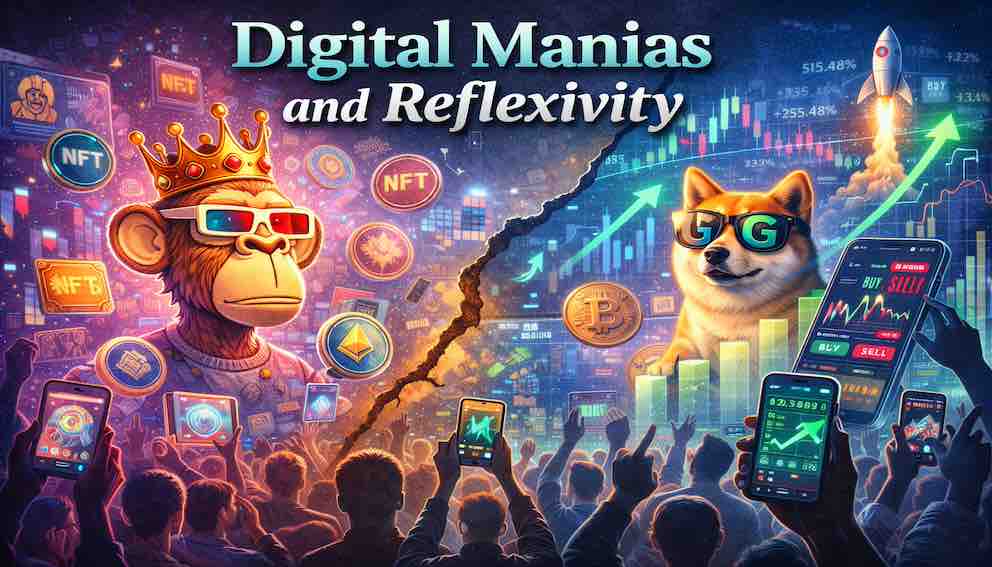
In 2021, a struggling video game retailer became the most talked-about stock in the world. Digital images sold for millions. New investors, armed with smartphones and social media, appeared to rewrite the rules of finance. Yet beneath the screens and hashtags, forces centuries old were quietly at work. This tutorial explores how reflexivity drives modern manias, why low interest rates and pandemic stimulus provided the fuel, how options and payment for order flow changed the mechanisms, and what the crashes teach us about the difference between genuine innovation and speculative excess. By the end, you will see digital manias not as anomalies, but as the latest chapter in a story as old as markets themselves
Introduction: The Year Everything Changed, Again
If you were paying attention to financial markets in early 2021, you witnessed something that felt like science fiction.
A video game retailer named GameStop, a company many had assumed was headed for slow decline, saw its stock price rise more than 1,500 percent in a matter of weeks. A movie theater chain called AMC, struggling to survive pandemic closures, became a battleground between retail traders and hedge funds. Digital images that could be viewed by anyone with an internet connection sold for tens of millions of dollars at major auction houses.
The commentary at the time was filled with words like "unprecedented," "revolutionary," and "new era." Social media, zero-commission trading apps, and blockchain technology seemed to have created something entirely outside the bounds of financial history.
But had they?
If we slow down and examine these events with the patience of a historian, we see something both familiar and revealing. The instruments are new. The speed is new. The platforms are new. But the underlying dynamics—the way rising prices attract buyers, the way shared stories create collective conviction, the way abundant liquidity finds outlets, the way leverage amplifies both gains and losses—are as old as markets themselves.
This tutorial is about those dynamics. It is about understanding why digital manias happen, not as random anomalies, but as predictable expressions of how humans respond to uncertainty, social validation, and the sight of others getting rich—especially when the macroeconomic environment provides the fuel.
The Macroeconomic Kindling — Why This Moment Was Different
Before examining the manias themselves, we must ask a prior question: Why did they happen when they did?
The answer lies partly in the extraordinary macroeconomic conditions of 2020 and 2021.
In response to the COVID-19 pandemic, central banks around the world cut interest rates to near zero. The Federal Reserve alone expanded its balance sheet by trillions of dollars through quantitative easing. Governments issued massive fiscal stimulus. In the United States, direct stimulus payments arrived in bank accounts. Lockdowns meant that travel, dining, and entertainment were curtailed.
The result was an unusual combination: abundant liquidity, elevated household savings, and limited opportunities for spending. Millions of individuals found themselves with both time and capital. Boredom and money are a powerful mixture.
Historically, nearly every major speculative episode has been preceded by easy money and credit expansion. The 1920s boom followed a period of loose monetary policy. The late 1990s followed declining interest rates. The housing bubble of the 2000s followed low rates after the 2001 recession. In 2020–2021, the pattern repeated.
Social media and trading apps were the spark. But macroeconomic liquidity was the fuel.
Reflexivity — The Engine of Bubbles
To understand what happened with GameStop and NFTs, we need a framework. The most useful one comes from George Soros, who developed the concept of reflexivity.
Reflexivity describes a circular relationship between belief and reality. In financial markets, it works like this:
- Investors form beliefs about an asset's future value.
- Those beliefs influence their buying and selling decisions.
- Those decisions move the price.
- The changed price influences other investors' beliefs.
- The cycle repeats.
It is a feedback loop. Rising prices can appear to validate the original belief, which attracts more buyers, which pushes prices higher still.
Here is an example from a relatively recent era. In the early 1990s, India was undergoing dramatic economic change. The country had just embraced liberalization, throwing open its economy after decades of protectionism. The stock market, once a sleepy corner of Mumbai's financial district, suddenly became the focus of national attention A stockbroker named Harshad Mehta formed a simple belief: if he could pour enough money into select stocks, he could drive their prices up.
That belief influenced his actions. Mehta discovered a loophole in India's banking system and diverted massive sums—estimates range from $400 million to $1.6 billion—into the stock market. He concentrated his buying on a few key stocks. Shares of ACC, a cement company, began to climb.
The effect was dramatic. Between April 1991 and April 1992, the Sensex—India's benchmark index—surged from around 1,200 to nearly 4,500, a gain of 274 percent. ACC shares rose from around ₹200 to nearly ₹9,000—a gain of 4,400 percent.
Now the reflexivity loop engaged. Other investors saw Mehta's chosen stocks climbing and concluded that he must know something. They began buying the same stocks. Mehta's flamboyant lifestyle—luxury cars, a penthouse with a miniature golf course—became evidence of his success, attracting more followers. Retail investors mortgaged homes and borrowed money to buy shares. The new buyers pushed prices even higher. Higher prices validated the original belief that these stocks were special. The belief and the price reinforced each other.
Then, in April 1992, a financial journalist named Sucheta Dalal exposed the fraud. Mehta had been using forged documents to borrow from banks. The rising prices were fueled not by genuine demand alone, but by stolen money.
Confidence shattered. The reflexivity loop reversed. Falling prices triggered selling. Selling triggered more selling. The Sensex crashed from 4,500 to below 2,600 in months—a fall of more than 40 percent. Mehta was arrested and later died in jail.
Yet the episode left lasting change. The scam led to sweeping reforms in India's financial system: the securities regulator was empowered, interbank controls tightened, and trading moved from paper to electronic systems. The infrastructure outlasted the mania.
The Harshad Mehta episode contains all the elements we will see in meme stocks and NFTs: a concentrated buyer driving prices; followers imitating without fully understanding; leverage amplifying the loop; a crash when the source of liquidity vanishes; and enduring institutional change.
Reflexivity explains why bubbles are not simply mass delusions. They are self-reinforcing systems. They can persist for months or years because each price increase seems to confirm the thesis that drove it.
Meme Stocks — When Belief Becomes a Movement
GameStop and the Short Squeeze
In early 2021, GameStop was not a company that inspired confidence. The rise of digital game downloads had eroded its business model. Several large hedge funds had bet against it, selling shares short in the expectation that the price would fall.
On a Reddit forum called WallStreetBets, a group of retail traders noticed something. The short interest—the total number of shares sold short—was unusually high. If they could coordinate buying, they reasoned, the rising price would force short sellers to buy shares to cover their positions. Those forced purchases would push the price even higher. This is called a short squeeze.
What followed was reflexivity on steroids.
The belief that a coordinated buying effort could trigger a squeeze led to buying. The buying pushed the price up. The rising price validated the belief. Media coverage amplified the story. New participants flooded in. The price rose further.
But there was another layer. Many traders were not buying shares outright. They were buying call options—contracts that give the right to buy shares at a fixed price in the future. Options are leveraged instruments. A small investment can control many shares. When options traders win, their profits can be enormous. But when they lose, they can lose everything.
The options market added fuel through a mechanical process called gamma hedging. When call options are purchased in large volume, the market makers who sold them must hedge their risk by buying the underlying shares. As the stock price rises, they must buy more to remain hedged. This creates additional buying pressure independent of human emotion. It is reflexivity encoded in algorithms.
At its peak, GameStop's stock price exceeded $480 per share. The company, once written off, raised hundreds of millions by selling shares at these elevated prices. It paid down debt. It began investing in digital transformation. The frenzy had real effects on the company's balance sheet.
But reflexivity works in both directions. When buying pressure exhausted itself, the loop reversed. Falling prices weakened confidence. Confidence erosion led to selling. Selling pushed prices down further. By mid-2021, GameStop traded below $200. By 2022, it was below $50.
The people who bought at the peak experienced what every bubble's late entrants experience: the painful realization that past returns do not guarantee future ones.
AMC and the Theater of Identity
AMC Entertainment followed a similar pattern but with an additional twist. Here, the story was not only about a short squeeze. It was about identity.
AMC's retail investors began describing themselves as a community. They called themselves "apes." They used phrases like "I'm not selling" and "HODL" (hold on for dear life). Owning AMC shares became a badge of belonging. Selling was framed as betrayal.
This emotional dimension is crucial. When buying becomes an expression of identity, the normal calculus of risk and reward shifts. Investors hold through declines not because they have analyzed the fundamentals, but because selling would mean abandoning the tribe. Social validation replaces financial analysis as the primary driver of behavior.
Here again, reflexivity operated. The more people held, the more committed the community appeared. The more committed the community appeared, the more attractive it became to new participants seeking belonging. Rising prices validated the identity. The identity encouraged holding. Holding supported prices.
When the price eventually fell, many held anyway. They had become attached not to the investment, but to the story they told themselves about what the investment meant. This is a phenomenon behavioral finance calls loss aversion: the pain of realizing a loss is psychologically more intense than the pleasure of an equivalent gain. Better to hold and hope than to sell and admit defeat.
The Infrastructure That Made It Possible
None of this would have happened without structural changes in how retail trading works.
In the 1920s, small investors traded through "bucket shops" that often did not execute genuine orders. In the 1990s, they paid high commissions per trade. By 2021, apps like Robinhood offered commission-free trading.
But the trading was not truly free. These apps routed customer orders to market makers—large firms like Citadel Securities—in exchange for payment. This practice, called payment for order flow, meant that the apps earned revenue from the order flow itself. It encouraged high trading volume and gamified engagement.
From a historical perspective, this is significant. Just as margin lending in the 1920s amplified speculation, payment for order flow and options trading amplified the volatility of 2021.
Historical Parallels — Coffeehouses, Chat Rooms, and the Eternal Return of the Same
The Harshad Mehta story and the GameStop episode, separated by three decades and half a world, share a common structure.
In both cases, a concentrated buyer (Mehta / the Reddit community) drove prices up through coordinated action. In both cases, rising prices attracted followers who bought based on momentum rather than fundamentals. In both cases, leverage amplified the loop—bank borrowing in Mehta's era, options trading in GameStop's. In both cases, the crash revealed the fragility of the underlying structure. And in both cases, the episode led to lasting institutional change.
The Reddit forum WallStreetBets was often described as unprecedented. But if we look back, we find striking parallels across centuries.
In 18th-century London, during the South Sea Bubble, investors gathered in coffeehouses to exchange tips and rumors about the company's prospects. They heard stories of monopoly profits from Spanish America—territories that were largely inaccessible. They bought shares based on narratives, not fundamentals.
In the 1920s, bucket shops allowed small investors to speculate on margin with minimal capital. Tickers transmitted prices instantly. Tip sheets circulated recommendations.
In the late 1990s, internet message boards like Silicon Investor and Raging Bull buzzed with discussion of tech stocks. Day traders gathered in physical trading rooms. The narratives were about network effects and the new economy.
In 2021, the coffeehouse became a subreddit. The ticker became a smartphone app. The tip sheet became a viral post. But the underlying behavior—the search for the next big thing, the tendency to extrapolate recent price moves, the desire to belong to a winning group—remained unchanged.
The greater fool theory operated in 1720 as surely as it operated in 2021: buyers assume they will find someone else willing to pay more later.
NFTs — Digital Scarcity and the Search for Status
If meme stocks were about collective action against Wall Street, NFTs were about something older and more personal: the human desire for status, uniqueness, and belonging.
An NFT, or non-fungible token, is a digital record on a blockchain that designates a particular file as "original" or "authenticated." In 2021, this concept captured the imagination of collectors, speculators, and artists.
Why Would Anyone Pay for Something They Can View Free?
This question puzzled many observers. If a digital image can be right-clicked and saved by anyone, why would someone pay millions for it?
The answer lies in social signaling. Throughout human history, people have valued objects not only for their utility but for what they say about their owners. A rare stamp, a first-edition book, a painting by a master—these things have value because others recognize them as rare and desirable. The owner gains status by possessing what others cannot.
NFTs translated this logic into the digital realm. By owning a token linked to a specific artwork, a collector could display it as a profile picture, and others would recognize it as authentic. The blockchain provided proof of ownership that could not be forged.
In 2021, this dynamic went into overdrive. The artist Beeple sold a collage at Christie's for $69 million. Collections like CryptoPunks and Bored Ape Yacht Club became status symbols. Celebrities bought them, changed their social media avatars, and amplified the trend.
Reflexivity worked exactly as it had in stocks and in the Mehta episode. Rising prices attracted media attention. Media attention attracted new buyers. New buyers pushed prices higher. The higher prices reinforced the belief that NFTs were a revolutionary asset class. Trading volumes on marketplaces like OpenSea exploded.
But leverage played a role here too. Platforms emerged that allowed users to borrow against their NFTs. Others allowed fractional ownership, letting people buy "shares" of expensive tokens. This created additional demand and additional risk. When prices turned down, leveraged positions were liquidated, accelerating the fall.
By 2022, NFT trading volumes had collapsed by more than 90 percent from their peak. Many collections lost 80 to 90 percent of their value. The people who bought at the height—often late entrants drawn by stories of overnight wealth—were left holding assets no one wanted to buy.
Yet the underlying technology did not disappear. Artists continue to use NFTs. Communities continue to form around collections. The bubble popped, but the infrastructure remains. This, too, is a historical pattern: genuine innovation survives the speculative excess that surrounds its birth.
The Crash — What Happens When the Music Stops
Every mania ends. The GameStop frenzy cooled. NFT volumes collapsed. Prices fell. The Sensex, after its 1992 peak, took years to recover.
The human consequences were uneven. Early entrants who sold near the peak walked away with substantial gains. Late entrants—drawn by news stories and social media hype when prices were already high—bore the heaviest losses.
Behavioral finance helps explain why so many held too long. Narrative fallacy—the human preference for coherent stories over probabilistic thinking—led investors to believe they were part of a movement, not a speculative peak. Overconfidence, fueled by early gains, encouraged larger positions. Loss aversion made selling at a loss feel unbearable.
These are not new phenomena. They have been documented in every bubble. The names change. The psychology does not.
What Technology Actually Changes
It would be a mistake to say that nothing has changed. Technology matters. But it matters in specific ways.
Speed. In the eighteenth century, information traveled at the speed of a horse. In 1992, it traveled at the speed of newspapers and television. Today, it travels at the speed of light. Reflexivity loops operate faster than ever before.
Access. A teenager with a smartphone can now trade stocks, buy options, and purchase NFTs. Commission-free apps have eliminated the friction that once kept small investors on the sidelines.
Visibility. Real-time price charts, social media updates, and celebrity endorsements create a constant sense of urgency. The fear of missing out is no longer a vague anxiety. It is a notification on your phone.
But there are darker sides to these changes. Social media algorithms amplify the most extreme narratives because they generate engagement. Misinformation spreads instantly. Coordinated manipulation becomes easier. The same tools that democratize access also democratize risk.
The Aftermath — Regulation and Evolution
Every major speculative episode produces a regulatory response. GameStop was no exception.
In 2021, the SEC released a detailed staff report on the GameStop episode. It concluded that the price spike was driven primarily by buying pressure rather than short covering alone. Congressional hearings followed. Payment for order flow faced scrutiny. Discussions about shortening the settlement cycle gained momentum, eventually leading to the move toward T+1 settlement in U.S. markets.
NFT markets triggered separate debates. Regulators began asking whether some NFTs should be classified as securities. Intellectual property questions emerged. Tax authorities issued guidance on reporting requirements.
The Harshad Mehta scam produced an even more dramatic transformation. India's securities regulator, SEBI, was given statutory powers. The banking system tightened controls on interbank deals. Electronic trading and dematerialization of shares replaced paper-based systems that had enabled the fraud. Audit and compliance norms were strengthened .
Historically, this pattern is consistent. The railway bubble of the 1840s left behind tracks that transformed transportation. The dot-com bubble left behind fiber optic cables that enabled streaming and cloud computing. The NFT bubble left behind blockchain infrastructure and digital wallet adoption. The Mehta scam left behind a more robust, transparent Indian financial system .
Speculation builds excess capacity. Excess capacity enables future innovation at lower cost. That is a paradox, but it is also a historical truth.
What Makes a Bubble Different from Innovation?
This brings us to a crucial distinction. How do we tell the difference between speculative excess and genuine technological progress?
Innovation changes productivity. It enables new forms of economic activity that persist after the bubble deflates. The railway moved goods more efficiently. The internet reduced communication costs. Blockchain may yet find durable applications in settlement, supply chain tracking, or digital identity. India's post-1992 reforms made its markets more efficient and accessible.
Bubbles change valuation multiples. They inflate prices beyond sustainable levels. When the bubble bursts, most of the price appreciation reverses.
Innovation can survive a crash. Amazon survived the dot-com bust because its business model had genuine utility. The tracks remained after the railway bubble popped. India's stock market, after its 1992 crash, eventually resumed its upward trajectory on stronger foundations.
Speculative pricing rarely does. The prices paid at the peak are rarely seen again in the same asset.
The presence of a bubble does not mean the underlying technology or market is worthless. It means that excitement and liquidity temporarily overwhelmed sober assessment.
Conclusion: What Endures
The stories of Harshad Mehta, GameStop, AMC, and the NFT boom are not anomalies in financial history. They are its latest expressions.
We have seen how macroeconomic conditions—low rates, stimulus, lockdown savings—provided the fuel. We have seen how reflexivity creates self-reinforcing loops between belief and price. We have seen how leverage, through bank borrowing in 1992 and options trading in 2021, amplifies these loops. We have seen how social identity can override financial calculation. We have seen how technology accelerates but does not transform the underlying dynamics. We have seen how every mania meets its regulatory aftermath. And we have seen how genuine innovation often survives the speculative excess that surrounds its birth.
The forms will continue to change. The next mania will involve technologies we cannot yet name. It will unfold on platforms we cannot yet imagine. It will be fueled by liquidity conditions we cannot yet predict.
But the human behaviors—the hope, the fear, the imitation, the desire for status, the tendency to extrapolate recent trends into an infinite future—will remain. So will the structural patterns: reflexivity, leverage, regulatory response, and the strange persistence of infrastructure after the prices collapse.
This is not a counsel of despair. It is a counsel of awareness. Understanding the patterns does not make us immune to them. But it might help us recognize them when they appear. And recognition, however imperfect, is the beginning of wisdom.
The screen may have replaced the trading floor. The blockchain may have replaced paper certificates. But the human heart remains what it has always been. Digital manias are not a break from history. They are history, repeating, in a language we are only beginning to learn.
Further Reading
For readers who want to explore these ideas more deeply:
- Manias, Panics, and Crashes by Charles Kindleberger — the classic text on speculative episodes
- Irrational Exuberance by Robert Shiller — on narrative contagion and psychological drivers
- The Alchemy of Finance by George Soros — the original articulation of reflexivity
- The Scam by Sucheta Dalal and Debashis Basu — the definitive account of the Harshad Mehta affair
- "Staff Report on Equity and Options Trading on the GameStop Stock" (SEC, October 2021) — the official analysis
- "NFTs and the Digital Art Market" (The Economist, various 2021-2022) — accessible contemporary coverage
- This Time Is Different by Carmen Reinhart and Kenneth Rogoff — on the recurring nature of financial folly
About Swati Sharma
Lead Editor at MyEyze, Economist & Finance Research WriterSwati Sharma is an economist with a Bachelor’s degree in Economics (Honours), CIPD Level 5 certification, and an MBA, and over 18 years of experience across management consulting, investment, and technology organizations. She specializes in research-driven financial education, focusing on economics, markets, and investor behavior, with a passion for making complex financial concepts clear, accurate, and accessible to a broad audience.
Disclaimer
This article is for educational purposes only and should not be interpreted as financial advice. Readers should consult a qualified financial professional before making investment decisions. Assistance from AI-powered generative tools was taken to format and improve language flow. While we strive for accuracy, this content may contain errors or omissions and should be independently verified.