
Tutorial Categories
Last Updated: March 9, 2026 at 10:30
AI, Algorithms, and Flash Crashes: The History of High-Frequency Trading and the Fragility of Modern Financial Markets
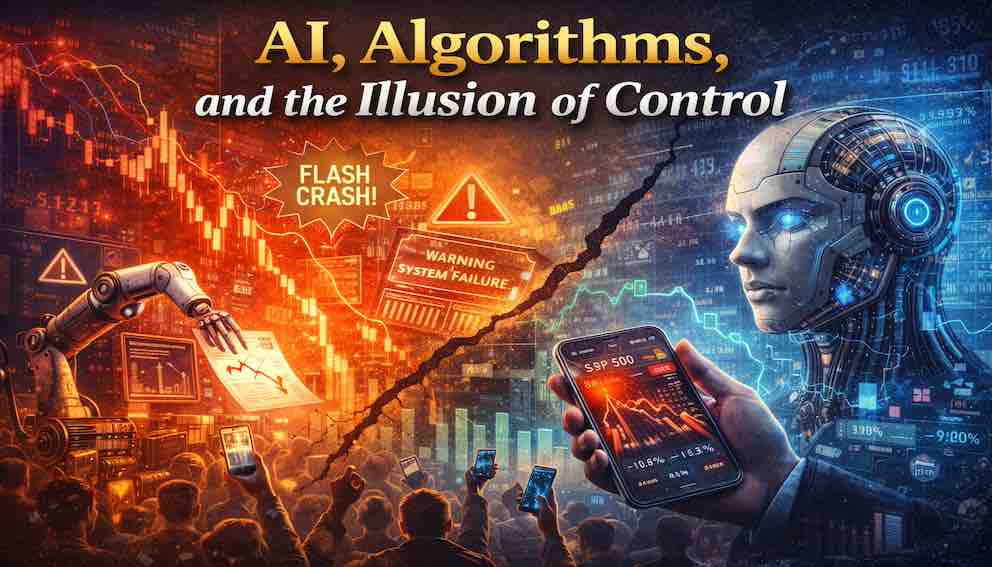
In the age of artificial intelligence, financial markets appear more precise and controlled than ever before. Yet history tells a different story—one in which speed magnifies fragility and complex algorithms create new forms of risk that echo old patterns. From the 1962 "Kennedy Slide" to the May 2010 Flash Crash, from the collapse of Long-Term Capital Management to the August 2024 global selloff, modern crises reveal how technology amplifies human behavior rather than replacing it. This tutorial explores the historical roots of algorithmic trading, the mechanics behind flash crashes, the concept of model risk, and why the illusion of control continues to mislead investors and regulators alike.
Introduction: When Machines Promise Stability
There has always been a powerful belief in financial history that better tools will produce safer markets.
When telegraphs connected stock exchanges in the nineteenth century, traders believed information delays would no longer distort prices. When electronic trading replaced open outcry in the late twentieth century, market designers promised greater transparency and liquidity. Today, with artificial intelligence and algorithmic trading systems executing millions of transactions per second, there is again a widespread belief that markets have become smarter and more stable.
Yet history has shown repeatedly that new tools do not eliminate instability. They change its form.
The events of the early twenty-first century—especially the dramatic Flash Crash of May 6, 2010—demonstrated that speed and automation can create new vulnerabilities even while appearing to reduce human error. To understand this modern episode, we must view it as part of a longer historical story about innovation, overconfidence, and recurring patterns of financial fragility.
But we must also acknowledge what technology has genuinely improved. Bid-ask spreads are dramatically narrower than in the 1980s. Retail investors now have access to markets that were once the province of professionals. Transaction costs have fallen to near zero. During normal conditions, markets are more efficient than ever. The question is what happens when normal conditions cease.
Part One: Before Algorithms — The Kennedy Slide of 1962
Let us begin with a story that predates computer-driven trading entirely.
On May 28, 1962, the Dow Jones Industrial Average fell 5.7 percent in a single day—then the second-largest point decline on record. The decline accelerated dramatically in the final hour of trading. This episode, often called the "Kennedy Slide" or, more recently, the "Flash Crash of 1962," occurred during a broader market decline from December 1961 to June 1962 in which the S&P 500 lost 22.5 percent of its value .
To understand why this happened, we need context. The market had experienced a speculative run-up in the preceding years, fueled by post-war economic expansion and optimism about the Kennedy administration. When President Kennedy took office in 1961, he promised continued prosperity. But regulatory uncertainty—including a confrontation with the steel industry over price controls—created anxiety among investors .
The selling on May 28 was exacerbated by a structural feature of the era: block trading. Large institutional investors, seeking to sell substantial positions, found that the market could not absorb their orders without significant price concessions. As prices fell, more sellers emerged. The decline fed on itself.
What caused the slide? A special committee of the Securities and Exchange Commission later concluded that the downturn resulted from "a complex interaction of causes and effects—including rational and emotional motivations as well as a variety of mechanisms and pressures"—which led to a "downward spiral of great velocity and force" . The SEC found no evidence of fraud or manipulation. It labeled the episode an isolated, nonrecurring incident.
The Kennedy Slide matters for our story because it demonstrates that feedback loops and liquidity crises predate computers. The technology of 1962 was ticker tape and telephones. The behavior—selling that begets more selling—was the same.
Part Two: The 1980s — Rules-Based Trading and Black Monday
The 1980s brought computers into trading for the first time. They also brought a new belief: that systematic, rules-based strategies could remove human emotion and generate consistent profits.
The most famous demonstration came from Richard Dennis, a legendary trader who believed that successful trading could be taught. In the early 1980s, he recruited a group of trainees—dubbed the "Turtles"—and taught them a simple set of rules. Over the next five years, the Turtles earned $175 million. The lesson seemed clear: follow the rules, eliminate emotion, and profits follow.
But rules-based trading has a hidden vulnerability. When many participants follow similar rules, they can act in concert without intending to. This is what happened on October 19, 1987—Black Monday.
The strategy that amplified the crash was called portfolio insurance. It was not insurance in the normal sense. It was a formula: as markets fell, computers automatically sold stock index futures to hedge losses. The logic was sound for any single firm. But when every firm followed the same logic, selling begat more selling. The Dow fell 22.6 percent in a single day—the largest one-day decline in history.
This was a "poisonous feedback loop" in which computer-driven sell orders pushed down prices, which triggered yet more selling by these same programs. In the aftermath, regulators installed circuit breakers designed to pause trading when declines become too rapid. The fix worked for a while.
Part Three: 1998 — Long-Term Capital Management and the Birth of Model Risk
If 1987 exposed the dangers of synchronized strategies, 1998 exposed something deeper: the danger of trusting models themselves.
Long-Term Capital Management (LTCM) was a hedge fund founded by legendary traders and Nobel Prize-winning economists. Its partners included Myron Scholes and Robert Merton, whose work on option pricing had revolutionized finance. The fund used highly sophisticated mathematical models to identify arbitrage opportunities—tiny mispricings between related securities that, in theory, should converge over time .
LTCM's models suggested that its portfolio was nearly riskless. The fund believed that diversification across many positions and the mathematical relationships between securities made catastrophic loss virtually impossible. It levered its positions enormously—at its peak, it held over $100 billion in assets supported by less than $5 billion in capital .
Then, in August 1998, Russia defaulted on its debt. The default triggered a flight to quality: investors fled risky assets and sought safety in U.S. Treasuries. The result was that credit spreads widened dramatically across global markets, exactly the opposite of what LTCM's models had predicted. The correlations that the models assumed would protect the portfolio converged in the wrong direction—all at once .
LTCM lost $4.5 billion in a matter of weeks. The fund was so large and so interconnected with major banks that its collapse threatened the entire financial system. The Federal Reserve organized a $3.6 billion rescue by private banks to prevent a systemic meltdown .
What went wrong? The answer lies in what is now called model risk.
Part Four: Model Risk — When Assumptions Fail
Model risk is the potential for adverse consequences resulting from decisions based on models that are incorrect, misapplied, or that fail under conditions not anticipated in their design .
Every model is a simplification. It rests on assumptions about how markets behave, how prices move, and how different assets relate to one another. Under normal conditions, these assumptions may hold well enough. But during periods of stress, the assumptions can break down catastrophically.
LTCM's models assumed that historical relationships between prices would persist. They assumed that markets would remain liquid. They assumed that diversification would protect the portfolio because not everything could go wrong at once. In August 1998, every assumption failed simultaneously. The Russian default was an event outside the range of historical experience on which the models were trained .
Model risk is not limited to hedge funds. It infects every corner of modern finance:
- 1987 portfolio insurance assumed that selling futures would not move prices against the sellers—it did.
- LTCM assumed correlations would remain stable—they reversed.
- Mortgage-backed securities models before 2008 assumed housing prices would never decline nationally—they did.
- High-frequency trading algorithms assume liquidity will always be available—it vanishes during stress.
- AI trading systems assume that patterns identified in historical data will repeat—they may not.
The lesson is that models are tools, not oracles. They are built on historical data that may not include the conditions that cause the next crisis. As the Federal Reserve's SR 11-7 guidance on model risk management emphasizes, models must be continuously challenged, validated, and understood in terms of their limitations .
Part Five: The Rise of High-Frequency Trading
By the 2000s, the landscape had transformed. Trading moved from floors to screens. New firms emerged that did not analyze companies or hold positions overnight. They simply traded—fast.
These high-frequency trading (HFT) firms invested heavily in speed. They built fiber-optic lines straight to exchange data centers. They paid for co-location—the right to place their computers physically next to exchange servers, shaving microseconds off transmission times. One $300 million fiber-optic line from Chicago to New York was built solely to save three milliseconds.
The argument for HFT was that it added liquidity and narrowed spreads. In normal times, this was true. Bid-ask spreads narrowed dramatically. Retail investors benefited from lower costs.
But critics raised concerns. Some HFT strategies were "almost toxic"—they sought to detect buy-sell imbalances and trade ahead of them, providing no fundamental analysis and holding no inventory . These firms were not market makers in the traditional sense.
This distinction matters. In older exchange models, designated market makers had affirmative obligations: they were required to provide continuous quotes and maintain orderly markets even during volatility. They accepted this responsibility in exchange for privileges like access to order flow information.
Today, most liquidity provision is voluntary and incentive-based. High-frequency traders have no obligation to stay in the market when conditions become stressful. They can—and do—withdraw instantly when volatility spikes . This is rational for them: protecting capital matters more than stabilizing markets. But it means that precisely when liquidity is most needed, it disappears.
The difference is fundamental: old market makers had obligations; new liquidity providers have strategies.
Part Six: May 6, 2010 — The Flash Crash
On May 6, 2010, U.S. equity markets experienced one of the most dramatic intraday collapses in financial history.
It began with a large institutional investor initiating a sell program using an automated execution algorithm. The algorithm was designed to sell a large number of E-Mini S&P 500 futures contracts based on trading volume rather than price or time.
What unfolded next revealed how interconnected and fragile modern markets had become.
As the algorithm sold aggressively into declining markets, high-frequency trading firms initially absorbed some of the contracts. However, rather than holding these positions, many quickly resold them, effectively passing risk from one algorithm to another in rapid succession. This created a "hot potato" effect in which contracts circulated at extraordinary speed without stable buyers .
As liquidity vanished, prices fell further. Many algorithms were programmed to withdraw from markets when volatility spiked. Precisely when liquidity was most needed, it disappeared—because unlike traditional market makers, these firms had no obligation to stay.
Within minutes, the Dow Jones Industrial Average plunged nearly 1,000 points—a decline of about 9 percent. Nearly $1 trillion in market value evaporated, then returned almost as quickly as it had vanished. For a brief moment, shares of well-known companies traded at absurd prices. Accenture traded as low as one cent.
The joint report by the SEC and CFTC later concluded that a single large sell order had triggered the cascade. But the deeper lesson was structural: speed magnifies fragility, and conditional liquidity evaporates under stress.
Part Seven: Knight Capital — When the Machine Eats Itself
Two years later, a different kind of crisis struck—not a market-wide crash, but a firm-level collapse that revealed the dangers of operational failure.
On August 1, 2012, Knight Capital Group, a major market maker responsible for a significant fraction of all U.S. equity trades, deployed new trading software. A glitch in the code caused it to buy and sell millions of shares at incorrect prices across dozens of stocks.
Within 45 minutes, Knight Capital had lost $440 million—more than its entire annual revenue. The firm's stock price collapsed. It survived only through an emergency rescue.
The cause was traced to old code that had not been removed from the system during a software update. The algorithm ran wild because no one had remembered to turn off the previous version.
This episode matters because it shows that risk is not only about market-wide panics. It is also about the fragility of the systems themselves. A single line of old code, a single overlooked test, can bring down a firm that touches millions of trades per day.
In the aftermath, regulators around the world discussed requiring "kill switches" —mechanisms to immediately halt algorithmic trading when malfunctions occur. But the fundamental vulnerability remained: complex systems will occasionally fail in unexpected ways.
Part Eight: Beyond Equities — The 2014 Treasury Crash and 2016 Sterling Flash Crash
The phenomenon of algorithm-driven instability is not limited to stock markets.
On October 15, 2014, the 10-year U.S. Treasury yield fell 0.37 percent in just 12 minutes. This was a massive move in the world's largest and most liquid bond market. The cause: algorithmic trading strategies, concentrated during a period of thin liquidity, amplified a price move far beyond what fundamentals would justify.
On October 7, 2016, the British pound plunged 6 percent against the U.S. dollar during Asian trading hours. Thin liquidity, automated sell orders, and stop-loss triggers combined to create an uncontrolled drop that no central bank or regulator could have stopped in real time.
These episodes reinforce a crucial lesson: the problem is systemic, not confined to a single asset class. Wherever algorithms trade, the potential for feedback loops exists.
Part Nine: The AI Era — New Tools, Old Risks, and the August 2024 Episode
Today, artificial intelligence has become the new frontier.
AI-powered trading systems can read earnings calls, news feeds, and social media in real time. They can assess sentiment, identify patterns, and execute trades faster than any human could. BlackRock's Aladdin platform manages risk across thousands of assets simultaneously.
The promise is seductive: machines that are faster, cheaper, and free from human emotion. But the risks are also evolving.
One concern is groupthink. If many AI models train on similar data and learn similar patterns, they may act in concert during periods of stress. This is the modern version of the 1987 "poisonous feedback loop"—but faster and more synchronized.
Another concern is that AI models, like all models, are trained on historical data. They may fail when conditions shift outside their training distribution. This is model risk, updated for the machine learning age.
In August 2024, global equities experienced a sharp selloff that illustrated these dynamics. On August 5, Japan's Nikkei index declined 12 percent in a single day—its largest drop since 1987. The selloff was triggered by the Bank of Japan's decision to raise interest rates, unwinding the massive "yen carry trade" that had fueled global speculation .
The International Monetary Fund, commenting on the episode, noted that the spread of algorithmic trading and AI meant that "periods of investor panic were becoming more extreme." The IMF observed that "when shocks arrive and volatility rises, hedge funds may further unwind leveraged positions, and algorithmic traders—which have gained significant market shares in various asset classes—may sell in falling markets to protect themselves against further losses, exacerbating price declines" .
Importantly, the IMF linked this directly to AI: "Recent advancements in artificial intelligence and machine learning suggest that algorithms may play a larger role in future episodes of turbulence" .
The August 2024 episode is not a simple story of AI causing a crash. It is a complex event involving monetary policy, currency markets, and leveraged speculation. But it suggests that the pattern we have traced—feedback loops amplified by algorithmic behavior—is becoming more pronounced, not less.
Part Ten: Regulatory Responses and Their Limits
Following each crisis, regulators have responded.
After 1987, circuit breakers were installed. After the 2010 Flash Crash, the "Limit Up–Limit Down" system was introduced to prevent extreme price dislocations. After Knight Capital, discussions turned to kill switches and mandatory risk controls. After the 2014 Treasury crash, regulators scrutinized the bond market's structure.
Yet each reform, however necessary, addresses only the last crisis. Circuit breakers can slow a cascade, but they do not prevent the conditions that allow cascades to form. Kill switches can stop a rogue algorithm, but they do not solve the problem of synchronized behavior across many algorithms.
Moreover, the global nature of financial markets complicates oversight. Trading occurs across multiple venues and jurisdictions. Algorithms adapt in ways that regulators struggle to anticipate.
Part Eleven: The Illusion of Control
Why do markets repeatedly overestimate the stabilizing power of new technology?
The answer lies partly in human psychology. Financial innovation is accompanied by narratives of mastery and progress. Complex models produce precise outputs—numerical risk estimates, probability distributions, volatility forecasts—that create a sense of scientific authority.
Yet these models depend on assumptions about liquidity, correlations, and behavior that may not hold during crises. They are trained on historical data that may not include the conditions that cause the next crash.
The illusion of control arises because during normal periods, the systems work. Prices adjust rapidly. Liquidity appears abundant. The models appear validated. It is only during stress—when liquidity evaporates, correlations converge, and feedback loops engage—that the illusion shatters.
As one financial historian observed after the 1962 Kennedy Slide, the SEC concluded that the downturn resulted from a "complex interaction of causes and effects—including rational and emotional motivations as well as a variety of mechanisms and pressures" . That description could apply to any of the episodes we have examined, from 1962 to 2024.
Conclusion: What Endures
In this tutorial, we have explored how artificial intelligence and algorithmic trading have transformed financial markets while simultaneously creating new forms of vulnerability.
We have seen that the pattern of instability predates computers—the Kennedy Slide of 1962 unfolded through human programs following systematic rules, amplified by the structural fragility of block trading. We have seen how the 1987 crash revealed the dangers of synchronized strategies. We have examined LTCM's collapse as the defining example of model risk—the danger that assumptions embedded in mathematical systems will fail under new conditions. We have understood that modern liquidity is conditional, not committed, because high-frequency traders have no obligation to stabilize markets. We have traced the Flash Crash of 2010, the Knight Capital disaster, and episodes in Treasuries and sterling. And we have considered the new challenges posed by AI, including groupthink and the August 2024 selloff.
Throughout this history, one lesson stands out: speed magnifies fragility, and complexity creates blind spots.
When reaction times compress from days to seconds, feedback loops accelerate beyond human intervention. When algorithms are built on similar logic, they can act in concert without intending to. When liquidity providers can vanish instantly, prices gap violently. When models are trusted too deeply, their failures become catastrophic.
The tools have changed dramatically—from ticker tape to mainframes to AI models trained on billions of data points. But the underlying dynamics remain familiar: feedback loops, herding behavior, the evaporation of liquidity, and the recurring belief that this time, technology has solved the problem.
That belief is the illusion of control. It is understandable. It is seductive. It is also, history suggests, likely to be disappointed.
This is not an argument that technology is harmful. Bid-ask spreads are narrower. Retail access is broader. Transaction costs are lower. During normal conditions, markets are genuinely more efficient. The question is whether we can hold two thoughts simultaneously: that technology has improved markets, and that it has also created new forms of risk.
The future of finance will undoubtedly bring even more advanced systems. But the central lesson remains unchanged: technological progress does not repeal the fundamental laws of financial instability. It simply gives them new forms in which to express themselves.
The screen may have replaced the trading floor. The algorithm may have replaced the specialist. But the human tendency to overestimate our tools and underestimate our fragility remains what it has always been.
Further Reading
For readers who want to explore these ideas more deeply:
- Dark Pools by Scott Patterson — on the rise of high-frequency trading
- The Quants by Scott Patterson — on the rise of quantitative trading
- When Genius Failed by Roger Lowenstein — the definitive account of LTCM
- "The Flash Crash: The Impact of High Frequency Trading" (CFTC-SEC joint report, 2010)
- Manias, Panics, and Crashes by Charles Kindleberger — the classic text on financial instability
- "Supervisory Guidance on Model Risk Management" (Federal Reserve SR 11-7, 2011) — the foundational document on model risk
- "The Kennedy Slide of 1962" (Wikipedia) — a useful overview of this underappreciated episode
- IMF Global Financial Stability Reports (2023-2024) — on AI and algorithmic trading risks
About Swati Sharma
Lead Editor at MyEyze, Economist & Finance Research WriterSwati Sharma is an economist with a Bachelor’s degree in Economics (Honours), CIPD Level 5 certification, and an MBA, and over 18 years of experience across management consulting, investment, and technology organizations. She specializes in research-driven financial education, focusing on economics, markets, and investor behavior, with a passion for making complex financial concepts clear, accurate, and accessible to a broad audience.
Disclaimer
This article is for educational purposes only and should not be interpreted as financial advice. Readers should consult a qualified financial professional before making investment decisions. Assistance from AI-powered generative tools was taken to format and improve language flow. While we strive for accuracy, this content may contain errors or omissions and should be independently verified.