Tutorial Categories
Last Updated: March 9, 2026 at 10:30
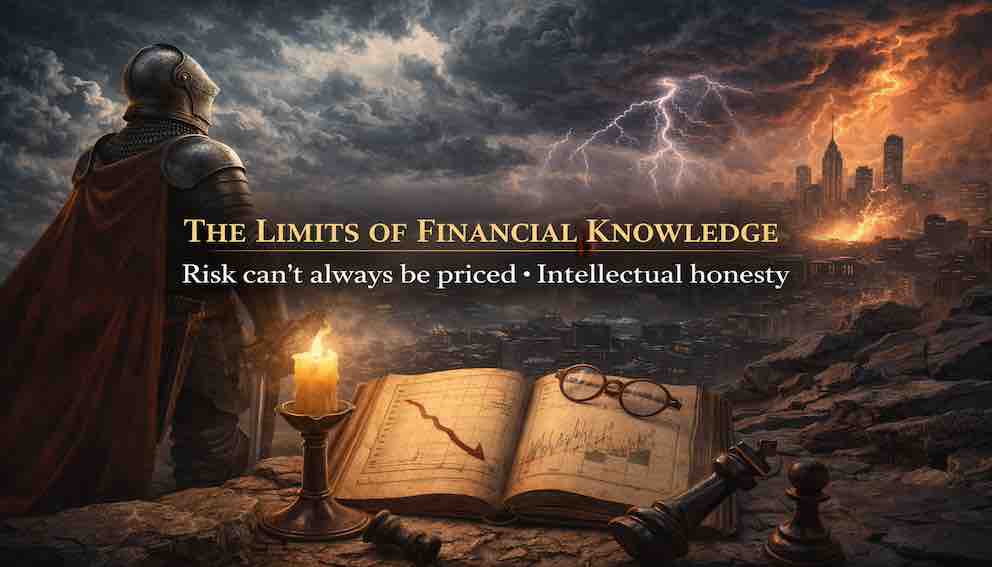
The Limits of Financial Knowledge
Navigating the Unknowable: Why Admitting What You Don’t Know Is the Only Edge in Finance
After 5,000 years of financial history—from Mesopotamian grain loans to the 2020 pandemic crash—every generation has been surprised. The reason is simple: most of what matters in markets lives in uncertainty, not measurable risk. Models fail, predictions misfire, and confidence proves fragile. The only reliable advantage is intellectual honesty: holding cash, diversifying, avoiding leverage, questioning narratives, and preparing for the unexpected. Survival, not certainty, is the path to long-term success.
Introduction: The Paradox of 5,000 Years
Here is an uncomfortable fact: after 5,000 years of financial history, after the invention of double-entry accounting, after the development of options pricing models, after supercomputers and PhDs and artificial intelligence—we are not meaningfully better at predicting financial crises than our ancestors were.
The Mesopotamian lender who watched his borrower default on a grain loan in 2000 BCE was surprised. The Roman citizen who woke to find his denarius would buy half of what it did yesterday was surprised. The Dutch investor who bought tulips at the peak was surprised. The British lord who loaded up on South Sea stock was surprised. The Nobel laureates at Long-Term Capital Management were surprised. The hedge fund managers of 2008 were surprised. The pandemic deniers of early 2020 were surprised.
Every generation believes it has better tools, more data, smarter people. Every generation is surprised.
Why?
The answer lies in a distinction first articulated by economist Frank Knight in 1921, and it is a distinction that every investor must understand if they hope to navigate financial markets with their capital—and their sanity—intact.
The distinction is between risk and uncertainty.
And the uncomfortable truth is this: most of what determines long-term outcomes in financial markets lives in the domain of uncertainty, where no model reaches, no probability can be assigned, and no amount of data will save you.
Knight's Insight: The Territory Beyond Risk
Frank Knight, an economist at the University of Chicago, published a book in 1921 titled Risk, Uncertainty, and Profit. In it, he drew a line that has haunted economics ever since.
Risk is when you do not know what will happen, but you know the range of possibilities and their likelihoods. A roulette wheel is risk. You do not know where the ball will land, but you know there are thirty-eight slots and each has a one-in-thirty-eight probability. An insurance actuary deals with risk. They do not know who will die this year, but they have excellent data on mortality rates across populations. Risk is measurable. Risk is insurable. Risk is the stuff of spreadsheets and models.
Uncertainty is when you do not know what will happen, and you cannot assign probabilities because the range of possibilities itself is unknown. A pandemic is uncertainty. A financial crisis is uncertainty. The impact of artificial intelligence on markets in 2030 is uncertainty. A geopolitical black swan is uncertainty. Uncertainty is not merely unknown; it is unknowable. No spreadsheet captures it. No model contains it.
Here is the problem: finance has spent the last century pretending uncertainty is just complicated risk.
Every value-at-risk model, every options pricing formula, every economic forecast takes unknown unknowns and stuffs them into probability distributions, pretending that what we cannot know is merely what we have not yet measured. The more precise a financial model appears, the more fragile it usually becomes. Precision creates false confidence. Overfitting historical data increases vulnerability to the very events the model cannot see. Elegant mathematics does not guarantee robustness. It often guarantees the opposite.
This is not just intellectually dishonest. It is dangerous.
When Brilliant People Confused Uncertainty for Risk
We have seen this pattern repeatedly across the tutorials in this series. Let us revisit them not for their historical details, but for what they reveal about the limits of knowledge.
Long-Term Capital Management assembled the smartest team in financial history: Nobel laureates, PhDs from MIT, legendary traders from Salomon Brothers. They built models that could price any security, in any market, under any conditions. They computed correlations between every asset class, every country, every scenario they could imagine.
What they could not imagine was Russia defaulting on its debt in August 1998.
Their models treated a Russian default as a risk—a low-probability event for which they could assign a number and hedge accordingly. But the models missed something fundamental: they could not know that Russian default would trigger a global flight to liquidity that would break every correlation they had calculated. They could not know that the very structure of their positions—massively leveraged, with hundreds of thousands of trades—meant that a single margin call could unravel everything. They treated uncertainty as risk. They were destroyed.
In the years before 2008, the smartest minds in finance built models that said mortgage risk had been diversified away. They had sliced and diced subprime loans into tranches, spread them across the globe, insured them with credit default swaps. The models showed that a nationwide housing crash was a near-impossibility. Even if it happened, the correlations were low. Even if correlations rose, the counterparties were sound.
What they could not know: that the entire system was connected through invisible threads. That AIG, which had sold insurance on all of it, would collapse. That Lehman's failure would freeze money markets. That a crisis in subprime—a tiny corner of the market—would bring down the global financial system. They treated uncertainty as risk. They were destroyed.
In early 2020, markets were calm. Models showed steady growth. Risk metrics were benign. Value-at-risk numbers were low. Then a novel virus, which did not exist in any dataset, shut down the global economy in weeks.
No model could have predicted it. No probability distribution contained it. Because it was not risk. It was uncertainty.
The pattern is consistent across centuries: every major financial disaster was preceded by confident prediction. The disasters happened because the confident predictions were wrong about things that could not have been known.
Why Models Always Fail
If uncertainty is the permanent condition of financial life, why do we keep pretending otherwise? Because models simplify reality, and simplification removes the nonlinear behavior that defines how complex systems actually behave. Small inputs can create massive feedback loops. Liquidity stress causes cascading effects that no equilibrium model captures. Interconnected systems amplify shocks in ways that linear mathematics cannot represent.
Beyond this fundamental limitation, three specific reasons explain why models consistently fail.
First, non-stationarity. Most financial models assume the world is stationary—that the rules of the game do not change. They calculate correlations from historical data and assume those correlations will hold in the future. But the rules do change. Bretton Woods collapsed. The gold standard was abandoned. Central banks discovered quantitative easing. The internet changed everything. Every regime shift makes historical data partially irrelevant. You cannot model a world where the rules of the game keep changing, but that is the world we inhabit.
Second, reflexivity. George Soros built his career on a simple insight: markets are not passive phenomena to be observed. They are active participants in the reality they attempt to measure. When investors believe a stock will rise, they buy it, causing it to rise—validating their belief. When they believe a currency will fall, they sell it, causing it to fall. Beliefs shape fundamentals. Fundamentals shape beliefs. The observer and the observed are entangled. No model can fully capture this because the model itself becomes part of the system it models. The moment a model gains adherents, it changes behavior. The moment a prediction becomes widely known, it alters the outcome.
Third, fat tails. The mathematician Benoit Mandelbrot spent his career fighting a simple lie: that financial returns follow a normal distribution. In a normal distribution, extreme events are virtually impossible. A ten-standard-deviation move should happen once in the lifetime of the universe. In real markets, ten-standard-deviation moves happen every few years. Why? Because markets are not random walks. They are complex systems with feedback loops, herding behavior, and occasional phase transitions. The tails are fat. The improbable happens constantly. Models that assume thin tails systematically underestimate the probability of disaster. They always have. They always will.
The Psychological Trap: Why We Cannot Accept Uncertainty
If uncertainty is so obvious, why do we keep ignoring it?
Because the human brain did not evolve to handle uncertainty. It evolved to survive on the savanna, where quick pattern recognition and confident action meant the difference between eating and being eaten.
Our brains demand patterns, even where none exist. They demand certainty, even when none is available. They demand stories, even when the truth is random.
Daniel Kahneman's work on System One and System Two thinking shows this clearly. System One is fast, intuitive, confident. It jumps to conclusions and resists doubt. System Two is slow, analytical, skeptical. It requires effort, and it tires easily.
In financial markets, System One is always in charge. It tells us stories: this stock is going up because of this new technology, the economy is strong because of these policies, this time is different because of these structural changes. System Two, exhausted by the sheer complexity of modern markets, mostly nods along.
The result: we feel certain about things that are fundamentally uncertain. We build elaborate narratives to explain randomness. We trust models that cannot possibly capture reality. And then we are surprised when the unexpected happens.
What We Actually Know: An Honest Inventory
Let us pause and take stock. After 5,000 years of financial history, what do we actually know?
We know some things with confidence. Human nature does not change. Fear and greed, herding and panic, overconfidence and regret—these are constants across centuries and cultures. Leverage magnifies everything, especially disaster. Liquidity disappears exactly when you need it most. Stability breeds instability; the longer the calm, the bigger the shock. Bubbles end. Always. No one can consistently time them.
We do not know when the next crisis will come, what will trigger it, how bad it will be, how long it will last, what the policy response will look like, or whether that response will work.
We cannot know novel risks that do not yet exist. We cannot know how complex systems will behave under stress they have never experienced. We cannot know the second-order effects of our own actions. We cannot know what we will learn tomorrow that makes today's knowledge obsolete.
This is not pessimism. It is intellectual honesty.
What Uncertainty Means for Portfolio Construction
If we accept that uncertainty is permanent, how should we build portfolios? The answer requires shifting the questions we ask.
Instead of asking, "What is the optimal portfolio?" we must ask, "What portfolio can survive unknown unknowns?"
Under uncertainty, concentration becomes dangerous. A portfolio built around a few high-conviction bets assumes you know more than you possibly can. Correlation assumptions break precisely when you need them most; assets that seemed diversified during calm periods move together during stress. Liquidity risk dominates return optimization; the asset with the highest expected return is worthless if you cannot sell it when you need cash.
This means portfolio construction under uncertainty must prioritize different virtues. Scenario diversification matters more than statistical diversification. Instead of optimizing for a single expected future, you build for multiple possible futures. Instead of assuming correlations will protect you, you assume they will fail and build accordingly. Instead of maximizing return, you maximize survivability.
The goal is not the highest expected return within your model. The goal is robustness outside your model.
Living with Uncertainty: Operational Principles
Given that we cannot eliminate uncertainty, how do we navigate it? Four principles, drawn from the wisest investors in history, provide practical guidance.
First, maintain a margin of safety. Benjamin Graham's concept is simple: never pay full price for something, because your valuation might be wrong. The margin of safety is the gap between what you pay and what you think something is worth. It is an admission of uncertainty—a cushion for your own ignorance. If you think a stock is worth one hundred dollars, do not pay ninety-five. Pay sixty. If you are wrong—and you will be, often—the margin of safety protects you.
Second, consider the barbell strategy. Nassim Taleb's barbell is elegant: hold most of your portfolio in extremely safe assets such as cash or short-term government bonds, and a small slice in extremely speculative, asymmetric bets such as venture capital, distressed debt, or options. The safe side protects you from ruin. The speculative side gives you exposure to positive black swans. The middle—the optimized, balanced portfolio of financial theory—is where disaster lives. It is exposed to uncertainty on both sides.
Third, preserve optionality. Optionality means keeping your powder dry. Holding cash. Maintaining untapped credit lines. Avoiding leverage that forces you to act at the worst moment. The investor with options can wait. They can watch the crisis unfold without being forced to sell. They can act when others cannot. Optionality is the only hedge against uncertainty, because uncertainty always brings opportunity along with danger.
Fourth, stress test your assumptions. Simulate extreme scenarios where your assumptions break. Ask what happens if correlations all go to one. Ask what happens if liquidity disappears entirely. Ask what happens if policy shifts dramatically overnight. These exercises are not predictions; they are explorations of your own portfolio's fragility. They reveal vulnerabilities you did not know existed.
Fifth, practice narrative skepticism. Every investment comes with a story. The story is not the truth. It is a sales pitch, a self-justification, a comforting fiction. The intellectually honest investor holds stories loosely. They ask: Who benefits from this narrative? What would make it false? What am I not seeing? They do not fall in love with their investments, because they know that love is blind and markets are not.
Intellectual Honesty as Competitive Advantage
Here is the paradox: admitting you do not know is not weakness. It is the only durable advantage.
The investor who knows they cannot predict the future behaves differently. They diversify not for returns, but for survival. They hold cash even when it feels stupid. They avoid leverage even when it seems safe. They question every story, especially their own. They prepare for scenarios they cannot imagine.
The investor who thinks they know makes different choices. They concentrate in their best ideas. They leverage to amplify gains. They optimize for the world they expect. They dismiss risks they cannot model. They are surprised, again and again.
Over a lifetime, who wins?
The answer is obvious. The humble survive. The confident are consumed.
The Fog Will Never Lift
We return to where we began. After 5,000 years of financial history, after all the empires, bubbles, crashes, and resurrections, one truth remains: the future is not merely undiscovered. It is structurally undiscoverable.
The models will always be wrong. The predictions will always miss. The confident will always be humbled. The fog will never lift.
This is not cause for despair. It is cause for liberation.
You are freed from the impossible task of knowing the unknown. You are freed from the exhausting performance of certainty. You are freed to admit, honestly and openly, that you are navigating a fog that no one can see through.
And in that admission, you gain the only advantage that has ever mattered: the wisdom to prepare for what you cannot predict, the humility to survive what you cannot foresee, and the honesty to know that in the end, the markets will always be more complex, more surprising, and more humbling than any mind can fully grasp.
The Final Question
Every investor, in every era, faces the same choice.
They can pretend they know. They can build elaborate models, spin confident narratives, trade with conviction and leverage and certainty. They can feel smart, right up until the moment the world proves them wrong.
Or they can admit the truth. They can build portfolios that survive not knowing. They can hold cash, diversify broadly, avoid leverage, question every story. They can feel humble, every day, and watch the confident ones fall around them.
The choice is yours.
But history has already rendered its verdict. The survivors were never the ones who knew the most. They were the ones who knew they could not know.
That is the limit of financial knowledge. That is where wisdom begins.
Practical Synthesis: A Checklist for Intellectual Honesty
Before every investment decision, ask:
On Uncertainty:
- What am I assuming I know that I might not?
- What events could happen that my models do not capture?
- If I am wrong, how bad can it get?
On Models:
- Does this model assume the rules will not change?
- Does it account for the fact that my actions change outcomes?
- Does it underestimate the probability of extreme events?
On Psychology:
- Am I telling myself a comforting story?
- Would I feel different if I did not already own this investment?
- What would make this narrative false?
On Preparation:
- Do I have a margin of safety?
- Is my portfolio structured to survive uncertainty, not just optimize for a single future?
- Do I have options—cash, liquidity, flexibility—if the world surprises me?
- Have I stress-tested my assumptions against extreme scenarios?
On Honesty:
- Can I say, out loud, "I do not know"?
- Can I act on that admission?
- Can I build a financial life that does not depend on being right?
About Swati Sharma
Lead Editor at MyEyze, Economist & Finance Research WriterSwati Sharma is an economist with a Bachelor’s degree in Economics (Honours), CIPD Level 5 certification, and an MBA, and over 18 years of experience across management consulting, investment, and technology organizations. She specializes in research-driven financial education, focusing on economics, markets, and investor behavior, with a passion for making complex financial concepts clear, accurate, and accessible to a broad audience.
Disclaimer
This article is for educational purposes only and should not be interpreted as financial advice. Readers should consult a qualified financial professional before making investment decisions. Assistance from AI-powered generative tools was taken to format and improve language flow. While we strive for accuracy, this content may contain errors or omissions and should be independently verified.