
Tutorial Categories
Last Updated: March 9, 2026 at 10:30
Why There Will Always Be Another Crisis
Understanding the Forces That Make Financial Crises Inevitable—and How to Survive Them
Crises are not accidents; they are baked into the structure of financial systems. Across 5,000 years, from Mesopotamian grain loans to crypto mania, the same patterns repeat: credit fuels growth, leverage breeds fragility, human behavior drives extremes, and incentives reward risk at the wrong time. The lesson is not to prevent the next crisis—it is to survive it. Cash, diversification, humility, and preparation are the only edges that truly work.
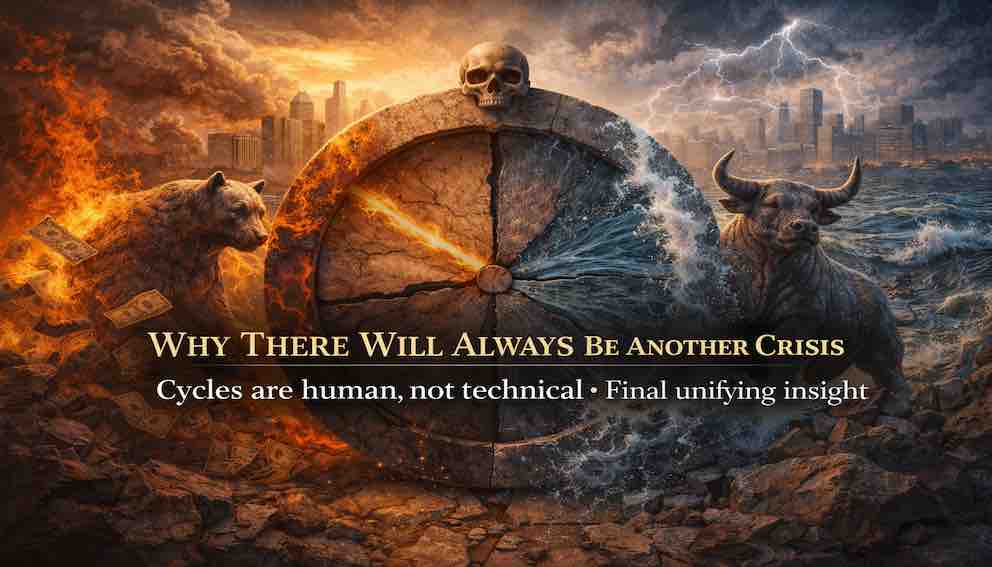
Introduction — The Wrong Question
After 5,000 years of financial history, after thirty-six tutorials tracing the arc from Mesopotamian grain loans to cryptocurrency manias, after studying every bubble, panic, crash, and resurrection, we arrive at the final question.
Most people ask it this way: "Can we prevent the next crisis?"
This is the wrong question.
It assumes crises are aberrations—interruptions of an otherwise stable system that smarter regulation, better models, or wiser leaders could eliminate. It assumes that with enough effort, enough data, enough intelligence, we could finally build a financial system that does not break.
Five thousand years of evidence suggest otherwise.
The better question is: "Why are crises embedded in financial systems?"
This reframing changes everything. It moves us from the futile pursuit of prevention to the necessary work of understanding. It acknowledges that crises are not bugs to be fixed but features of how financial systems actually work. It accepts that the cycle is not a failure of design but a consequence of structure.
And once we understand why crises are embedded, we can stop asking how to escape the cycle and start asking how to survive it.
Structural Causes of Cycles
Crises do not arise from random misfortune or external shocks alone. They arise from structural forces built into the very architecture of financial systems. Four forces, working in combination, guarantee that cycles will recur.
Credit Expansion
Every modern financial system depends on credit. Growth requires borrowing. Businesses need loans to expand. Households need mortgages to buy homes. Governments need debt to finance spending. Credit is the lubricant of economic activity.
But credit is also the source of fragility.
When credit expands, it does not flow evenly. It flows to whatever asset class seems most promising—technology stocks, housing, emerging markets, crypto. As more credit chases the same assets, prices rise. Rising prices attract more credit. The cycle feeds itself.
Leverage accumulates beneath the surface. A system with little leverage can absorb losses. A system with high leverage cannot. A small decline in asset prices triggers margin calls, forced selling, further declines. The expansion that felt like prosperity reveals itself as vulnerability.
This is not a bug. It is how credit works. Growth requires borrowing. Borrowing creates leverage. Leverage creates fragility. The seeds of the next crisis are planted in the expansion of the last.
Liquidity Mismatch
Financial systems operate on a dangerous promise: that assets which cannot be quickly sold can be funded by liabilities which can be quickly withdrawn.
Banks take deposits that can be demanded at any moment and lend them out as mortgages that cannot be called for thirty years. This is liquidity mismatch. It is also the foundation of modern banking. It works as long as depositors do not all ask for their money at once.
But sometimes they do.
The bank run is the purest expression of liquidity mismatch. It is not irrational. When depositors fear others will withdraw, the rational response is to withdraw first. The run becomes a self-fulfilling prophecy. The bank that was solvent in theory fails in practice.
Modern finance has not eliminated liquidity mismatch. It has spread it. Money market funds, repurchase agreements, shadow banks, open-ended bond funds—all rely on the same fragile promise: that short-term funding will always be available for long-term assets. In 2008, in 2020, in every crisis, the same dynamic appears. Liquidity looks abundant until it vanishes, and when it vanishes, it vanishes for everyone at once.
Human Behavior
The structural forces of credit and liquidity would be dangerous enough in a world of rational actors. But we do not inhabit that world.
During expansions, humans become optimistic. Rising prices feel like confirmation that the future is bright. Caution feels like foolishness. The investor who sits out the boom is mocked. The banker who tightens lending standards loses market share. The regulator who warns of excess is ignored.
During contractions, fear takes over. The same assets that seemed certain to rise forever now seem certain to fall forever. Selling feels like survival. The investor who holds on is panicked. The banker who continues lending is reckless. The regulator who stays quiet is blamed.
Herd behavior amplifies both directions. We find safety in numbers, even when the numbers are going over a cliff. In 1999, no one lost their job for buying technology stocks because everyone was buying them. In 2008, no one lost their job for holding mortgage bonds because everyone was holding them. The herd provides cover, right up until the moment it provides none.
Incentive Distortion
The people who make decisions in financial systems are not the ones who bear the full consequences of those decisions.
A trader earns a bonus on gains but does not return it when losses come. A banker originates loans, sells them to investors, and moves on. A fund manager collects fees on assets under management, regardless of performance. An executive's compensation is tied to this year's stock price, not next decade's survival.
These incentives reward risk-taking. They reward leverage. They reward short-term thinking. They reward doing what everyone else is doing, because being wrong together is safer than being right alone.
No regulation can fully align incentives because the misalignment is structural. The people who take risks are not the people who bear losses. That gap is where crises are born.
Why Technology Does Not Remove Cycles
Every generation believes its technology will break the cycle.
In the 1920s, it was the ticker tape and modern accounting. In the 1980s, it was portfolio insurance and computer trading. In the 1990s, it was the internet and the "new economy." In the 2000s, it was financial engineering and mortgage securitization. In the 2020s, it is artificial intelligence and blockchain.
The technology changes. The cycle does not.
Why?
Because financial engineering evolves, but leverage reappears in new forms. The names change—margin debt, repo, derivatives, crypto leverage—but the underlying reality does not. Borrowing to amplify returns is as old as finance itself.
New products create new risks. Mortgage-backed securities were supposed to diversify risk; instead, they concentrated it in ways no one understood. Credit default swaps were supposed to hedge risk; instead, they created counterparty chains that froze the system. Crypto was supposed to bypass traditional finance; instead, it recreated every speculative excess in digital form.
Technology changes form. It does not change function. The underlying dynamics—credit expansion, liquidity mismatch, human behavior, incentive distortion—operate regardless of whether the assets are tulip bulbs or tokenized securities.
The specific crisis you cannot imagine is already being built with tools that do not yet exist, by people who believe this time is different, for reasons that will seem obvious in hindsight.
The Meta-Pattern Behind Every Crisis
Before we declare inevitability, let us formalize what we have observed across 5,000 years.
Every crisis, without exception, follows this pattern:
Phase One — Stability Increases Confidence
After a crisis, the system restructures. Regulation tightens. Participants are cautious. Leverage is low. For a time, the system is genuinely safer. This period of stability feels like progress. It feels like the lessons have been learned.
Phase Two — Confidence Increases Leverage
As stability persists, memory fades. Caution feels like paranoia. The opportunities being missed become painful. Gradually, leverage creeps back. New instruments emerge. New participants enter. The boundaries are tested.
Phase Three — Leverage Increases Fragility
The system becomes more interconnected, more complex, more opaque. Small risks are diversified away in theory but concentrated in ways no one sees. The foundation weakens, but the building looks magnificent.
Phase Four — A Shock Exposes Fragility
Something breaks. It could be a default, a scandal, a policy error, an external event. The trigger matters less than the vulnerability. The shock reveals that the system was not resilient—it was just lucky.
Phase Five — The System Restructures
Cascading failures force intervention. Institutions fail. Prices collapse. Trust evaporates. Then, slowly, the pieces are reassembled. New rules are written. New leaders take charge. Caution returns.
Phase Six — Stability Returns
And the cycle begins again.
This is not a theory. It is a historical fact. It has happened in Mesopotamia and Rome, in Amsterdam and London, in New York and Tokyo. It will happen again. The pattern is not visible to those inside it, but it is unmistakable from the outside.
The meta-pattern explains everything. It explains why each generation believes it has finally solved the problem. It explains why each generation is wrong. It explains why the crisis always feels like a surprise even though it was entirely predictable in structure if not in timing.
The Inevitability Argument
Now we bring everything together.
Crises are not failures. They are recurrences.
Because:
Humans chase yield. In a world of low returns, investors reach for higher yields. They buy riskier assets. They use more leverage. They crowd into whatever seems to be working. This is not irrational. It is what humans do when returns are scarce. And it always ends badly.
Systems reward leverage. The players who borrow more grow faster. The banks that lend more earn more. The funds that lever more outperform—until they do not. Competition rewards risk-taking in the short term and punishes it only in the long term, by which time the rewards have been distributed and the losses are someone else's problem.
Risk is underestimated in good times. After years of stability, the memory of crisis fades. The models show low volatility. The regulators relax. The investors become complacent. The very success of the system breeds the conditions for its failure. Minsky's insight is not a theory. It is a law.
Therefore:
Another crisis is not a sign that we failed to learn. It is a sign that the system is working as designed. The same forces that produce growth produce fragility. The same behaviors that drive innovation drive excess. The same incentives that reward prudence in theory reward recklessness in practice.
The cycle is not a bug. It is the feature.
What Would It Take To Break This Cycle?
Let us ask the question that很少有人 asks: What would actually have to change to eliminate crises permanently?
Permanent elimination of leverage? Impossible. Leverage is how growth is financed. Without leverage, economies would stagnate. The cure would be worse than the disease.
Abolition of credit? Even more impossible. Credit is not a modern invention; it is as old as Mesopotamia. The first written records were grain loans. Credit precedes money. It is foundational.
Perfect human rationality? Biologically impossible. Our brains evolved for survival on the savanna, not for pricing derivatives. The cognitive biases that drive bubbles are not errors we can eliminate; they are features of how we think.
Removal of incentive distortions? Structurally impossible as long as decision-makers are not the full bearers of consequences. And they never will be, because risk-sharing is the point of finance. If bankers bore the full downside of every loan, they would never lend.
Elimination of uncertainty? Epistemologically impossible. The future is not merely unknown; it is unknowable. The next crisis will come from a direction no one anticipates.
Every path to permanent crisis prevention is a dead end. The very features that make finance useful—credit, leverage, risk-sharing, human judgment—are the features that make crises inevitable.
This is not an argument for resignation but for realism. The goal is not to eliminate the cycle. The goal is to survive it.
Operational Rules for a World of Permanent Crisis Risk
If crises are inevitable, how should you live?
Not by trying to predict them. The next crisis will not look like the last one. It will come from a direction no one anticipates, driven by instruments that do not yet exist, triggered by events no model captures.
Not by trying to time them. The investor who exits the market to avoid a crash misses the growth that precedes it. The investor who waits for the all-clear signal buys at the peak. Timing the cycle is a fool's errand, and the fools are consistently humbled.
Not by hoping regulation will save you. Regulation follows crisis. It is designed to prevent the last one. By the time the rules are written, the next crisis is already forming elsewhere.
Instead, adopt these operational rules for a world of permanent crisis risk:
Hold cash. Not because it earns a return, but because it gives you options when others have none. Cash is the only asset that becomes more valuable in a crisis, because it allows you to buy when others are forced to sell.
Diversify broadly. Not because it maximizes gains, but because it prevents any single failure from taking you out of the game. The one concentrated bet that goes to zero is the one you do not recover from.
Avoid leverage. Not because it feels conservative, but because leverage is the fastest path to ruin. The investor without leverage cannot be forced to sell at the worst moment.
Question every story. Especially the ones you want to believe. The narratives are always more seductive than the truth, and the most dangerous stories are the ones you tell yourself.
Maintain a margin of safety. In valuation, in liquidity, in psychology. Assume you are wrong about something. Build a cushion.
Stress-test your assumptions. Ask what happens if correlations go to one, if liquidity vanishes, if policy shifts overnight. The scenarios you can imagine are not the ones that will happen, but the exercise reveals vulnerabilities.
The goal is not to avoid the crisis. The goal is to be standing when it passes.The Only Real Edge
The only advantage an investor gains from studying 5,000 years of financial history is not prediction.
It is preparation.
History does not give certainty. It gives perspective.
Perspective allows patience. When others panic, you have seen this before—not this exact crisis, but this pattern. You know that the cycle turns, that fear passes, that the world does not end.
Patience allows survival. You do not sell at the bottom because you have no need to. You hold cash, you avoid leverage, you wait. The crisis becomes opportunity, not destruction.
Survival allows compounding. The investor who is still in the game after fifty years has outperformed every genius who flamed out after five. The returns do not come from brilliant bets. They come from staying.
That chain—perspective to patience, patience to survival, survival to compounding—is the only edge that has ever worked. It is the edge of the Mesopotamian lender who stored grain against famine. It is the edge of the Venetian merchant who diversified across voyages. It is the edge of the Dutch investor who held cash when tulip prices defied reason. It is the edge of everyone, in every era, who understood that the cycle does not stop and that the only winning move is to stay in the game.
Conclusion — The Final Insight of the Series
We began this journey with a simple premise: that finance is not a story of instruments, but of humans.
We have traveled from Mesopotamian temples, where money was invented as an accounting tool before coins existed, to the trading floors of Amsterdam, where the first stock market changed human behavior forever. We have watched Rome debase its currency into oblivion and seen the Dutch convince themselves that tulip bulbs were worth a fortune. We have studied the South Sea Bubble, the Great Depression, the 2008 crisis, and the crypto mania. We have learned that survival beats optimization, that risk cannot always be priced, that the limits of knowledge are not failures but facts.
And now we arrive at the final insight.
Financial history is not a story of progress toward stability.
It is a story of adaptation around instability.
Each generation builds new institutions, new models, new regulations designed to prevent the last crisis. Each generation believes it has finally solved the problem. Each generation discovers that the underlying forces—credit, liquidity, human nature, incentives—have not changed at all.
The crisis will come. It always has. It always will.
This is not pessimism. It is realism. And realism is the only foundation on which to build.
The investor who accepts this truth does not waste energy trying to prevent the inevitable. They do not chase the fantasy of a crisis-free future. They do not believe that this time is different.
Instead, they build portfolios that can survive any environment. They cultivate humility in the face of uncertainty. They hold cash, diversify broadly, avoid leverage, question every story. They prepare not for the crisis they can imagine, but for the one they cannot.
They know that the cycle is not an interruption of normalcy. It is normalcy. Stability is the interruption.
And they know that in the end, the only strategy that has ever worked, across 5,000 years of financial history, is the one that lets you play again tomorrow.
The cycle does not stop. It cannot stop. It is driven by forces deeper than any regulation, any technology, any intelligence.
But you can survive it.
You have the history. You have the principles. You have the humility.
The rest is up to you.
About Swati Sharma
Lead Editor at MyEyze, Economist & Finance Research WriterSwati Sharma is an economist with a Bachelor’s degree in Economics (Honours), CIPD Level 5 certification, and an MBA, and over 18 years of experience across management consulting, investment, and technology organizations. She specializes in research-driven financial education, focusing on economics, markets, and investor behavior, with a passion for making complex financial concepts clear, accurate, and accessible to a broad audience.
Disclaimer
This article is for educational purposes only and should not be interpreted as financial advice. Readers should consult a qualified financial professional before making investment decisions. Assistance from AI-powered generative tools was taken to format and improve language flow. While we strive for accuracy, this content may contain errors or omissions and should be independently verified.