
Tutorial Categories
Last Updated: January 13, 2026 at 11:45
Overconfidence: Why We Overestimate Our Skill and Knowledge - Behavioral Finance Series
In uncertain environments like financial markets, many people often feel more confident in their judgments than the evidence warrants. They trust their research, their instincts, and their ability to spot opportunities others miss. Yet decades of behavioral finance research show a striking pattern: the investors who are most confident tend to trade more, take greater risks, and earn lower returns. This tutorial explores overconfidence—the deeply human tendency to overestimate our knowledge, skill, and control in uncertain environments. Drawing on research by Kahneman, Tversky, Barber, and Odean, we examine why intelligent people fall into this trap, how overconfidence distorts real financial decisions like trading frequency and stock selection, and why even professionals are not immune. Most importantly, we show how experienced investors manage confidence through process, probability, and discipline—turning humility into a strategic advantage.
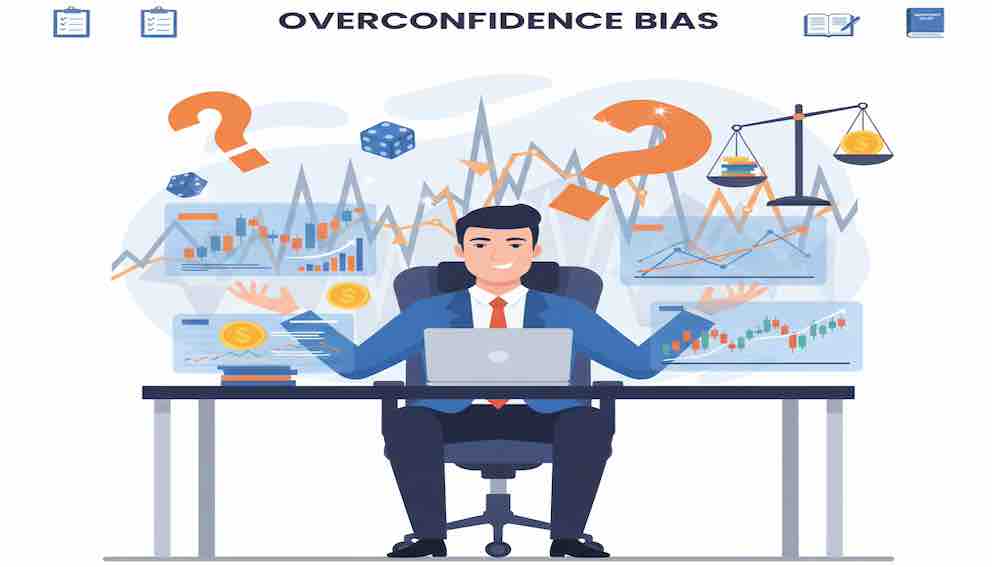
The Paradox of Confidence in Investing
Many investors take investment actions with lots of confidence and conviction.
They believe they can spot good stocks, time entries better than the crowd, and “know” when markets are wrong. Yet, when researchers examine real trading data, a stubborn paradox emerges: the more confident investors are, the worse they often perform.
If markets reward skill, why do confident investors trade more, take more risk, and earn lower returns?
Overconfidence is one of the most pervasive and damaging behavioral biases in finance. Unlike fear-driven mistakes, overconfidence feels rational, even virtuous. It wears the disguise of intelligence, experience, and conviction. That is precisely why it is so dangerous.
What Is Overconfidence?
Overconfidence refers to a systematic tendency to overestimate:
- One’s knowledge
- One’s predictive ability
- The precision of one’s information
- One’s control over outcomes
In finance, overconfidence leads investors to believe they are more skilled, better informed, or more accurate than they actually are.
Psychologists usually break overconfidence into three related forms:
1. Overestimation
Believing you are better than you really are
“I can consistently beat the market.”
2. Overprecision
Being too certain about the accuracy of your beliefs
“I’m sure this stock will outperform.”
3. Illusion of Control
Believing you influence outcomes that are largely random
“My timing and analysis make the difference.”
All three show up repeatedly in investing—and often reinforce one another.
The Psychological Roots of Overconfidence
Overconfidence is not arrogance; it is how the human mind works under uncertainty.
1. System 1 Dominance Under Complexity
As discussed earlier in this series, System 1 thinking is fast, intuitive, and narrative-driven. Financial markets are complex, noisy, and ambiguous—ideal conditions for System 1 to take over.
When outcomes are uncertain, the brain fills gaps with stories:
- “I saw this coming.”
- “I understand this company.”
- “The market is mispricing this.”
These narratives create an illusion of understanding, even when outcomes are driven by chance.
2. Self-Attribution Bias
Humans naturally credit successes to skill and failures to bad luck.
- Profitable trade → “Good analysis”
- Losing trade → “Unlucky timing”
Over time, this biased feedback loop inflates confidence without improving skill.
3. Asymmetric Feedback in Markets
Markets do not provide clean learning signals.
A bad decision can succeed.
A good decision can fail.
Because feedback is noisy, investors struggle to distinguish luck from skill, leading to persistent overconfidence even after poor long-term performance.
What the Evidence Shows
The academic evidence on overconfidence is remarkably consistent.
Trading More, Earning Less
In a landmark study, Barber and Odean (2000) analyzed thousands of brokerage accounts and found:
- Overconfident investors traded significantly more
- Higher trading frequency led to lower net returns
- The most active traders underperformed the market by wide margins after costs
Confidence encouraged action—but action destroyed value.
Gender and Overconfidence
In a follow-up study, Barber and Odean (2001) found that:
- Men traded 45% more than women
- Men underperformed women by nearly 1% per year
The explanation was not intelligence or access to information—but greater overconfidence.
Professional Investors Are Not Immune
Overconfidence is not limited to amateurs.
Studies of mutual fund managers and analysts show:
- Excessive belief in stock-picking ability
- Overly narrow confidence intervals in forecasts
- Persistent failure to outperform benchmarks net of fees
Expertise reduces some errors—but does not eliminate overconfidence.
How Overconfidence Distorts Financial Decisions
Overconfidence reshapes behavior in predictable ways.
1. Excessive Trading
Confident investors believe each trade adds value.
In reality:
- Trading increases transaction costs
- Taxes rise
- Timing errors accumulate
Markets reward patience, not activity.
2. Stock Picking and Concentration
Overconfident investors prefer:
- Individual stocks over diversified funds
- Familiar or “story-driven” companies
- High-conviction bets
This leads to under-diversification, increasing risk without increasing expected return.
3. Market Timing
Believing one can predict:
- Market tops and bottoms
- Interest rate moves
- Short-term price trends
Evidence shows timing errors are frequent and costly, even for professionals.
4. Ignoring Base Rates
Overconfidence causes investors to overweight:
- Personal research
- Recent news
- Anecdotes
And underweight:
- Long-term averages
- Historical probabilities
- Failure rates
This tendency to ignore broader evidence is known in behavioral finance as base-rate neglect. Investors often overweight their personal research or recent experiences while underweighting statistical averages and historical probabilities. For example, an investor might focus on a single company’s impressive quarterly report and believe it will outperform, while ignoring the long-term performance trends of similar companies in the sector.
Closely related is narrative bias—our brains naturally construct stories to make sense of complex information. A compelling story can make a stock, market trend, or investment strategy feel inevitable, even when the outcome is largely uncertain. Overconfidence and these biases reinforce each other: the more persuasive the story, the more investors trust their judgment, and the less they consider base-rate evidence or alternative explanations.
In short, overconfidence is rarely just misplaced self-belief; it is amplified by how we process information and stories, often at the expense of objective statistical reasoning.
A Reflective Pause
Think back to a confident investment decision you made.
- Did you overestimate how much you knew?
- Were you more certain than the evidence justified?
- Did the outcome reinforce confidence—even if luck played a role?
Overconfidence is most powerful when it feels invisible. Put another way, we often don’t even realize that we are being overconfident.
Experts vs Novices: The Confidence Gap
Interestingly, professional investors are not less confident—but their confidence is structured differently.
Novice Confidence
- Outcome-focused (“Did I make money?”)
- Story-driven
- Resistant to disconfirming evidence
- Emotionally attached to positions
Expert Confidence
- Process-focused (“Did I follow my rules?”)
- Probability-based
- Comfortable with uncertainty
- Willing to say “I don’t know”
Experienced professionals replace personal judgment with systems.
Evidence-Based Mitigation Strategies
Overconfidence cannot be eliminated—but it can be managed.
1. Shift from Prediction to Probability
Instead of asking:
“Will this investment succeed?”
Ask:
“What is the probability-weighted outcome?”
This reframes decisions away from certainty toward uncertainty.
2. Use Base Rates Explicitly
Before making a decision, consider:
- How frequently has a strategy like this succeeded historically?
- What do long-term averages indicate about likely outcomes?
Doing this helps ground your judgment in objective data, countering the pull of persuasive stories or personal intuition.
3. Pre-Commitment and Rules
Experts rely on:
- Asset allocation rules
- Rebalancing schedules
- Position size limits
By setting clear rules, we reduce the room for overconfidence to influence decisions.
4. Decision Journals
Record:
- Why you made a decision
- What you expected
- What could go wrong
Review results periodically; doing so helps identify biased reasoning and fine-tune your confidence.
5. Reduce Feedback Frequency
Frequent reviews can make us feel more skilled than we really are.
Taking a longer-term perspective helps to:
- Filter out short-term noise
- Reveal actual performance trends
- Temper overconfident reactions
6. Embrace Humility as Strategy
The most successful investors—from Buffett to institutional allocators—emphasize:
- Margin of safety
- Unknowns
- Avoiding big mistakes over seeking brilliance
Humility is not weakness; it is risk management.
Nuance and Debate
Some confidence is necessary.
Without confidence:
- Investors freeze
- Avoid risk altogether
- Fail to act even when odds are favorable
The problem is not confidence—but miscalibrated confidence.
Recent research indicates that:
- Gaining experience can help align confidence with actual skill
- Receiving structured feedback strengthens judgment
- Teams with diverse perspectives tend to make better decisions than individuals working alone
The key takeaway: the aim is well-calibrated confidence, not unnecessary self-doubt.
The Core Takeaway
Overconfidence is not about ego—it is about misjudging uncertainty.
It leads investors to:
- Trade too much
- Concentrate too narrowly
- Trust their judgment too deeply
Markets do not punish ignorance as harshly as they punish misplaced certainty.
The best investors are not those who believe they are smartest—but those who build systems that protect them from being wrong.
About Swati Sharma
Lead Editor at MyEyze, Economist & Finance Research WriterSwati Sharma is an economist with a Bachelor’s degree in Economics (Honours), CIPD Level 5 certification, and an MBA, and over 18 years of experience across management consulting, investment, and technology organizations. She specializes in research-driven financial education, focusing on economics, markets, and investor behavior, with a passion for making complex financial concepts clear, accurate, and accessible to a broad audience.
Disclaimer
This article is for educational purposes only and should not be interpreted as financial advice. Readers should consult a qualified financial professional before making investment decisions. Assistance from AI-powered generative tools was taken to format and improve language flow. While we strive for accuracy, this content may contain errors or omissions and should be independently verified.