
Tutorial Categories
Last Updated: February 10, 2026 at 19:30
Beyond Plain Vanilla Bonds: Understanding Municipal Bonds, Mortgage-Backed Securities, and Asset-Backed Investments
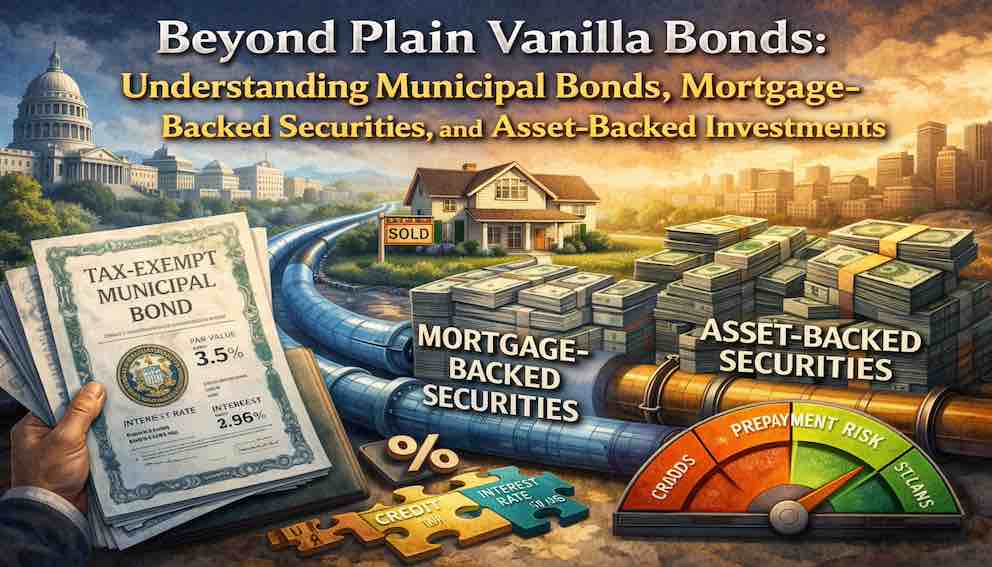
This tutorial explores fixed-income securities that go beyond traditional government and corporate bonds. You’ll learn why municipal bonds exist and how tax advantages enhance returns, discover how predictable cash flows from mortgages or other assets are transformed into marketable securities, and gain insight into mortgage-backed and asset-backed securities. Using vivid examples, numeric illustrations, and clear explanations, we unpack their structure, risks, and role in financial markets. By the end, you’ll have a unifying mental framework to navigate even the most complex corners of fixed-income investing with confidence and clarity.
Introduction: From Promises to Cash Flows
So far, we have thought about bonds in a very simple and intuitive way. A company borrows money and promises to pay it back. A government does the same. In each case, the bond represents a direct IOU from a single, clearly identifiable borrower. You know who owes you money, and you know where your interest and principal are supposed to come from.
In this next stage, that idea starts to change. Instead of lending to one borrower, investors can own a claim on a process. That process collects thousands of small payments from many different sources and passes them on to investors. The bond is no longer tied to a single promise, but to the steady operation of a system that produces cash flows over time.
This is what securitization does. It takes predictable payments—such as mortgage installments, loan repayments, or public fees—and reorganizes them into securities that investors can buy and sell. The purpose is practical: it allows money to move efficiently from savers to borrowers, while giving investors access to cash flows that would otherwise be difficult to own directly.
A helpful way to think about this is to imagine many small payments adding up over time. Each toll paid on a bridge, each monthly mortgage payment, and each credit card repayment is small on its own. When these payments are collected together, they form a large, steady stream of cash. Securitization takes that stream and divides it into portions that investors can own, much like drawing water from a shared reservoir.
The key mental model to carry forward is simple but powerful: any predictable cash flow can, in principle, be turned into a bond. This single idea connects municipal bonds, mortgage-backed securities, and asset-backed securities, and it provides a clear lens for understanding the more complex parts of the fixed-income market that follow.
Part 1: Municipal Bonds – Financing Community, with a Tax Twist
Municipal bonds, or “munis,” are debt instruments issued by states, cities, or local governments to finance public projects. These bonds are a way for governments to fund long-term projects without imposing large, immediate tax increases on residents.
The Town Water Plant Example
Imagine your town needs a new water treatment plant costing $50 million. Raising property taxes by 20% for a year would be politically painful and unfair to current residents. Instead, the town issues a municipal bond. It borrows the $50 million from investors and repays it over 30 years through water bills or general taxes. The cost of the project aligns with the benefits it provides over decades.
This approach spreads financial responsibility over time, ensures infrastructure gets built, and offers investors a predictable income stream.
The “Muni” Distinction: Two Types of Promises
Not all munis are alike. There are two primary types:
General Obligation (GO) Bonds
- Backed by the “full faith and credit” of the issuing government.
- The town promises to pay from any available revenue: taxes, fees, or surpluses.
- Generally lower-risk and lower-yielding.
Revenue Bonds
- Paid solely from revenue generated by the project.
- Our water plant could be funded by a revenue bond, repaid via water bills.
- Higher risk because if the project fails or revenues decline, bondholders bear the loss.
- Typically higher-yielding to compensate for this risk.
Think of it like lending to a neighbor: lending based on their entire income is like a GO bond, while lending based on a single new business they are starting is like a revenue bond.
The Tax Advantage: The Real Yield
Municipal bonds often have lower headline coupons than corporate bonds, but tax-exempt interest can make their after-tax yield more attractive.
Example: Sarah, in the 32% federal tax bracket, compares:
- Corporate bond: $10,000 at 5% = $500 interest. After 32% tax ($160), she keeps $340.
- Municipal bond: $10,000 at 3.5% = $350 interest. Because this interest is exempt from federal income tax, she keeps the entire $350.
Effectively, the muni’s 3.5% yield is equivalent to 5.15% taxable yield ($350 ÷ (1 – 0.32)). This explains why high-income investors often favor munis: it’s not the coupon quoted, but what you keep that matters.
Part 2: Mortgage-Backed Securities (MBS) – The Pool, The Pipeline, and Prepayment Risk
Now, let’s scale from a town to a nation of homeowners. Banks issue mortgages to thousands of individuals, collecting millions of small monthly payments. Keeping all these mortgages on the books ties up capital, limiting the bank’s ability to lend. Securitization solves this problem.
The Mechanics of MBS
- Pooling: The bank groups thousands of mortgages into a pool.
- Selling to a Trust/SPV: This special purpose vehicle (SPV) legally holds the mortgages and isolates them from the bank’s balance sheet.
- Issuing Bonds: The SPV issues bonds (MBS) backed by the mortgage payments. Investors now receive principal and interest payments funded by homeowners.
Numeric Illustration:
- 10,000 mortgages, each $200/month → $2,000,000 monthly cash flow.
- Bond structure: Senior tranche gets $1,200,000, Mezzanine $600,000, Equity $200,000.
- If 10% of homeowners default ($200,000), the loss hits Equity first, then Mezzanine, then Senior.
This structured cash flow allocation is called a waterfall.
Prepayment Risk: The Open Tap
Homeowners can refinance or sell, returning principal early. This prepayment risk affects expected cash flows:
- You buy a 30-year MBS expecting $2,000/month for 30 years.
- Interest rates fall; a third refinance next year.
- Suddenly, $666,667 of principal returns early.
- You must reinvest at lower rates, shortening your expected duration and reducing long-term yield.
MBS are therefore uniquely sensitive to interest rate movements.
Tranching: The Waterfall
Mortgage payments are often divided into tranches:
- Senior (AAA): First claim, lowest risk, lowest yield.
- Mezzanine (AA–BBB): Paid after senior tranche, higher risk, higher yield.
- Equity (unrated): Residual cash flow, first to absorb losses, highest potential return.
Think of the waterfall metaphor: each tranche is a cup in a tiered fountain. The water flows from top to bottom, filling senior first, then mezzanine, then equity. Losses follow the same order.
Part 3: Asset-Backed Securities (ABS) – The Same Idea, Different Ingredients
The MBS blueprint can be applied to almost any predictable payment stream. This is the world of Asset-Backed Securities (ABS).
Common ABS Examples
Auto Loan ABS: Payments from thousands of car loans fund the bonds.
Credit Card ABS: Monthly credit card payments back the bond.
Student Loan ABS: Monthly student loan repayments provide cash flow.
Numeric Illustration:
- 50,000 car loans at $400/month → $20,000,000/month cash flow.
- Bonds structured into Senior, Mezzanine, Equity tranches, similar to MBS.
- Auto loans: partially secured by the car itself. Credit cards: unsecured, higher risk, higher yields.
Investors must ask: “What is the behavior and financial health of the underlying borrowers?” Instead of evaluating a single company, you are underwriting thousands of individual cash flows.
Part 4: Layered Risks – Understanding What You’re Buying
Securitized products introduce multiple layers of risk beyond traditional corporate or government bonds:
- Credit Risk: Will the underlying borrowers pay? Defaults can reduce cash flow.
- Structural Risk: How does the waterfall allocate payments and losses across tranches?
- Interest Rate / Prepayment Risk: Payments can return early or late, altering duration and yield.
Understanding these layers is crucial to avoid surprises. While municipal bonds have straightforward risk assessment (issuer solvency and project revenue), MBS and ABS require examining both the assets and the legal structure governing cash flow distribution.
Part 5: Mental Model & Practical Navigation
The unifying mental model remains: any predictable cash flow can be transformed into a bond.
- Revenue Munis: A slice of a financial process—the project’s income stream.
- MBS: A share of mortgage payments across thousands of homeowners.
- ABS: A claim on payments from a fleet of cars, credit card accounts, or student loans.
Practical Investor Guidance
Munis:
- Calculate the taxable-equivalent yield.
- Decide between GO (safer) or Revenue (higher-yield, project-specific risk).
- Evaluate the municipality’s financial health.
MBS / ABS:
- For most individual investors, use mutual funds or ETFs where experts model prepayment and tranche risk.
- If investing directly, read the prospectus carefully. Understand tranches, cash flows, and underlying asset quality.
- Consider layered risks: credit, structural, and market.
By focusing on the underlying cash flows and how they are distributed, even complex instruments become understandable.
Part 6: Structured Comparison (Mental Table in Words)
Munis: Backed by government revenue, tax-exempt interest, relatively simple structure, lower risk.
MBS: Backed by mortgage payments, tranches, prepayment risk, moderate complexity, sensitive to interest rates.
ABS: Backed by other consumer receivables (auto loans, credit cards, student loans), tranches, credit and prepayment risk, complex, yields vary widely.
This mental comparison helps situate any fixed-income instrument in context and guides decision-making.
Conclusion: From Complexity to Clarity
We’ve traveled from the local (a town’s water plant) to the abstract (tranches of credit card debt). Across munis, MBS, and ABS, the unifying theme is the transformation of scattered, predictable cash flows into tradable bonds.
Securitization is neither inherently good nor bad—it is a financial tool that enables capital for public works and consumer finance, while redistributing risk.
The key takeaway: look through the structure to the underlying cash flows. Ask:
- What is generating the payments?
- How stable is the source?
- How are my payments and losses prioritized in the structure?
By focusing on these questions, you can move beyond intimidating terms like “ABS” and evaluate them with the same disciplined reasoning applied to any bond. You see not just complexity, but the predictable stream of value at its heart.
About Swati Sharma
Lead Editor at MyEyze, Economist & Finance Research WriterSwati Sharma is an economist with a Bachelor’s degree in Economics (Honours), CIPD Level 5 certification, and an MBA, and over 18 years of experience across management consulting, investment, and technology organizations. She specializes in research-driven financial education, focusing on economics, markets, and investor behavior, with a passion for making complex financial concepts clear, accurate, and accessible to a broad audience.
Disclaimer
This article is for educational purposes only and should not be interpreted as financial advice. Readers should consult a qualified financial professional before making investment decisions. Assistance from AI-powered generative tools was taken to format and improve language flow. While we strive for accuracy, this content may contain errors or omissions and should be independently verified.