Tutorial Categories
Last Updated: February 24, 2026 at 13:30
The Corporate Engine — Cash, Debt, and Value
A company does not collapse when it reports a loss. It collapses when it runs out of cash. Those two things sound similar. They are not. And understanding the difference is the beginning of understanding financial distress.
Let us start with something that might sound strange. We assume that if a company is making money, it must be safe. Profit feels like proof of health. It is the number we look for in headlines, the metric we celebrate. But here is the quiet fact that surprises most people when they first hear it: a company can be profitable and still die. Not years from now, after a long decline. Not in some theoretical sense. On an ordinary Tuesday afternoon, when payroll is due and the bank account comes up empty. This happens more often than we admit. It happens because profit and cash are not the same thing. They live in the same financial statements, yes. They appear on the same pages, reported in the same currency. But they behave very differently.
Think of profit as a story about the past. It tells us whether the business model worked over the last quarter, the last year. It is a report card on decisions already made, products already sold. Cash is different. Cash is about the next few minutes. It is the fuel in the tank, the ability to meet the obligation that lands on the desk at 3 p.m. on a Friday. If cash runs out, the story about profit becomes irrelevant. Employees cannot be paid with past success. The bank does not care about margins when the direct debit bounces.
This is not an argument against profit. Profit matters. It is the only way to build sustainable value over time. But profit without cash is like an engine without fuel—it looks impressive, but it is not going anywhere.
Hold that idea gently in mind. It is the foundation for everything that follows.
Now imagine two companies.
Company A is impressive. Revenue is rising. Margins look strong. Investors are optimistic. But customers take longer to pay than expected, and inventory keeps expanding to support growth. Every month, the bank balance drifts lower.
Company B is far less exciting. Growth is modest. Margins are average. Nothing about it looks dramatic. But each week, cash comes in roughly when expected, and the bank balance rarely surprises management.
Now imagine a sudden shock—a supplier demands faster payment, or a bank tightens credit.
Which company survives the first few months more comfortably?
It is Company B. Because suppliers, employees, and lenders do not accept promises of future profitability. They accept cash.
Beneath the income statement, beneath valuation multiples, beneath investor presentations, there is something quieter. There is plumbing. If that plumbing fails, nothing else matters.
What This Series Is Really About
This series is not a technical manual and it is not a bankruptcy law course; it assumes you already understand financial management and corporate finance, and instead focuses on something more practical and more dynamic: how companies move from stability to stress, from stress to distress, and sometimes back again. We will examine how cash actually flows through a business, how leverage amplifies small problems, how liquidity tightens before headlines appear, how refinancing risk builds quietly, how valuation changes when survival becomes uncertain, and why ownership shifts when enterprise value falls. Formulas will appear where they help, but they will not lead; our aim is to build intuition about movement, pressure, and timing so that when we later discuss covenants, restructuring, or bankruptcy, you understand not just the mechanics but the forces underneath them. Everything begins with the engine.
The Illusion of Profit
Let us build a picture together. Imagine a company—a real one, with sawdust on the floor and the smell of fresh wood in the air. This company makes wooden tables and chairs. Solid craftsmanship. The kind of furniture people keep for decades, pass down to their children, refinish when it grows old.
Business is good right now. Orders are increasing. Revenue is up 40 percent compared to last year. The founder walks through the workshop with a quiet sense of pride. Employees feel secure. Everyone assumes things are going well.
On paper, this looks like success.
But now let us look at something else. Let us look at the bank account.
To fulfil all those new orders, the company had to purchase more timber. Not next month—immediately. The supplier was paid last week.
The company had to produce more inventory. The warehouse is fuller than it has ever been. Those tables and chairs, stacked in rows, waiting to be sold—they represent cash already spent.
The company offered credit terms to a new retail chain. The chain will pay in 60 days. That is two months before the cash arrives.
Three new workers were hired to keep up with demand. Their wages are due on Friday.
Pause here for a moment.
Revenue is rising. The income statement will show a thriving business. But cash is leaving the building faster than it is returning.
This is not necessarily a crisis. It is simply a timing gap. Money goes out now; money comes in later. That is how growing businesses operate.
But here is where things can go wrong. If management confuses reported profit with available cash, that gap quietly widens. They look at the rising revenue and feel reassured. They accept more orders. They hire more staff. They assume the bank balance will eventually catch up.
And sometimes, it does not.
This gap between earning and receiving—between selling a table and actually holding the money—is where the corporate engine lives. It is the quiet machinery beneath all those impressive numbers.
Let us give that gap a name.
The Cash Conversion Cycle — The Timing Machine
There is a formal term for this timing gap. It is called the Cash Conversion Cycle.
Do not think of it as a formula to memorise. Think of it as a clock. A clock that measures how long your cash stays out of your control.
Here is how it works.
When you pay a supplier, cash leaves your account. When a customer finally pays you, cash returns. The number of days in between—that is your Cash Conversion Cycle.
Three things determine how long that cycle runs.
First, Inventory Days. How long does your cash sit inside goods before those goods are sold? For our furniture maker, timber is purchased, cut, assembled, finished. Those tables may sit in storage for weeks before a customer walks in. During all that time, the cash is frozen inside wood. It is not available for anything else.
Second, Receivable Days. You sell a table. The customer loves it. They take it home. But they do not pay today. They pay in 30 days, or 45, or 60. Until that payment arrives, your cash is effectively sitting in your customer's bank account. You earned it, but you cannot spend it.
Third, Payable Days. When you buy timber, do you pay immediately? Or does your supplier give you time? If you can delay payment for 30 days, you keep your cash longer. In that sense, your supplier is temporarily financing you.
The formula is simple: Inventory Days plus Receivable Days minus Payable Days.
But the meaning matters more than the arithmetic.
It tells you how long your cash is outside your control. It tells you how many days you must fund your own operations before the money comes back.
For our furniture maker, imagine inventory sits for 60 days. Receivables take 45 days. Suppliers are paid in 30 days.
Sixty plus forty-five minus thirty equals seventy-five.
For 75 days, cash leaves and does not return. For 75 days, the company is funding itself.
Now imagine sales double. Suddenly, you need twice the timber. Twice the inventory. Twice the receivables outstanding.
For 75 days, you are funding twice as much business.
Growth, in that moment, does not generate cash. It consumes it. The faster you grow, the more cash you need—at least until that 75-day cycle completes and money finally starts coming back.
This is why working capital is not just an abstract accounting concept. It is the practical cost of timing. It is the price of the gap between spending and receiving.
If you cannot fund those 75 days, you must borrow. And borrowing, as we will see, introduces something powerful into the engine—something that can amplify both success and failure.
The Three Doors of Cash
Let us stay with our furniture maker for a moment longer. The business is growing, but cash is tight. The owner looks at the bank balance and wonders: if we need money quickly, where would it come from?
This is a question every business faces at some point. And the answer, it turns out, is surprisingly simple.
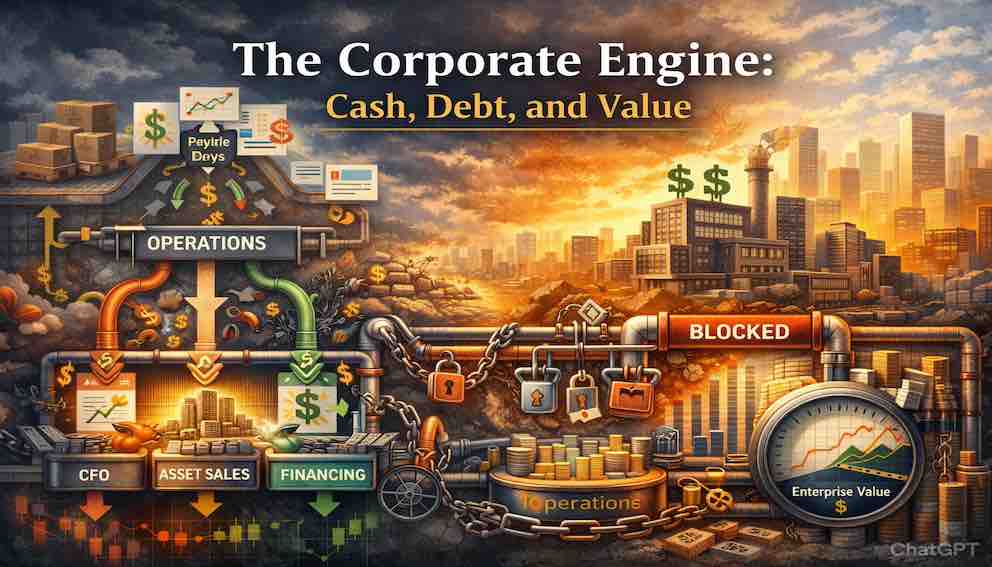
There are only three places a company can obtain cash. Only three doors to knock on.
The first door is operations. This is the cleanest source. Customers pay for their tables. The money comes in from the core business. If operations generate more cash than they consume, the company breathes easily. No one needs to be convinced. No assets need to be sold. The business funds itself.
The second door is selling assets. If operations fall short, management can look around at what the company owns. Perhaps there is a building that could be sold and leased back. Perhaps a subsidiary that is not central to the business. Perhaps old equipment no longer in use. These assets can be converted into cash. But assets are finite. You can only sell them once.
The third door is financing. If operations are not enough and selling assets is not enough, the company turns to lenders or investors. Banks, bondholders, private equity—these are the sources of outside capital.
In healthy times, that third door swings open easily. Capital is abundant. Lenders compete for business. Terms are favorable.
In uncertain times, the door becomes heavier. Lenders grow cautious. They ask more questions. They demand higher rates.
In crises, that door can close entirely. Not just narrow—slam shut. And when it does, companies that relied on it find themselves trapped.
Here is something worth noticing. Financial distress often begins not with a dramatic loss, not with a sudden collapse in sales. It begins quietly, with one of these doors narrowing. Then another. Then another.
By the time the crisis becomes visible, the exits are already blocked.
Enterprise Value — The Size of the Pie
Now we need to connect cash to something broader. We need to talk about value.
There is a concept in finance called Enterprise Value. Do not let the name intimidate you. It is simply the present value of all the cash a company is expected to generate in the future. Everything the business will ever earn, discounted back to today.
Think of it as the size of the economic pie.
That pie is divided among the people who have claims on the company. At the top are the debt holders—the banks, the bondholders, the lenders. Below them are the equity holders—the shareholders, the owners, the founders.
If the pie is large relative to the debt, everyone is comfortable. Debt gets paid. Equity gets the rest.
But if the pie shrinks, something interesting happens. The loss is not shared equally. It is absorbed first by the people at the bottom—the equity holders.
Consider a simple example. A company is worth 100. It has 60 of debt. Equity is worth 40.
Now imagine expectations weaken. Perhaps the economy slows. Perhaps a competitor emerges. The enterprise value falls to 80.
The debt holders still expect their 60. They are first in line. That leaves only 20 for equity.
A modest change—a 20 percent decline in enterprise value—has caused a 50 percent decline in equity value.
This is leverage at work. Leverage does not create volatility. It amplifies it. It takes a small movement and turns it into a dramatic one.
When enterprise value declines far enough, equity disappears entirely. The pie remains—the company still has value—but the ownership changes. The debt holders, who were once just lenders, become the new owners.
This is the mechanism beneath so much of what we will explore. It is not magic. It is simple arithmetic. But its consequences are profound.
The Blueprint
Now step back for a moment and look at the structure we have built.
A company survives when three things are true.
First, cash moves predictably through its operations. Not necessarily smoothly—business is rarely smooth—but predictably enough to plan around.
Second, the timing gap between spending and receiving is funded responsibly. That gap, the Cash Conversion Cycle, is not a problem to eliminate. It is a reality to manage.
Third, at least one of those three doors remains open. If operations are tight, assets can be sold. If assets cannot be sold, financing is available. If all three close, the company cannot survive.
And beneath all of this, enterprise value must comfortably exceed the obligations against it. Because if the pie is smaller than the claims, someone will lose. And that someone is usually the equity holder.
Everything else in this series—the early warning signals, the liquidity spirals, the covenant breaches, the restructuring negotiations—is a variation of this blueprint. A different angle on the same underlying structure.
We begin here because without understanding the engine, the later drama makes no sense. You cannot understand why a company collapses if you do not understand what holds it up.
Before distress becomes visible, it begins in timing. Before default becomes public, it begins in cash. Before creditors fight over the remains, it begins in the quiet machinery of the business.
And now you know where to look.
About Swati Sharma
Lead Editor at MyEyze, Economist & Finance Research WriterSwati Sharma is an economist with a Bachelor’s degree in Economics (Honours), CIPD Level 5 certification, and an MBA, and over 18 years of experience across management consulting, investment, and technology organizations. She specializes in research-driven financial education, focusing on economics, markets, and investor behavior, with a passion for making complex financial concepts clear, accurate, and accessible to a broad audience.
Disclaimer
This article is for educational purposes only and should not be interpreted as financial advice. Readers should consult a qualified financial professional before making investment decisions. Assistance from AI-powered generative tools was taken to format and improve language flow. While we strive for accuracy, this content may contain errors or omissions and should be independently verified.