
Tutorial Categories
Last Updated: February 24, 2026 at 13:30
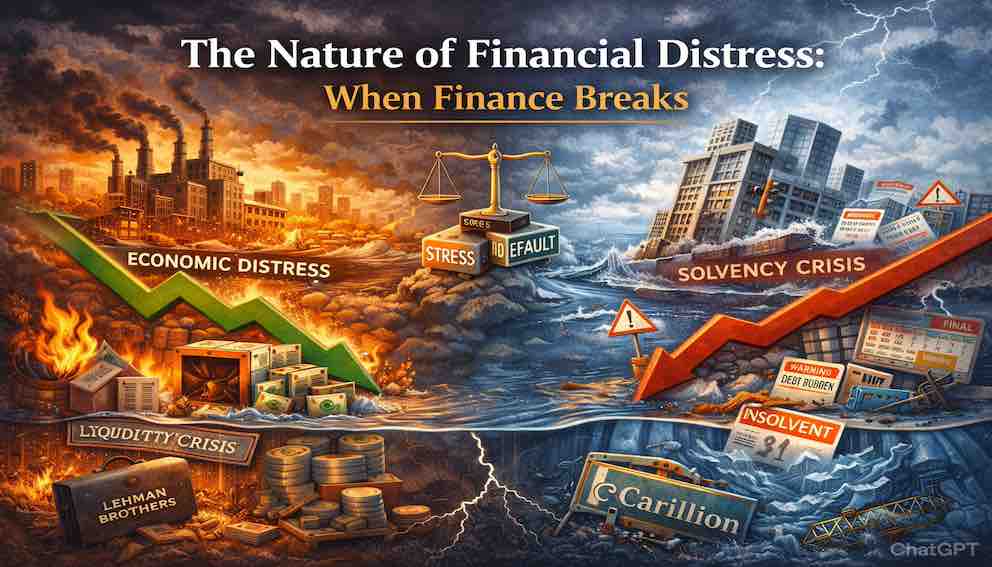
The Nature of Financial Distress: When Finance Breaks — Liquidity, Solvency, Capital Structure, and the Slow Slide Toward Default
Financial distress rarely begins with a dramatic collapse. It usually begins quietly, with small mismatches between cash coming in and cash going out, between promises made and resources available. In this tutorial, we move carefully through the difference between economic distress and financial distress, liquidity crises and solvency crises, temporary shocks and structural imbalances. We examine why even profitable firms fail, how capital structure rigidity accelerates decline, and why distress becomes self-reinforcing once confidence erodes. Above all, we learn to see default not as a sudden event, but as the final stage of a long and often misunderstood transition.
When Something Starts to Tighten
There is a moment in every difficult situation when nothing appears broken, yet something feels tighter than before.
The numbers still print. The lights are still on. The quarterly call still uses confident language.
But inside, decisions feel heavier. Payments are timed more carefully. Conversations with lenders grow slightly more frequent.
Financial distress rarely begins with noise. It begins with pressure.
To understand when finance “breaks,” we must resist the temptation to look only at the dramatic ending. Collapse is visible. Distress is gradual. Finance breaks when the structure of promises and the flow of resources stop moving in rhythm.
The misalignment may be small at first. A delay here. A cost overrun there. A refinancing that becomes slightly more expensive than expected. None of these, alone, signals catastrophe.
But taken together, they alter the internal balance of the system.
And misunderstanding the type of imbalance is often what turns stress into failure.
A Small Business to Carry With Us
Let us hold a simple business in our imagination and let it travel through this discussion.
A café opens in a growing neighbourhood. It serves good coffee, fresh pastries, and light lunches. Office workers become regulars. Catering orders come in steadily. After two years, it is modestly profitable and stable.
Then three events occur.
A new competitor opens nearby, offering cheaper prices and a loyalty app.
A major catering client begins stretching payments from two weeks to 45 days.
The refrigeration system fails, costing £8,000 to replace.
The owner now faces a quiet but profound question:
Is this temporary strain — or is something fundamentally wrong?
That question captures the essence of financial distress.
Economic Distress vs Financial Distress
Before we can diagnose the café’s problem, we must distinguish two different forms of weakness.
A company can suffer economic distress or financial distress. They often interact, but they are not the same.
Economic distress concerns the engine of the business. It arises when the company’s operations no longer generate adequate returns relative to costs and capital employed. Demand may have shifted. Competition may have intensified. The cost structure may be permanently misaligned. The underlying value creation mechanism weakens.
Financial distress, by contrast, concerns the structure and timing of obligations. A firm may have a viable business model, yet still be unable to meet its financial commitments when due.
Return to the café.
If customers permanently migrate to the competitor and the café cannot restore margins through pricing or differentiation, the business model itself is impaired. That is economic distress.
If customers remain loyal but the delayed catering payment and equipment failure create a temporary cash shortfall, the engine still functions. Cash flow timing has faltered. That is financial distress.
This distinction matters because the remedy differs. Financial support cannot repair a broken business model. Operational redesign cannot solve a near-term liquidity gap without financing.
In practice, these two forms of distress often reinforce one another. Economic weakness reduces cash flow. Reduced cash flow limits investment. Limited investment weakens competitive position further. The system begins to tighten.
Understanding which force moved first is not academic curiosity. It is strategic necessity.
Liquidity Crisis vs Solvency Crisis
If economic distress concerns the engine, liquidity and solvency concern the balance sheet.
A liquidity crisis arises when a firm lacks sufficient cash — or access to cash — to meet near-term obligations. The company may have valuable assets. It may even have positive net worth. But it cannot convert those assets into cash quickly enough.
A solvency crisis is deeper. It occurs when the economic value of assets is insufficient to cover liabilities. Even with time, the firm cannot repay its obligations in full.
Liquidity is about timing. Solvency is about substance.
In our café’s case, suppose the owner’s building is worth £500,000 and the mortgage is £300,000. She is solvent. But if she cannot make next month’s payment due to short-term cash pressure, she faces a liquidity problem.
Now imagine the neighbourhood declines and the building is worth only £250,000 while the mortgage remains £300,000. Even if she remains current on payments, she is economically insolvent.
In legal systems, insolvency can be defined either as balance-sheet insolvency (liabilities exceeding assets) or as inability to meet debts as they fall due. These definitions overlap with liquidity concerns. The language varies by jurisdiction, but the underlying economic distinction remains clear: timing versus adequacy.
Many corporate collapses begin as liquidity stress that gradually reveals solvency weakness.
The collapse of Lehman Brothers illustrates this progression. Before its 2008 bankruptcy, questions arose about the value of its mortgage-related assets. On paper, the firm argued it remained solvent. Yet its heavy reliance on short-term funding meant that once counterparties withdrew confidence, liquidity evaporated. The loss of daily refinancing capacity proved fatal, regardless of debates about asset valuation.
Liquidity can disappear before solvency is conclusively resolved. In financial markets, perception often precedes accounting clarity.
Capital Structure Rigidity: Why Structure Matters as Much as Size
At this point, it is tempting to say that debt causes distress. But debt alone is not the full story. Structure matters.
Consider two firms with identical total debt.
The first firm has long-term bonds maturing in ten years, with no restrictive covenants and manageable annual interest payments.
The second firm relies on short-term loans that must be rolled over every six months, secured against fluctuating asset values, and subject to strict financial covenants.
Both firms may appear equally leveraged on paper. Yet the second is far more fragile.
Capital structure determines how quickly stress becomes crisis.
Short-term debt increases refinancing risk.
Covenants create tripwires that can trigger technical default even before cash runs out.
Secured debt limits flexibility because key assets are already pledged.
Bullet maturities concentrate risk into a single moment.
In the case of Lehman Brothers, dependence on overnight and short-term funding meant that liquidity had to be renewed constantly. When confidence declined, funding disappeared rapidly. The structure amplified vulnerability.
Rigidity is what converts volatility into existential threat.
Temporary Shock vs Structural Imbalance
Not every period of distress signals permanent decline. Sometimes a business experiences a temporary shock — a recession, a supply disruption, a regulatory change.
In such cases, revenue dips but the long-term competitive position remains intact. Given time and modest financing, recovery is possible.
The danger lies in mistaking structural imbalance for temporary disruption.
A structural imbalance exists when long-term cost structure, leverage, or strategic positioning is misaligned with sustainable revenue.
In our café’s case, if customers are simply sampling the new competitor and will likely return, the shock is temporary. But if the competitor permanently shifts pricing expectations in the neighbourhood, the imbalance is structural.
The collapse of Carillion reflected structural imbalance rather than a brief shock. Years of aggressive contract assumptions and leverage masked underlying fragility. When project losses emerged, what seemed like temporary setbacks revealed deeper systemic weakness.
Temporary shocks pass. Structural imbalances accumulate.
The difficulty is that both feel similar at the beginning.
Why Profitable Firms Still Fail
One of the most confusing aspects of distress is that firms can report profits and still collapse.
Profit is measured over an accounting period. It includes accruals and estimates. Cash is immediate.
A company may recognize revenue long before cash arrives. It may capitalize expenses. It may face heavy interest obligations that consume operating income. It may distribute dividends while retaining little liquidity.
Profitability does not guarantee flexibility.
If our café earns £10,000 annually without debt, a downturn to £6,000 is painful but survivable.
If annual interest payments total £8,000, the same downturn creates an immediate shortfall.
Leverage transforms ordinary business variability into existential risk.
And here we encounter an important feedback loop.
When Distress Becomes Self-Reinforcing
There is something important to understand about financial distress that is not obvious at first glance.
Distress does not merely reflect weakness. It can create it.
Think about what happens when a company begins to struggle. The signs are subtle at first—a payment delayed here, a covenant approached there. But each small sign triggers a reaction.
Suppliers, sensing risk, shorten payment terms. Where they once allowed 30 days, now they want 15. Cash leaves faster.
Customers, hearing rumors, hesitate to commit to long-term contracts. They keep their options open, order smaller quantities, test alternative suppliers. Revenue becomes less predictable.
Employees, noticing the tension, update their resumes. The best ones leave first. The ones who stay are distracted, anxious, less productive.
Credit rating agencies, reviewing the numbers, downgrade their outlook. The company's debt becomes more expensive to service. Borrowing costs rise.
Notice what is happening here. Each of these reactions is rational from the perspective of the person taking it. Suppliers protecting themselves. Customers managing risk. Employees seeking stability. Agencies doing their job.
But collectively, these rational actions make the company's situation worse. They increase cash outflows. They reduce cash inflows. They tighten the very liquidity that was already under pressure.
And so the cycle continues. Liquidity stress reduces the company's ability to meet obligations. That weakness triggers more reactions. More reactions create more stress.
Sometimes the company must sell assets to raise cash. But when many companies are selling similar assets at the same time—or when buyers know the seller is desperate—prices fall. A factory that might have been worth ten million in an orderly sale goes for seven million in a forced sale. That lower price reduces the company's balance sheet strength. Weaker balance sheets can trigger covenant breaches. Covenant breaches restrict further borrowing. Restricted borrowing worsens liquidity.
You can see where this is heading.
Liquidity stress reduces solvency. Solvency concerns worsen liquidity. The loop feeds itself.
During the 2008 financial crisis, this dynamic played out across the entire system. Asset values fell not because the long-term earning power of those assets had suddenly vanished, but because so many institutions were forced to sell at the same time. The selling drove prices down. Lower prices forced more selling. The decline became self-reinforcing.
Once distress reaches this stage, it becomes very difficult to arrest. The mechanics of the business are no longer the only problem. The reactions of everyone around the business have become part of the problem too.
The Psychological and Strategic Delay
There is another force that shapes the trajectory of distress, quieter than the financial mechanics but equally powerful.
Delay.
Management hesitates to admit that problems are structural rather than temporary. Admitting structural problems means admitting that past decisions were wrong. It means facing difficult conversations with boards, with lenders, with employees. It is easier to believe that next quarter will be better.
Boards, receiving optimistic forecasts from management, hope that conditions will normalize. They do not want to intervene prematurely. They do not want to be seen as panicking. So they wait.
Creditors, facing the prospect of recognizing losses on their books, may extend maturities rather than force the issue. Extending allows them to defer the write-down. Maybe things will improve. Maybe they will not have to explain the loss to their own stakeholders.
Equity holders, seeing their investment shrink, prefer riskier strategies. The conservative path offers little upside. The aggressive path might fail completely—but it might also save them. So they push for the gamble.
Each of these responses is understandable. Each makes sense from the perspective of the person making the decision.
But together, they deepen the imbalance. Delay allows problems to compound. Small gaps become large gaps. Manageable issues become existential threats.
By the time restructuring finally begins, liquidity buffers that could have provided breathing room are exhausted. Options that were available six months ago have disappeared. The company arrives at the negotiating table with empty hands.
This is why distress often follows a particular pattern. It persists longer than it should—months of quiet deterioration, gradual decline, missed opportunities. And then it resolves more abruptly than anyone expected. A sudden default. A rushed filing. A collapse that seems to come from nowhere but was years in the making.
Default: Contractual vs Economic Failure
It is worth pausing here to clarify something important.
When a company defaults, it does not necessarily mean the business has stopped working. It does not mean the products have no buyers or the employees have no skills. Default is a contractual event, not an economic one.
A company can default by breaching a covenant—failing to maintain a required ratio, even if it continues making all its payments. It can default by missing an interest payment, even if the business is fundamentally sound. It can trigger cross-default clauses in one loan agreement by defaulting on another.
These are all contractual failures. They happen when the company fails to meet the terms of its agreements, not when it fails to operate.
Economic distress—the weakening of the business itself—usually comes first. Then comes contractual default. Then, if the default cannot be cured, comes legal insolvency—the formal proceedings of bankruptcy or administration.
Default is rarely the beginning of the story. It is the visible marker, the point at which pressures that have been building quietly finally break the surface.
A Simple Diagnostic Framework
When you encounter a company under pressure—whether as an investor, a creditor, or simply an observer—there are three questions worth asking. They will not give you perfect certainty. No framework can. But they will help you avoid the most common errors.
First: Is the business model intact?
Are customers still willing to buy what the company sells at prices that cover its costs? Is the competitive position still defensible? If the answer is yes, then the problem may be financial rather than economic. If the answer is no, then no amount of financial engineering will save it.
Second: Is the problem timing or substance?
Does the company have positive asset value—more than it owes—but simply cannot access cash quickly enough to meet near-term obligations? That is a liquidity problem. Or do its liabilities meaningfully exceed what its assets are worth on a realistic basis? That is a solvency problem. The remedies are different.
Third: Is the imbalance temporary or structural?
Will conditions reasonably normalize if the company can just hold on for another six months? That suggests a temporary shock. Or is the cost structure permanently misaligned with the revenue environment? Is the debt burden simply too high for the cash flow the business can generate? That suggests a structural problem requiring fundamental change.
These questions do not eliminate uncertainty. But they reduce the risk of applying the wrong remedy to the wrong problem.
Conclusion: How Finance Breaks
We began this tutorial with the image of tightening—subtle at first, barely visible. A supplier shortening terms. A customer delaying an order. A bank asking for more frequent reporting.
We explored the difference between economic distress, which is about the business itself, and financial distress, which is about the structure of claims against it. We distinguished liquidity crises, which are about timing, from solvency crises, which are about substance. We saw how temporary shocks differ from structural imbalances, and how confusing the two can be fatal.
We examined how capital structure rigidity amplifies vulnerability—how fixed obligations turn ordinary business variability into existential risk. We saw how distress can become self-reinforcing, with rational reactions from suppliers, customers, and creditors compounding the original problem.
Through the examples of Lehman Brothers and Carillion, and through the smaller story of our café owner, we observed that collapse is rarely sudden. It is the final stage of accumulated pressure—pressure that built over months or years while the people inside the organization hoped, delayed, and deferred.
Financial distress is not chaos. It is misalignment unfolding over time.
Understanding the nature of that misalignment—whether economic or financial, temporary or structural, liquid or insolvent—is the first step toward repair. And if repair is no longer possible, it clarifies why.
In the next part of this series, we will examine how capital structure design, covenant architecture, and restructuring strategy determine whether a company bends under pressure—or breaks.
About Swati Sharma
Lead Editor at MyEyze, Economist & Finance Research WriterSwati Sharma is an economist with a Bachelor’s degree in Economics (Honours), CIPD Level 5 certification, and an MBA, and over 18 years of experience across management consulting, investment, and technology organizations. She specializes in research-driven financial education, focusing on economics, markets, and investor behavior, with a passion for making complex financial concepts clear, accurate, and accessible to a broad audience.
Disclaimer
This article is for educational purposes only and should not be interpreted as financial advice. Readers should consult a qualified financial professional before making investment decisions. Assistance from AI-powered generative tools was taken to format and improve language flow. While we strive for accuracy, this content may contain errors or omissions and should be independently verified.