
Tutorial Categories
Last Updated: February 25, 2026 at 13:30
The Company After Restructuring: A New Beginning for Sustainable Growth
Emerging from a restructuring process marks a critical new beginning for any company. This tutorial explores how ownership shifts from distressed equity holders to former creditors, how governance and management incentives realign with recovery goals, and why operational discipline, cash management, and strategic refocus are essential for long-term success. Through the story of Precio Components and real-world examples, readers will understand why post-restructured companies often emerge financially healthier, operationally leaner, and strategically better positioned to pursue sustainable growth.
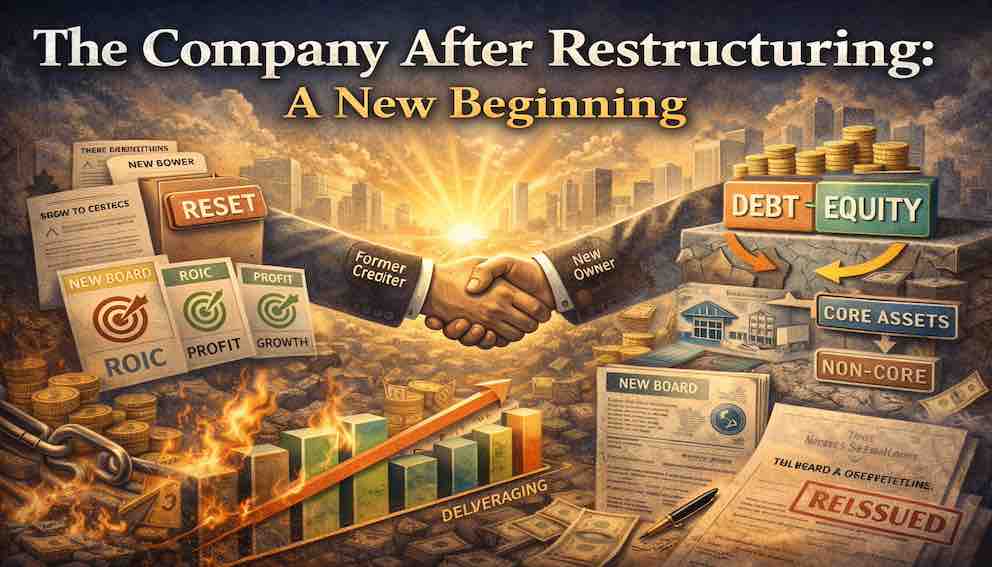
Introduction: The Day After Restructuring
Let us return to Precio Components.
The restructuring is complete. The court has confirmed the plan. The new company—technically a new legal entity, but operating the same factories, serving the same customers, and employing many of the same people—has emerged from Chapter 11 bankruptcy.
It is a Tuesday morning, like any other. The factory floor hums with activity. Orders are being filled. Trucks are being loaded. But everything has changed.
Maria remains CEO, and Sarah remains CFO, but they now report to a new board dominated by representatives of the former creditors. Heinrich, the family patriarch, is no longer on the board. He is at home, contemplating what to do with the rest of his life.
This is the day after restructuring. It is not an ending. It is a new beginning—one with different owners, different incentives, and different challenges.
From a broader perspective, this moment illustrates a key principle: post-restructuring companies must balance continuity with transformation. While the business may appear familiar, ownership, governance, and operational priorities have fundamentally shifted. These changes are crucial to ensuring long-term resilience and sustainable growth.
Ownership Changes: From Creditors to New Shareholders
One of the most striking outcomes of restructuring is the transformation of ownership.
Before restructuring, Precio Components had:
- €70 million in senior secured debt
- €30 million in unsecured bond debt
- €10 million in subordinated debt
- €5 million in trade payables
- Equity held by the founding family and a private equity investor
After restructuring:
- Senior secured debt is reduced to €50 million
- Unsecured bondholders converted €20 million of their debt into 45% of the new equity
- Senior lenders converted €15 million of their debt into 35% of the new equity
- The founding family received 2% as a stub interest
- Management holds 3% in incentive shares
- The remaining 15% is held by various parties, including trade creditors who accepted equity
The implication is profound. Creditors, who were once external claimants seeking repayment, now have a vital economic and strategic stake in the company. Their financial interests are directly linked to operational success, creating strong incentives for prudent decision-making.
For example, Chen, who represented the bondholders throughout the restructuring, is now a board member. Her fund retains some exposure to remaining debt, but their largest position is now equity. Similarly, Dietrich, representing the senior lenders, holds both secured debt and equity, giving him a dual perspective: protecting the loan while fostering long-term growth.
This transformation highlights a universal principle in corporate finance: equity conversion realigns incentives. Creditors experience the consequences of past mismanagement and now have a vested interest in ensuring that the company does not repeat those mistakes.
Control Versus Ownership: Understanding Influence
A subtle but critical distinction in post-restructuring companies is that ownership and control are not identical. Owning a percentage of equity does not necessarily equate to proportional influence over decisions.
At Precio Components:
- The board has seven seats
- Bondholder representatives hold three seats
- Senior lender representatives hold two seats
- Maria, the CEO, holds one seat
- An independent director holds one seat
Despite holding 2% of the company, the founding family has no board representation, illustrating that their ownership is economic rather than controlling.
This reflects a broader restructuring principle: creditors with continuing exposure often negotiate for board influence exceeding their equity stake, especially if their loans remain on the balance sheet. Board composition, therefore, becomes a critical mechanism for ensuring that post-restructuring priorities—like deleveraging, operational stability, and strategic focus—are achieved.
Governance Realignment: Board and Management Focus
Ownership changes naturally trigger governance realignment. Boards in post-restructured companies typically focus on three objectives:
- Protecting newly created equity – Former creditors have converted their claims into equity, making the preservation of this value central.
- Maintaining operational stability – The company must continue serving customers, paying suppliers, and keeping employees productive to sustain recovery.
- Overseeing strategic repositioning – The company must address weaknesses that led to distress and prioritize sustainable growth.
Maria, the CEO, experiences these changes immediately. Previously reporting to a family-dominated board, she now answers to professionals who ask rigorous questions:
"Show us the 13-week cash flow forecast," Chen demands. "Not the annual budget—the cash week by week. Liquidity is everything."
Dietrich adds, "We need covenant headroom projections. We are not repeating this again."
Management incentives are redesigned to align with these priorities. Maria’s bonus now ties 60% of compensation to free cash flow generation, debt reduction milestones, and return on invested capital targets. Revenue growth, once the main metric, is secondary.
This underscores a central lesson: in post-restructuring companies, governance and management incentives must reinforce financial discipline and long-term viability over short-term expansion.
Operational Priorities: Deleveraging and Cash Discipline
Even after restructuring, the company’s financial position requires careful attention. Precio Components’ post-restructuring balance sheet shows:
- €50 million in senior secured debt (down from €70 million)
- No unsecured bonds (converted to equity)
- €5 million in trade payables (normal course)
- €10 million in new equity (from debt conversions)
Deleveraging remains a priority. Maria presents a three-year debt reduction plan:
- Year 1: Generate €8 million in free cash flow, reduce debt by €5 million
- Year 2: Generate €10 million, reduce debt by €7 million
- Year 3: Generate €12 million, reduce debt by €8 million
By year three, debt would be down to €30 million—a level the company can support comfortably.
Cash discipline is equally crucial. The company implements:
- Weekly cash forecasting for the first year
- Capital expenditure thresholds requiring board review for projects over €25,000
- Monthly inventory monitoring
- Quarterly reporting on receivable days to the board
This illustrates a broader post-restructuring principle: cash management and financial discipline are the backbone of recovery, signaling credibility to suppliers, customers, and capital markets.
Strategic Refocus: Core Assets and Growth Path
Restructuring offers an opportunity for strategic refocus, where companies shed non-core or underperforming assets.
Precio Components had three divisions:
- Automotive components: Profitable but capital-intensive
- Aerospace components: High-margin, technically demanding
- Consumer hardware: Low-margin, commoditized
Previously, management hesitated to sell the consumer hardware division because it contributed 20% of revenue. With new owners focused on profitability, the board approves a sale, completed for €15 million.
Simultaneously, the company carves out its emerging aerospace technology unit into a separate subsidiary, enabling focused investment and attracting potential outside capital.
This illustrates a generalizable lesson: post-restructured firms must concentrate resources where they have genuine competitive advantage, avoid spreading limited resources thin, and prioritize strategic clarity over mere revenue growth.
Incentives and Culture: Aligning Behavior with Recovery
Human behavior plays a crucial role in post-restructuring success. Employees of Precio Components remember months of uncertainty. Some left, while others stayed, loyal but weary.
Maria implements several initiatives:
- Monthly all-hands meetings with transparent financial reporting
- Performance-based bonuses tied to cash flow and customer satisfaction
- A “no-blame” approach to operational issues, focusing on learning rather than fault-finding
- Recognition programs for teams exceeding targets
This cultural reset ensures that the lessons of distress—misaligned incentives, short-termism, and risk mismanagement—do not repeat. Culture and behavior are as critical as the balance sheet in sustaining post-restructuring recovery.
The New Capital Structure: Flexibility and Risks
The post-restructuring capital structure provides advantages:
- Lower leverage: Debt is reduced from €115 million to €55 million
- Alignment of interests: Creditors-turned-shareholders now prioritize long-term success
- Flexibility: Covenant headroom allows strategic decision-making
- Clear priorities: The board focuses on recovery rather than conflicting claims
Risks remain. Bondholders-turned-equity owners may eventually seek to sell stakes, while senior lenders still hold secured debt. Management must balance short-term performance with long-term investment.
Exit Strategies: Planning for the Future
Most creditors-turned-shareholders are not permanent owners. Chen’s fund, for example, expects to sell its stake in three to five years. Dietrich’s bank, holding secured debt, may be more patient but still monitors both debt repayment and eventual equity exit.
These differing objectives create healthy tension: Should the company pay down debt faster or invest in growth? Pursue an IPO or a strategic sale? Distribute dividends or reinvest?
The very presence of these strategic debates demonstrates that the company has moved from survival mode to sustainable planning.
The Fate of the Founding Family
Heinrich, the family patriarch, now holds only 2% of the company. While symbolic, this stub interest allows the family to retain a connection to the business. His decision to hold the shares illustrates a critical principle: post-restructuring equity, even in small amounts, carries both financial and psychological significance.
Long-Term Implications: Building Financial Resilience
Successful post-restructuring companies often exhibit:
- Lower leverage ratios
- Healthier balance sheets with more equity and less risk
- Predictable cash flows and embedded financial discipline
- Clear strategic focus on core assets
- Better governance with engaged and skeptical boards
- Aligned management and owner incentives
For Precio Components, two years after emergence:
- Debt reduced to €40 million
- Operating margins improved from 8% to 12%
- Aerospace division growing at 15% annually
- Consumer hardware division sold
- Cash reserves of €15 million
When a recession hits, the company can absorb the shock. Margins compress, but debt service remains manageable. No covenant breaches. No liquidity crisis. The restructuring has worked.
Case Example: Real-World Parallel
A mid-sized industrial company in the United States went through Chapter 11 for similar reasons: over-leveraged acquisitions and declining cash flow. After restructuring:
- Senior lenders converted debt into equity
- The new board implemented deleveraging, divestitures, and focused investment
- Management incentives were tied to cash flow and profitability
Within three years, debt was reduced by 50%, liquidity improved, and profitability returned. Former lenders eventually sold their stakes to a private equity firm at a profit, illustrating that distress, when managed effectively, becomes a catalyst for renewal.
Conclusion: A New Beginning Rooted in Discipline and Strategy
Through the story of Precio Components and real-world parallels, we have explored the post-restructuring phase, highlighting:
- How former creditors become new owners with a vested interest in success
- How governance shifts to align with recovery goals
- How management incentives focus on cash flow, debt reduction, and operational efficiency
- How strategic refocus sheds non-core assets and concentrates resources
- How cultural change supports financial and operational discipline
- How the new capital structure balances flexibility, resilience, and risk
The post-emergence phase is not an ending. It is a new beginning that demands careful stewardship, disciplined decision-making, and strategic clarity. Companies that navigate this phase successfully emerge leaner, more focused, financially resilient, and better positioned for sustainable long-term growth.
For executives, investors, and students of corporate finance, the lessons are clear: the aftermath of restructuring provides an opportunity to transform distress into a foundation for renewed strength, strategic agility, and operational excellence.
About Swati Sharma
Lead Editor at MyEyze, Economist & Finance Research WriterSwati Sharma is an economist with a Bachelor’s degree in Economics (Honours), CIPD Level 5 certification, and an MBA, and over 18 years of experience across management consulting, investment, and technology organizations. She specializes in research-driven financial education, focusing on economics, markets, and investor behavior, with a passion for making complex financial concepts clear, accurate, and accessible to a broad audience.
Disclaimer
This article is for educational purposes only and should not be interpreted as financial advice. Readers should consult a qualified financial professional before making investment decisions. Assistance from AI-powered generative tools was taken to format and improve language flow. While we strive for accuracy, this content may contain errors or omissions and should be independently verified.