
Tutorial Categories
Last Updated: February 24, 2026 at 13:30
How Some Companies Survive and Thrive After Distress: Turning Recovery Into Long-Term Success
Recovering from financial distress is far more than avoiding bankruptcy—it is a chance to rebuild, reposition, and emerge stronger. This tutorial explores how companies can move beyond mere survival to long-term success by leveraging a clean balance sheet, improving return on invested capital (ROIC), executing strategic repositioning, and fostering cultural transformation. Real-world examples, including General Motors, Marvel Entertainment, and Precio Components, illustrate how disciplined restructuring can create sustainable growth, rebuild trust, and generate lasting shareholder value. Whether you are an executive, investor, or student of corporate finance, understanding these principles shows how crises can become catalysts for enduring strength.
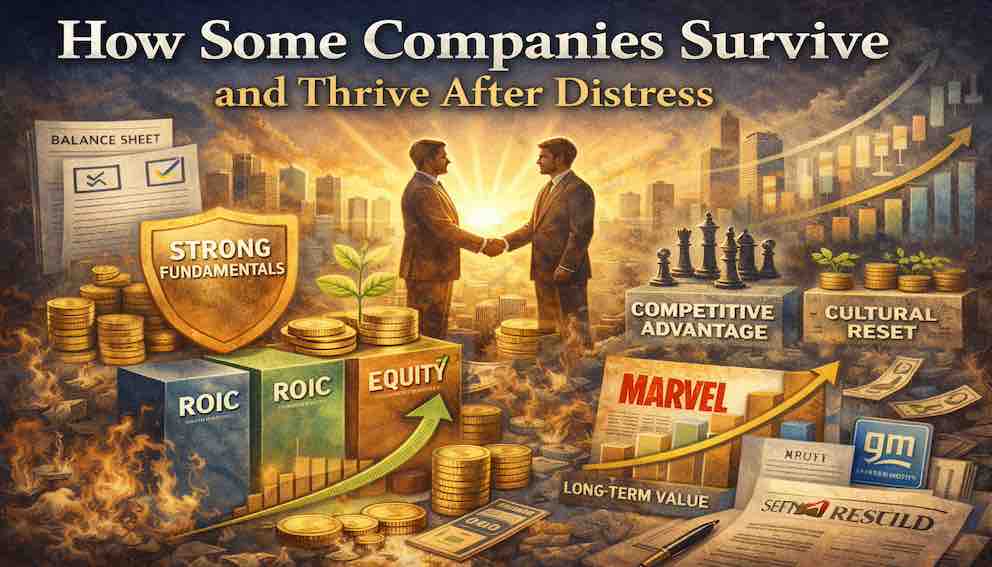
Introduction: From Survival to Choice
Let us begin by revisiting Precio Components, a company that emerged from Chapter 11 three years ago. The memory of the restructuring is now faint. The board meets quarterly rather than weekly. Cash forecasts are no longer tense—they are predictable.
Maria, the CEO, looks out over the factory floor. Machines hum steadily. Orders flow. Employees are focused, but the tension of crisis has faded.
Sarah, the CFO, enters. "Good news," she says. "€20 million in cash, debt reduced to €30 million, and the aerospace division just landed a major contract."
Maria smiles. "So we survived."
"More than survived," Sarah replies. "Now we have choices."
That single word—choice—captures the essence of thriving after distress. In crisis, a company reacts. It sells assets, cuts costs, and survives on borrowed time. Thriving, by contrast, is about strategic freedom. A company that thrives can decide where to invest, whether to acquire, how to grow, and when to wait. It is no longer bound by past constraints.
This tutorial explores how companies achieve that freedom, using a combination of financial discipline, operational efficiency, strategic insight, cultural renewal, and trust-building.
The Foundation: A Clean Balance Sheet Creates Optionality
A clean balance sheet is often described as the most valuable asset a company can have post-distress. But what does “clean” mean in practice?
For Precio Components, it meant:
- Debt reduced from €115 million to €30 million
- Interest coverage ratio improved from 1.2x to 5.5x
- €20 million in cash reserves
- No near-term debt maturities
- Covenant headroom of 40%
This financial position is not only about safety—it provides optional strategic choices. With this balance sheet, Maria could:
- Invest in advanced equipment to improve margins
- Acquire a smaller competitor to expand market share
- Hire engineers to accelerate product development
- Return capital to shareholders
- Choose to wait for better opportunities
Before restructuring, none of these options were feasible. Decisions were reactive. Now, they are deliberate.
A comparable case is General Motors after its 2009 bankruptcy. With a dramatically reduced debt burden and access to fresh capital, GM could modernize factories, innovate, and refocus its brands globally. The clean balance sheet did not guarantee success, but it made strategic success possible.
From Survival to Performance: Improving ROIC
A clean balance sheet provides freedom, but freedom alone does not create value. Companies must convert that freedom into performance, and one of the clearest measures is return on invested capital (ROIC).
ROIC evaluates how efficiently a company generates profit from its capital. Its implications are profound. High ROIC signals that capital is being allocated effectively, creating sustainable shareholder value.
For Precio Components:
- Pre-distress ROIC: 6% (below cost of capital, value destruction)
- Three years post-emergence ROIC: 14%
How was this achieved?
- Sold low-margin consumer hardware division
- Focused investment on high-margin aerospace division
- Improved working capital: receivables days from 65 → 45, inventory turns 4x → 6x
- Reduced overhead costs by 20% without sacrificing capability
Each action was enabled by financial flexibility, but required discipline in prioritization and execution.
Similarly, Marvel Entertainment, after emerging from mid-1990s bankruptcy, focused resources on high-return projects—particularly film franchises and licensing deals. ROIC improvement demonstrated to investors that the company was not just surviving, but actively optimizing for growth.
Strategic Repositioning: Doing Different, Not Just Better
Financial restructuring alone cannot secure long-term success. Companies must rethink their competitive positioning—what differentiates them, how they create value for customers, and how they respond to changing market conditions.
Precio Components faced a choice: remain a broad-line industrial parts supplier, competing on price, or reposition as a high-precision aerospace specialist, where technical excellence and reliability commanded higher margins.
The board chose the latter:
- Invested in precision machining
- Hired aerospace-experienced engineers
- Pursued certifications required by major manufacturers
- Exited low-margin commodity lines
Result: margins increased from 8% to 15%, and customer concentration shifted toward stable, long-term contracts. The company became harder to replicate, creating a durable competitive advantage.
GM’s post-bankruptcy example mirrors this principle: it refocused on fuel-efficient vehicles, improved quality, and streamlined its brand portfolio, discontinuing weaker brands while strengthening strong ones. Strategic repositioning, therefore, is about creating structural advantages, not merely recovering lost ground.
Cyclical vs Structural Recovery
Not all post-distress recoveries are equal. Companies must distinguish between cyclical recovery and structural recovery:
- Cyclical recovery relies on improving external conditions, such as an economic rebound. It is fragile and can reverse with the next downturn.
- Structural recovery comes from internal change: costs permanently lowered, margins sustainably higher, competitive positioning strengthened. This type of recovery endures.
Precio Components’ recovery is structural. Exited product lines remain exited. Aerospace contracts will continue through economic cycles. Cultural changes are embedded.
Marvel’s recovery is almost entirely structural, driven by an entirely new business model (interconnected cinematic universe) rather than market rebound. GM’s recovery combined both: the auto market rebounded, but strategic brand and cost changes made the improvement durable.
Rebuilding Stakeholder Trust: The Invisible Asset
During distress, trust erodes:
- Suppliers tighten terms
- Customers worry about continuity
- Employees disengage
- Investors flee
Rebuilding trust is crucial. Without it, strategic and operational initiatives cannot be executed effectively.
Precio Components approached trust methodically:
- Suppliers: personal visits, transparent financials, consistent 30-day payments
- Customers: open-house events, tours of new facilities, transparent communication
- Employees: monthly all-hands, shared results, recognition for success
- Investors: regular updates, no surprises, clear progress reporting
GM and Marvel followed similar paths: GM restored consumer confidence through marketing and quality initiatives, Marvel rebuilt fan trust by consistently delivering high-quality content.
Cultural Transformation: From Compliance to Initiative
Culture is often the most critical factor in long-term success. Post-distress organizations tend to have low morale, fear, and cynicism, which inhibits growth.
Precio Components’ cultural evolution:
- Year 1: Stability—clear processes, consistent communication
- Year 2: Accountability—performance metrics, transparent feedback
- Year 3: Initiative—employees encouraged to propose improvements and experiment
This shift allowed engineers to innovate and salespeople to collaborate, creating a culture aligned with growth rather than survival.
Marvel’s revival relied on a similar cultural design: creativity and autonomy were nurtured systematically, directly translating into innovative products and revenue growth.
Long-Term Shareholder Value: The Ultimate Measure
When a company emerges from restructuring, the first question everyone asks is simple: did it survive? That is natural. Survival is the immediate concern, the thing that was in doubt.
But survival is not the ultimate measure. Not really. The true measure of a successful restructuring is whether the company can go on to create sustainable value for its shareholders over the long term.
Let us look at Precio Components five years after its emergence from distress. The numbers tell a striking story.
When the company emerged, its equity was valued at €40 million. Five years later, that same equity was worth €120 million. The value had tripled.
The bondholders who had converted their debt into equity during the restructuring did not just recover their money. They profited substantially. The debt that remained after restructuring was repaid ahead of schedule—a sign of healthy cash flow and disciplined financial management.
Even the founding family, whose 2 percent stub interest had seemed almost symbolic at the time, saw that small stake multiply in value. What was once a face-saving gesture became real money.
So what drove this outcome? How does a company go from the edge of collapse to tripling its equity value in five years?
It was not luck. It was not a single brilliant decision. It was the integration of several elements, each reinforcing the others.
A clean balance sheet gave management the freedom to invest. Without the crushing weight of excessive debt, they could make strategic choices rather than survival-driven reactions.
Improved return on invested capital reflected operational discipline. Every pound invested was working harder, generating more profit. The company was not just bigger; it was more efficient.
Strategic repositioning created competitive advantage. Precio Components did not simply return to its old ways. It changed what it did and how it did it, focusing on areas where it could win.
Cultural transformation enabled effective execution. The people inside the company—employees, managers, leaders—were aligned around the same goals. They moved in the same direction.
Rebuilt trust with stakeholders meant that suppliers, customers, and investors all believed in the company again. That confidence became a self-fulfilling prophecy. It brought better terms, more orders, and patient capital.
Here is the key insight. None of these elements worked in isolation. The clean balance sheet enabled the strategic repositioning. The strategic repositioning improved returns. The improved returns attracted investor confidence. The confidence reinforced the culture. The culture delivered the execution.
Value creation was not accidental. It was designed. It was systemic. And because it was built on multiple reinforcing foundations, it was sustainable.
That is what thriving after distress looks like. Not just surviving. Not just recovering. Building something durable enough to last.
Lessons From Real-World Examples
- Financial Freedom Enables Strategy: Clean balance sheets provide strategic optionality.
- Efficiency and Focus Drive Performance: High ROIC ensures scarce resources generate maximum value.
- Competitive Repositioning Creates Opportunity: Thriving companies redefine their markets, not just improve operations.
- Trust Is an Invisible Asset: Suppliers, customers, employees, and investors must believe in the company’s future.
- Culture Matters as Much as Strategy: Operational and financial improvements are amplified when culture supports growth.
- Cyclical Recovery Is Fragile; Structural Recovery Is Durable: Fundamental internal changes ensure resilience.
- Integration Creates Value: Thriving emerges when finance, strategy, operations, culture, and trust work together.
Precio Components: Five-Year Reflection
Five years after emergence:
- Aerospace division: 70% of revenue, 85% of profit
- Automotive division: stable cash generator, no longer focus
- Consumer hardware: exited
- Leadership evolved: Maria recruited to another board, Sarah promoted to COO
- Investors and bondholders realized substantial returns
Maria reflects: "Five years ago, we were fighting for survival. Today, we are choosing our future. That is the difference between surviving and thriving."
The company is not just alive—it is strong, adaptable, and strategically positioned for continued success.
Conclusion: Designing Thriving Organizations
This tutorial demonstrated how companies move beyond survival to thriving after financial distress.
We learned that:
- A clean balance sheet enables strategic choice
- Disciplined ROIC management turns freedom into performance
- Strategic repositioning creates structural advantage
- Cultural transformation ensures sustainable execution
- Trust rebuilding underpins all actions
- Integration across finance, strategy, operations, culture, and trust drives lasting shareholder value
Surviving is reactive; thriving is deliberate. Companies that emerge stronger are those that use distress as a catalyst for renewal, not simply a challenge to endure.
The journey from survival to thriving is designed, led, and executed, beginning precisely where restructuring ends.
About Swati Sharma
Lead Editor at MyEyze, Economist & Finance Research WriterSwati Sharma is an economist with a Bachelor’s degree in Economics (Honours), CIPD Level 5 certification, and an MBA, and over 18 years of experience across management consulting, investment, and technology organizations. She specializes in research-driven financial education, focusing on economics, markets, and investor behavior, with a passion for making complex financial concepts clear, accurate, and accessible to a broad audience.
Disclaimer
This article is for educational purposes only and should not be interpreted as financial advice. Readers should consult a qualified financial professional before making investment decisions. Assistance from AI-powered generative tools was taken to format and improve language flow. While we strive for accuracy, this content may contain errors or omissions and should be independently verified.