
Tutorial Categories
Last Updated: February 25, 2026 at 13:30
Psychological and Governance Failures in Corporate Distress: How Overconfidence, Board Inertia, and Incentives Push Companies Into Financial Crisis
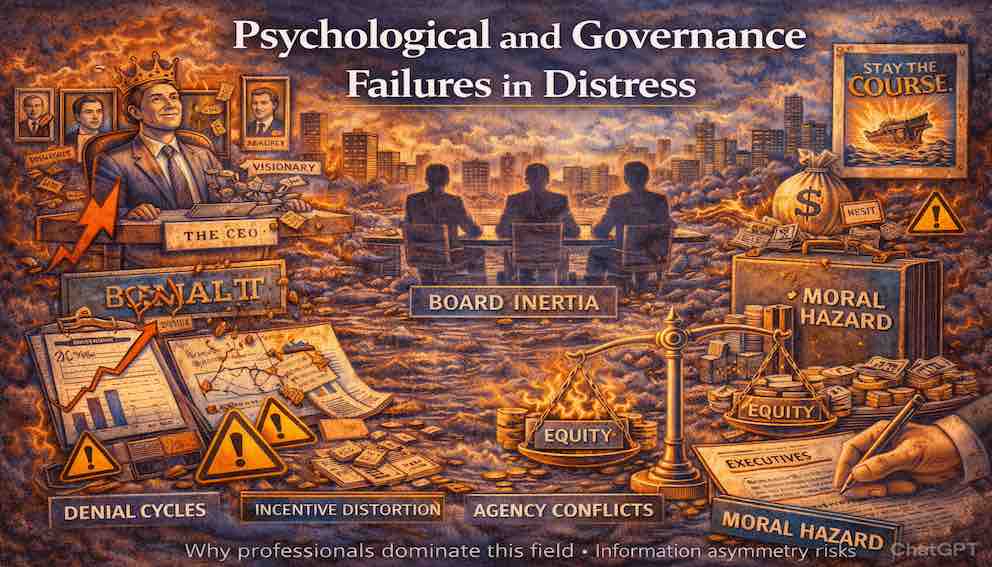
Corporate financial distress rarely begins with a sudden collapse; it begins with subtle psychological biases, governance weaknesses, and distorted incentives that quietly reshape decision-making inside the firm. Long before bonds trade at distressed levels or restructuring frameworks such as Chapter 11 or the Insolvency Act 1986 are invoked, executives and boards make choices shaped by optimism, loyalty, and institutional design. This tutorial examines how CEO overconfidence, board inertia, agency conflicts, cultural conformity, and moral hazard gradually push companies toward crisis. Through the continuing story of Precio Components, we explore how intelligent leaders can drift into distress without recognizing it. Understanding these behavioral and governance failures is essential for investors, directors, and managers who want to prevent crisis rather than merely navigate it.
Introduction: Distress Begins Long Before the Market Notices
When investors analyze distressed securities, they often begin at the point where markets have already reacted. Bonds trade at 45 pence on the pound. Credit spreads widen. Liquidity tightens. Legal frameworks are activated. Recovery rates are modeled. Negotiations begin.
However, by the time markets recognize distress, the deeper causes are already embedded.
Financial crisis rarely arrives as a dramatic shock. It arrives as a slow normalization of risk. It emerges gradually, through a series of decisions that each appear reasonable in isolation but become dangerous in combination.
To understand this, let us return to Precio Components, not at the moment of restructuring, not at the brink of insolvency, but years earlier.
Before the bonds traded at distressed levels.
Before the CFO began monitoring cash daily.
Before lenders imposed stricter covenants.
Before external advisors were hired.
What was happening inside the company?
Nothing that would have appeared catastrophic.
There was no fraud. No sudden collapse in revenue. No obvious incompetence. Instead, there was a gradual drift. A steady accumulation of optimistic assumptions, delayed corrections, and incentives that subtly encouraged risk at precisely the wrong moment.
Heinrich, the founder and long-standing CEO, had built Precio Components over three decades. He had navigated recessions and industry shifts. His judgment had been correct more often than not. The board trusted him deeply. The management team admired him. Employees respected him.
From the outside, the company looked stable. Revenues were steady. Customers remained loyal. The factory continued operating efficiently.
Yet beneath that surface, structural pressures were building.
A lower-cost Asian competitor entered the market. Margins began to compress. A new product line required capital investment funded with debt. Forecasts assumed recovery just beyond the visible horizon.
None of these developments alone guaranteed failure. But together, they began altering the company’s risk profile.
This is how distress begins. Not with a crash, but with a drift.
CEO Overconfidence and the Illusion of Control
Corporate leaders are typically highly capable individuals who have succeeded through intelligence, ambition, and resilience. These traits are necessary to build enterprises. Yet those same traits can become liabilities when circumstances change.
Overconfidence is not arrogance in the conventional sense. It is a documented cognitive bias in which individuals systematically overestimate their ability to forecast outcomes and influence events. In corporate environments, overconfidence often manifests as excessive faith in strategic vision, execution capability, or competitive advantage.
Heinrich exemplified this dynamic.
For decades, his strategic instincts had proven correct. When previous competitors had emerged, Precio Components had survived and strengthened. Each success reinforced not only Heinrich’s confidence in his own judgment but also the board’s belief in his reliability.
When the Asian competitor began undercutting prices, Heinrich framed it as a temporary disruption. Precio Components, he argued, had superior quality and long-term customer relationships. The competitor would sacrifice margins and eventually withdraw.
This narrative was not irrational. It was plausible. It was also comforting.
Comforting narratives preserve continuity. They delay painful decisions. They make leverage seem manageable.
Overconfidence becomes especially dangerous when paired with debt. When executives believe competitive pressure is temporary, they may borrow to invest rather than retrench. Under optimistic forecasts, debt service appears sustainable. Under more conservative assumptions, it is tight.
Precio Components borrowed to fund a new product line intended to offset margin compression. The forecasts presented to the board showed recovery within two quarters. No one asked a fundamental question: what if the forecasts are wrong for longer than expected?
Overconfidence delays corrective action. Delay increases leverage. Increased leverage reduces flexibility. Reduced flexibility transforms manageable operational pressure into existential financial risk.
The unsettling reality is that each decision, viewed individually, had logic. The failure was not recklessness. It was the accumulation of optimism inside a leveraged system.
The Denial Cycle: How Organizations Normalize Deterioration
Corporate decline often follows a recognizable psychological pattern. It is not dramatic. It is progressive.
The first stage is minimization. Early warning signs are framed as temporary or cyclical. When Precio Components lost a significant customer to the new competitor, the explanation emphasized that the customer had always been price-sensitive. The loss was acknowledged, but its structural implications were softened.
The second stage is rationalization. Detailed forecasts are constructed showing imminent recovery. The new product line, Heinrich argued, would restore growth. Financial models projected improvement beginning next quarter. The numbers were internally consistent. What they did not include were sustained downside scenarios.
The third stage is escalation of commitment. When results fail to match projections, organizations often double down rather than reverse course. Having invested capital, reputation, and public confidence in a strategy, leadership finds it psychologically difficult to retreat. Precio Components increased marketing spending for the underperforming product line. Inventory levels rose. Working capital tightened.
Escalation of commitment is not stubbornness in a simplistic sense. It is a deeply human tendency to justify past investment by committing further resources.
The final stage is abrupt recognition. Liquidity pressure eventually forces confrontation with reality. For Precio Components, this moment arrived when the senior lender declined additional credit. Forecasts no longer mattered. Cash constraints imposed discipline that governance had not.
This denial cycle rarely involves intentional deception. It reflects gradual reinterpretation of negative information in ways that preserve existing strategy.
Distress therefore does not begin when lenders intervene. It begins when uncomfortable data is first softened.
Board Inertia and the Limits of Formal Independence
Boards of directors exist to provide oversight and challenge. In theory, they protect shareholders and ensure prudent risk management. In practice, effectiveness depends not merely on formal independence but on psychological independence.
Precio Components’ board included Heinrich as CEO and chair, a long-time external lawyer, a retired executive from another industry, Heinrich’s daughter, and a local banker. Several directors met formal independence criteria. They had no direct commercial relationships with the company.
However, independence on paper does not guarantee independence in thought.
Long-standing relationships create loyalty. Loyalty makes confrontation uncomfortable. Directors who have witnessed decades of success may unconsciously defer to the architect of that success. Information presented to the board typically flows through management. Directors rely on board packs prepared internally. Metrics are selected by management. Forecast assumptions are explained by those who constructed them.
This creates information asymmetry. Even without deliberate filtering, the framing of data influences interpretation. If downside scenarios are not presented explicitly, they remain abstract. If key performance indicators emphasize revenue growth rather than return on capital, board discussion will follow that emphasis.
Board inertia therefore does not require negligence. It requires gradual normalization of deteriorating performance within a culture that prizes cohesion.
At Precio Components, no director asked to see sustained downside projections. No one played the role of devil’s advocate. No one insisted on stress-testing leverage under prolonged margin compression.
Silence, in this context, was not malicious. It was habitual.
Incentives and the Option-Like Nature of Equity Under Leverage
Incentive structures often shape behavior more powerfully than explicit intention.
Heinrich owned a substantial equity stake in Precio Components. When leverage increased and performance weakened, equity value became highly sensitive to outcomes. In such situations, equity begins to resemble an option. If conservative retrenchment leads to gradual decline, equity holders may receive little. If aggressive expansion succeeds, equity value can recover dramatically.
This asymmetry makes risk-taking economically and psychologically attractive to shareholders.
From a creditor’s perspective, however, risk amplification is undesirable. Creditors participate primarily in downside protection. They do not share proportionally in upside gains.
When management compensation is heavily tied to equity or revenue growth without sufficient emphasis on return on invested capital, decision-making may tilt toward expansion even when balance sheet fragility suggests caution.
At Precio Components, bonuses rewarded revenue growth. The new product line contributed revenue despite weak returns. No metric explicitly penalized poor capital allocation.
This is not evidence of bad faith. It is evidence of incentive design that functions differently under leverage.
When equity is deeply impaired, it can begin to resemble a lottery ticket. If nothing changes, shareholders lose. If a risky strategy succeeds, recovery can be substantial. That dynamic makes volatility appear rational.
In distressed environments, this option-like payoff structure becomes central to understanding behavior.
Agency Conflicts Within the Organization
Agency conflicts do not exist only between shareholders and creditors. They also arise between management and shareholders, and between divisions within the firm.
Division heads at Precio Components were evaluated on revenue and profit metrics within their units. They were not evaluated on whether their divisions should continue operating. A division that underperformed on capital efficiency could still defend itself through optimistic forecasts and short-term improvements.
Shutting down a division would eliminate managerial positions and reduce organizational scale. Executives whose identity and compensation are tied to scope and influence have little personal incentive to recommend contraction.
Similarly, acknowledging impairment in an underperforming investment signals prior over-optimism. Delay allows hope that conditions will improve before recognition becomes unavoidable.
Agency misalignment is often tolerable during stable periods. During fragile periods, it becomes destabilizing.
Distress exposes these misalignments, but it rarely creates them.
Culture, Groupthink, and the Suppression of Dissent
Corporate culture shapes how information travels.
Heinrich’s leadership style was charismatic and decisive. Those qualities had driven growth. They also created an environment in which disagreement felt uncomfortable. Middle managers learned to present negative developments in softened language. Forecasts were framed as challenges being addressed rather than structural threats.
Groupthink emerges when cohesion suppresses critical evaluation. When board members share similar backgrounds and long-term relationships, cognitive diversity narrows. Without deliberate mechanisms for structured dissent, optimistic interpretations dominate.
Healthy governance requires psychological safety. Directors and executives must be able to challenge assumptions without reputational cost. Absent that safety, organizations drift toward collective blind spots.
Moral Hazard and the Subtle Expectation of Rescue
Moral hazard arises when decision-makers believe they will not bear the full consequences of risk.
At the corporate level, moral hazard does not require explicit government guarantees. It can arise from relationship banking, industry precedent, or perceived strategic importance.
Precio Components had longstanding relationships with its lenders. Heinrich believed that if conditions deteriorated, the bank would provide flexibility. The company operated in a sector that had previously received government support during downturns. These historical experiences shaped expectations.
Such expectations alter risk perception. If leadership assumes that lenders will restructure rather than liquidate, aggressive expansion appears less dangerous. The downside seems partially buffered.
This belief may never be articulated directly. It may simply influence tone and urgency. Difficult decisions are postponed because assistance is presumed available.
Over time, incremental postponements convert manageable strain into structural distress.
For distressed investors, this insight is important. Behavioral patterns often reflect implicit expectations of rescue long before liquidity evaporates.
Why Intelligent Organizations Still Fail
It is tempting to attribute corporate collapse to incompetence. That explanation is emotionally satisfying but analytically shallow.
Precio Components was not led by fools. Heinrich had decades of successful experience. The board consisted of accomplished professionals. The management team was competent.
The vulnerability lay not in individual intelligence but in systemic design.
Success breeds confidence. Long periods of favorable outcomes reduce skepticism. Familiar strategies feel proven. Cognitive biases are universal. Incentive asymmetries are embedded in compensation structures. Governance norms evolve gradually.
When these elements combine within a leveraged firm facing structural change, small misjudgments compound.
Distress rarely results from a single catastrophic error. It emerges from incremental decisions that each seemed reasonable at the time.
Understanding this cumulative dynamic is more valuable than assigning blame.
The Warning Signs That Were Present
Looking back at Precio Components, the warning signs were visible:
Competitive threats dismissed as temporary
Forecasts consistently projecting improvement just beyond the current quarter
Escalating investment in underperforming initiatives
Board reluctance to demand downside analysis
Incentives rewarding growth over capital discipline
Cultural reluctance to deliver bad news
Implicit assumptions of lender support reducing urgency
None of these indicators alone guaranteed collapse. Together, they created drift.
By the time bonds traded at distressed levels, the psychological and governance failures had already shaped the outcome. The legal and financial mechanics that followed were consequences, not causes.
Implications for Prevention
If distress originates in psychology and governance, prevention must address institutional design.
Boards must cultivate genuine independence of thought, not merely satisfy formal definitions. They should actively request downside scenarios, stress-test leverage under adverse conditions, and periodically evaluate whether long-serving directors have become culturally captured.
Management teams should design compensation systems that balance growth with return on invested capital and balance sheet resilience. Forecasts should explicitly acknowledge uncertainty rather than present single-point optimism.
Organizations should institutionalize structured dissent. Rotating devil’s advocate roles, conducting independent reviews, and holding executive sessions without management present can encourage open discussion.
Investors evaluating companies should examine governance quality, incentive alignment, and behavioral patterns alongside financial metrics. Signs of denial and escalation of commitment often precede visible balance sheet distress.
Overconfidence cannot be eliminated. Denial cycles cannot be abolished. However, structured challenge and thoughtful governance can mitigate their effects.
Distress prevention is therefore not purely financial. It is behavioral and institutional.
Conclusion: Behavior Determines Whether Recovery Becomes Necessary
Financial restructuring frameworks such as Chapter 11 or procedures under the Insolvency Act 1986 provide mechanisms to manage collapse once it occurs. They allocate losses, protect enterprise value, and restructure obligations.
However, by the time such frameworks are invoked, the deeper dynamics have already unfolded.
In this tutorial, we examined how corporate distress begins long before markets recognize it. Through the story of Precio Components, we observed how overconfidence delayed recognition of competitive change, how denial cycles normalized deterioration, how board inertia limited challenge, how incentive structures encouraged risk-taking under leverage, how agency conflicts shaped capital allocation, how culture suppressed dissent, and how moral hazard reduced urgency.
The central insight is that distress is rarely a failure of intelligence. It is often a failure of incentives, psychology, and governance design operating within a leveraged system.
If structure determines recovery, behavior determines whether recovery becomes necessary at all.
Understanding that gradual drift toward crisis is essential not only for distressed investors seeking opportunity but for directors and executives seeking prevention. The path to collapse is rarely dramatic at first. It is incremental, human, and shaped by institutional design.
Recognizing that drift early may be the most valuable discipline in the study of corporate failure.
About Swati Sharma
Lead Editor at MyEyze, Economist & Finance Research WriterSwati Sharma is an economist with a Bachelor’s degree in Economics (Honours), CIPD Level 5 certification, and an MBA, and over 18 years of experience across management consulting, investment, and technology organizations. She specializes in research-driven financial education, focusing on economics, markets, and investor behavior, with a passion for making complex financial concepts clear, accurate, and accessible to a broad audience.
Disclaimer
This article is for educational purposes only and should not be interpreted as financial advice. Readers should consult a qualified financial professional before making investment decisions. Assistance from AI-powered generative tools was taken to format and improve language flow. While we strive for accuracy, this content may contain errors or omissions and should be independently verified.