Tutorial Categories
Last Updated: February 25, 2026 at 13:30
Macro Cycles and Waves of Corporate Distress: How Interest Rates, Credit Booms, and Economic Shocks Create Systemic Corporate Failures
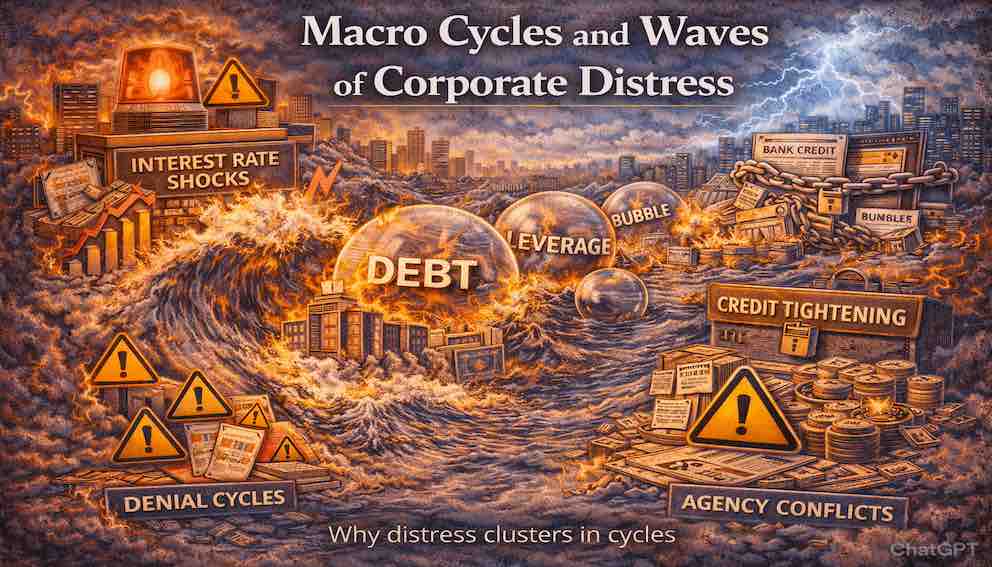
Corporate distress rarely occurs randomly. Instead, it tends to follow macroeconomic cycles, appearing in waves that impact entire industries. In this tutorial, we explore how interest rate changes, credit booms, asset price bubbles, and economic contractions turn previously manageable leverage into systemic fragility. Through the story of Precio Components and historical examples, we show how optimism builds quietly during expansions, risk becomes mispriced across sectors, and even well-managed firms can face serious pressure when financial conditions reverse. Understanding these macro cycles helps investors, directors, and policymakers anticipate and navigate waves of corporate distress.
From the Boardroom to the Business Cycle
In our previous tutorial, we explored corporate distress from the inside, examining how overconfidence, governance inertia, and misaligned incentives push firms gradually toward crisis. We saw that corporate failure is rarely the result of a single catastrophic misstep; instead, it emerges from human behavior interacting with institutional design over time.
But no company operates in isolation. Even the most disciplined management teams are influenced by macroeconomic conditions beyond their control. Interest rates, credit availability, industry trends, and geopolitical events all shape the environment in which firms make decisions. Precio Components, a mid-sized industrial manufacturer, provides a useful lens to see how internal missteps and external forces interact.
While Heinrich’s overconfidence, the board’s cautious inertia, and aggressive leverage choices were internal failures, the company also faced significant external pressures. During the decade leading up to its distress:
- Interest rates remained low, encouraging borrowing across the manufacturing sector.
- Credit was abundant, with banks competing to finance industrial expansion.
- A wave of cheaper imports from Asia compressed margins for Western manufacturers.
- The aerospace sector, a key customer segment, experienced cyclical slowdowns.
- Regional banking stress made relationship lenders more cautious.
Individually, none of these factors was catastrophic. Together, they created an environment in which internal choices had amplified consequences. To fully understand corporate distress, we must step back from the boardroom and examine the economic tides that lift and lower entire industries.
Why Distress Clusters Rather Than Appears Randomly
Corporate bankruptcies and distress rarely appear randomly; they often cluster during certain periods. History offers compelling evidence.
- Early 1990s recession: Commercial property companies, highly leveraged developers, and overextended financial institutions in the UK and US faced widespread distress.
- 2000–2002 dot-com bust: Technology firms that had expanded aggressively under optimistic capital markets suddenly lacked financing.
- 2008–2009 global financial crisis: Corporate failures spread across housing, banking, construction, and consumer sectors.
- 2020 COVID-19 pandemic: Entire industries—aviation, hospitality, energy—experienced simultaneous acute stress.
These clusters are not a coincidence. They reflect macroeconomic cycles that change the environment in which all firms operate. When credit is abundant and markets are calm, leverage quietly builds across sectors. When conditions reverse—through rising interest rates, liquidity contraction, or demand shocks—the fragility accumulated during expansion is suddenly revealed.
Economist Hyman Minsky famously described this phenomenon, noting that periods of stability often breed instability. Long stretches of economic calm encourage risk-taking and leverage, laying the groundwork for future distress—the so-called "Minsky moment."
Precio Components in Context
Placing Precio Components within its macroeconomic context clarifies how external forces compounded internal missteps:
- 2009–2015: Interest rates stayed near historic lows after the global financial crisis, with central banks pursuing accommodative policies to support recovery.
- 2012–2017: Credit spreads narrowed. Lenders, hungry for yield, extended financing to industrial companies with less rigorous scrutiny.
- 2015–2018: Low-cost Asian competitors emerged, compressing margins for Western manufacturers.
- 2018–2019: Central banks began normalizing rates; the US Federal Reserve raised rates four times in 2018.
- 2019: Trade disputes created uncertainty for exporters; the aerospace sector, a key customer, experienced order delays.
- 2020: COVID-19 disrupted both supply chains and demand simultaneously.
Heinrich did not cause interest rates to rise, the Asian competitor to emerge, or the trade dispute to occur. Yet his internal decisions—expansion financed with leverage, optimistic growth projections, and reliance on continued favorable credit—interacted with these macro forces to create distress.
The Expansion Phase: When Risk Feels Small
Economic expansions encourage optimism and often disguise underlying risk. During these periods:
- Interest rates remain low or stable, making borrowing inexpensive.
- Credit becomes readily available as lenders compete for clients.
- Investors demand lower risk premiums, reflecting the belief that defaults are unlikely.
- Asset prices rise, reinforcing confidence and valuation assumptions.
- Corporate earnings improve, encouraging further investment and expansion.
- Default rates remain low, making the system appear safe.
These factors create a reinforcing feedback loop. When defaults are rare, lenders are willing to extend more credit, enabling firms to borrow cheaply. Easy borrowing encourages higher leverage, which amplifies returns during expansion. Asset prices rise further, reinforcing optimism.
Precio Components expanded into a new product line during this phase. Debt appeared manageable, interest rates were low, and growth projections seemed reasonable. Yet all of these assumptions rested on the continuation of favorable macro conditions. Risk, while present, felt smaller than it actually was.
Interest Rate Shocks and Capital Structure Stress
Interest rate shifts are a primary driver of corporate distress waves. Rates affect balance sheets in several ways:
- Cost of new borrowing: Higher rates increase interest expense on new loans.
- Refinancing conditions: Existing debt may become more expensive to roll over.
- Asset valuations: Rising rates can depress asset prices, affecting collateral-based borrowing.
- Investor appetite: Risk premia adjust, impacting equity and debt markets.
For Precio Components, a floating-rate term loan suddenly added €400,000 in annual interest when rates rose. Its revolving credit facility, due for refinancing in 18 months, would carry higher rates and stricter covenants. Bonds, though fixed-rate, traded at a discount as new issues offered higher coupons. The operational business was sound—customers still ordered, production continued—but the capital structure became unsustainable.
Multiply this across a sector with similar assumptions, and isolated stress becomes systemic.
Credit Tightening: When Liquidity Disappears
Interest rate increases are often accompanied by credit tightening. Lenders become more cautious and reduce exposure, resulting in:
- Stricter lending standards at banks.
- Higher spreads in bond markets.
- Reduced willingness of private credit funds to provide financing.
- Tighter covenants and reduced refinancing flexibility.
For firms relying on debt maturities staggered over time, access to refinancing is often more important than profitability. When Precio Components approached its lender for an extension on the revolving facility, it was granted—but at higher rates and stricter covenants. Liquidity, which had seemed abundant, was now constrained.
The 2008 financial crisis provides a stark example: interbank lending froze, and firms that had relied on commercial paper markets suddenly faced funding shortages. Liquidity risk can create distress even when operational fundamentals remain solid.
Sector Bubbles and Collective Optimism
Macroeconomic waves of distress often follow sector-specific bubbles. Bubbles emerge when plausible growth narratives—technological change, demographic shifts, commodity booms, or industrial expansion—fuel investor enthusiasm beyond fundamentals.
Recent examples include:
- The late-1990s internet boom, when minimally profitable tech firms achieved extraordinary valuations.
- The mid-2000s housing boom, driven by rising property prices and easy mortgage lending.
- Commodity super-cycles during rapid industrialization in emerging markets.
Precio Components experienced a mini-bubble in its sector during the mid-2010s, with cheap debt fueling acquisitions and inflating valuation multiples. When growth slowed and synergies failed to materialize, debt remained, turning expansion into distress.
Psychologically, bubbles reduce skepticism. Analysts who warned of overvaluation were dismissed. Risk models extrapolated recent performance, reinforcing collective complacency. When reversals occur, confidence collapses as rapidly as it expanded.
Leverage as a Multiplier of Cycles
Leverage amplifies both growth and decline. During expansions, it magnifies returns; during contractions, it magnifies losses. Fixed obligations do not adjust to falling revenues, potentially wiping out equity even with moderate revenue declines.
For Precio Components, a 15% revenue decline due to competitive pressure and aerospace slowdowns translated into a 40% drop in operating profit because interest costs remained fixed. Across the sector, highly leveraged firms experienced covenant breaches simultaneously. Lenders forced asset sales, depressing prices further and creating a self-reinforcing cycle of distress.
Contagion and Fire Sales
Once distress begins, it spreads through two key mechanisms:
- Contagion: Distress at one firm affects perceptions of similar firms. Investors reassess sector risk, widening credit spreads and tightening refinancing conditions.
- Fire Sales: Distressed firms sell assets quickly, depressing market prices. Other firms holding similar assets face balance sheet impairments or covenant pressure.
Precio Components’ bond price decline affected other industrial manufacturers, not due to operational change but because investors reassessed sector risk. These dynamics convert isolated problems into systemic waves.
Why Even Well-Managed Firms Suffer
Macroeconomic waves of distress do not imply universal managerial incompetence. Firms with strong governance and prudent balance sheets can still face pressure when systemic conditions deteriorate. Airlines, hotels, and retailers during COVID-19 demonstrate that even disciplined management cannot fully insulate a company from shocks affecting entire industries.
Macro cycles determine aggregate demand, capital costs, and investor sentiment. Individual excellence mitigates idiosyncratic risk but cannot eliminate systematic risk—the risk that affects all firms in a sector or market.
The Role of Policy and Central Banks
Monetary policy shapes macro cycles significantly. Central banks adjust interest rates to control inflation and stimulate or cool economic growth. Quantitative tightening reduces market liquidity, while rate cuts and liquidity injections can stabilize distressed sectors.
Timing matters. Precio Components’ distress peaked just as central banks began cutting rates in response to COVID-19. Policy interventions arrived too late to prevent balance sheet stress caused by pre-existing leverage.
Historical Patterns of Distress Waves
Corporate distress clustering is a recurring historical phenomenon:
- Great Depression (1930s): Bank failures and corporate bankruptcies surged after severe demand and credit contraction.
- Stagflationary 1970s: Inflation and interest rate volatility stressed leveraged firms.
- Early 1980s: High rates pressured manufacturing and real estate sectors.
- 2008–2009 Financial Crisis: Distress spread from financial institutions into the broader corporate sector.
- 2020 COVID-19 Shock: Aviation, hospitality, energy, and retail sectors simultaneously faced severe stress.
Common elements include credit expansion, elevated leverage, sudden tightening, falling asset prices, and rapid reassessment of risk.
Interaction Between Micro and Macro Forces
Corporate distress emerges from the interaction of internal decisions and macroeconomic conditions. Executives may rationally increase leverage during expansions because financing is cheap and competitors are growing. Investors reward growth, and boards approve acquisitions.
However, when macro conditions reverse, those same decisions can be dangerous. Leverage that was manageable becomes excessive. Growth projections prove optimistic. Refinancing assumptions fail.
Understanding this interaction helps avoid simplistic explanations that attribute distress solely to incompetence or external shocks. In reality, distress waves reflect both behavioral tendencies and macro cycles.
Why Timing Matters More Than Individual Events
Distress waves reflect cumulative vulnerabilities rather than single events. An interest rate increase or demand slowdown alone may not trigger widespread failures. Distress emerges when elevated leverage, refinancing needs, high valuations, narrow spreads, and sector concentration coincide.
The tide recedes, revealing which firms relied too heavily on favorable conditions.
Conclusion: From Human Bias to Economic Tide
In this tutorial, we stepped back from the boardroom to examine macroeconomic forces shaping waves of corporate distress.
Through Precio Components, we saw how internal decisions interacted with external conditions:
- Leverage built during low-rate periods amplified exposure.
- Global competition and trade shifts affected revenue potential.
- Rising rates and credit tightening stressed refinancing.
- Sector-wide pressures compounded company-specific challenges.
We learned that corporate distress clusters in waves during macroeconomic contractions, rather than occurring randomly. Stability breeds instability, as described by the Minsky moment. Contagion and fire sales spread stress across firms, and even well-managed companies can suffer. Distress reflects the interaction of firm-level behavior with macroeconomic cycles.
Key mechanisms to remember:
- Leverage accumulation during expansion.
- Interest rate and credit shocks.
- Sector-specific bubbles and overvaluation.
- Contagion and fire sales.
- Micro decisions conditioned by macro forces.
Recognizing these patterns allows investors, directors, and policymakers to assess risk not only at the firm level but systemically. Understanding the tide is the first step; learning to read its direction allows more informed and resilient navigation.
In the final tutorial of this series, we will integrate internal governance, capital structure, investor behavior, legal frameworks, and macro forces to explore what it takes to build truly resilient companies prepared for crises they cannot predict.
About Swati Sharma
Lead Editor at MyEyze, Economist & Finance Research WriterSwati Sharma is an economist with a Bachelor’s degree in Economics (Honours), CIPD Level 5 certification, and an MBA, and over 18 years of experience across management consulting, investment, and technology organizations. She specializes in research-driven financial education, focusing on economics, markets, and investor behavior, with a passion for making complex financial concepts clear, accurate, and accessible to a broad audience.
Disclaimer
This article is for educational purposes only and should not be interpreted as financial advice. Readers should consult a qualified financial professional before making investment decisions. Assistance from AI-powered generative tools was taken to format and improve language flow. While we strive for accuracy, this content may contain errors or omissions and should be independently verified.