Tutorial Categories
Last Updated: January 31, 2026 at 19:30
Equity, Dividends, and Buybacks — How Mature Companies Allocate Capital After Survival - Corporate Finance Series
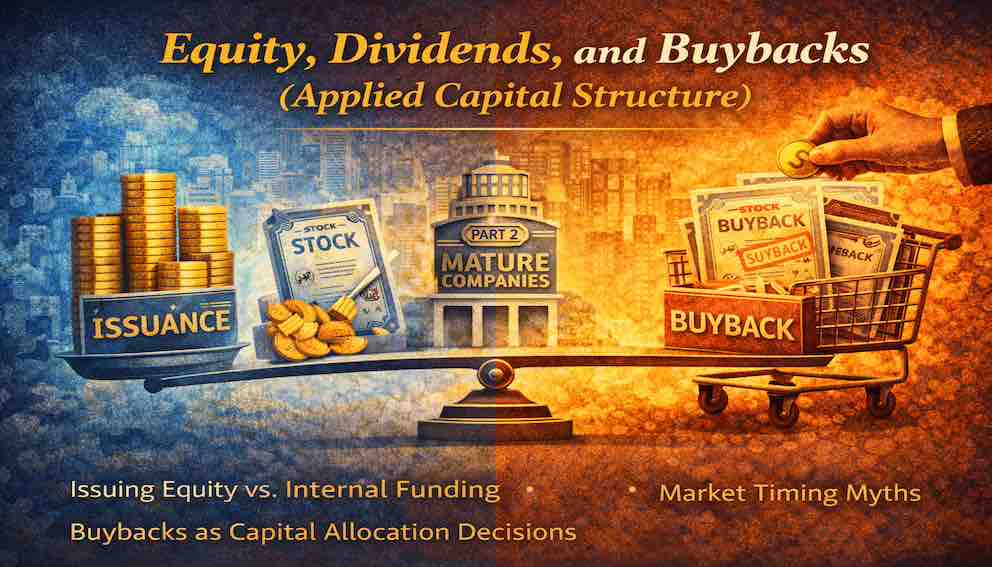
For a mature company, the most critical capital allocation decision is no longer where to invest, but when to stop. This tutorial examines the strategic calculus behind equity, dividends, and buybacks when a company shifts from capital scarcity to surplus. We explore why issuing equity is rarely a neutral act, how dividends function as a costly credibility bond, and why buybacks should be viewed as a market-checked reinvestment decision. Through contrasting real-world examples, you will learn to distinguish disciplined capital stewardship from value-destroying financial engineering. Ultimately, you will understand how a disciplined payout policy signals strong managerial judgment and is essential for ensuring long-term shareholder value.
Introduction: The Strategic Pivot from Growth to Stewardship
Throughout this series, we've traced the corporate journey from survival to scale. In a startup, equity is oxygen—dilution is the price of life. In a growth company, capital is fuel for expansion. But in a mature company, a fundamental shift occurs: capital becomes abundant relative to high-return opportunities.
This is the stewardship phase. The core challenge is no longer finding cash to fund growth, but deciding what to do with cash the business no longer needs without destroying value. At this inflection point, equity transforms from a fundraising tool into a governance mechanism and a claim on surplus cash flows.
The decisions a company makes—to hoard, to pay out, or to dilute—reveal more about its discipline than any growth projection. This tutorial provides the framework for these final, defining choices.
Equity Issuance: The Permanent Cost of "Easy" Capital
For a mature company, issuing new equity is rarely a neutral event. Unlike debt, which imposes discipline through fixed payments, equity dilutes ownership permanently. Each new share is a claim on all future cash flows, forever dividing the economic pie into smaller slices.
The decision to issue equity sends one of two stark signals:
- "We have a transformative, high-return opportunity that exceeds our internal cash." (Rare and value-creating)
- "We have run out of good ideas for our own cash and are willing to permanently dilute you to fund mediocre growth." (Common and value-destroying)
The Dilution Discipline Test:
Before issuing equity, a disciplined management team must ask: Is the expected return on this capital (RONIC) so compelling that it justifies permanently sharing our company's future with new owners?
When Issuing Equity Is Rational:
Given the severe cost, equity issuance in a mature company is only justified in specific, high-stakes scenarios:
- Funding a Transformative Acquisition: A large, strategic acquisition that promises synergies and a post-deal ROIC far above the cost of capital, and which exceeds available internal cash and prudent debt capacity.
- Seizing an Extraordinary Growth Opportunity: A "now or never" project (e.g., building a once-in-a-generation new product line or entering a massive new market) that dwarfs the company's cash generation.
- Crisis Survival & Balance Sheet Fortification: Facing an existential threat (e.g., a liquidity crisis, a legal verdict, or an industry shock) where equity is the only tool to repair the balance sheet and ensure survival.
Case Study: IBM vs. Apple - The Diluter vs. The Steward
- IBM (The Value Destroyer): For two decades, IBM used its stock as "acquisition currency" to buy growth, constantly issuing shares to fund deals. This perpetual dilution spread its stagnating profits over more and more shares, systematically destroying per-share value while masking operational decline. Equity was a crutch for a lack of organic innovation.
- Apple (The Disciplined Steward): Despite having over $200 billion in cash, Apple has never issued new shares to fund operations or acquisitions. When it needed cash for strategic moves (like developing its own chips), it used its colossal operating cash flow or issued cheap debt. It treats equity not as a funding source, but as a sacred claim to be preserved and optimized.
Key Insight: For a mature company, equity issuance should feel momentous—reserved for genuine transformation or crisis survival. Using it for routine "growth" is often a sign of strategic failure.
Dividends: The Credibility Bond That Builds Trust
Dividends are commonly misunderstood as shareholder "rewards." In finance, they serve a deeper function: a credibility bond. By initiating a dividend, a company makes a costly, public promise: "Our cash flows are so stable and predictable that we can bind ourselves to this perpetual obligation."
This bond creates powerful discipline:
- Forces Capital Discipline: Committed cash outflows reduce the pool of money available for low-return empire-building.
- Signals Stability: Attracts long-term, income-focused investors, which can lower the company's cost of capital.
- Imposes Accountability: Cutting the dividend is a catastrophic signal of failure, so management is incentivized to protect the underlying cash flow.
Example: The Utility vs. The Tech Hoarder
- NextEra Energy (The Bond Issuer): As a regulated utility with predictable cash flows and limited high-return projects, NextEra pays a substantial, growing dividend. This is the optimal strategy: it signals stability and returns capital it cannot reinvest at high rates. The dividend is the value proposition.
- Extreme Mismanagement: Cisco Systems (circa 2010s): For years, the mature tech giant generated billions in cash but refused to pay a meaningful dividend, hoarding over $50 billion. This "strategic flexibility" was a failure of capital allocation discipline. The cash earned minimal returns, and the company missed opportunities to build shareholder trust through committed returns, ultimately attracting activist pressure.
Key Insight: A dividend is a strategic choice for stable businesses, not a generic benefit. It trades managerial flexibility for market credibility.
Buybacks: Reinvestment at the Market's Price
The public debate on buybacks is politically charged but financially simple. A buyback is a capital allocation decision where a company concludes: "Investing in our own publicly-traded shares offers a higher risk-adjusted return than any internal project available to us."
This reframes a buyback not as financial engineering, but as a market-checked reinvestment. Unlike an internal project with optimistic manager forecasts, a buyback reinvests capital at the price set by the collective wisdom of the market.
Dispelling the Two Great Myths:
- Myth 1: "Buybacks are about market timing." Reality: Most buybacks are not attempts to outsmart the stock chart. They are a rational response to a mature firm's reality: limited high-return internal projects lead to cash accumulation. Companies naturally have the most surplus cash when economies are strong and stock prices are high, creating a mechanical correlation, not intentional market timing.
- Myth 2: "All buybacks create value." Reality: Value creation depends on two independent factors: the source of funds and the price paid. Using surplus cash to buy undervalued shares is brilliant; using debt to buy overvalued shares is destructive.
The Buyback Matrix: A Framework for Analysis
Two variables determine if a buyback creates or destroys value:
| Type of Buyback | Source of Funds | Valuation Context | Result & Logic |
| Value-Creating | Genuine Free Cash Flow Surplus | Stock Price < Intrinsic Value | Disciplined capital recycling. Using true surplus to buy a dollar of value for less than a dollar increases per-share worth for remaining owners. |
| Value-Destroying | New Debt | Stock Price at Market Highs | Financial engineering. Inflates EPS using leverage but buys overpriced assets, increasing risk without creating underlying value. Destroys long-term value. |
Critical Distinction: Even a buyback funded by free cash flow can destroy value if the price paid is too high. The goal is to use surplus capital to acquire undervalued equity claims.
Contrasting Examples:
- Apple (2016-2019): Executed history's largest buyback program funded by immense free cash flow, often when its stock traded at low P/E ratios. This was a clear, value-creating statement that its own stock was its best investment.
- The S&P 500 (2021): Many companies borrowed record amounts of ultra-cheap debt to buy back shares at all-time market highs. This was not capital allocation; it was leveraged speculation on their own stock. When interest rates rose, these companies were left with heavier debt and no incremental earnings.
Key Insight: A buyback is only as smart as the price paid and the health of the balance sheet funding it.
The Capital Return Hierarchy: A Disciplined Process
Faced with surplus cash, a mature company needs a strict decision-making hierarchy—a "Capital Return Dashboard." This process ensures cash is allocated to its highest and best use:
- Fund All High-ROIC Internal Projects: Reinvest in projects where Return on New Invested Capital (RONIC) > Cost of Capital.
- Pay the Committed Dividend: Uphold the credibility bond first.
- Execute Opportunistic Buybacks: Use remaining surplus to repurchase shares only when price < intrinsic value.
- Hold Cash (Temporarily): If no good internal or market reinvestment exists, hold a prudent buffer. Indefinite hoarding is a failure of this process.
Case Study: Procter & Gamble's Stewardship Masterclass
P&G exemplifies this hierarchy in action:
- Step 1: It reinvests billions in R&D and brand marketing—projects with high, certain returns in its core business.
- Step 2: It has paid and raised its dividend for 68 consecutive years, making this bond its top priority.
- Step 3: It uses remaining surplus for steady, programmatic buybacks, systematically retiring shares.
- This disciplined triptych creates a virtuous cycle: trust lowers its cost of capital, generating more surplus to return responsibly.
Conclusion: The Stewardship Imperative
Maturity demands a different virtue: not the boldness to bet on growth, but the humility to admit its limits and the courage to return capital.
The master allocator at this stage understands:
- Equity is permanent ownership, not a funding tool. Dilution should be rare, reserved for true transformation or crisis.
- Dividends are a costly bond that purchases market trust by limiting managerial freedom.
- Buybacks are a price-sensitive reinvestment decision, only valuable when shares are bought cheaply with true surplus cash.
- Surplus Cash is a problem to be solved through a strict hierarchy, not an asset to be admired.
Ultimately, the final test of corporate leadership is looking at a dollar of excess cash and seeing not an opportunity, but a responsibility. The disciplined choice to give it back is the ultimate proof that a company exists to steward capital, not merely to collect it.
About Swati Sharma
Lead Editor at MyEyze, Economist & Finance Research WriterSwati Sharma is an economist with a Bachelor’s degree in Economics (Honours), CIPD Level 5 certification, and an MBA, and over 18 years of experience across management consulting, investment, and technology organizations. She specializes in research-driven financial education, focusing on economics, markets, and investor behavior, with a passion for making complex financial concepts clear, accurate, and accessible to a broad audience.
Disclaimer
This article is for educational purposes only and should not be interpreted as financial advice. Readers should consult a qualified financial professional before making investment decisions. Assistance from AI-powered generative tools was taken to format and improve language flow. While we strive for accuracy, this content may contain errors or omissions and should be independently verified.