Tutorial Categories
Last Updated: January 31, 2026 at 19:30
Working Capital Management: The Strategic Engine of Internal Capital Allocation - Corporate Finance Series
Working capital is not just an operational metric—it’s the most active capital allocation decision a company makes every day. This tutorial introduces the "Cash Conversion Cycle (CCC) Gap Analysis," a framework showing how the gap between funding needs (Inventory + Receivables) and free funding (Payables) dictates financial health. We explain the mechanics of DIO, DSO, and DPO with clear formulas, and contrast a struggling retailer with a world-class operator like Apple to demonstrate how strategic management creates billions in internal funding. You will learn the tangible trade-offs and see how every invoice, inventory order, and supplier payment is a daily capital allocation choice that drives corporate value.
Introduction: The Daily Capital Allocation Decision
In corporate finance, we analyze billion-dollar acquisitions and multi-year capital projects. Yet, the most frequent and impactful capital allocation decisions happen silently, every day, within a company's working capital. This is the capital trapped in daily operations: cash tied up in inventory sitting in warehouses, receivables from customers who haven't paid, and payables to suppliers you haven't yet settled.
Mismanage this, and you constantly borrow to fund operations, eroding profits with interest. Master it, and you turn your operating cycle into an internal bank, generating the cash to fund growth, pay down debt, or return capital to shareholders. This tutorial provides the framework to transform working capital from a cost center into your most reliable source of strategic funding and liquidity management.
The Core Framework: The Cash Conversion Cycle (CCC) Gap
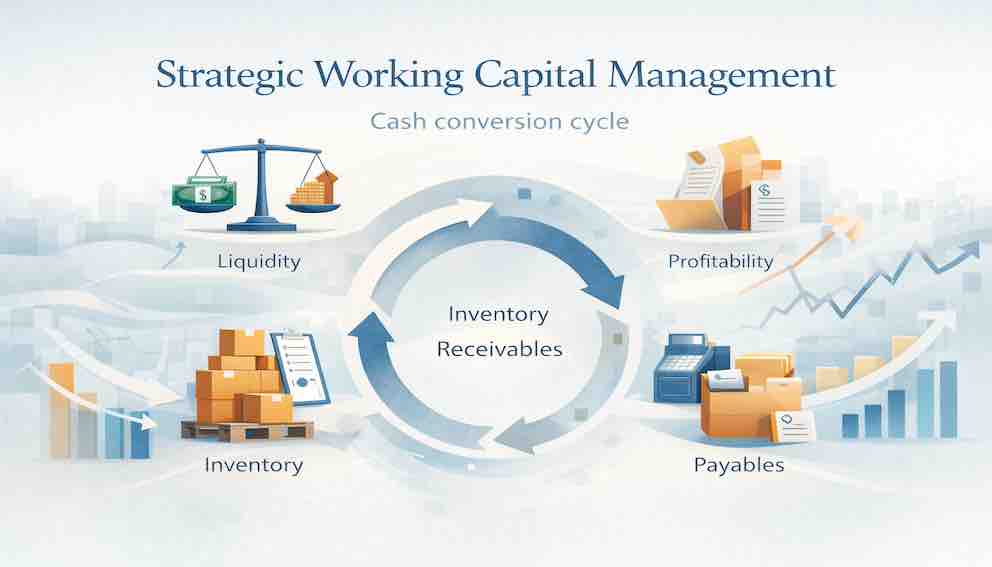
The Cash Conversion Cycle (CCC) is the vital sign of working capital health. It measures the net number of days between paying cash out to suppliers and collecting cash in from customers. To understand it, we must first define its components with precision.
The Three Core Metrics:
- Days Inventory Outstanding (DIO): How long cash is tied up in unsold stock.
- Formula: DIO = (Average Inventory / Cost of Goods Sold) × 365
- Example: A company holds an average of $5M in inventory and has COGS of $30M. DIO = ($5M / $30M) × 365 = ~61 days.
- Days Sales Outstanding (DSO): How long cash is tied up in unpaid customer invoices.
- Formula: DSO = (Average Accounts Receivable / Revenue) × 365
- Example: Average receivables are $8M on revenue of $50M. DSO = ($8M / $50M) × 365 = ~58 days.
- Days Payables Outstanding (DPO): How long you delay payment to suppliers, using their capital.
- Formula: DPO = (Average Accounts Payable / Cost of Goods Sold) × 365
- Example: Average payables are $6M with COGS of $30M. DPO = ($6M / $30M) × 365 = ~73 days.
The Strategic CCC Calculation:
CCC = DIO + DSO – DPO
Let's interpret what this truly represents:
- DIO + DSO = The "Funding Gap": This is the total days you are financing your customers' purchases and your own unsold stock. It's a use of cash.
- DPO = The "Funding Source": This is the days your suppliers are financing you for free. It's a source of cash.
The Strategic Insight: The goal is not always to minimize the CCC absolutely, but to optimize the gap. You want to minimize the funding gap (DIO+DSO) and maximize the funding source (DPO), without damaging operations. The cash freed from a positive gap is capital you have allocated away from funding operations and toward strategic initiatives. This is the essence of cash conversion cycle optimization.
The Negative CCC: The Ultimate Strategic Advantage
Some companies achieve a Negative Cash Conversion Cycle. This means they collect cash from customers before they have to pay their suppliers. They are not just efficient; they use their operating model as a profit center.
Case Study: The Strategic Contrast – Struggling Retailer vs. Apple
Consider two technology sellers at the end of a fiscal year.
Company A: The Struggling Retailer
- DIO: 60 days (High inventory of slow-moving gadgets)
- DSO: 45 days (Lenient credit to distributors)
- DPO: 30 days (Weak supplier negotiation power)
- CCC: 60 + 45 - 30 = 75 Days
- Strategic Implication: This retailer must find 75 days of sales worth of cash to fund its operating cycle. It likely relies on a costly revolving credit line, paying millions in interest—capital is being destroyed daily.
Company B: Apple Inc.
- DIO: ~5 days (Extremely efficient supply chain, products often built to order)
- DSO: ~30 days (Most sales are direct/retail with immediate payment)
- DPO: ~100+ days (Immense power to dictate terms to component suppliers)
- CCC: 5 + 30 - 100 = -65 Days
- Strategic Implication: Apple gets paid 65 days before it pays its suppliers. For a company with ~$400B in annual revenue, this generates a permanent, interest-free float of tens of billions of dollars. This cash isn't sitting idle; it's allocated to R&D, stock buybacks, and strategic investments. Their working capital model is a strategic weapon and a masterclass in internal funding.
Tactical Levers and Strategic Trade-Offs
Achieving a favorable CCC gap requires deliberate management of the three components. Each lever involves a critical trade-off between efficiency and risk—a daily capital allocation choice.
1. Inventory (DIO): The Turnover vs. Stockout Trade-Off
The goal is to maximize inventory turnover. However, cutting inventory too aggressively risks stockouts, lost sales, and damaged customer relationships.
- Best Practice: Implement demand forecasting and lean systems. The toy company Hasbro invested in sophisticated demand planning. This reduced DIO and freed cash, but they had to balance this with ensuring hot products were always available during peak seasons. Their success lay in optimizing, not just minimizing.
2. Receivables (DSO): The Collection vs. Sales Growth Trade-Off
Accelerating cash collection is key, but overly strict credit policies can deter customers and stunt sales growth.
- Best Practice: Use tiered credit terms and early-payment discounts. A large industrial supplier reduced its DSO from 60 to 35 days by offering a 2% discount for 10-day payment. They accepted a small margin concession to secure faster, more reliable cash flow—a deliberate trade-off that funded an acquisition.
3. Payables (DPO): The Free Funding vs. Supplier Relationship Trade-Off
Extending payables improves your cash position, but consistently late payments can strain vital supplier relationships, leading to less flexible terms or priority going to competitors.
- Best Practice: Negotiate terms transparently based on mutual benefit. Walmart uses its scale to secure long DPO, but it also provides suppliers with vast, predictable order volumes. The extended terms are part of a strategic partnership, not unilateral pressure.
The Daily Mechanics of Value Creation and Destruction
Strategic value isn't just created in boardrooms; it's created or destroyed in countless daily operational decisions. Every action directly impacts cash and capital allocation.
- The Daily Choice: A sales manager approves a 60-day term for a large, new customer to win a deal. This immediately increases DSO, tying up perhaps $500,000 in cash for an extra 30 days. The company may now need to draw on its credit line to meet payroll.
- The Daily Opportunity: The procurement team negotiates net-60 terms instead of net-30 with a key supplier on a $1M monthly order. This effectively creates $1M in interest-free funding for 30 extra days, cash that can be used elsewhere in the business.
- The Daily Risk: The warehouse manager, fearing a shortage, orders an extra month's worth of a key component. This $200,000 increase in inventory ties up cash that could have been used for a marketing campaign. If demand shifts, that cash may be permanently lost to obsolescence.
This granular view reveals working capital management as a continuous, company-wide discipline where every employee touching the order-to-cash or procure-to-pay cycle is making a capital allocation decision.
The Capital Allocation Payoff: From Survival to Strategy
The cash freed from optimizing the CCC gap doesn't just sit on the balance sheet. It is reallocated to higher strategic purposes, directly linking daily operations to corporate finance best practices and long-term goals.
The Strategic Payoff Hierarchy:
- Reduce External Debt: The first use of freed cash is often to pay down expensive revolving credit lines, directly boosting net income by reducing interest expense and improving financial health.
- Fund Organic Growth: Reliable internal cash flow allows for confident investment in R&D, marketing, and new equipment without needing board approval for external financing.
- Create Strategic Optionality: A strong, internally-funded balance sheet provides the "war chest" for opportunistic acquisitions or to weather economic downturns.
- Return Capital to Shareholders: Sustained excess cash generation can fund consistent dividends and share buybacks, directly enhancing shareholder value.
Lifecycle Perspective: Evolving Working Capital Strategy
A company's approach to working capital must evolve with its lifecycle stage, reflecting its changing strategic priorities and risk profile.
- Startup/Growth: Focus is on minimizing the funding gap (DIO+DSO) at all costs. Cash is king, and survival depends on not tying it up in operations. Terms are likely cash-only or very short.
- Maturity: The goal shifts to optimizing the entire CCC gap. Companies have the scale to negotiate longer payables (DPO) and the systems to manage inventory and receivables efficiently. This stage generates the greatest internal cash for strategic allocations.
- Decline: The imperative is liquidation and cash preservation. The focus is on radically reducing inventory (DIO) and collecting receivables (DSO) aggressively, while maintaining payables (DPO) to preserve cash for the wind-down.
Conclusion: Every Operational Decision is a Capital Allocation
Disciplined working capital management is the art of turning your operating cycle into a source of capital. It is a continuous, strategic activity that directly competes with external financing. Every day you shorten your DIO or DSO, you are making a decision to allocate less capital to funding operations. Every day you extend your DPO responsibly, you are deciding to use supplier capital instead of your own.
The choice is stark: you can run your business like Company A, perpetually borrowing to fund inefficiency, or you can architect it like Apple, where the model itself generates strategic capital. By applying the CCC Gap framework, you move from seeing working capital as a series of operational tasks to treating it as the most active and impactful portfolio in your capital allocation toolkit.
The final lesson is profoundly human: in the world of corporate finance, strategy is executed daily. The salesperson structuring a deal, the procurement manager negotiating terms, the warehouse controller placing an order—each is acting as a capital allocator. Their daily decisions on inventory, receivables, and payables collectively determine whether the company is building an internal engine for growth or a perpetual drain on value. The goal is clear: build an operating model that doesn't just make money, but one that funds its own ambition through everyday excellence. This is the ultimate integration of strategic vision and operational execution.
About Swati Sharma
Lead Editor at MyEyze, Economist & Finance Research WriterSwati Sharma is an economist with a Bachelor’s degree in Economics (Honours), CIPD Level 5 certification, and an MBA, and over 18 years of experience across management consulting, investment, and technology organizations. She specializes in research-driven financial education, focusing on economics, markets, and investor behavior, with a passion for making complex financial concepts clear, accurate, and accessible to a broad audience.
Disclaimer
This article is for educational purposes only and should not be interpreted as financial advice. Readers should consult a qualified financial professional before making investment decisions. Assistance from AI-powered generative tools was taken to format and improve language flow. While we strive for accuracy, this content may contain errors or omissions and should be independently verified.